How do I choose the right coating for my part?
The right coating depends on the base material, wear pattern, operating temperature, corrosion exposure, surface finish requirements, and whether the part can be rebuilt. Parkway-Kew Corporation evaluates those conditions and recommends suitable options such as ceramic, tungsten carbide, chrome oxide, nickel chrome alloy, or metalized coatings using HVOF, plasma spray, thermal spray, fuse welding, or sub-arc welding.
What is the difference between HVOF and plasma spray coating?
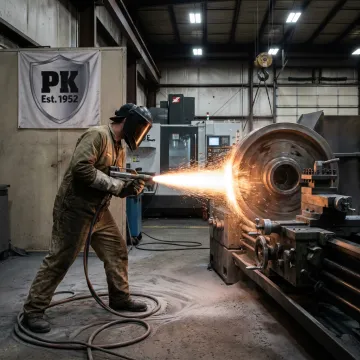
HVOF uses high-velocity combustion to propel alloy powder at speeds that can exceed Mach 2, creating hard, dense, virtually defect-free coatings. Plasma spray is especially useful for ceramic coatings, including chrome oxide coatings used in high-speed and high-slip wire drawing applications. The best choice depends on the component, desired wear resistance, surface finish, and operating environment.
What coating materials are available?
Parkway-Kew Corporation works with a range of wear-resistant materials, including ceramics, tungsten carbide, chrome oxide, aluminum, stainless, zinc, nickel chrome alloys, and proprietary PK coating systems. Examples include PK-1500 chrome oxide for ceramic-coated wire drawing blocks, PK-730 tungsten carbide for harsh fracking plunger conditions, and PK-920 nickel chrome boron alloy for HVOF or fuse welding applications.
Can you rebuild worn wire drawing blocks?
Yes. Parkway-Kew Corporation is recognized as a world leader in hardsurfaced wire drawing blocks and capstans. The company rebuilds and hardsurfaces blocks using submerged arc welding, HVOF, plasma spray, metallizing, and fuse welding. Its Restore & Grind process can also fill only the drawline area and blend it into the original coating to extend usable coating life.
How long does a custom coating project take?
Turnaround depends on the component size, coating system, required machining, inspection needs, and current production schedule. Standard business availability is Monday through Friday, 8:00 am to 5:00 pm. Projects that involve grinding, CNC turning, large-diameter parts, or specialized coatings may require additional planning, especially when tight tolerances or rebuilt surfaces are involved.
Can damaged or worn parts be repaired instead of replaced?
In many cases, rebuilding is more cost-effective than replacing. Parkway-Kew Corporation offers rebuilding for wire drawing blocks, fracking plungers, wire rope pulleys, crane wheels, and urethane coated festoon wheels. Depending on wear depth and coating thickness, certain parts can be restored multiple times before a completely new coating or replacement component becomes necessary.
What industries use ceramic and powder coating services?
These coating and hard surfacing solutions are designed for heavy industrial users, including wire mills, oil and gas fracking companies, shipping terminals, crane operations, heavy equipment manufacturers, earth-moving equipment users, and container ship loading and unloading operations. The goal is to extend component life, reduce changeouts, improve corrosion resistance, and maintain dependable operation in demanding production environments.
How much longer will a coated part last?
A properly selected coating can reduce wear, corrosion, vibration issues, and downtime, but service life depends on operating conditions and maintenance. Parkway-Kew Corporation focuses on matching the coating to the actual application, including how the component is held, loaded, finished, and used. For example, its fracking plunger process helps maintain concentricity to reduce vibration and uneven operation.