Introduction
A brand-new HVOF coating starts flaking off a wire drawing block within months of installation. The alloy wasn't defective. The application technique was sound. The problem happened before the coating gun ever fired: the substrate was never properly prepped.
Surface preparation is the mechanical or chemical treatment of a substrate, removing contaminants and creating the right profile before coating, bonding, or welding. Skip it, or rush it, and even the best coating in the world has nothing to hold onto.
This guide walks through what surface preparation actually involves, including the five-stage process behind it and the methods and ISO standards that govern quality control. It also covers why proper prep matters more than usual in heavy industrial hardsurfacing work.
Key Takeaways
- Poor surface prep is the leading cause of coating and adhesion failures industry-wide
- The process includes five stages: assessment, removal, profiling, and drying
- Five methods dominate: blasting, power tools, chemical cleaning, water jetting, and laser cleaning
- ISO 8501-1 remains the reference standard for grading rust and cleanliness worldwide
- Thermal spray and hardfacing coatings rely on mechanical bonding, making profile quality essential
What Is Surface Preparation?
Surface preparation cleans and profiles a substrate, steel, aluminum, concrete, plastic, so a coating, paint, adhesive, or weld can actually stick and stay stuck. This work determines whether the finished part holds up structurally, not just how it looks.
The practice spans construction, marine, oil and gas, and metal manufacturing. Anywhere a coating needs to survive years of stress, prep work comes first.
Why Surface Preparation Is Critical
Skip proper prep and you get adhesion failure, blistering, peeling, and premature corrosion. An AMPP CoatingsPro article cited an estimate from Materials Analytical Group that 75% of coating failures trace back to inadequate surface preparation.
That number matters in industrial contexts. A wear-resistant coating that fails early on heavy machinery costs more than a warranty claim: it drives unplanned downtime, emergency part swaps, and lost production hours.
Proper preparation extends component service life. It's the difference between a wire drawing block lasting years and one needing replacement after a single production run.
What Surface Preparation Involves
Every surface prep process, regardless of industry, chases three objectives:
- Removing contaminants: oils, grease, dirt, salts
- Stripping old coatings and corrosion: rather than coating over failing material
- Creating a surface profile: a roughened texture that gives coatings something to mechanically grip
Miss any one of these three, and the whole system is compromised before the new coating even touches the part.
Key Stages of the Surface Preparation Process
Surface preparation follows a specific sequence of steps. Skipping steps or doing them out of order often shows up later as premature coating failure.
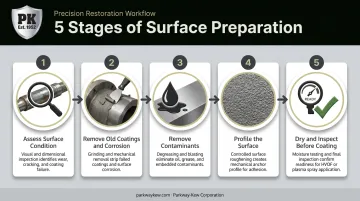
Stage 1 – Assess Surface Condition
Every job starts with an inspection. Under ISO 8501-1, initial steel condition gets graded A through D, based on how much mill scale remains and how far rusting has progressed. This grade determines which cleaning method and cleanliness level the job actually requires.
Stage 2 – Remove Old Coatings and Corrosion
Failing coatings can't just be painted over. Whatever caused the original failure (trapped moisture, poor adhesion, active corrosion cells) will resurface through the new coating if it isn't fully stripped first.
Stage 3 – Remove Contaminants
Oils, grease, salts, and chlorides need to go before anything else happens. Two common verification checks:
- Water-break test (ASTM F22) — a clean surface holds a continuous water film; beading or breaks signal hydrophobic contamination
- Chloride/soluble salt testing (ISO 8502-6/-9) — extracts and measures surface salt levels via conductivity
Stage 4 – Profile the Surface
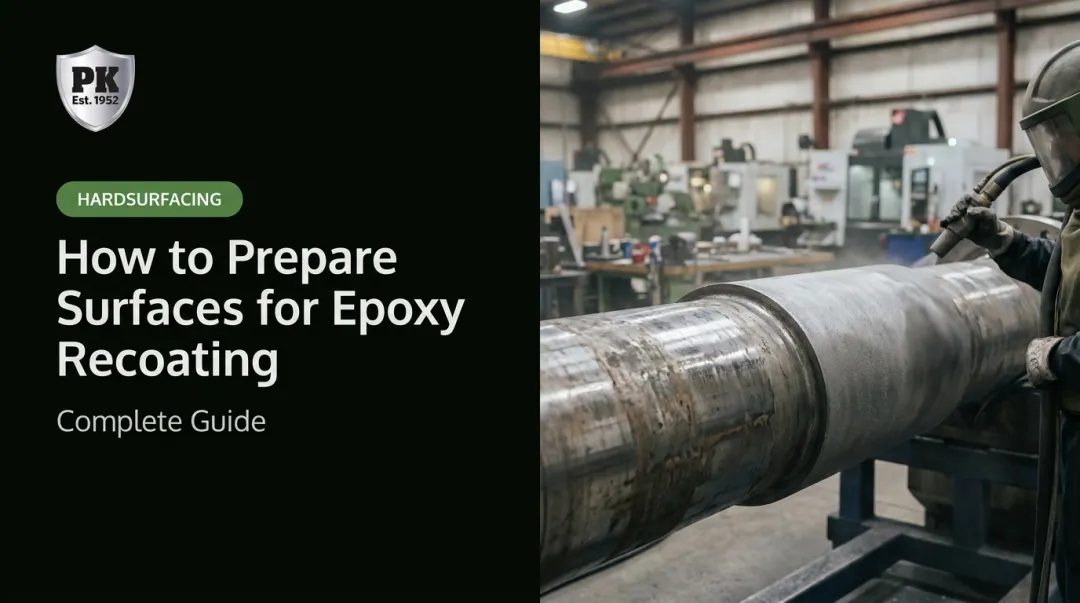
This stage creates the "anchor pattern," a roughened texture that gives coatings mechanical grip. It's critical for standard industrial coatings, and it's absolutely essential for thermal spray and hardfacing overlays, which bond almost entirely through mechanical interlock rather than chemical adhesion.
Stage 5 – Dry and Inspect Before Coating
High humidity invites flash rust to form within hours of blasting. Before coating goes on, crews typically check:
- Relative humidity levels against manufacturer thresholds
- Substrate temperature relative to dew point
- Dust levels using tape-lift assessment (ISO 8502-3)
Skip this stage and moisture or dust gets sealed under the coating, guaranteeing early failure.
Common Surface Preparation Methods
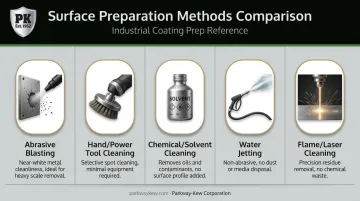
Five method categories cover nearly every surface prep scenario, each suited to different substrates, contamination types, and performance requirements.
Mechanical Abrasive Blasting
Dry abrasive blasting uses steel shot (round, impact-based, good for peening) or steel grit (angular, cuts and removes coating while creating profile). SSPC grading defines how clean the result needs to be:
| SSPC Grade | Cleanliness Requirement |
|---|---|
| SP 6 (Commercial) | Staining allowed on up to 33% of each unit area |
| SP 10 (Near-White) | Staining allowed on up to 5% of each unit area |
| SP 5 (White Metal) | No visible contamination permitted |
Heavy mill scale and rust typically require SP 10 or SP 5 for coatings expected to perform in demanding environments.
Hand and Power Tool Cleaning
Wire brushing, grinding, and needle guns fall under SSPC-SP 2 (hand tools) and SP 3 (power tools). Both remove loose material, but neither matches the cleanliness ceiling of blasting. Fabricators use this method when blasting equipment isn't feasible on-site or the part geometry doesn't allow it.
Chemical and Solvent Cleaning
Acid pickling, solvent degreasing, and chromate conversion coatings all fall here. These require serious environmental and safety controls:
- Acid pickling with HCl solutions above 6% by weight triggers EPA hazardous air pollutant monitoring requirements
- Chromate conversion involving hexavalent chromium falls under OSHA's exposure limits, given its carcinogenic classification
- Solvent degreasing with chlorinated solvents requires VOC emission controls to meet Clean Air Act standards
Water Jetting (Wet Abrasive and Ultra-High Pressure)
Water jetting reduces airborne dust and excels at removing soluble salts that dry blasting can leave behind. Under the 2002 NACE No. 5/SSPC-SP 12 standard, ultra-high-pressure (UHP) water jetting is defined as above 30,000 psi. This method typically exposes an existing profile rather than creating a new one.
Flame and Emerging Techniques
Oxy-gas flame cleaning sees limited use today, largely replaced by more controlled methods. Laser cleaning is gaining ground as a low-media alternative, ablating rust, paint, and oil without abrasive consumables. It still produces fumes requiring extraction, so it's not dust-free, just lower-mess than blasting.
Surface Preparation Standards You Should Know
Standards exist so a "clean" surface means the same thing to every contractor, inspector, and coating manufacturer involved.
ISO 8501-1 is the core international standard. It defines rust grades A through D and cleanliness grades from Sa 1 (light blast) through Sa 3 (visually clean) for blast cleaning, plus St 2 and St 3 for hand and power tool cleaning.
Related standards worth knowing:
- ISO 8503 — measures surface roughness/profile via comparators and replica tape
- ISO 8502-3 — assesses dust quantity and particle size on prepared steel
- SSPC-NACE joint standards (SP 5, SP 6, SP 10, SP 12) — serve as the North American equivalents referenced constantly in specs
For high-value or safety-critical assets, such as pressure vessels, offshore structures, or wear parts running 24/7, adherence to these standards makes surface quality verifiable and repeatable across different shops, crews, and time periods.
Surface Preparation in Industrial Hardsurfacing and Coating Applications
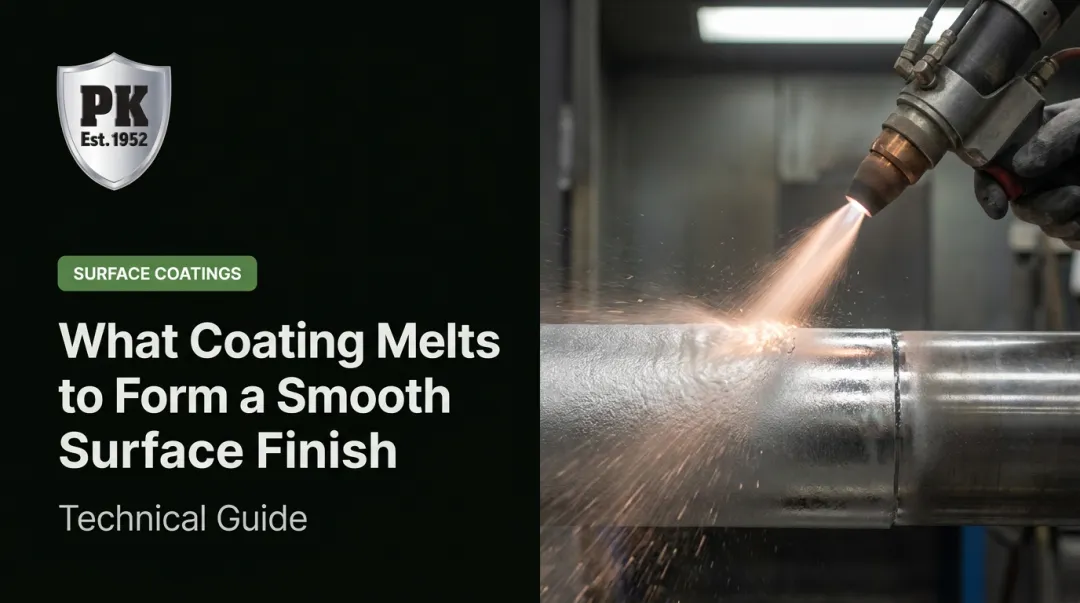
For high-performance coatings like HVOF, plasma spray, and thermal spray, surface preparation forms the entire foundation the coating depends on. Unlike paint systems that get some help from chemical adhesion, these coatings bond almost purely mechanically.
Oerlikon's technical guidance on thermal spray confirms this: molten particles flatten into splats on impact and mechanically key into surface irregularities. No profile, no bond. The required roughness varies by process:
- Combustion spray: 15-75 μm Ra
- HVOF: 3-8 μm Ra
- Plasma spray: 5-10 μm Ra
At Parkway-Kew Corporation, this principle has driven the shop floor since the company started hardsurfacing wire drawing blocks and capstans in 1952.
Precision blast cleaning, grinding, and profiling happen before every HVOF and plasma spray application. This groundwork lets coatings survive the high-speed, high-friction wire drawing environments common in oil and gas and heavy equipment settings.
One example of this discipline in action is Parkway-Kew's proprietary Restore & Grind process. Rather than stripping and recoating an entire wire drawing block once the drawline area wears down, this process profiles and fills only the worn section, blending it seamlessly with the surrounding original coating.
This targeted approach pays off because Parkway-Kew applies its coatings at greater-than-standard thickness from the start:
- Creates enough material reserve for 5 to 7 lower-cost repair cycles before a full recoat is needed
- Cuts downtime by avoiding full strip-and-recoat cycles on the entire block
- Lowers total maintenance cost over the life of the part
Frequently Asked Questions
What is surface preparation?
Surface preparation is the mechanical or chemical treatment of a substrate to remove contaminants and create a bonding profile before coating, adhesive, or welding processes. It ensures the applied material actually adheres and performs as intended.
What are the five methods of surface treatment?
The five recognized categories are abrasive blasting, hand/power tool cleaning, chemical cleaning, water jetting, and flame or laser cleaning. Each suits different substrates, contamination levels, and coating requirements.
What is the ISO standard for surface preparation?
ISO 8501-1 is the core international standard, defining rust grades A-D and cleanliness grades like Sa 2.5 for blast-cleaned steel. Related standards like ISO 8503 cover surface roughness measurement.
How do you know which surface preparation method to use?
Substrate type, contamination level, coating requirements, and project specifications all determine the right method. A high-performance thermal spray coating demands far more rigorous prep than a basic maintenance paint job.
Can surface preparation be done without abrasive blasting?
Yes, hand and power tools or chemical cleaning work when blasting isn't feasible, such as on delicate parts or restricted job sites. These methods are generally less thorough than blasting, though.
Why is surface preparation important before coating?
It ensures proper adhesion, prevents premature coating failure, and extends the component's service life. Industry estimates suggest poor prep contributes to the majority of coating failures, making it the most impactful step in the process.