Pick the wrong one and you're looking at premature failure, unplanned downtime, or a safety hazard on a high-traffic floor. Surface preparation problems alone are commonly cited as contributing to 60%-90% of coating failures, according to AMPP's CoatingsPro, and that's before you even factor in choosing the wrong material for the job.
This guide breaks down what each coating is made of, how they compare side-by-side, where each one earns its keep, and how to decide (or combine them) for flooring and industrial equipment applications.
Key Takeaways
- Epoxy's rigidity suits heavy-load, high-traffic, and concrete-bonding applications
- Polyurethane's flexibility and UV/abrasion resistance suit outdoor and scratch-prone surfaces
- Cost, cure time, and jobsite humidity are usually the deciding factors
- Some systems layer epoxy base coats with polyurethane topcoats for strength and finish
- For extreme-wear components, specialized hardsurfacing like HVOF can outlast either coating
Epoxy vs Polyurethane: Quick Comparison
Here's how the two stack up across the factors that matter most on a spec sheet.
| Factor | Epoxy | Polyurethane |
|---|---|---|
| Cost | Lower upfront cost per square foot; typically the more affordable base flooring option | Higher material cost, often justified by longer service life outdoors or in high-abrasion zones |
| Composition | Two-part system: epoxy resin cross-linked with a hardener (polyamide, amine, or cycloaliphatic) | Two-part system: isocyanate reacts with a polyol; splits into aromatic (TDI/MDI) and aliphatic (HDI/IPDI) types |
| Durability & Hardness | Very rigid, high compressive strength; one common floor product tests at Shore D 80-85 and 7,426 psi | More flexible and elastic; a comparable aromatic product runs closer to Shore D 60, trading hardness for flex |
| UV & Temperature Resistance | Prone to yellowing and chalking under sunlight; best kept indoors or under a protective topcoat | Aliphatic formulations resist UV yellowing and hold color and gloss outdoors; aromatic types still discolor |
| Cure Time & Application Sensitivity | Slightly longer full cure (around seven days); less sensitive to ambient humidity | Often reaches full cure faster (around five days) but limited to environments below roughly 80% relative humidity |
According to Sika's comparison of epoxy and urethane flooring, cost is often the first factor buyers weigh. Yet the two systems solve different problems rather than competing on price alone.
What Is Epoxy Coating?
Epoxy is a two-part system: a resin and a hardener that stay separate until mixed on the jobsite. Once combined, the resin cross-links with the hardener and cures into a rigid film that chemically bonds to concrete or steel.
That rigidity is why epoxy dominates manufacturing floors and equipment foundations. A coating that flexes under a forklift wheel is a coating that cracks.
Core benefits:
- High compressive strength - a common industrial floor epoxy tests at 7,426 psi
- Chemical and acid resistance, useful anywhere spills or washdowns are routine
- Self-leveling formulations fill hairline cracks and pitting, cutting down on surface prep before recoating
Fewer cracks and pits mean fewer unplanned maintenance calls down the road.
Beyond these core benefits, not all epoxy is the same:
- Standard build-coat epoxy - the workhorse floor and structural coating
- Flake epoxy - broadcast flakes add slip resistance and hide minor surface flaws
- Fast-setting epoxy - shortens downtime when a floor needs to reopen quickly
- Epoxy primers and mortars - foundation layers under thicker flooring systems
Use Cases of Epoxy
Epoxy typically shows up as the first layer in a multi-coat system: a primer or structural base coat doing the heavy lifting before anything else goes on top.
Where epoxy dominates:
- Warehouses and distribution centers with constant forklift and pallet-jack traffic
- Manufacturing plants running heavy machinery on concrete pads
- Chemical processing facilities needing spill and acid resistance
- Equipment foundations and bases exposed to repeated impact loading
That compressive-strength rating explains why epoxy floors resist denting under a loaded pallet rack, holding their shape for years.
What Is Polyurethane Coating?
Polyurethane is an elastomeric polymer coating, prized less for rigidity and more for how much movement it can absorb before it cracks. In a two-part system, an isocyanate reacts with a polyol to form the urethane bond. That chemistry produces a coating that flexes with vibration, thermal expansion, and mechanical movement instead of fighting it.
Core benefits:
- Superior abrasion and scratch resistance on surfaces facing constant foot or wheel traffic
- UV stability (in aliphatic formulations) that keeps color and gloss from fading outdoors
- Waterproofing that protects substrates from moisture intrusion and freeze-thaw damage
Better abrasion resistance and UV stability add up to fewer replacement cycles on outdoor or high-wear components.
Not all polyurethane behaves the same:
- Aromatic polyurethane (TDI or MDI-based) is tough and elastic but yellows under sunlight
- Aliphatic polyurethane (HDI or IPDI-based) costs more but holds its color and gloss outdoors
- Rigid urethane suits structural applications where minimal flex is needed
- Flexible urethane is the go-to choice for rollers, wheels, and moving parts
Use Cases of Polyurethane
Polyurethane most often shows up as a topcoat layered over epoxy, adding a flexible, UV-stable finish over epoxy's rigid base. It also works standalone anywhere flexibility or UV exposure matters more than raw hardness.
Where polyurethane fits:
- Multi-story parking structures exposed to weather, deicing salts, and constant vehicle movement
- Dairy and food processing floors needing washdown resistance and slip control
- Industrial rollers, wheels, and other moving mechanical components
Parkway-Kew's urethane-coated festoon wheels, used in shipping terminal crane operations, are a good example of this last category. Field testing has shown these wheels running 2 to 3 years longer than OEM equivalents, a meaningful cut in replacement frequency for terminals running cranes around the clock.
Manufacturer abrasion testing has also shown aliphatic polyurethane topcoats can substantially outperform standard epoxy in wheel-and-wear testing, though results vary by formulation and test method.
Epoxy vs Polyurethane: Which Is Better?
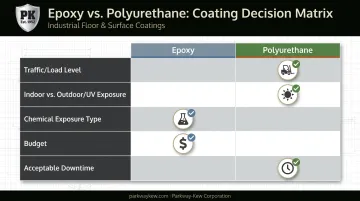
Neither coating wins outright. The right call depends on five factors:
- Traffic and load level - heavy forklift or pallet-jack traffic favors epoxy's rigidity
- Indoor vs. outdoor/UV exposure - direct sunlight favors polyurethane, specifically aliphatic grades
- Chemical exposure type - acids and solvents often call for epoxy's chemical resistance
- Budget - epoxy usually wins on upfront cost
- Acceptable downtime - faster full-cure times can favor polyurethane on tight schedules
Choose epoxy when:
- Heavy forklift or pallet-jack traffic is a daily reality
- The coating needs to bond directly to bare concrete
- Chemical containment is a priority
Choose polyurethane when:
- The surface sits outdoors or under UV exposure
- You need a food-grade or flexible finish
- Turnaround time is tight and humidity is under control
Many industrial specs don't force a choice at all. Layering an epoxy base coat with a polyurethane topcoat is common practice. Epoxy handles adhesion and compressive strength as the base coat, while polyurethane adds UV stability, gloss, and surface wear as the topcoat. This system design approach often outperforms either coating alone.
Real-World Application: Choosing the Right Coating
Shipping terminals running festoon cranes around the clock know this problem well. OEM wheels wear down fast under constant load cycling, and every wheel swap means crane downtime. Parkway-Kew's answer was a urethane-coated festoon wheel built specifically for that environment.
The coating adds flexibility and abrasion resistance that standard OEM wheel materials lack. It absorbs repeated impact and rolling wear instead of degrading under it.
Field testing across terminal operations has shown these wheels running 2 to 3 years longer than OEM equivalents, cutting replacement cycles and unplanned crane downtime.
The broader lesson: for some components, even the best polyurethane or epoxy formulation isn't enough. Wire drawing blocks, capstans, and other extreme-wear machine parts see friction, heat, and abrasive contact that outlast what a polymer coating can handle.
That's where specialized hardsurfacing takes over, including HVOF thermal spray, plasma spray, and tungsten carbide coatings. HVOF's high particle velocity produces coatings with better wear resistance, higher bond strength, and lower porosity than most conventional processes, according to TWI's technical overview of thermal spray methods.
Parkway-Kew has built its business around exactly this gap for more than 70 years. The company applies HVOF, plasma spray, metallizing, and sub-arc welding to components facing the harshest wear in oil and gas, wire drawing, and shipping terminal operations.
Its engineering team matches the coating to the specific wear problem instead of defaulting to one material for every job:
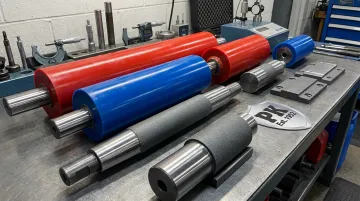
- Urethane finish for flexible, high-impact rolling components
- Tungsten carbide HVOF coating for extreme abrasion resistance
- Chrome oxide ceramic for high-friction, corrosive environments
If you're weighing epoxy, polyurethane, or something tougher for a wear-prone industrial component, Parkway-Kew's coating specialists can evaluate the application and recommend the right fit. Reach the team at (732) 398-2100 or info@parkwaykew.com to talk through your specific wear challenge.
Quick takeaway: there's no universal winner between epoxy and polyurethane. The right coating depends on your traffic load, your environment, and how much downtime you can tolerate.
Frequently Asked Questions
What coating is stronger than epoxy?
Specialized hardsurfacing options, like HVOF thermal spray or tungsten carbide coatings, offer far greater wear resistance than standard epoxy for extreme industrial applications. These suit metal components under continuous heavy abrasion, not flooring.
What is cheaper, epoxy or polyurethane?
Epoxy is generally the more cost-effective option upfront. Polyurethane costs more initially but can deliver better long-term value in outdoor or high-abrasion settings where epoxy would need more frequent recoating.
Can epoxy and polyurethane coatings be combined in one system?
Yes. A layered system, an epoxy base coat topped with a polyurethane finish, is common in industrial flooring and often delivers the best overall performance.
Which coating lasts longer, epoxy or polyurethane?
It depends on the environment. Epoxy tends to hold up longer under heavy indoor traffic, while polyurethane lasts longer in outdoor or UV-exposed settings.
Is polyurethane or epoxy better for outdoor use?
Polyurethane, specifically aliphatic formulations, is usually better outdoors thanks to superior UV resistance. Epoxy tends to yellow and degrade under direct sunlight over time.
Which coating cures faster?
Polyurethane typically reaches full cure faster than epoxy, though it's more sensitive to humidity during application. That sensitivity makes experienced installers important for polyurethane jobs.