Introduction
Every tool change interrupts production. In high-speed machining environments — where shops are cutting hardened steels, titanium, or Inconel — tools can wear out faster than scheduled, turning predictable operations into reactive firefighting. Replacement costs add up, but the real damage is downtime.
Tool coatings are one of the most direct ways to address this. Applied as ultra-thin layers to cutting surfaces, the right coating can mean the difference between 200 parts per tool change and 600. Yet many shops treat coatings as an afterthought — selecting based on what's available rather than what the application actually demands, and paying for it in premature wear and scrap.
This article covers the three core mechanical advantages of tool coatings, the main coating types and where each performs best, and what happens operationally when coating selection goes wrong. Get these decisions right and you'll cut fewer tool changes, fewer scrapped parts, and less unplanned downtime.
Key Takeaways
- Tool coatings redirect heat into chips, reduce friction at the cutting interface, and add significant surface hardness to the tool
- AlTiN reaches 4,500 HV — more than double the hardness of bare tungsten carbide
- Coating selection must match the workpiece material; no single coating works best across all applications
- Skipping coatings, or using the wrong one, leads to accelerated wear, built-up edge, and reactive tool management
- Dry-cutting applications demand coatings with high oxidation resistance (AlTiN, AlCrN); wet-cutting applications open the door to TiAlN and TiCN without sacrificing tool life
What Are Tool Coatings?
Tool coatings are ultra-thin layers — typically 1–20 microns thick — deposited onto cutting tool surfaces through Physical Vapor Deposition (PVD) or Chemical Vapor Deposition (CVD). They don't change tool geometry. Instead, they alter the surface's thermal, tribological (friction and wear), and mechanical behavior under cutting conditions.
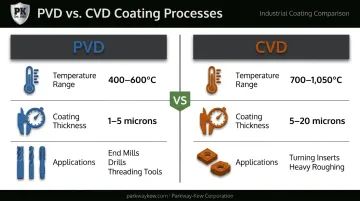
PVD operates at 400–600°C, depositing coatings 1–5 microns thick. The lower process temperature preserves substrate toughness, making PVD the standard for sharp-edged tools: end mills, drills, grooving tools, and threading tools.
CVD operates at 700–1,050°C and produces thicker coatings — commonly 5–20 microns — with exceptional adhesion. CVD is preferred for turning inserts, heavy roughing, and applications where maximum wear resistance matters more than edge sharpness.
Coated tools appear across virtually every machining application:
- Milling and drilling of steel, stainless, and hardened alloys
- Turning of cast iron, nickel superalloys, and titanium
- High-volume production where consistent tolerances are non-negotiable
Coatings are a performance multiplier. They allow the underlying carbide substrate to handle greater heat, cutting forces, and abrasion without degrading as quickly. They don't, however, compensate for wrong parameters or incompatible material combinations.
Key Advantages of Tool Coatings for Cutting Tools
Each advantage below maps to a measurable outcome: tool life, surface quality, cycle time, or cost.
Thermal Barrier Between Tool and Workpiece
Heat is the primary enemy of cutting tool life. Cemented carbide has a thermal conductivity of approximately 121–176 W/m·K — it conducts heat efficiently, which means heat generated during cutting flows directly into the tool. TiN coating, by contrast, has a thermal conductivity of around 19–22 W/m·K. TiAlN is even lower, reported at approximately 12 W/m·K under cutting conditions.
This gap matters. A coated tool redirects heat into chips and the workpiece rather than accumulating it in the carbide. In testing on gray cast iron, a TiN-coated tool measured interface temperatures of 200°C versus 500°C for an uncoated tool — a 60% reduction. Separately, TiAlN coating reduced substrate temperature by at least 10.68% during orthogonal machining of H13 hardened steel.
In practice, carbide's cobalt binder softens at elevated temperatures, accelerating plastic deformation and wear. The thermal barrier delays this degradation cycle, extending the interval between tool changes.
Most impactful in:
- Dry and near-dry machining
- High-speed cutting without coolant
- Superalloys, titanium, and hardened steels that concentrate heat at the cutting edge
Reduced Friction and Improved Lubricity
Friction at the tool-chip interface generates heat, degrades surface finish, and accelerates built-up edge (BUE), where workpiece material welds onto the cutting edge and progressively destroys it.
Research on AISI 316L stainless steel shows uncoated carbide reaching friction coefficients near 1.0 at low cutting speeds, with TiN-coated tools dropping to around 0.53 at 180 m/min. The reduction isn't universal, though. TiAlN showed higher friction than uncoated tools in some titanium micro-milling data, which reinforces why coating selection requires application-specific thinking rather than blanket assumptions.
Where friction reduction clearly pays off:
- Aluminum and copper alloys — low melting points mean heat from friction causes material to weld onto the tool; DLC and ZrN coatings are specifically designed to prevent this
- Long production runs — BUE accumulation compounds over time, degrading finish quality progressively
- Fine finishing operations where surface roughness specifications are tight
DLC-coated tools in Ti6Al4V micro-milling reduced surface roughness by 17.5% compared with uncoated carbide — a directly measurable quality outcome.
Increased Hardness and Wear Resistance
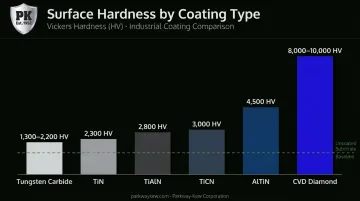
The hardness gap between coated and uncoated tools is substantial:
| Coating | Vickers Hardness (HV) |
|---|---|
| Tungsten Carbide (substrate) | 1,300–2,200 HV |
| TiN | 2,300 HV |
| TiAlN | 2,800 HV |
| TiCN | 3,000 HV |
| AlTiN | 4,500 HV |
| CVD Diamond | 8,000–10,000 HV |
Source: Hannibal Carbide technical data
This hardness advantage directly resists the two dominant wear mechanisms:
- Flank wear — abrasion at the cutting edge that widens the contact zone and degrades dimensional accuracy
- Crater wear — material removal on the rake face from chip sliding at high temperatures
Greater wear resistance translates to more consistent part dimensions across a production run, fewer tool changes per shift, and lower per-part tooling costs. The cost calculation extends beyond the replacement tool price: it includes the time to change it, re-establish offsets, and inspect the first parts back.
Common applications include:
- Highly abrasive materials: Inconel, cast iron, hardened steel, CFRP
- High-volume runs where dimensional drift accumulates
- Operations running without dedicated coolant systems
Common Types of Tool Coatings and When to Use Each
Coating selection should be driven by workpiece material, cutting speed, coolant availability, and the primary failure mode being addressed.
Titanium Nitride (TiN)
TiN is the foundational general-purpose coating. At 2,300 HV with an oxidation temperature of 550°C, it offers solid wear resistance for common materials — steel, brass, cast iron — at moderate cutting speeds. It's widely compatible and cost-effective.
Its limitation: the 550°C oxidation threshold makes it unsuitable for dry, high-speed machining of hard alloys. At those conditions, it degrades faster than higher-performance coatings.
Titanium Carbonitride (TiCN)
TiCN steps up hardness to 3,000 HV and reduces the friction coefficient to around 0.45, making it well-suited for abrasive materials — cast iron, high-silicon aluminum alloys, copper — and interrupted cuts.
The tradeoff: TiCN has a lower oxidation temperature than TiN (400°C), so it requires coolant at higher cutting speeds. Run it dry on demanding materials and its advantage disappears quickly.
Aluminum Titanium Nitride (AlTiN) and Titanium Aluminum Nitride (TiAlN)
These are the workhorses of high-performance dry machining. Both offer high oxidation resistance at 800°C, making them the preferred choice for superalloys, hardened steels, and titanium without coolant.
The distinction matters for application selection:
- AlTiN (higher aluminum content): 4,500 HV, harder, better for dry high-speed machining where abrasion resistance is the priority
- TiAlN (higher titanium content): 2,800 HV, tougher, better for interrupted cuts and general-purpose difficult-material applications
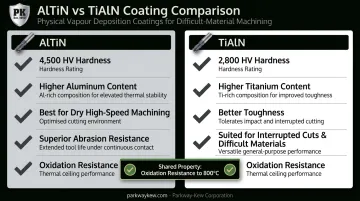
Per Oerlikon Balzers, AlTiN offers superior oxidation resistance at temperature, while TiAlN provides higher hardness and lower friction — making this a genuine trade-off, not just a marketing distinction.
Diamond and CVD Diamond Coatings
CVD diamond coatings deliver the highest hardness available — 8,000–10,000 HV — and are the top choice for extremely abrasive non-ferrous applications:
- Carbon fiber reinforced polymers (CFRP)
- Graphite and ceramics
- Aluminum-silicon alloys
- Metal matrix composites (MMC)
The critical limitation: diamond is chemically incompatible with ferrous metals. At cutting temperatures, the iron in steel causes the carbon in the coating to react and degrade rapidly. Applying diamond coatings to steel machining leads to fast failure — this is a misapplication, not a coating deficiency.
HVOF and Thermal Spray Coatings for Heavy Industrial Applications
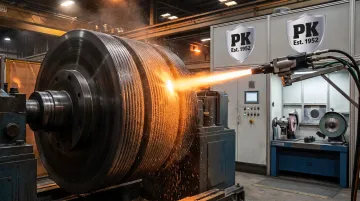
Beyond precision cutting tools, heavy industrial components face continuous abrasive wear that PVD/CVD thin-film coatings aren't designed to handle. Wire drawing blocks, pump plungers, crane wheels, and high-friction contact surfaces require thick, metallurgically bonded coatings — and that's where HVOF (High Velocity Oxygen Fuel) and thermal spray technologies apply.
HVOF coats achieve WC-Co surface hardness around 1,120 HV with bond strengths reaching 9,600 psi, deposited at thicknesses of 0.005–0.010 inches — significantly thicker than any PVD/CVD layer.
Parkway-Kew Corporation, operating since 1952, pioneered HVOF coating for wire drawing blocks in 1989, applying alloy powder at speeds exceeding Mach 2 to form dense, virtually defect-free coatings. Their proprietary alloy lineup spans from PK-920 (nickel chrome boron) through PK-750 (maximum tungsten carbide concentration), each engineered for the sustained abrasive contact of wire drawing rather than the short-duration cutting loads of machining tools.
The underlying principles are consistent with cutting tool coatings — heat resistance, surface hardness, friction reduction — but the scale, layer thickness, and substrate geometry are entirely different.
For fracking plungers, their proprietary PK-730 fused tungsten carbide coating delivers the longest service life in the industry, paired with a concentricity-holding finishing process that corrects misalignment of up to .015 inches. That precision matters: even a sound coating degrades prematurely if the plunger runs off-center.
What Happens When Tool Coatings Are Skipped or Ignored
Running uncoated tools in demanding applications creates compounding problems that show up across multiple dimensions of the operation.
Direct wear consequences:
- Faster flank and crater wear progression
- Quicker cutting edge breakdown
- Higher frequency of unplanned tool changes
- Tool failures account for approximately 20% of total manufacturing downtime — a figure that rises when tools are underspecified for the application
Surface quality consequences:
- More heat and friction at the interface increases BUE risk
- Thermal discoloration of machined surfaces
- Dimensional drift across a production run as the tool degrades
- Secondary finishing operations become necessary, adding process steps and cost
Systemic risk: The deeper operational risk is the shift from scheduled to reactive tooling management. Unpredictable change-out intervals make it impossible to plan around tool life. Tolerances drift, quality control overhead increases, and per-part costs climb as replacement frequency rises.
Skipping coatings entirely isn't the only failure mode — selecting the wrong coating produces nearly the same outcome. A 2024 study on dry aluminum turning found built-up edge on both TiAlN+TiN coated and uncoated inserts, showing that a coating chosen without regard to the workpiece material can perform no better than bare carbide.
How to Get the Most Value from Tool Coatings
Getting the performance that coatings promise requires matching selection to application. That means evaluating:
- Workpiece material — the single most important factor; ferrous vs. non-ferrous, hardness, abrasiveness
- Cutting speed and depth — higher speeds demand higher-temperature coatings
- Coolant availability — dry machining requires AlTiN/TiAlN; TiCN needs coolant at speed
- Primary failure mode — is the tool dying from heat, abrasion, or BUE?
Once a coating is selected, it performs within its designed parameters — not beyond them. Pushing a TiCN-coated tool into dry, high-speed Inconel cutting will degrade the coating faster than running uncoated at appropriate speeds. Review manufacturer specifications, and run controlled trials when switching coatings on an established process.
The same selection logic applies beyond cutting tools. For industrial components (machinery contact surfaces, wire drawing blocks, pump plungers, wear blocks), getting the coating wrong is just as costly — the variables of substrate material, operating temperature, and failure mode still drive the decision.
Working with an experienced industrial coating specialist ensures the right process, alloy, and thickness match the component. Parkway-Kew's engineering team evaluates worn components and recommends from their HVOF, plasma spray, sub-arc welding, and thermal spray capabilities, serving more than 500 companies worldwide. They can be reached at (732) 398-2100 or info@parkwaykew.com.
Conclusion
Tool coatings deliver measurable returns across three interconnected mechanisms: thermal protection keeps heat in the chips rather than the carbide, friction reduction prevents built-up edge and improves finish quality, and increased surface hardness extends the interval before wear forces a tool change. Each mechanism reinforces the others — better heat management reduces friction, which in turn slows surface degradation — so the cumulative effect on cost-per-part is larger than any single factor suggests.
The selection discipline matters as much as the coatings themselves. A well-matched coating on a demanding application outperforms a premium coating on the wrong material. Matching coating to workpiece, cutting conditions, and failure mode turns theoretical performance data into real reductions in tooling cost and unplanned downtime.
These same principles extend well beyond cutting tools. For industrial components facing heavier wear loads — fracking plungers, wire drawing blocks, crane wheels — coating selection, surface hardness, and heat management still govern how long a part lasts and what it costs per cycle to keep running. Parkway-Kew Corporation has applied that logic to large-format industrial restoration since 1952, using HVOF, plasma spray, and sub-arc welding to extend the service life of high-wear components across oil and gas, wire drawing, and shipping terminal operations.
Frequently Asked Questions
What are the main types of coatings for cutting tools?
The four primary types are TiN (general-purpose steel and cast iron), TiCN (abrasive materials and interrupted cuts), AlTiN/TiAlN (high-speed dry machining of superalloys and hardened steels), and CVD diamond (non-ferrous abrasive materials like CFRP and graphite). Each targets a different balance of hardness, temperature resistance, and friction characteristics.
What is carbide coating for cutting tools?
"Carbide coating" typically refers to coatings applied to carbide-substrate tools (made from tungsten carbide bonded with cobalt) rather than a coating made of carbide. Additional PVD or CVD coatings improve surface hardness, heat resistance, and wear performance beyond what the substrate alone provides.
What coatings are used on high-hardness cutting tools?
AlTiN, TiAlN, and CVD diamond are the primary choices for high-hardness or difficult-to-cut materials. AlTiN reaches 4,500 HV with 800°C oxidation resistance, TiAlN offers comparable thermal stability with better toughness for interrupted cuts, and CVD diamond tops out at 8,000–10,000 HV for extreme abrasive applications.
What is the best coating for aluminum cutting tools?
Diamond and DLC coatings are generally preferred for aluminum due to their low friction coefficients and resistance to built-up edge. ZrN is another effective option, showing approximately four times wear reduction in aluminum alloy milling. TiN and AlTiN are not recommended for aluminum — both have adhesion issues that promote BUE formation.
How does tool coating affect surface finish quality?
Coatings reduce friction at the cutting interface and suppress built-up edge formation — both of which directly improve surface finish consistency. DLC-coated tools showed a 17.5% reduction in surface roughness compared with uncoated carbide in Ti6Al4V micro-milling, and similar improvements appear in other research on coated tools across multiple materials.
What is the difference between PVD and CVD tool coatings?
PVD operates at 400–600°C, deposits thinner coatings (1–5 microns), and preserves substrate toughness, making it the preferred choice for sharp-edged tools like end mills and drills. CVD operates at 700–1,050°C and produces thicker coatings (5–20 microns) with superior wear and adhesion performance, suited to heavy turning inserts and roughing operations.