For machine components operating under constant friction, chemical exposure, and mechanical stress, this distinction matters considerably. A coating that fails predictably and gradually gives you options. One that fails suddenly because of poor preparation or wrong material selection gives you downtime.
This article covers how ceramic coatings degrade, which factors accelerate that process, how to recognize early warning signs, and when recoating versus full replacement makes sense for industrial wear components.
Key Takeaways
- Ceramic coatings wear off gradually through mechanical wear, heat, and corrosion — not sudden failure
- Industrial thermal spray coatings (plasma spray, HVOF) significantly outlast liquid-applied automotive coatings due to their mechanical bond and material density
- Early warning signs — increased friction, rising temperatures, surface finish changes — appear before visible wear sets in
- Proactive inspection and timely recoating extend component life and lower total cost of ownership
Does Ceramic Coating Actually Wear Off? Understanding the Degradation Process
Yes, all ceramic coatings wear off over time. But for properly applied industrial thermal spray coatings, degradation is a slow, progressive process at the microstructural level, not a sudden peel or flake.
How the Bond Type Determines Wear Behavior
Industrial thermal spray coatings (plasma spray and HVOF) achieve adhesion by embedding molten ceramic particles into surface irregularities at high velocity, creating a mechanical and metallurgical bond with the substrate. Consumer automotive ceramic coatings rely on a chemical polymer bond, which differs fundamentally in both strength and failure mode.
A 2022 Journal of Thermal Spray Technology review found that lamellae detachment drives abrasive wear in thermal spray coatings, and that erosion resistance increases with splat bonding ratio. Coating quality is inseparable from how well individual particles bonded during application.
What Wear Actually Looks Like at the Material Level
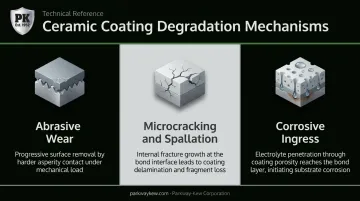
Thermal spray ceramic coatings degrade through three primary mechanisms:
- Abrasive wear — microscopic surface peaks are progressively removed through contact, reducing hardness and surface uniformity
- Microcracking and spallation — residual stresses from quenching, phase transformation, and thermal cycling can accumulate internal cracks that eventually weaken the coating/substrate interface
- Corrosive ingress — pores and microcracks allow electrolytes to reach the interface, attacking the bond rather than the ceramic surface directly
A 2024 plasma-sprayed thermal barrier coating study found that thermal cycling at 850°C for 350 cycles caused interface weakening, crack development, and potential spallation. Wire drawing blocks that experience repeated heat buildup during high-speed draws face exactly this failure pathway — making material selection and application quality direct production concerns.
The Industrial Severity Factor
A wire drawing block or capstan endures constant high-speed abrasive contact with wire under tension. That is a fundamentally more aggressive environment than an automotive paint surface. Mechanical contact stress compresses effective service life compared to low-contact applications, which is why coating selection, application method, and maintenance discipline carry far greater consequence in industrial settings.
Visible delamination or premature adhesion failure almost always traces back to one of three root causes:
- Inadequate surface preparation before coating
- Wrong coating selection for the operating environment
- Improper application conditions (temperature, velocity, spray distance)
Normal end-of-life wear rarely causes sudden failure. Premature failures do.
Types of Ceramic Coatings and Their Expected Lifespan
Not all ceramic coatings are the same. The performance gap between industrial thermal spray coatings and automotive consumer coatings is substantial.
Plasma-Sprayed Ceramic Coatings
Plasma spray operates at temperatures of 12,000–16,000 K, depositing molten oxide ceramics — aluminum oxide, chromium oxide, or zirconia — at approximately 450 m/s onto the substrate. The result is a dense, hard coating well-suited for high-speed abrasive and thermal protection applications.
Parkway-Kew's PK-1500 chrome oxide, applied via plasma spray, is the most wear-resistant ceramic in their portfolio for wire drawing applications. Introduced in the late 1990s, it has proven particularly effective for:
- High-speed and high-slip ferrous wire drawing
- Small, high-quality, or plated wire production
- Applications where surface finish precision is critical alongside wear resistance
Typical thickness for alumina-titania plasma coatings runs 0.25–0.38 mm, with applications generally not exceeding 0.5–0.63 mm to prevent cracking — meaning there's a finite wear reserve that must be managed through inspection and timely repair.
HVOF (High Velocity Oxy-Fuel) Coatings
HVOF uses lower flame temperatures than plasma spray (2,600–3,000°C) but drives particles at up to 700 m/s, nearly 60% faster. The result is a denser, harder coating with porosity typically under 0.5%, compared to 1–2% for standard plasma spray coatings. That difference in density directly affects corrosion resistance and wear life.
Parkway-Kew introduced the first HVOF coating for wire drawing blocks in 1989, advancing beyond earlier submerged arc welding methods. Their HVOF lineup covers a range of application severities:
- PK-920 — entry-level tungsten carbide concentration for moderate wear
- PK-675 — mid-range formulation for standard drawing conditions
- PK-700 — higher carbide content for demanding applications
- PK-750 — maximum tungsten carbide concentration for the most aggressive drawing environments
All four operate within a nickel chrome boron matrix, calibrated to match the specific drawing load.
Liquid-Applied Automotive Ceramic Coatings
For context, consumer-grade ceramic coatings follow a very different performance profile:
| Product Type | Approximate Lifespan |
|---|---|
| Spray-on consumer products | 6–12 months |
| DIY nano-coatings | Up to 2 years |
| Professional automotive application | 3–7+ years |
These products share the "ceramic" label but differ fundamentally in construction: lower hardness, no meaningful high-temperature or high-pressure resistance, and a polymer bond rather than a mechanical one. They're not comparable to thermal spray industrial coatings in any performance dimension.
Key Factors That Accelerate Ceramic Coating Wear
Surface Preparation Quality
Surface prep is the single most controllable variable in coating longevity. The AMPP/AWS/SSPC thermal spray standard covers requirements for surface preparation, application, defect repair, thickness measurement, and adhesion testing. Getting it wrong at this stage causes premature local failure that no amount of good coating material can compensate for.
Inadequate grit blasting, surface contamination, or improper cleanliness allows stress concentrations to develop at the bond interface, which cause early spalling or delamination under operating loads.
Operating Environment and Contact Stress
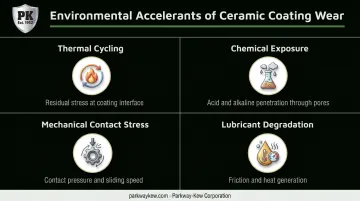
Four environmental factors accelerate ceramic coating degradation:
- Thermal cycling builds residual stress and weakens the coating/substrate interface over repeated heat-and-cool cycles
- Acids, alkaline solutions, and aggressive lubricants penetrate pores and microcracks, attacking the bond layer
- Higher contact pressure, faster sliding speed, and harder abrasive media all remove surface material faster
- In wire drawing, degraded or incompatible lubricants accelerate both mechanical and chemical wear by raising friction and heat generation
Coating Thickness and Material Selection
Thinner coatings wear through to the substrate faster. The ceramic compound also has to match the dominant wear mode — thickness alone won't compensate for a wrong material choice:
- Chromium oxide (PK-1500) excels in high-speed sliding abrasion
- Tungsten carbide-based HVOF coatings (PK-750) provide maximum hardness for aggressive drawing conditions
- Aluminum oxide handles moderate abrasive wear with good thermal resistance
Selecting a coating based on material name alone — without considering whether the failure mode is abrasive, erosive, or corrosive — leads to premature coating failure.
Maintenance Practices
Using abrasive cleaning tools or incompatible chemical cleaners removes protective surface layers prematurely. Beyond shortening coating life, poor maintenance can accelerate substrate corrosion once the ceramic layer thins below its protective threshold — turning a coating wear problem into a substrate replacement problem.
Warning Signs Your Ceramic Coating Is Failing
Visual inspection alone will miss early coating failure. Performance degradation typically shows up well before wear becomes visible — which means by the time you see a problem, you're already behind.
Performance-Based Indicators (Catch These First)
- Rising friction coefficients or operating temperatures during normal use
- Changes in wire surface finish quality — pitting, scoring, or finish inconsistency in drawn wire
- Increased draw force required to maintain production speed
- Reduced corrosion resistance on the component surface
Visual Indicators
- Visible wear patterns or localized color changes in the coating
- Loss of the original ground or polished surface finish
- Substrate exposure or rust staining at worn zones
- In advanced cases, visible delamination or flaking at edges or contact zones
Measurement-Based Monitoring
The most reliable approach to catching wear before it reaches a critical threshold is trending measurable parameters over time. ISO 21920 defines the profile surface texture framework used to standardize these measurements. Recommended measurements include:
- Surface roughness (Ra/Rz) — trending increases in roughness indicate surface wear progression
- Coating thickness — ultrasonic or eddy current testing provides non-destructive thickness measurements
- Dimensional inspection — diameter, roundness, and tolerances checked against original specifications to catch geometric drift before it affects output quality
Building these checks into a scheduled inspection program, rather than waiting for operational symptoms, gives you the lead time to plan recoating and avoid emergency downtime.
When to Recoat vs. Replace Your Ceramic Coating
Start With Professional Inspection
Before choosing a path, have the component assessed by a qualified coating specialist. Decontamination — removing bonded wear debris, corrosion products, and surface contamination — is always the first step, regardless of what comes next.
Recoating as a Cost-Effective Option
When wear is localized and the substrate remains sound, targeted recoating is typically far more economical than full component replacement. For wire drawing blocks, Parkway-Kew's Restore & Grind process takes this further: rather than grinding the entire block surface down to the level of the deepest wear groove, the process selectively fills only the worn drawline area and seamlessly blends it with the surrounding original coating.
The practical advantage is significant:
| Approach | Material Removed | Repair Cycles | Cost per Cycle |
|---|---|---|---|
| Conventional regrind | Entire surface to deepest groove | Limited | Higher |
| Restore & Grind | Drawline area only | 5–7 cycles | Lower |
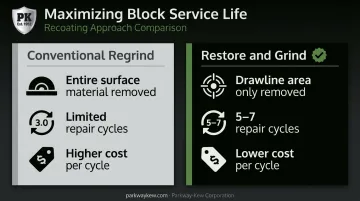
Because PK coatings are applied at enhanced thickness specifically to support multiple repair cycles, Restore & Grind preserves both the surrounding coating and the block's overall diameter, extending usable component life considerably before a full recoat is warranted.
Full Strip and Reapplication
When coating degradation is severe, delamination has occurred, or the substrate has been compromised by corrosion or mechanical damage, complete removal and fresh application is the correct path. Parkway-Kew handles the full sequence in-house, from substrate preparation through final finishing, with turning and grinding capacity up to 65" diameter x 12' length.
A full strip-and-reapply also creates a natural upgrade window. If wear history points to abrasive failure, switching to a tungsten carbide HVOF system — rather than reapplying the same alloy — directly addresses the root cause and extends the next service interval.
Frequently Asked Questions
Can you recoat ceramic coating?
Yes — provided the existing coating is cleaned, decontaminated, and in adequate condition. Localized wear on industrial components can often be addressed with targeted recoating rather than full replacement. Severely degraded or delaminated coatings require complete removal first.
How long does ceramic coating last on industrial components?
Service life varies by coating type, process, and operating conditions — no universal range applies. Plasma-sprayed and HVOF ceramic coatings on industrial components significantly outlast consumer automotive coatings. Application-specific consultation and condition monitoring give more accurate lifespan estimates than any calendar figure.
What causes ceramic coating to fail prematurely?
Three factors account for most premature failures:
- Inadequate surface preparation before application
- Operating beyond the coating's rated parameters (temperature, pressure, chemical exposure)
- Incompatible or abrasive maintenance products that erode the ceramic surface or undermine the bond interface
What are the first signs that a ceramic coating is wearing off?
Early signs include reduced surface slickness, rising friction or operating temperatures, and degraded surface finish on drawn wire or machined components. These functional changes typically appear before visible wear — which is why measurement-based monitoring is more reliable than visual inspection alone.
Is ceramic coating better than hard chrome plating for industrial wear applications?
Modern HVOF and plasma spray ceramic coatings can match or exceed hard chrome in wear resistance and corrosion protection, while eliminating the environmental and health risks of hexavalent chromium electroplating. The right choice depends on the specific wear mode, substrate, and operating conditions.
For application-specific guidance on ceramic coating selection, wear assessment, or the Restore & Grind process for wire drawing blocks, contact Parkway-Kew Corporation at (732) 398-2100 or info@parkwaykew.com.