Introduction
Wire mills and heavy equipment operators face a recurring decision when a wear surface finally gives out: bond a solid ceramic insert to the metal, or apply a fused ceramic coating instead. Manufacturers running wire drawing blocks, capstans, and similar high-wear components need an answer that holds up under real production conditions, not just on a spec sheet.
This choice isn't cosmetic. It shapes how often a line goes down for repairs, and whether wire comes off the block with a clean finish or visible defects. It also determines what the part actually costs to own over its working life.
Understanding the difference starts with how each method actually attaches to the part. Bonded ceramic insert methods like ECKBOND attach solid ceramic tiles to a metal substrate. Plasma-sprayed ceramic coatings fuse ceramic particles directly onto the surface. Both solve the same wear problem, but they get there differently, and that difference matters.
This article breaks down composition, durability, application, cost, and real-world performance for each method, so you can match the right technology to your equipment.
Key Takeaways
- ECKBOND-style bonding secures solid ceramic inserts via epoxy or mechanical retention
- Plasma-sprayed coatings fuse ceramic directly onto the substrate, eliminating chip-prone edges
- Wire drawing blocks and other precision components benefit most from seamless coatings
- Restore & Grind repairs extend coated part life without full replacement
- Total lifecycle cost depends on vibration exposure, load type, and service frequency
ECKBOND vs Ceramic Coating: Quick Comparison
Before getting into specifics, here's how the two methods stack up across the factors that matter most on the shop floor.
| Factor | ECKBOND-Style Inserts | Ceramic Coating |
|---|---|---|
| Cost | Covers the ceramic tile plus the bonding process, whether epoxy or mechanical fasteners. A cracked or slipped tile means a full tile swap, not a partial fix. | Plasma spray application costs more upfront per surface area, but targeted repairs allow partial fixes instead of full recoats, lowering the effective cost per year of service. |
| Composition | Solid ceramic tiles, commonly alumina, zirconia-toughened alumina, or silicon carbide, mechanically clamped or adhesively bonded to a metal substrate. | Fused ceramic particles, such as chrome oxide or aluminum oxide, thermally sprayed to form a continuous layer. Parkway-Kew's PK-1500 chrome oxide coating is built specifically for wire drawing blocks. |
| Durability | Vulnerable to cracking, chipping, or slipping under repeated impact since each tile has edges and seams that can fail independently. | Fused directly to the substrate with no discrete edges to dislodge, giving more consistent wear resistance under vibration-heavy conditions. |
| Application & Repair | Replacing a damaged tile typically means partial or full disassembly of the component to access and swap it out. | Selective recoating targets just the worn drawline area, blending new material into the existing coating without pulling the part apart. |
| Surface Finish | Tile seams create small inconsistencies across the surface, which can transfer to the wire being drawn. | A seamless, smooth finish better suited to precision wire drawing, where consistent surface contact matters. |
What Is ECKBOND?
ECKBOND-style bonding is a technique used to mechanically or adhesively attach solid ceramic inserts to metal parts that take a heavy beating in production. Instead of fusing ceramic onto the metal itself, this method secures pre-formed ceramic tiles or blocks using epoxy adhesive, mechanical clamps, or stud-welded panels.
The appeal is straightforward: solid ceramic tiles bring high initial hardness, translating into strong abrasion resistance under the right load conditions. For equipment absorbing steady, direct abrasion rather than sharp impacts or heavy vibration, a bonded tile can perform well for a long stretch.
Common attachment methods include:
- Urethane-epoxy bonding, where ceramic tile adheres to a steel backing plate
- Mechanical clamping systems that hold ceramic panels in place without adhesive
- Stud-welded panels that snap into a chute or liner for faster installation
Insert shapes, sizes, and bonding approaches vary widely depending on the equipment and the manufacturer supplying the tile.
Where Bonded Ceramic Inserts Are Used
Bonded ceramic inserts show up most often outside precision wire drawing, in applications where a seamless surface isn't the priority and impact resistance matters more than an exact finish:
- Chutes and hoppers in bulk material handling
- Transfer points and pipeline sections in mineral processing
- Wear plates and liners exposed to sliding abrasion from ore, aggregate, or bulk solids
Mining and mineral processing remain the industries where insert-based ceramic solutions stay common, largely because loads there call for raw resistance rather than precision.
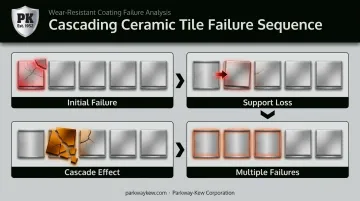
That reliance on raw resistance carries a tradeoff: what happens when a single insert fails. A patent filed for ceramic chute liners describes this exact scenario: conventional ceramic blocks can dislodge during operation, and losing one tile often triggers the loss of adjacent tiles.
The missing piece removes support from its neighbors, letting one failure cascade into several. What starts as a small repair can quickly turn into a much larger one, with production downtime attached.
What Is Ceramic Coating?
Plasma-sprayed ceramic coating is a thermal spray process. An electric-arc plasma plume ionizes gas, melts injected ceramic powder, and propels it onto a prepared metal substrate, where it fuses into a continuous, dense layer.
That fusion is what matters for wire drawing blocks and capstans. Because the ceramic bonds directly to the metal rather than sitting on top as a separate tile, there's no seam, edge, or discrete piece that can dislodge under vibration.
Core benefits for high-wear industrial components:
- Extended wear life compared to standard metal surfaces
- Reduced downtime from fewer replacement cycles
- Improved corrosion resistance alongside abrasion resistance
- Delivers a consistent surface for better finish quality on the wire being drawn
Parkway-Kew Corporation has offered plasma-sprayed ceramic coated blocks since the late 1990s, using its PK-1500 chrome oxide formulation, identified internally as the most wear-resistant ceramic used for wire drawing blocks.
It sits alongside HVOF coating, introduced in 1989, and the company's proprietary Restore & Grind process, giving wire mills a cost-effective alternative to solid ceramic inserts without the breakage or slippage risks that come with them.
Where Ceramic Coating Fits in Production
Plasma-sprayed ceramic coating dominates wherever a smooth, hard-wearing surface has to hold tight tolerances:
- Wire drawing blocks and capstans in ferrous, copper, and aluminum wire operations
- Tuner rolls, sheaves, step cones, and guide devices in wire mills
- Fracking equipment components exposed to abrasive, corrosive conditions
- Heavy equipment parts where downtime from frequent changeout is costly
Wire and cable manufacturing is where this method is most established. PK-1500 chrome oxide, specifically, has proven especially cost-effective for high-speed, high-slip ferrous wire drawing, including small, high-quality, and plated wire applications, where surface defects show up immediately in the finished product.
Service life for any coated block varies with substrate prep, load, lubrication, and maintenance, so there's no universal number that applies across the board.
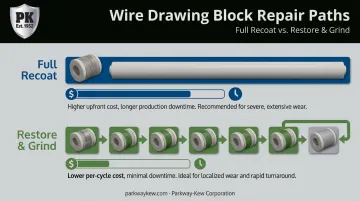
Parkway-Kew addresses this variability directly, which is part of why targeted repair options like Restore & Grind matter. Rather than waiting for a full recoat, operators can perform 5 to 7 lower-cost repairs to just the drawline wear area first.
ECKBOND vs Ceramic Coating: Which Is Better?
Neither method wins in every scenario. The right call depends on four factors specific to your equipment and operating environment.
Weigh these factors before choosing:
- Vibration and impact exposure – Heavy, repeated vibration favors a seamless coated surface over tiles with seams that can loosen.
- Precision surface finish needs – Applications where surface consistency directly affects product quality push toward coating over inserts.
- Repair frequency and method – If a targeted repair process like Restore & Grind is available, coated components often cost less to maintain over time than swapping tiles.
- Total cost over the component's life – Factor in the initial application plus replacement frequency and downtime per failure event.
When Bonded Ceramic Inserts Make Sense
Bonded, tile-based ceramic tends to fit lower-precision applications with less risk of vibration-induced slippage, such as chutes, hoppers, and static wear plates absorbing sliding abrasion rather than dynamic loads. These installations typically see slower wear rates, so tile seams rarely become a failure point, and the lower upfront cost of inserts makes sense.
When Plasma-Sprayed Coating Makes Sense
For high-precision components like wire drawing blocks and capstans, plasma-sprayed ceramic coating is generally the stronger choice. The seam-free surface holds up better under continuous vibration and delivers the consistent finish wire drawing demands.
Unlike bonded tiles, there's no insert to crack, no tile to slip, and no chain-reaction failure risk between adjacent pieces.
Hybrid decision-making should also weigh repairability. A component that can be selectively recoated rather than fully replaced shifts the lifecycle math toward coating, even where the upfront application cost is higher.
If your current setup requires full disassembly every time a wear point fails, that ongoing labor cost adds up fast, often faster than the coating premium.
Real-World Case Study: Choosing Ceramic Coating Over Bonded Ceramic Inserts
Picture a mid-sized wire mill running ferrous wire drawing lines with bonded ceramic tile inserts on its capstans. Over several months, the maintenance team notices a pattern: tiles chip near high-vibration zones, and once one dislodges, adjacent tiles follow within weeks.
Each failure means partial disassembly, tile replacement, and line downtime, plus wire coming off with visible surface defects during the failure window.
The operational cost stacks up fast:
- Draining maintenance hours through partial disassembly and tile replacement
- Scrapping wire due to visible defects during failure windows
- Triggering unplanned stoppages that ripple through production schedules
That combination is usually the trigger point for evaluating an alternative.
Switching to a plasma-sprayed ceramic coating, like Parkway-Kew's PK-1500 chrome oxide system, removes the seam-and-edge failure mode entirely. There's no discrete tile to crack or slip, so the chain-reaction damage pattern that plagued the bonded insert setup doesn't happen.
A Restore & Grind repair option also means the mill can address drawline wear without pulling the block for full replacement, cutting both repair cost and downtime per service event.
The takeaway: seamless ceramic coatings reduce the number of failure points compared to insert-based bonding. Fewer failure points mean fewer unplanned stops and a more predictable maintenance schedule.
If your wire drawing blocks or capstans are showing similar wear patterns, Parkway-Kew Corporation can evaluate whether a plasma-sprayed ceramic coating upgrade fits your operation. Reach the team at (732) 398-2100 or info@parkwaykew.com.
Conclusion
There's no universal winner between ECKBOND-style bonded ceramic inserts and plasma-sprayed ceramic coating. The right choice depends on four factors:
- Load conditions the component will face
- How much vibration your equipment absorbs
- Whether precision surface finish matters for your process
- How you plan to handle repairs once wear shows up
Buyers who skip this evaluation and default to whatever their equipment shipped with often pay for it later, in downtime, scrapped material, or repeat failures.
Regardless of which method you're leaning toward, tie the decision back to outcomes you can measure: how often the line goes down, what it costs to keep parts running, and whether the finished product meets spec.
For high-precision components like wire drawing blocks and capstans, a seamlessly coated surface with a built-in repair option, such as Parkway-Kew's Restore & Grind process, tends to deliver the most predictable results over the component's working life.
Frequently Asked Questions
How durable is ECKBOND?
Durability depends heavily on the bonding method and load conditions. Bonded ceramic inserts can chip, crack, or slip under vibration or impact, especially compared to fused coatings that have no seams to fail.
Is ECKBOND ceramic?
Not exactly. ECKBOND refers to the bonding method used to attach solid ceramic inserts or tiles to a metal surface, not the ceramic material itself.
What is better than a ceramic coating?
For most industrial wear applications, few alternatives match ceramic coating's durability and finish quality. Solid ceramic inserts may still suit lower-precision, high-impact use cases like chutes or hoppers.
What is ECKBOND typically used for in industrial settings?
Bonded ceramic inserts are common on wear plates, chutes, and liners, where mechanically attaching a solid ceramic tile is practical and precision finish isn't the top priority.
How long does a plasma-sprayed ceramic coating last on wire drawing blocks?
Service life varies with load, lubrication, and maintenance, so there's no single universal figure. Processes like Restore & Grind extend that lifespan further by allowing several targeted repairs before a full recoat is needed.
Can a bonded ceramic insert be repaired if it cracks or breaks?
Usually not selectively. A cracked or broken insert typically requires full tile replacement, while a coated surface can often be repaired in just the worn area instead.