Introduction
Coating an entire part sounds simple, until you realize seal faces need to stay bare, bearing journals need a precise fit, and threads can't tolerate a single stray droplet. That's the problem selective coating solves.
Selective coating applies protective or functional material only to the zones that need it, using masking, dip processes, or programmed dispensing to control exactly where coverage stops.
Manufacturers rely on this approach for good reason. Coatings applied without careful masking or process control can fail prematurely, wasting material and creating costly rework on parts that already carry significant machining investment.
This guide covers what selective coating means, the three primary application methods, and how to pick the right one for your parts.
Key Takeaways
- Selective coating shields functional zones, leaving connectors and test points bare
- Masking and dip coating are foundational; automation leads high-precision runs
- The right method depends on part complexity, volume, and reliability needs
- Electronics and thermal spray masking share one rule: block what shouldn't get coated
What Is Selective Coating & Why It Matters
Selective coating is a targeted application process. Instead of covering an entire surface, manufacturers use barriers, immersion with pre-masking, or programmed dispensing to apply coating only to designated areas.
This isn't limited to one industry. You'll find selective coating logic in:
- Electronics assembly — conformal coating applied to PCBs while connectors and test points stay exposed
- Industrial component manufacturing — thermal spray and HVOF coatings applied to wear parts while bores, journals, and threads remain untouched
- Heavy equipment restoration — HVOF and thermal spray rebuild worn bearing journals and shaft surfaces while mounting faces and keyways stay coating-free
All three share the same goal: protection without sacrificing precision.
The Cost of Getting It Wrong
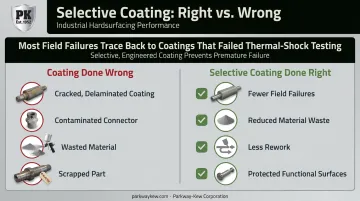
Coating defects aren't just cosmetic. A study of seven MIL/IPC-approved conformal coating products tested on populated assemblies found that two failed to survive 100 thermal-shock cycles between -65°C and +125°C. One polyurethane coating cracked and delaminated in fewer than 19 cycles (IPC Apex Expo, 2015).
That finding matters beyond the coating itself. It shows why choosing an application method, and validating it, matters as much as picking a qualified material. IPC-HDBK-830A addresses this directly, covering design, masking, curing, and inspection as parts of one connected process rather than isolated steps. The same principle applies to industrial hardsurfacing: a poorly masked bore or journal on a wear part can mean scrapped inventory and unplanned downtime just as easily.
Done right, selective coating delivers:
- Fewer field failures from unprotected connectors or contaminated contact points
- Less material waste compared to full-surface coating
- Reduced rework from coating that has to be stripped off keep-out zones
- Protection for functional surfaces like threads, bearing journals, and mating faces
Types of Selective Coating Application Methods
Selective coating isn't one technique. It spans three distinct approaches, each suited to different production realities. The right one depends on precision required, production volume, part complexity, and how much equipment investment makes sense.
Masking Method
Masking means physically covering the areas that must stay coating-free before you apply the bulk coating, whether by spray, dip, or spray-and-cure.
Common masking materials include:
- Polyimide tape (including Kapton-type tape) for defined keep-out boundaries
- Peelable latex or water-soluble spot masks for temporary liquid protection
- Silicone boots for connectors or irregular components
- Custom-machined mechanical fixtures for repeatable, high-precision zones
Masking is a preparatory barrier technique, not a standalone application method. It gets combined with spraying, dipping, or dispensing.
This same logic shows up well beyond circuit boards. In industrial hardsurfacing, thermal spray and HVOF operations depend on masking just as heavily. According to ASM International's guide on spray tip masking, shadow masks, high-temperature silicone tape, and sheet-metal tooling are standard preparation steps, with sheet metal often preferred for HVOF because of its high particle velocity and heat output.
At Parkway-Kew, that principle applies directly to wire drawing blocks and capstans. Before HVOF or plasma spray coating goes on, bearing journals, bores, and mounting threads need protection from overspray—the same barrier concept used on a PCB, just scaled up for heavy industrial parts.
Best suited for: low-to-medium volume runs, prototypes, or parts with a limited number of critical no-coat zones.
Key strengths:
- Low equipment investment
- High flexibility across varied geometries
- Works for both electronics and heavy industrial coating processes
Limitations: Masking is labor-intensive. Incomplete coverage, adhesive residue, and added cycle time are real risks, especially at scale.
Dip Coating Method
Dip coating fully immerses the part or board in a tank of coating material, then withdraws it at a controlled rate to allow drainage before curing.
Process discipline matters here. MacDermid Alpha's Electrolube AFA technical data sheet specifies immersion for roughly 10 seconds, withdrawal at 1-2 mm per second, and drainage time over a tray until residual flow stops. Viscosity, orientation, and withdrawal speed all affect final film thickness.
Unlike masking, dip coating doesn't selectively target zones on its own. It coats everything submerged. If specific areas need to stay clean, you mask first, then dip.
Best suited for: simple geometries with few keep-out zones, high-volume production of uniform parts, and applications where full-surface protection is acceptable.
Key strengths:
- Fast throughput
- Simple equipment requirements
- Cost-effective for large batch runs
- Uniform coverage on complex 3D shapes
Limitations: Every no-coat area still needs masking beforehand. Material consumption runs higher than targeted methods, and pooling or uneven drainage can create thickness inconsistencies.
Automated Selective Dispensing / Robotic Application
This method uses programmable robotic arms with precision valves or nozzles to apply coating only along programmed paths, guided by vision systems and fiducial alignment.
It eliminates most masking and dipping altogether. Instead of physical barriers, software controls exactly where material lands.
Manufacturer specifications illustrate the precision gains possible. Nordson's SC-280 film coater specifications report near-100% transfer efficiency and 30-50% higher material utilization compared to less targeted methods, with application speeds up to 750 mm/s. These figures apply to that specific system, not every robotic coater on the market, but they show the ceiling this approach can reach.
Best suited for: complex, high-density boards with many keep-out zones; high-reliability industries like automotive, medical, and aerospace electronics; and repeat production requiring consistency.
Key strengths:
- Minimal material waste
- No masking labor
- Highly repeatable results
- Easy integration into inline production
Limitations: Higher upfront equipment cost. Requires programming expertise. Often overkill for simple parts or one-off prototypes.
| Method | Best For | Main Trade-off |
|---|---|---|
| Masking | Low-to-medium volume, varied geometries | Labor-intensive, error-prone at scale |
| Dip coating | High-volume, simple geometries | Requires masking for any keep-out zones |
| Automated dispensing | Complex, high-reliability, repeat production | High upfront investment |
How to Choose the Right Coating Method
Choosing the right method comes down to your part, your production volume, and your budget, not which technology sounds most advanced.
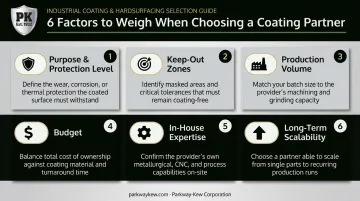
Weigh these factors before committing:
- Purpose and protection level: Determine whether you're sealing against environmental exposure or protecting a precision fit, such as a bearing journal.
- Number and location of keep-out zones: A handful of critical surfaces favors masking, while dozens of tight zones on a dense board favor automated dispensing.
- Production volume and design change frequency: High-volume, stable designs justify automation costs, whereas frequent design changes favor masking's flexibility.
- Budget for equipment vs. ongoing costs: Automated systems cost more upfront but cut labor and material waste over time, while masking carries a low entry cost with higher per-unit labor.
- In-house expertise: Confirm whether you have programming capability for robotic dispensing or hands-on masking experience for manual processes.
- Long-term scalability: Automated systems adapt through reprogramming, while masking adapts through new fixtures as part variations increase.
None of these factors work in isolation. A high-volume job with only two keep-out zones might still favor masking plus dip coating over an expensive automated setup.
Common Mistakes to Avoid Before Finalizing Your Approach
Even experienced teams fall into predictable traps when selecting a coating method:
- Over-investing in automation for simple parts. Automated dispensing brings real precision, but it's wasted capital on parts with one or two keep-out zones that a $2 piece of tape handles fine.
- Underestimating masking labor on dip-coated parts. If your part has many critical no-coat zones, the masking labor required before dipping can erase any cost advantage dip coating offers.
- Chasing lower upfront costs while ignoring long-term waste. Cheap equipment that generates high material waste or long cycle times often costs more over a production run.
- Ignoring industry-specific reliability standards. Electronics work should reference IPC-CC-830 for material qualification, while industrial wear components need precision fit tolerances, not just visual coating coverage.
Skipping validation is the costliest mistake of all. The IPC Apex Expo findings referenced earlier prove that even qualified coatings can fail without proper application-specific testing.
The same logic applies to industrial hardsurfacing. A coating that meets spec on a test coupon still needs validation on the actual part geometry, whether that's a densely populated PCB or a wire drawing block journal.
Conclusion
Selective coating protects the parts of a component or board that matter most, without wasting material on surfaces that need to stay clean. Masking, dip coating, and automated dispensing each solve that problem differently. The right choice comes down to complexity, volume, and budget, not which method looks most sophisticated on paper.
These principles hold whether you're protecting contact pads on a PCB or a bearing journal on a wire drawing block. At Parkway-Kew, that same masking discipline applies when preparing capstans and wire drawing blocks for HVOF and plasma spray coating. Protecting critical surfaces this way ensures the finished part performs exactly as designed.
Frequently Asked Questions
What are the different types of selective coatings?
The three main methods are masking (physical barriers before bulk coating), dip coating (full immersion, often paired with masking), and automated selective dispensing (programmed, targeted application).
What is the function of a selective coating in FPC (flexible printed circuits)?
On flexible printed circuits, selective coating protects the board from moisture and contaminants while keeping contact pads and connectors free of material for reliable electrical connections.
What is a selective surface?
A selective surface is engineered to exhibit different properties, such as coating coverage, in specific zones instead of uniformly. It's the physical result of selective coating application.
What are common methods of masking before coating?
Polyimide tape, peelable latex or liquid masks, silicone boots, and custom-machined mechanical fixtures are the most common masking approaches, chosen based on part geometry and reuse needs.
How do you choose between masking and dip coating for a project?
Base it on production volume, the number of keep-out zones, and part geometry. Simple parts with few no-coat areas suit dip coating; parts with many critical zones often need masking regardless of the bulk method.
Can selective coating principles apply outside electronics, such as industrial hardsurfacing?
Yes. Companies like Parkway-Kew use masking techniques to protect precision surfaces, such as journals and threads, during HVOF and plasma spray coating of wire drawing blocks and capstans.