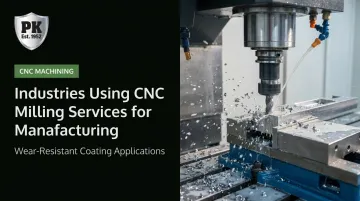
What makes CNC milling so broadly applicable is its combination of precision, material flexibility, and repeatability. Whether the application calls for titanium aerospace structures, biocompatible orthopedic implants, or heavy industrial components that endure extreme abrasion, CNC milling handles the full spectrum.
This article covers which industries rely most on CNC milling services, what specific parts and workflows they use it for, and what to look for when choosing the right CNC milling partner for demanding industrial applications.
Key Takeaways:
- Aerospace, medical, defense, automotive, oil and gas, and wire manufacturing all depend on CNC milling for precision components
- CNC milling supports both new-part production and component reconditioning — extending service life and reducing replacement costs
- Unplanned downtime costs the world's 500 largest companies $1.4 trillion annually, making precision component availability a business-critical issue
- Choosing the right CNC milling partner means matching machine capacity, material expertise, and complementary services to your application
What Is CNC Milling?
CNC milling is a subtractive manufacturing process: a computer-controlled machine removes material from a solid workpiece — metal, plastic, or composite — using rotating cutting tools that follow a pre-programmed digital design.
Unlike manual machining, CNC milling eliminates human variability. The machine executes the same toolpath identically on every part, whether it's the first piece or the ten-thousandth. It also differs from CNC turning, which rotates the workpiece against a stationary cutting tool and suits cylindrical parts. Milling is better suited to complex prismatic shapes, angled features, and contoured geometries.
Axis Count Matters
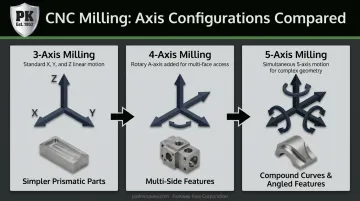
That geometric range is largely determined by how many axes the machine operates on — each additional axis expands what shapes and features are achievable:
- 3-axis milling — cutting tool moves in X, Y, and Z; suited for simpler prismatic parts
- 4-axis milling — adds a rotary axis for multi-side features without full repositioning
- 5-axis milling — enables simultaneous motion across five axes, producing complex compound curves and angled features in fewer setups
In practice, CNC milling serves a wide range of output: production parts, prototypes, tooling, and the restoration of worn components in demanding industrial environments. That versatility is why it appears across so many sectors — from oil and gas to wire manufacturing to heavy equipment.
Why Industries Rely on CNC Milling Services
Industrial equipment fails when components don't meet spec. CNC milling exists to prevent that — delivering precision, repeatability, and material flexibility that manual processes can't sustain across high volumes or complex geometries.
When those qualities are absent, the consequences are real and measurable. According to Siemens' 2024 True Cost of Downtime report, unplanned downtime costs the world's 500 largest companies $1.4 trillion annually — representing 11% of revenue. In the oil and gas sector specifically, downtime runs nearly $500,000 per hour. Ill-fitting components, worn parts that go unrestored, and substandard machined geometry all feed directly into that exposure.
New Parts and Restoration
CNC milling serves two distinct roles in industrial maintenance and manufacturing:
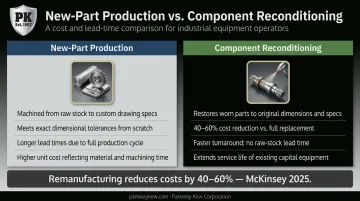
- New-part production — machining components from raw stock when off-the-shelf options don't meet drawing specifications
- Component reconditioning — bringing worn parts back to original dimensions, typically as part of a coating or rebuild process that extends service life
For industries where equipment is expensive and replacement lead times run long, reconditioning worn components through CNC milling is often the faster and cheaper path forward. McKinsey reported in 2025 that remanufacturing reduces costs by 40–60% compared to new replacement — which means the milling partner you choose directly shapes your maintenance economics, not just your parts budget.
Precision and Safety-Critical Industries
In industries where a defective part can cause catastrophic failure — mid-flight, during surgery, or in military operations — CNC milling is the manufacturing standard. It eliminates human variability and consistently holds tight tolerances that manual processes cannot reliably achieve.
Aerospace
Aerospace manufacturers use CNC milling to produce:
- Structural airframe components and fuselage sections
- Turbine blades and engine housings
- Landing gear parts and brackets
- Avionics enclosures and mounting structures
These parts endure extreme temperature swings, pressure, and vibration while maintaining exact dimensional specifications. CNC milling handles this because it can machine difficult materials like titanium, Inconel, and aerospace-grade aluminum to tight tolerances without sacrificing repeatability.
The material demands are significant. According to NASA's aerospace materials research, approximately 60% of global titanium production goes into aero-engines, airframes, and spacecraft. Modern aircraft airframes are typically 80% aluminum by weight — both materials that CNC milling handles routinely.
Five-axis capability is particularly valuable here. Complex compound curves on turbine blades and structural connectors require simultaneous multi-axis motion that earlier machining methods simply couldn't achieve. Aerospace suppliers operating in this space typically hold AS9100 / IAQG 9100 certification, the quality management standard covering aviation, space, and defense supply chains.
Medical Device Manufacturing
CNC milling produces the components that go inside patients and into operating rooms:
- Orthopedic implants — knee, hip, and spinal components
- Surgical instruments and biopsy tools
- Prosthetic components and custom implants
- Diagnostic equipment housings
The medical sector demands patient-specific and low-volume custom parts with zero tolerance for dimensional error. The FDA's guidance for orthopedic devices explicitly requires engineering drawings, documented dimensions, tolerances, materials, surface finish, and manufacturing process information — so CNC milling here isn't just about capability. Traceability is mandatory.
Biocompatible materials — cobalt-chromium, titanium, and stainless steel — fall within the FDA's documented material safety framework for medical devices. All three are routinely machined via CNC milling to the smooth, cleanable surface finishes medical-grade components require.
Defense and Military
Defense applications for CNC milling include weapon components, armored vehicle parts, missile and drone housings, radar structures, and communication system enclosures. These components must meet exacting durability and dimensional specifications, often under classified requirements.
The DoD's own Project MFG international competition (documented in a 2023 DoD Office of Industrial Base Policy release) featured multiple-axis machining on a Haas UMC750 5-axis milling machine, confirming that advanced multi-axis CNC milling is directly relevant to defense manufacturing capability. Suppliers serving this sector typically qualify through IAQG 9100, the same QMS framework used in aerospace.
High-Volume and Technology-Driven Industries
Automotive and electronics industries depend on CNC milling for a specific reason: the ability to produce identical parts across thousands of production cycles without quality drift.
Automotive
CNC milling touches nearly every system in a vehicle:
- Engine blocks, cylinder heads, and pistons
- Transmission housings and steering assemblies
- Brake calipers and suspension components
- EV drivetrain components — battery trays, motor housings, and lightweight structural parts
The shift toward electric vehicles has increased demand for CNC-milled aluminum structures. EV battery enclosures and motor housings require complex geometries in light-metal alloys — tolerances that favor dedicated CNC machining centers over conventional fabrication. CNC milling supports both the prototyping phase, where designs change frequently, and high-volume production once a design is finalized.
Electronics and Consumer Technology
Smartphone frames, laptop enclosures, heat sinks, semiconductor test fixtures, and connector housings all require ultra-tight tolerances and excellent surface finishes at small scales. CNC milling produces these components from aluminum and engineering plastics with the miniaturization precision modern electronics demand.
Agriculture
Farm machinery faces brutal operating conditions. CNC milling produces precision components for agricultural equipment that carry heavy mechanical loads in dusty, wet, and abrasive field environments:
- Gearboxes and transmission housings
- Hydraulic system components
- Engine parts and structural assemblies
Precisely fitted components reduce wear and extend service intervals — critical for equipment that often runs miles from the nearest service shop.
Heavy Industrial and Wear-Critical Applications
Some of the most demanding CNC milling work happens in heavy industrial environments where components face extreme friction, pressure, and abrasion. Dimensional accuracy here isn't just about performance — it's about extending service life and preventing the kind of unplanned downtime that costs hundreds of thousands of dollars per hour.
Oil and Gas / Fracking
The oil and gas sector uses CNC milling to produce and recondition:
- Valves, manifolds, and pump housings
- Subsea connectors and fluid end components
- Fracking plungers — components that must survive high-pressure, high-abrasion slurry conditions
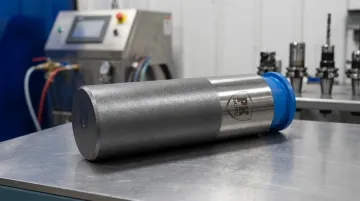
Fracking plungers illustrate how milling and coating must work together. These plungers operate at pressures up to 15,000 psi in environments carrying abrasive proppant. Precise machined geometry is required before wear-resistant coatings can be applied effectively — without it, coatings cannot adhere properly or perform as intended.
Parkway-Kew Corporation applies its proprietary PK-730 fused tungsten carbide coating to fracking plungers following precision machining — a process specifically designed for the harshest downhole conditions. One critical detail in their process involves concentricity: conventional centerless grinding can leave the wear surface as much as .015 inches out of alignment with the clamping end, causing vibration, uneven loading, and premature failure. Parkway-Kew's finishing process holds the clamping end during final machining, mirroring how the plunger is actually held in the pump and eliminating that failure mode.
Wire Manufacturing Industry
Wire mills rely on CNC milling to produce and recondition wire drawing blocks, capstans, and dies. These components experience severe abrasive wear as wire is drawn through them at high speeds.
Research published in peer-reviewed materials journals shows that friction coefficients as low as 0.01–0.1 during wire drawing can raise surface temperatures by 300°C, with dry friction at higher speeds potentially exceeding 1,400°C. That thermal and abrasive load degrades drawing surfaces quickly.
CNC milling is central to Parkway-Kew's Restore & Grind process, which selectively mills only the worn drawline area of a wire drawing block, fills it with hardsurfacing alloy, and precision-grinds the surface back to original geometry.
Rather than grinding the entire block down to the depth of the deepest groove — which removes serviceable coating and reduces block diameter unnecessarily — this approach targets only the worn zone. Because Parkway-Kew applies its PK coatings at enhanced thickness, customers can perform 5 to 7 Restore & Grind repairs before a full recoat is needed, substantially reducing total reconditioning costs.
Shipping Terminals and Port Operations
Container ship loading and unloading operations depend on large-diameter components — festoon wheels, crane wheels, wire rope pulleys, and sheaves — that endure constant mechanical stress. CNC milling is used to restore base geometry on worn components before coating application and to manufacture new replacement parts to original dimensional specifications.
Parkway-Kew manufactures and rebuilds urethane-coated trolley festoon wheels for shipping cranes, with field-tested results showing lifespans 2 to 3 years longer than OEM wheels. Their machining capabilities handle components up to 72 inches in diameter for milling and turning, with large-diameter grinding up to 65 inches in diameter and 12 feet in length — equipment scale that matches the heavy hardware found in port crane operations.
How to Choose the Right CNC Milling Partner
The right CNC milling partner depends heavily on what your application actually requires. Here's a practical framework:
Match Capabilities to Application Requirements
| Application Type | What to Prioritize |
|---|---|
| Aerospace / Defense | AS9100 / IAQG 9100 certification, documented quality control, 5-axis capability |
| Medical devices | FDA-traceable documentation, biocompatible material experience, surface finish control |
| High-volume automotive | Speed, repeatability, multi-material capability |
| Heavy industrial / oil & gas | Large work envelope, wear-resistant material expertise, complementary coating services |
| Wire drawing / shipping terminals | Component reconditioning experience, large-diameter capacity, hardsurfacing integration |
Key Questions to Ask
- Machine capacity — What is the maximum diameter and length the shop can handle? Large industrial components may require milling up to 65–72 inches in diameter.
- Axis configuration — Does the shop's equipment match your part geometry? Not all 5-axis machines are configured the same way.
- Material expertise — Has the shop documented experience with your specific alloy — titanium, Inconel, hardened steel, cobalt-chrome?
- Complementary services — Does the provider also offer hardsurfacing, HVOF coating, or thermal spray?
- Quality documentation — Can the shop provide dimensional inspection records, material certifications, or other documentation your application requires?
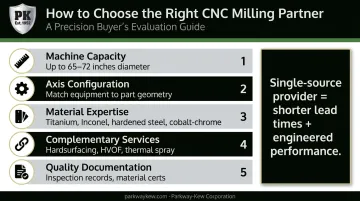
For industries where component restoration matters as much as new-part production — wire mills, shipping terminals, oil and gas — choose a CNC milling partner with integrated coating capabilities. A single-source provider handles both milling and coating, cutting lead times and ensuring the finished geometry and applied coating are engineered to perform together.
Conclusion
CNC milling is foundational to manufacturing across industries as varied as aerospace and wire drawing because it delivers what every demanding application requires: precise geometry, consistent repeatability, and the material range to handle everything from titanium airframe structures to hardened steel wire drawing blocks.
Choosing a CNC milling partner comes down to fit: machine size, axis count, material experience, and whether complementary services — grinding, coating, turning — are available under one roof. In safety-critical and high-wear environments, a mismatched tolerance or wrong material choice means scrapped components, unplanned downtime, and rework costs that dwarf the original machining quote. Companies like Parkway-Kew Corporation, which pair in-house CNC milling with wear-resistant coating services for wire drawing and oil & gas clients, show how tightly integrated machining and finishing capabilities reduce that risk from the start.
Frequently Asked Questions
What industries typically use CNC machines?
Aerospace, automotive, medical, defense, electronics, oil and gas, wire manufacturing, and shipping terminals all depend on CNC machining. Virtually any sector requiring precise, repeatable metal or plastic components relies on it in some form.
What is CNC milling used for in manufacturing?
CNC milling produces parts with complex geometries, tight tolerances, and specific surface finishes from solid material blocks. It handles both small precision components and large industrial parts, making it applicable across new production and high-volume manufacturing environments.
What materials can be CNC milled?
Common machinable materials include aluminum, stainless steel, titanium, Inconel, brass, copper, cobalt-chrome, and engineering plastics. Material selection is driven by the strength, weight, corrosion resistance, or biocompatibility requirements of the end application.
How does CNC milling differ from CNC turning?
CNC milling uses rotating cutting tools to remove material from a stationary or indexed workpiece — suited for prismatic and complex shapes. CNC turning rotates the workpiece against a stationary cutting tool — better for cylindrical or rotationally symmetric parts like shafts and plungers.
What parts are typically made using CNC milling services?
Common examples span a wide range: engine components, orthopedic implants, turbine blades, electronic enclosures, wire drawing blocks, hydraulic housings, and fracking plungers. The process handles both small precision parts and large industrial components up to several feet in diameter.
Can CNC milling be used for component restoration and repair?
Yes. CNC milling is widely used to recondition worn industrial components — wire drawing blocks, capstans, crane wheels, and pump parts — restoring worn surfaces to precise dimensional tolerances before or after hardsurfacing or coating is applied. This approach typically extends service life well beyond what outright replacement would offer, at a fraction of the cost.