Neither event made headlines beyond a small circle of engineers and machinists. Yet both marked the start of a decades-long shift in how manufacturers shape metal.
Today's machinists load a CAD file, hit start, and walk away while a multi-axis center carves complex geometry to within thousandths of an inch. Many never see the manual lathes, punch cards, and trial-and-error engineering that made this possible. Tracing that path explains why modern CNC works the way it does, and why manual skill still matters even now.
Key Takeaways
- NC machining began in 1949, with MIT's first working prototype arriving in 1952
- True computer-based CNC arrived in the 1960s-70s, powered by minicomputers and microprocessors
- Japan overtook the U.S. and Germany in CNC lathe production by 1980
- Modern shops blend CAD/CAM, multi-axis machining, and IoT monitoring for near-autonomous production
- Manual expertise still fills gaps CNC can't reach, especially on oversized parts
Before CNC: The Era of Manual Machining
Before the 1940s, precision manufacturing depended entirely on the machinist's hands and eyes. Lathes, mills, and drill presses required an operator to manually position the workpiece, set the feed rate, and guide the cutting tool through every pass. Tight tolerances came from trained judgment, not machine intelligence.
That reliance made production slow and inconsistent. A skilled machinist might spend hours on one complex part, and no two operators produced identical results. Manufacturers needed a way to standardize output and speed up repetitive work as demand for precision parts grew heading into the mid-20th century.
Blanchard's Copying Lathe: Automation's First Attempt
Thomas Blanchard offered a glimpse of automation more than a century before numerical control (NC) arrived. In 1818, he installed a cam-motion machine at Springfield Armory to shape the irregular breech of musket barrels, and then patented a related lathe in 1819 for turning irregular wooden forms.
The machine worked like a mechanical player piano: an iron master form rotated against a guide wheel, which directed a cutter to reproduce the model's shape in a wooden blank. It was clever, but limited:
- Required a physical master pattern for every new shape
- Could not be reprogrammed with new coordinates or instructions
- Depended on mechanical linkages, not stored data
Blanchard's lathe automated repetition, not decision-making. That gap, physical copying versus reprogrammable control, is exactly what engineers spent the next three decades trying to close.
The Birth of Numerical Control (NC): The 1940s-1950s
The story of computer-driven machining starts with a helicopter problem. In the late 1940s, John T. Parsons and his team at Parsons Corporation needed a faster way to calculate the complex curves of helicopter rotor blades for Sikorsky. Manual drafting couldn't keep pace with the precision required.
Parsons turned to an IBM 602A multiplier, a punched-card calculating machine, to compute airfoil coordinates directly. Operators then manually positioned cutting tools based on those punched-card figures, a method that became known as machining "by the numbers."
From Punched Cards to Automated Positioning
The by-the-numbers approach still required a person to read each coordinate off a card and dial it into the machine by hand. But it proved something important: numerical data, not a physical template, could define a cutting path.
The U.S. Air Force took notice. In 1949, it backed a project pairing Parsons Corporation with MIT's Servomechanisms Laboratory to build a machine that could read numerical instructions and move a cutting tool automatically, with no manual dialing required.
The 1952 Demonstration That Changed Manufacturing
MIT demonstrated the first continuous-path numerically controlled milling machine in September 1952, built from a modified Cincinnati Milling Machine Company Hydro-Tel. MIT's archive records confirm this date, the moment NC moved from concept to working hardware.
That same year, more than 200 miles south in New Jersey, Eugene Walter Klein founded what became Parkway-Kew Corporation, welding his first hardfacing test piece by hand. Two very different paths toward precision manufacturing, one digital and one manual, were taking shape at once.
The 1952 machine read instructions from perforated paper tape. An electronic director converted the punched patterns into electrical signals that drove the machine's servomechanisms, replacing manual card-reading with automated, repeatable input.
Parsons and colleague Frank L. Stulen filed a patent for their "Motor Controlled Apparatus for Positioning Machine Tool" in 1952; it issued as US 2,820,187 in 1958. Recognition followed slowly: the Society of Manufacturing Engineers reportedly named Parsons "The Father of the Second Industrial Revolution" in 1975, and President Reagan awarded him and Stulen the National Medal of Technology a decade later, in 1985.
From NC to CNC: The Computer Revolution (1960s-1980s)
Real computer control didn't arrive overnight. Early NC machines still relied on hardwired servo systems reading punched tape, powerful for their time, but inflexible. Changing a program meant punching a new tape, not editing software.
That began to shift as minicomputers became affordable through the 1960s. Cheaper computing made it possible to move control logic from dedicated hardware into stored programs, the real starting point for what we now call CNC.
APT and the Language of Machining
Programming these systems required a common language. MIT's Automatically Programmed Tools (APT) system, demonstrated in 1959, let programmers describe cuts using points and lines rather than raw coordinates. A general-purpose computer then translated those statements into tool motion and punched-tape output.
By the mid-1970s, microprocessors replaced dedicated control modules entirely. This shrank machine footprints, lowered costs, and made accurate closed-loop control affordable for smaller shops and technical schools, not just aerospace giants.
The Competitive Shakeup
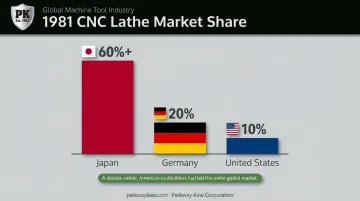
Cheaper, more capable CNC also reshuffled who dominated machine tool manufacturing. By 1981, market share had shifted dramatically from a decade earlier, when American builders led the field:
- Japan supplied more than 60% of the world's CNC lathe market
- Germany held roughly 20%
- United States fell to just 10%
The 1980s brought graphical interfaces and CAD/CAM integration, letting programmers verify toolpaths on screen before cutting a single chip. Digital design and physical machining connected directly for the first time, no punched tape intermediary required.
The Digital Age: CNC Machining from the 1990s to Today
Modern CNC machining bears little resemblance to that 1952 prototype, though the underlying logic, numbers directing motion, hasn't changed. What's changed is scale, speed, and how much of the process now runs itself.
Multi-Axis Machining and New Materials
Five-axis machining moved from a shop-floor luxury to a competitive requirement, letting a single setup cut complex geometry that once required multiple manual repositions.
This shift shows up across industries:
- Aerospace manufacturers rely on five-axis systems to machine multi-blade components from superalloys, materials nearly impossible to shape efficiently by hand
- Medical manufacturers use the same rotary-table technology for titanium implants
- Composite parts get purpose-built five-axis trimming and drilling
Connected, Predictive Shop Floors
Today's CNC systems generate operational data with every cut. Real-time monitoring protocols gather machine data for production planning and preventive maintenance. NIST research links heavy reliance on reactive maintenance, versus predictive, to 3.3 times more downtime and 16 times more defects across manufacturing broadly.
AI is now entering the programming stage itself:
- Tools automate roughing and finishing toolpaths, generating programs roughly 80% complete before programmer review
- Robotic machine tending pairs collaborative robots with CNC mills for loading and unloading
- Feature-recognition software proposes machining sequences from CAD data automatically
Demand keeps climbing alongside the technology. U.S. manufacturing technology orders hit $5.74 billion in 2025, up 22.5% from the previous year, reflecting the broader appetite for automated, precision equipment across American industry.
Manual Craftsmanship Meets Digital Precision: Why Both Still Matter
CNC precision didn't make manual skill obsolete. For oversized, irregular, or heavily worn industrial components, the two approaches work best together.
Parkway-Kew Corporation has lived this evolution firsthand. Founded in 1952, the same year MIT's NC prototype made its debut, the company started with manual hardfacing welding, rebuilding worn wire drawing blocks by hand.
Decades later, it runs in-house CNC milling and CNC turning up to 72 inches in diameter. Its large-diameter grinding handles parts up to 65 inches in diameter and 12 feet in length.
That combination matters because CNC machining, for all its precision, has real limits:
- It can only remove material, never deposit it
- Fixed programming struggles with irregular or localized wear patterns
- Standard processes can introduce dimensional errors on finished parts
Parkway-Kew's proprietary Restore & Grind process shows the gap manual expertise fills. Grinding an entire wire drawing block down to its deepest worn groove wastes good coating and shrinks the block unnecessarily.
Instead, technicians manually fill only the worn drawline area, then precision-grind it to blend with the surrounding original coating. That targeted approach stretches a block's service life across 5 to 7 repair cycles before a full recoating is needed.
A similar principle applies to fracking plunger restoration. Standard centerless grinding can leave a ground surface up to 0.015 inches out of concentricity with the clamping end, enough to cause vibration and premature wear in the field. Manually holding the clamping end while finishing the coated surface, mimicking actual pump-holding conditions, corrects an error automated grinding alone would introduce.
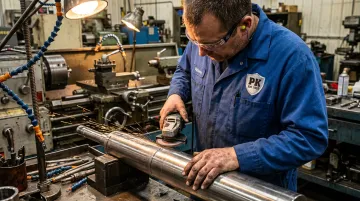
Seventy-plus years after Eugene Walter Klein welded that first test piece in his garage, Parkway-Kew's shop floor still proves the point. Code and coordinates deliver precision, and hands-on metallurgical knowledge keeps that precision working in the field.
Frequently Asked Questions
When was CNC milling invented?
The first NC milling prototype was built between 1949 and 1952 through the Parsons-Air Force-MIT project, demonstrated in September 1952. True computer-controlled CNC milling didn't emerge commercially until the 1960s and 1970s.
Who is considered the father of CNC?
John T. Parsons pioneered numerical control, developing and demonstrating the first NC machine tool concept. The Society of Manufacturing Engineers honored him in 1975 as "The Father of the Second Industrial Revolution."
How has CNC milling changed throughout history?
CNC evolved from punch-tape NC systems in the 1950s to computer-controlled machines in the 1970s, then to CAD/CAM-integrated, multi-axis systems today. Modern machines now add IoT connectivity and AI-assisted programming on top of that foundation.
What preceded CNC machines in manufacturing?
Manual machining—hand-operated lathes, mills, and drills—dominated manufacturing before NC arrived. Mechanical cam-based automation, like Thomas Blanchard's copying lathe from the 1820s, offered limited, non-reprogrammable automation.
What is the difference between NC and CNC machining?
NC systems read instructions from punched cards or tape without an onboard computer, limiting flexibility. CNC uses a stored computer program, letting operators edit instructions in software rather than re-punching tape for every change.
What was the first commercially available CNC machine?
MIT's 1952 prototype (a modified Cincinnati Milling Machine Company Hydro-Tel) was the first experimental NC machine tool, not a commercial product. Commercial NC machines began reaching aircraft production floors by around 1957.