Turning operations form the backbone of precision part manufacturing. Choosing the wrong operation, or running them in the wrong order, leads to poor surface finish, wasted material, tool damage, and rework that eats into your margins.
This guide breaks down the 10 essential turning operations, explains how they differ, and shows you how to sequence them correctly for your job.
Key Takeaways
- Lathes perform 10+ operations beyond basic turning, including facing, threading, and boring
- Tool geometry and feed direction define each operation, not the machine itself
- Facing starts the process; parting ends it, separating the piece from stock
- The right operation depends on the feature needed: a hole, thread, taper, or groove
What Is Turning & Why It Matters in Machining
Turning is the machining process where a workpiece rotates against a stationary, single-point cutting tool that removes material to create cylindrical or contoured shapes. "Turning operations" is the umbrella term for the full family of techniques performed on that same lathe: facing, grooving, threading, boring, and more, each using a different tool and tool path.
These techniques show up wherever tight tolerances matter. Industries that depend on them for critical parts include:
- Aerospace – shafts, spools, and turbine discs
- Automotive – gearbox shafts and splines
- Medical devices – bone screws requiring precision thread turning
- Oil & gas – tubing, couplings, and drill pipe
- Heavy industrial equipment – wire drawing blocks, capstans, and other oversized components
According to industry analysis from Grand View Research, the combined CNC machining and turning-centers market was valued at $25.9 billion in 2023, with projections reaching $40.6 billion by 2030 — a 6.6% annual growth rate. That growth reflects steady industrial demand for precision-turned parts across every sector listed above.

At Parkway-Kew, we see this firsthand. Wire drawing blocks, capstans, and fracking plungers all pass through turning operations, either to prepare the substrate before coating or to finish a hardsurfaced part to exact tolerance.
Skip a step or rush a sequence, and the result is dimensional inaccuracy, chatter marks, tool breakage, or a part that simply doesn't hold up in the field.
The 10 Essential Turning Operations You Need to Know
Each operation below is distinguished by tool shape, feed direction, and whether material comes off the outer diameter, inner diameter, or end face.
1. Turning (Straight/Cylindrical Turning)
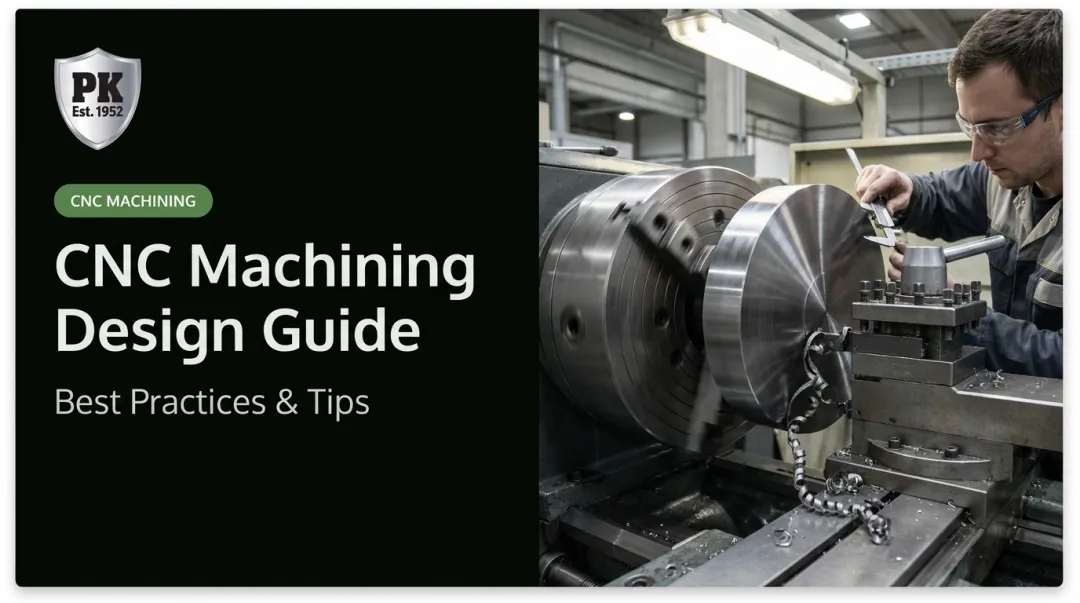
Straight turning is the baseline operation. The workpiece rotates while a cutting tool feeds parallel to the lathe axis, reducing the outer diameter to a consistent cylindrical surface.
Several variations fall under this category:
- Step turning – creates abrupt diameter changes (shoulders)
- Taper turning – produces a gradual diameter transition
- Chamfer turning – bevels an edge
- Contour turning – follows an irregular profile
Most shafts, pins, and rod stock start here. It's often called the "mother operation" because nearly every other cut builds on a surface first established by straight turning.
2. Facing
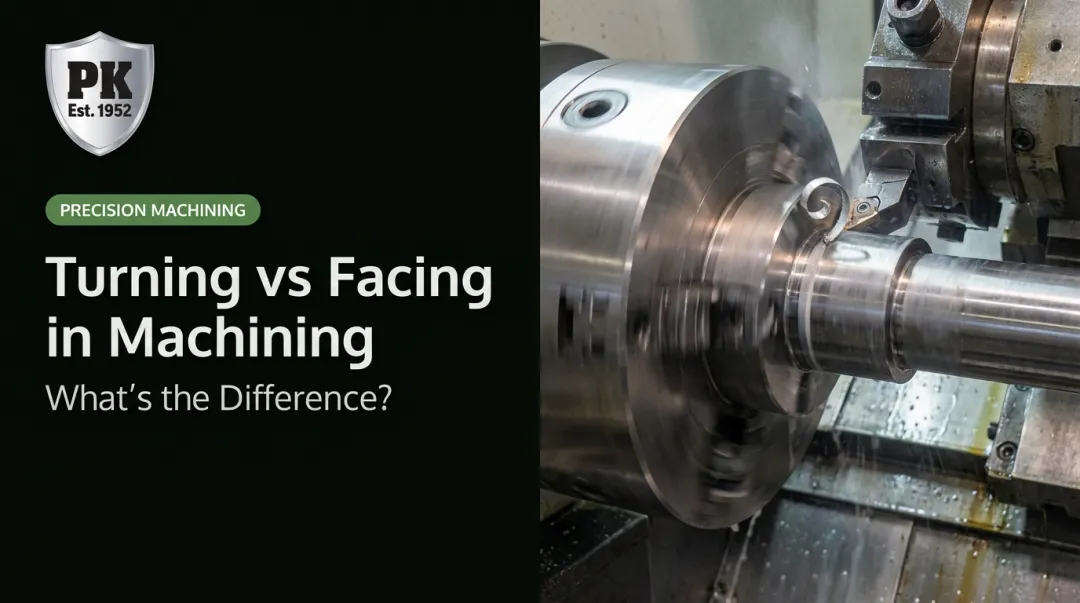
Facing machines the end of a workpiece perpendicular to the axis, producing a flat, smooth surface and setting the part's final length. It's usually the first operation performed on new stock, since it establishes an accurate reference surface for every measurement that follows. Skip it, and every downstream dimension is built on a shaky foundation.
3. Grooving
Grooving cuts a narrow recess into the outer diameter, inner diameter, or face of a workpiece using a tool matched to the groove width. Common applications include:
- Relief grooves cut before threading
- O-ring seats
- Retaining-ring grooves
External grooving and face grooving are distinct: one cuts radially into the OD or ID, the other cuts axially into the end face.
4. Parting (Cut-Off)
Parting feeds a thin, blade-like tool radially into the rotating workpiece until it separates the finished part from the remaining bar stock. This is typically the final operation in a bar-fed job. It demands careful feed control. Push too fast or use a dull blade, and you risk tool breakage or a rough, unusable cut face.
5. Threading
Threading cuts a uniform helical groove, external or internal, at a specified pitch using a shaped tool over multiple synchronized passes. Spindle speed and carriage feed must stay perfectly coordinated via the lead screw. Get that coordination wrong, and the thread pitch drifts. This operation produces fasteners, threaded shafts, and precision components like the bone screws documented in Sandvik's medical machining case studies.
6. Knurling
Knurling is a forming operation, not a cutting one. A patterned wheel presses into the rotating workpiece, displacing material to create diamond, straight, or angled grip patterns. Typical applications:
- Tool handles
- Gauge grips
- Adjustment knobs
Anywhere a human hand needs to grip and turn a part, knurling likely made it possible.
7. Drilling
Drilling produces a round axial hole by feeding a rotating drill bit, mounted in the tailstock, into the stationary center of the workpiece. Center-drilling first improves hole accuracy and keeps the drill from wandering off-axis, a small step that saves a lot of scrapped parts.
8. Reaming
Reaming is a finishing operation. A multi-edge reamer enlarges and smooths an existing drilled or bored hole to a precise diameter and tolerance. It removes minimal material and typically follows drilling or boring wherever tight tolerances matter, such as press-fit or dowel holes.
9. Boring
Boring enlarges an existing hole using a single-point boring bar fed axially into the part. Think of it as internal turning. It corrects roundness and concentricity or achieves a precise internal diameter, and it's critical for large-bore components.
Oversized industrial parts, like wire drawing blocks and capstans, often need specialized capacity most shops don't have. Parkway-Kew runs in-house CNC and manual turning up to 72 inches in diameter, alongside large-diameter grinding up to 65 inches in diameter and 12 feet in length. That combination matters for parts too large for a standard shop's chuck.
10. Tapping
Tapping cuts internal threads into a pre-drilled hole using a tap held in the tailstock or chuck while the workpiece rotates slowly. Because it happens in the same setup as drilling, there's no need to transfer the part to a separate machine, which saves setup time and preserves alignment.
How to Choose the Right Turning Operation for Your Job
Operation selection should follow the feature you need (a hole, a thread, a taper, a groove), not habit or whatever tool happens to be mounted.
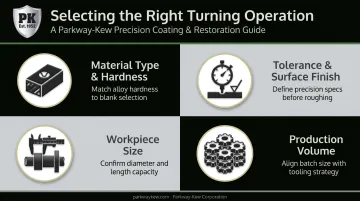
Key Selection Criteria
- Material type and hardness – dictates tool material and cutting speed
- Required tolerance and surface finish – tighter tolerances often mean adding a reaming or boring pass after the initial cut
- Workpiece size – oversized or heavy-duty parts may require a shop with large-capacity equipment; Parkway-Kew's 72-inch turning capacity, for example, handles parts standard lathes can't touch
- Production volume – one-off restoration jobs often favor manual setups, while repeatable batch work favors CNC for consistency
Choosing the right factors is only half the equation. The other half is avoiding execution mistakes that turn a straightforward job into a rework.
What to Avoid When Selecting an Operation
- Skipping facing before other cuts, which throws off length and reference measurements
- Using the wrong feed or speed for the material, causing chatter, poor finish, or premature tool wear
- Attempting parting or grooving with an oversized or dull tool, risking breakage or workpiece damage
These aren't rare mistakes. They're the most common reasons a "simple" turning job ends up back on the machine for rework.
Conclusion
Turning operations extend far beyond simple cylindrical shaping. The ten techniques covered here each solve a specific problem, whether that's a flat reference face, a threaded hole, or a corrected bore.
Understanding how they differ, and how to sequence them, leads to better dimensional accuracy, less scrap, and longer tool life. Large-diameter or heavy-duty industrial components like wire drawing blocks, capstans, and fracking plungers demand a shop with both the equipment and the experience to match the right operation to the job. Parkway-Kew has offered that expertise since 1952, combining in-house CNC turning and grinding up to 65 inches in diameter with coating expertise that keeps parts running instead of failing early.
Frequently Asked Questions
What are the operations of a lathe?
The core lathe operations are turning, facing, threading, grooving, parting, boring, drilling, reaming, knurling, and tapping. Which one you use depends entirely on the feature you're trying to produce.
What is the difference between turning and facing?
Turning removes material from the outer diameter, feeding the tool parallel to the workpiece axis. Facing cuts the end face perpendicular to the axis, setting the part's length and reference surface.
Can turning operations be performed on materials other than metal?
Yes. Wood, plastics, and composites can all be turned on a lathe, though speeds, feeds, and tool types differ from metalworking and vary by specific material.
What is the difference between manual and CNC turning?
Manual lathes rely on operator-controlled handwheels for every movement. CNC lathes use programmed, automated tool paths, delivering higher precision and repeatability across large production runs.
Which turning operation should be performed first on a new workpiece?
Facing is typically performed first. It creates a flat, accurate reference surface that every subsequent measurement and cut depends on.
What safety precautions should be followed during lathe turning operations?
Wear safety glasses, avoid loose clothing or jewelry, and secure the workpiece firmly before starting. Never measure or adjust a part while it's rotating, and follow OSHA's machine guarding standard 1910.212 for point-of-operation protection.