That's what makes it dangerous. Engineers and maintenance teams often don't get a warning before a catastrophic failure. A component can pass a visual inspection on Monday and split open by Friday.
This guide breaks down what causes SCC, the warning signs worth watching for, and the prevention strategies that actually work — from material upgrades to protective coatings and long-term inspection programs.
Key Takeaways
- SCC requires three simultaneous factors: a susceptible alloy, chloride exposure, and tensile stress
- Standard 304/316 stainless steel is highly vulnerable; duplex and high-nickel alloys resist it far better
- Cracks are frequently invisible until failure, so inspection protocols matter more than visual checks
- Prevention works by removing any one leg of the three-factor mechanism
- Coatings, stress relief, and routine monitoring form the backbone of long-term control
What Is Stress Corrosion Cracking and What Causes It?
Stress corrosion cracking is brittle, often branched cracking that forms when tensile stress and a specific corrosive environment act on a metal at the same time. Neither factor alone causes it. The combination causes the damage.
Metallurgists split SCC into two types:
- Transgranular SCC (TGSCC) — cracks propagate straight through the grains of the metal
- Intergranular SCC (IGSCC) — cracks follow the grain boundaries instead
According to a Nickel Institute review of chemical-plant SCC cases, roughly three-fourths of the cases studied were transgranular, typically driven by chloride ions, pH, temperature, and crevice conditions. Sensitization was the primary driver behind the intergranular cases.
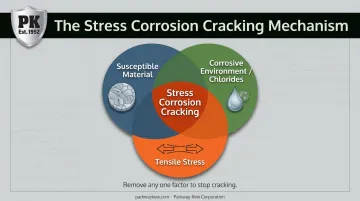
Here's the part that matters most for prevention: SCC needs three factors converging simultaneously. Take away any one (the corrosive environment, the susceptible material, or the tensile stress), and the cracking mechanism generally stops. That's the entire logic behind every prevention strategy covered later in this guide.
Cause 1: Chloride Exposure
Chloride ions from seawater, de-icing salts, or process chemicals attack the thin passive oxide layer that gives stainless steel its corrosion resistance. Once that layer breaks down locally, a crack can initiate and grow.
There's no single "safe" chloride concentration. Susceptibility shifts with alloy type, temperature, pH, oxygen levels, and how long the surface stays wet. Common scenarios include:
- Marine equipment exposed to salt spray and humidity
- Chemical processing piping carrying chloride-bearing fluids
- Evaporative or wet-dry cycling environments, where chlorides concentrate as moisture evaporates and reconcentrates on hot surfaces, insulation, or weld deposits
Cause 2: Elevated Operating Temperature
Temperature is a major accelerant. Alleima notes that standard austenitic grades like TP304L and TP316L become prone to chloride SCC above roughly 60°C (140°F), though this is a risk-screening point, not a hard safety limit.
Nickel Institute's case data found transgranular cracking occurring frequently at 80°C and higher. In one documented case, however, dropping the process temperature to 40°C eliminated corrosion entirely. Heat exchangers, boilers, and steam-exposed equipment are classic high-risk zones because they combine elevated temperature with chloride contact.
Cause 3: Residual or Applied Tensile Stress
Stress doesn't have to come from operating loads. Welding, cold forming, and machining all leave residual stress behind, and it can be as high as the material's own yield strength.
IMOA's fabrication guidelines cite a Type 347 example with 230 MPa (33 ksi) of residual stress before annealing, stress baked into the part before it ever sees service. Watch for these high-risk zones:
- Weld transitions and heat-affected areas
- Sharp corners or abrupt geometry changes
- Threaded connections, where stress concentrates at the root of each thread
Cause 4: Susceptible Material Composition
Not all stainless steel resists SCC equally. Standard austenitic grades like 304/304L and 316/316L carry lower nickel content and are significantly more vulnerable than duplex or high-nickel/molybdenum super austenitic families.
| Alloy Family | Chloride SCC Resistance |
|---|---|
| 304/304L, 316/316L | Highly susceptible above ~60°C |
| Duplex 2205 | Significantly more resistant than 300-series |
| Superduplex | High resistance, comparable to 6% Mo alloys |
| 6% Mo super austenitic | Highly resistant, though not immune |
The most common mistake: specifying standard-grade stainless in chloride-rich service simply because it's cheaper upfront, without accounting for the corrosion environment.
What Happens If Stress Corrosion Cracking Is Ignored
Undetected SCC doesn't wear a part down gradually. It causes sudden, catastrophic failure of a load-bearing part, often with no warning at all.
A documented industrial case illustrates the stakes well. Type 316 stainless outlet piping downstream of a waste-heat exchanger in a large ammonia unit developed SCC near a flange-to-cone weld. Condensate had leached chlorides out of the surrounding insulation, creating the exact aqueous chloride exposure needed to trigger cracking. The result: an ammonia leak, a fire, and a full unit shutdown.
The consequences of ignoring SCC typically include:
- Sudden catastrophic failure of pressure vessels, piping, or structural components
- Unplanned downtime that halts production with zero lead time
- Safety hazards from leaks, fires, or explosions in pressurized systems
- Costly emergency repairs that run far higher than planned maintenance would have
Warning Signs You're About to Experience SCC
Because SCC cracks are often microscopic and branched, the surface can look untouched even as a component approaches failure. Visual inspection alone isn't reliable. Watch for:
- Fine surface cracking detected only through dye penetrant or magnetic particle inspection, not visible to the naked eye
- Unexpected leaks or pressure loss in piping and vessels with no obvious external corrosion
- Failures concentrated in known high-stress zones (welds, bends, threaded joints) after extended service in a chloride-containing environment
How to Prevent Stress Corrosion Cracking in Stainless Steel
Prevention comes back to the same three-factor mechanism: material, environment, and stress. Address any one leg strongly enough, and SCC risk drops sharply.
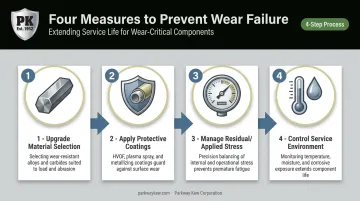
Prevention Measure 1: Upgrade Material Selection
Swap standard 304/316 for duplex, super-duplex, or high-nickel/molybdenum grades in chloride-rich applications. This directly removes the "susceptible material" leg of the equation by specifying an alloy that resists cracking in the first place. Make this call at the design or specification stage, before procurement locks you into the wrong grade.
Prevention Measure 2: Apply Protective Coatings or Barriers
Specialized coatings create a physical barrier between the corrosive environment and the base metal, which matters most on components that face both stress and corrosive media at once.
- HVOF (High Velocity Oxygen Fuel) thermal spray produces dense, low-porosity coatings
- Plasma spray ceramics offer chemical inertness against aggressive media
- Fused tungsten carbide coatings deliver extreme wear resistance on high-stress parts
Parkway-Kew Corporation applies precision coating processes for exactly this purpose. Their HVOF applications and proprietary PK-730 fused tungsten carbide coating are built for components running in demanding, corrosive, high-stress conditions, with fracking plungers and wire mill equipment among the toughest examples.
PK-730 was developed specifically for fracking plunger conditions harsh enough that standard nickel chrome coatings fall short. Apply coatings during initial fabrication or as part of scheduled refurbishment, before wear opens the door to corrosion.
Prevention Measure 3: Manage Residual and Applied Stress
Stress-relief annealing, disciplined welding procedures, and avoiding sharp geometric transitions all reduce the tensile stress concentrations that drive crack propagation. This addresses the "stress" leg directly. Build this into design review and apply it again after every welding or forming step — not just once at the end of fabrication.
Prevention Measure 4: Control the Service Environment
Limiting chloride concentration, controlling operating temperature, and managing pH and oxygen levels all shrink the "environment" leg of the mechanism. This matters most in evaporative or wet-dry cycling conditions, where chlorides concentrate on hot surfaces or under insulation. Build these controls into process design and back them with ongoing environmental monitoring, not a one-time check.
Tips for Long-Term Prevention and Control
Immediate fixes only go so far. Long-term SCC control depends on habits built into your maintenance program:
- Schedule routine non-destructive testing ( dye penetrant, magnetic particle, or ultrasonic testing) on components in known SCC-risk environments
- Train operators and maintenance staff to recognize early risk factors and follow clear reporting protocols
- Maintain documentation of material grades, coating applications, and inspection history for every critical component
- Partner with an experienced coating provider, such as Parkway-Kew Corporation, for periodic recoating and restoration of wear parts in high-stress, corrosive environments
Their Restore & Grind process illustrates this well: instead of stripping an entire coating on wire drawing blocks, it rebuilds only the worn drawline area.
Because Parkway-Kew applies its proprietary coatings at greater-than-standard thickness, components often support 5 to 7 lower-cost targeted repairs before a full recoat becomes necessary, giving a meaningful cost and downtime advantage over reactive full replacement.
Conclusion
Stress corrosion cracking isn't a mystery. It has well-understood causes rooted in the interaction between material, environment, and stress, and each of those legs can be managed with the right approach.
Smart material selection, protective coatings, disciplined stress management, and routine inspection work together to prevent it. Getting ahead of SCC protects more than equipment; it protects your people and your uptime. Preventive measures cost far less than an unplanned shutdown ever will.
Frequently Asked Questions
What causes stress corrosion cracking in stainless steel?
SCC results from three factors acting together: a susceptible alloy (like standard 304/316), a corrosive environment (usually chlorides), and sustained tensile stress. Remove any one factor and cracking generally stops.
At what temperature does stress corrosion cracking occur in stainless steel?
Standard austenitic grades become markedly more vulnerable above roughly 60°C (140°F) in chloride-bearing environments. Fully immersed conditions rarely crack below that range, though it's a screening threshold, not an absolute limit.
How can stress corrosion cracking in stainless steel be mitigated?
Core mitigation strategies include upgrading to duplex or high-nickel alloys, applying protective coatings, relieving residual stress through annealing, and controlling chloride, temperature, and pH in the service environment.
Can stress corrosion cracks in stainless steel be repaired?
Cracked sections typically require removal and replacement rather than in-place repair, since confirming complete flaw removal is difficult. Preventive recoating or restoration can extend component life before cracking starts.
Which stainless steel grades are most resistant to SCC?
Duplex 2205, superduplex, and high-nickel/molybdenum super austenitic grades all outperform standard 304/316 in chloride environments by a wide margin. None are fully immune, but the resistance gap is substantial.
What's the difference between transgranular and intergranular SCC?
Transgranular cracks propagate straight through the metal's grains, while intergranular cracks follow the grain boundaries instead. Transgranular is more common in chloride-driven cracking of austenitic stainless steel.