Many engineers assume any grade stamped "stainless" will hold up anywhere. It won't. Corrosion resistance operates within specific chemical, thermal, and mechanical limits, and choosing the wrong grade for the wrong environment is one of the most common causes of premature part failure.
This article breaks down what actually drives corrosion resistance, how it varies across grades, where the boundaries sit, and what happens when a component gets pushed past them.
Key Takeaways
- A self-healing chromium oxide layer, not the base metal, drives corrosion resistance
- 316 outperforms 304 in chloride-heavy environments due to higher chromium, nickel, and molybdenum content
- Pitting or crevice attack can breach the protective layer even when bulk specs look fine
- PREN calculations and lab testing quantify resistance, but real-world conditions often diverge from lab assumptions
- Where wear and chemical exposure combine, supplemental coatings often outperform bare stainless alloys
What Corrosion Resistance Represents in Stainless Steel
Stainless steel resists corrosion because of a phenomenon called passivation, not because the alloy is somehow immune to rust. Once chromium content exceeds roughly 10.5%, the surface spontaneously forms a nanometer-thin, chromium-rich oxide film. Worldstainless confirms this threshold as the defining line between stainless and non-stainless behavior.
That film is the entire mechanism. It's invisible, incredibly thin, and self-repairing. Scratch it, and it reforms within moments as long as oxygen is present. Compare that to carbon steel, where rust is porous, flaking, and progressive. Iron oxide doesn't protect the metal underneath; it just keeps accumulating.
Corrosion resistance is a derived characteristic, not a fixed material constant. It shifts based on:
- Alloy composition (chromium, nickel, molybdenum, nitrogen levels)
- Surface condition (polished, welded, contaminated, or mechanically damaged)
- The specific chemical environment the part actually operates in
Factors That Influence Corrosion Resistance in Real-World Operation
Lab-rated resistance and field performance often tell different stories. Most failures trace back to environmental or design factors, not defective alloy.
Alloy composition sets the ceiling. Chromium, nickel, molybdenum, and nitrogen content directly raise or lower how much abuse a grade can take before the passive film breaks down.
Fabrication can erase that ceiling fast. Welding heat, mechanical scoring, or embedded carbon-steel tool residue can locally destroy the passive layer, creating weak points invisible to the naked eye.
Environmental load does the rest. Chloride exposure from seawater, road salt, or cleaning chemicals, combined with acidity or stagnant crevice conditions, accelerates localized attack far faster than uniform corrosion would suggest.
Temperature and chloride concentration are the two variables researchers rely on most to predict pitting risk. Nickel Institute field data recorded Type 316 attack of 0.10 mm at 60°C climbing to 0.25 mm at 71°C, both at the same 175 ppm chloride level. Push either variable up, and the passive layer's margin shrinks.
Range of Corrosion Resistance Across Stainless Steel Grades
Choosing "stainless steel" as a spec is meaningless on its own. The real question is which grade's resistance range matches your specific operating environment.
Nominal Corrosion Resistance by Grade Family
| Grade family | Typical PREN | Chloride performance |
|---|---|---|
| 304/304L (austenitic) | ~18 | Baseline resistance; suited to mild indoor/atmospheric use |
| 316/316L (austenitic) | 24-25 | Molybdenum boosts pitting/crevice resistance for marine and chemical service |
| 430 (ferritic) | ~17 | Lower resistance than 304 |
| 444 (ferritic) | 24-25 | Molybdenum-bearing; rivals 316 in chloride pitting resistance |
| Standard duplex (2205) | ~35 | Higher chloride and stress-corrosion cracking resistance than 300-series |
| Super-duplex (2507) | >42.5 | Highest tier for chloride-heavy service |
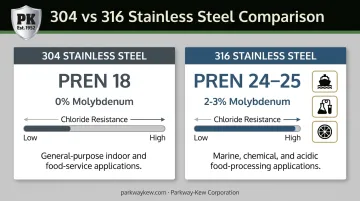
The 304 vs. 316 comparison comes up constantly, and for good reason. 316 contains 2.00-3.00% molybdenum, an element 304 doesn't require at all.
That molybdenum gives 316 materially better resistance to chlorides and pitting, making it the preferred choice for marine hardware, chemical processing, and food-acid environments. Plain 304 handles milder indoor or atmospheric exposure just fine, but it starts pitting in conditions where 316 keeps performing.
Allowable Tolerance and Boundary Limits
The Pitting Resistance Equivalent Number (PREN) quantifies where a grade sits on the chloride-resistance scale. The formula, per BSSA, is:
PREN = %Cr + 3.3(%Mo) + 16(%N)
Higher PREN means better theoretical resistance to pit initiation. But PREN was developed for immersion conditions, and it doesn't predict uniform corrosion or a service-life countdown. Short-term acid or chloride splash exposure produces a very different real-world outcome than continuous immersion in the same fluid, even for identical grades.
Safe Operating Margin
Engineers routinely specify higher-alloyed grades than the theoretical minimum, and that's a deliberate hedge. Chloride concentration in a real system rarely stays uniform. A gasket, a weld crevice, or a stagnant pocket can create local chloride levels far above the bulk average.
Operating too close to a grade's boundary means pitting or crevice corrosion can start even when bulk corrosion rate measurements look completely acceptable. That's the trap: the spec sheet says one thing, the crevice underneath a flange says another.
Key Technical Properties of Corrosion Resistance
Engineers can't evaluate corrosion resistance in isolation. It interacts with film stability, susceptibility to localized attack, and mechanical wear all at once.
Passive Film Stability and Self-Healing Behavior
The passive film reforms after mechanical abrasion or scratching, provided oxygen can reach the surface. That's the good news. The bad news: anything that blocks oxygen (a gasket, a deposit, a stagnant crevice) creates an oxygen-depleted anodic zone where the film can't rebuild itself. That's precisely where crevice corrosion tends to start.
Susceptibility to Localized and Intergranular Attack
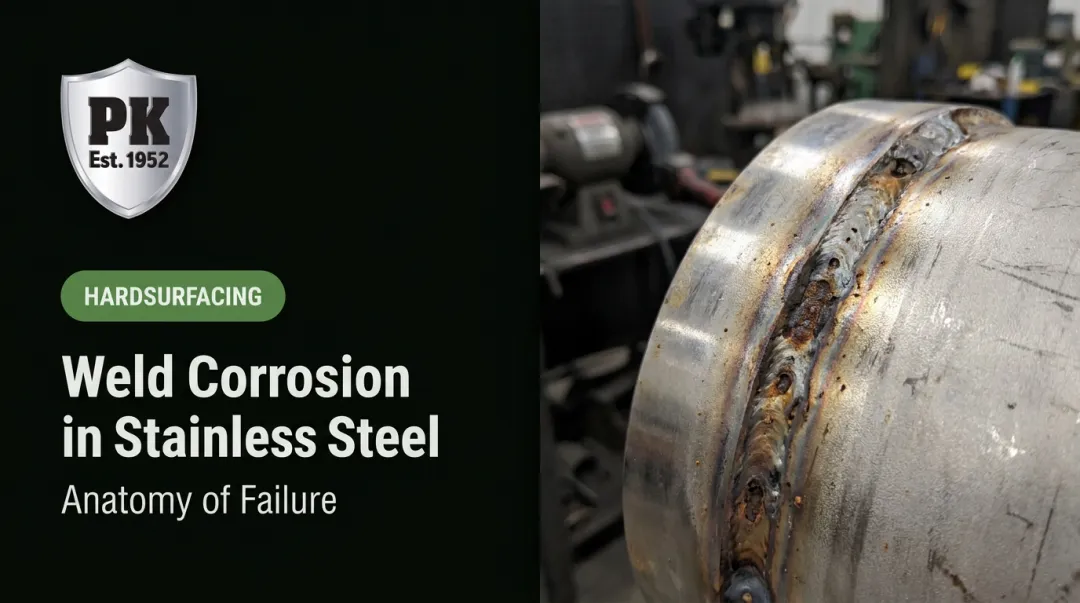
Welding and fabrication introduce a specific risk called sensitization. When austenitic grades are exposed to roughly 950-1450°F (about 510-790°C) during welding, chromium carbides precipitate at grain boundaries. This depletes chromium locally, even though the bulk chromium content of the part hasn't changed at all. The result is a corrosion-prone zone hiding right next to a weld that otherwise looks fine.
Trade-offs with Hardness and Wear Resistance
Here's the trade-off that catches a lot of operators off guard. Highly corrosion-resistant austenitic grades are relatively soft. Under sliding contact or high pressure, they're prone to galling, a severe adhesive wear mode where surfaces literally tear and transfer material to each other.
That's a serious problem for components that face both chemical exposure and mechanical wear simultaneously:
- Wire drawing blocks and capstans under constant sliding friction
- Festoon wheels and crane wheels cycling under load in coastal environments
- Fracking plungers exposed to abrasive proppant and corrosive fluids
Bare stainless steel isn't built to handle both stresses at once. That's why many heavy-industrial operators pair a corrosion-resistant base alloy with a specialized wear-resistant surface treatment rather than depending on bulk material properties alone.
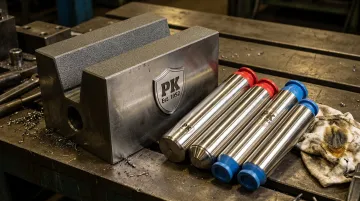
At Parkway-Kew, this shows up directly in how components get specified. Wire drawing blocks receive HVOF-applied nickel chrome boron coatings like PK-920, PK-675, PK-700, or PK-750, chosen based on how much tungsten carbide density the application demands. Fracking plungers get either the standard PK-62 nickel chrome coating or the heavier-duty PK-730 fused tungsten carbide coating for the harshest wellsite conditions.
How Corrosion Resistance Is Specified, Measured, and Validated
Corrosion resistance isn't something you assume from an alloy name. It's a design specification that has to be documented and, ideally, verified through testing.
Specification and Documentation
Mill test certificates, ASTM/EN grade datasheets, and PREN values form the standard paper trail for comparing corrosion performance across suppliers. But there's a key distinction: "rated" resistance is theoretical, based purely on chemical composition, while "tested" resistance reflects performance under conditions that resemble the service environment.
A certificate showing the right chemistry doesn't guarantee the part will hold up in your specific application.
Measurement and Verification Methods
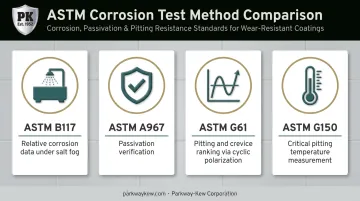
Several standardized tests exist, each answering a different question:
- ASTM B117 (salt spray/fog testing): produces relative corrosion data under controlled salt fog conditions
- ASTM A967: specifies chemical passivation treatments and verifies passivation effectiveness
- ASTM G61: ranks pitting and crevice susceptibility through cyclic polarization
- ASTM G150: measures critical pitting temperature electrochemically
None of these tests predict multi-year field life directly. ASTM itself notes that natural-environment performance has rarely correlated cleanly with standalone salt-spray results. A part that passes an accelerated lab test can still underperform in the field if the real operating conditions diverge from the test's assumptions.
Implications of Inadequate Corrosion Resistance and Common Misconceptions
Once the passive film fails locally, corrosion doesn't proceed at the same gradual rate as uniform attack. It accelerates, often catching operators off guard because the surrounding metal still looks fine.
Pitting can escalate into stress corrosion cracking, causing sudden component failure well before any scheduled replacement date. That risk is mechanical, carrying safety and downtime consequences beyond appearance.
Two misconceptions often set that failure in motion:
- Assuming the word "stainless" guarantees resistance regardless of grade, environment, or fabrication history
- Treating published corrosion data as an absolute limit instead of a baseline needing margin for real-world conditions
- Overlooking how chlorides, crevices, and galvanic coupling with dissimilar metals erode that margin further
These misconceptions carry the highest stakes in high-duty applications: wire drawing blocks, capstans, festoon wheels, oilfield plungers facing both mechanical wear and corrosive media. Engineered coating solutions extend service life beyond what base stainless steel can deliver alone.
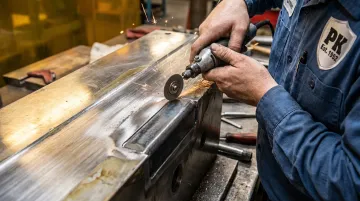
Parkway-Kew applies HVOF, plasma spray, and proprietary fused tungsten carbide coatings for exactly this purpose, without sacrificing surface finish quality. The company's Restore & Grind process targets only the worn drawline area on a wire drawing block, blending the repair into the original coating.
This preserves the surrounding corrosion-resistant surface across five to seven repair cycles before a full recoat is needed.
Reliable corrosion performance depends on matching grade, fabrication practice, and, where needed, supplemental surface engineering to the actual operating environment. The word "stainless" alone doesn't guarantee it.
Frequently Asked Questions
Is 304 or 316 stainless more corrosion resistant?
316 is more corrosion resistant thanks to its added molybdenum content, which greatly improves resistance to chlorides and pitting compared to 304. 304 still works well for milder, non-chloride environments.
Is stainless steel highly corrosion resistant?
Yes, due to its chromium oxide passive layer. But that resistance varies widely by grade and can fail under aggressive chloride exposure, high heat, or poor maintenance.
What determines how corrosion resistant a stainless steel grade is?
Chromium content is the primary driver, since it forms the passive film in the first place. Nickel, molybdenum, and nitrogen further enhance resistance depending on the specific grade family.
Can stainless steel corrosion be reversed or repaired?
Surface rust or staining can often be cleaned off and the passive layer restored through proper passivation. Pitting or intergranular damage, however, is generally permanent and requires mechanical repair or replacement.
Does stainless steel rust in saltwater environments?
Lower grades like 304 can pit in saltwater due to chloride exposure. Higher-alloyed grades like 316 or duplex stainless steel are specifically selected for marine service because they hold up far better.
What is PREN and why does it matter for corrosion resistance?
PREN is a formula-based score using chromium, molybdenum, and nitrogen content to compare and predict a grade's resistance to pitting corrosion. It's a ranking tool, not a guarantee of field performance under every condition.