Many shops struggle to decide when a fixed multi-cutter setup beats a flexible CNC tool-change program. The term also gets tangled with straddle milling and face milling, which only adds to the confusion on the shop floor. This guide breaks down how gang milling actually works, where it earns its keep, and when a different approach makes more sense.
Key Takeaways
- Gang milling stacks multiple cutters on one arbor, cutting several features simultaneously and reducing downtime.
- Best suited for batch production of identical parts with parallel slots, shoulders, or grooves.
- CNC machines with automatic tool changers have reduced, but not eliminated, manual gang setups.
- Success hinges on arbor rigidity, cutter alignment, and matching speeds to the largest cutter.
What Is Gang Milling?
Gang milling uses two or more peripheral milling cutters mounted on one arbor, typically on a horizontal milling machine, to cut multiple surfaces at once. The cutters can be identical or different sizes, according to the ASM Handbook's definition of milling operations.
The goal is straightforward: eliminate the downtime of swapping tools between cuts while producing identical features across every part in a batch. A shop making 200 identical shafts with two shoulders and a keyway slot can cut all three features in a single pass instead of three separate setups.
Gang Milling vs. Straddle Milling
This is where most confusion starts. The two terms describe different levels of complexity:
- Straddle milling: Uses two side-milling cutters positioned only at opposite ends of an arbor to machine two parallel faces, with nothing cutting in between.
- Gang milling: Combines any number of cutters in any arrangement, performing the same operation or entirely different ones (a slot, a flat, an angular groove) all in one pass.
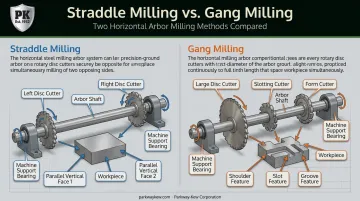
That flexibility is also why gang milling predates CNC by decades.
Before automatic tool changers existed, it was often the only practical way to produce duplicate parts efficiently. Haas Automation notes it has built its own automatic tool changers since 1988, and numeric control coverage in trade press dates back to the mid-1950s. That timeline explains why gang milling became a shop-floor staple long before machining centers could swap tools in seconds.
Why Gang Milling Is Used in Manufacturing
The core driver is simple math: one pass with multiple cutters beats several passes with one cutter and a tool change between each. The U.S. Army's machining manual notes that gang milling saves time specifically because several surfaces get cut in a single setup rather than sequential operations.
Batch and repetitive manufacturing demand three things gang milling delivers directly:
- Dimensional consistency across every part in the run
- Reduced cycle time per unit compared to repeated tool changes
- Lower labor cost when volumes are high enough to justify setup time
Skip gang milling in a high-volume run and problems show up fast:
- Setup time balloons with repeated tool changes
- Spacing and depth start drifting part to part
- Labor cost per unit climbs
None of this is catastrophic on a short run, but it adds up quickly at scale.
Despite these risks, no regulation or industry standard mandates gang milling. Manufacturers adopt it based on part geometry, batch volume, and the equipment already on their floor.
ISCAR documents this in practice with its gang milling application for side bearing caps on automotive cylinder blocks, where tangentially clamped cutters spanning a 100-250 mm diameter range machine multiple caps simultaneously.
Mold and die shops, plus heavy equipment manufacturers, still lean on the same principle for large-batch, cost-sensitive runs.
How Gang Milling Works (Conceptual Flow)
At a high level, machinists stack and space cutters of varying diameter, width, or profile along a single arbor, then drive them together across the workpiece in one continuous pass. Setup requires deciding on workpiece material, selecting the right combination of end mills, side-and-face cutters, or form cutters, and calculating spacer widths and arbor length.
During the cut, each cutter removes material according to its own geometry, but every cutter on that arbor spins at the same shared spindle speed. There's no way around this.
Rong Fu's technical guidance confirms that gang milling cutting speed is capped by the largest-diameter cutter in the stack. Feed rate and lubrication need to suit whichever material and cutter combination is toughest to machine. Get that wrong, and you're either burning up your smallest cutter or under-utilizing your largest one.
The payoff: a workpiece leaves the machine with multiple finished features, slots, shoulders, grooves, completed in one pass instead of three or four separate setups.
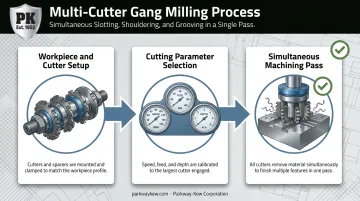
Step 1: Workpiece and Cutter Setup
Operators clamp the workpiece securely on the mill table or fixture, then select cutters and mount them on the arbor with precision spacers to achieve accurate axial and radial alignment before cutting begins.
Step 2: Cutting Parameter Selection
Operators set cutting speed, feed rate, and depth of cut based on the material and the largest or slowest cutter in the stack, which prevents overloading any single tool in the assembly.
Step 3: Simultaneous Machining Pass
The machine advances the workpiece through the entire cutter stack in one continuous pass, and every slot, shoulder, or groove finishes simultaneously as each cutter engages its own profile.
Where Gang Milling Is Applied & Key Factors That Affect It
Gang milling shows up most often in production and batch machining, not one-off prototyping or maintenance work. Common applications include:
- Parallel slot and groove cutting across identical parts
- Stepped shoulders on shafts or housings
- Batch production of automotive, mold/die, or heavy machinery components
By nature, it's a recurring process. Shops set up a gang arbor because they're running the same part configuration repeatedly, not because a single job calls for it once.
Large-diameter industrial components demand the same precision at a much bigger scale. At Parkway-Kew, in-house CNC milling capability extends to 72 inches in diameter, supporting precision fabrication on parts like wire drawing blocks and capstans, either coated or uncoated.
That capacity is separate from the company's large-diameter grinding department, which handles up to 65 inches in diameter and 12 feet in length. The distinction matters: milling and grinding capacity aren't interchangeable, and knowing which applies to which process avoids costly assumptions on large-part jobs.
Key Factors That Affect Gang Milling
Several variables determine whether a gang setup will perform well or fight you the whole way through the cut:
- Workpiece material hardness and machinability: dictates achievable feed and speed
- Arbor rigidity and alignment: misalignment causes vibration or deflection under combined loads
- Cutter spacing, diameter variation, and profile matching: must fit the required feature geometry precisely
- Batch size and throughput requirements: needs to justify the setup time a gang arrangement demands
- Machine tool rigidity and power capacity: has to handle the combined cutting forces of multiple simultaneous cutters
Common Issues, Misconceptions & When Gang Milling May Not Be Appropriate
A few misunderstandings persist even among experienced machinists.
Gang milling and straddle milling are not the same thing. Straddle milling only machines two opposite faces, with nothing cutting between them. Gang milling can include any combination of cutters positioned along the workpiece, running the same operation or several different ones at once.
Groove milling is not a separate mounting technique. It's a specific cutting operation, cutting a channel or slot, that can be one of several features produced within a broader gang setup. Sandvik's guidance on groove and slot milling treats it purely as an operation type, not a setup method.
Gang milling isn't automatically faster. Because cutting speed is capped by the largest or slowest cutter in the stack, a poorly planned combination of cutters can actually slow the whole job down rather than speed it up.
There are also times when gang milling isn't the right call. Skip it when:
- The job is low-volume or one-off, where CNC automatic tool-change flexibility beats a fixed arbor setup
- The machine lacks sufficient rigidity or arbor length for the combined cutting load
- Part geometry varies too much from run to run to justify a dedicated arbor configuration
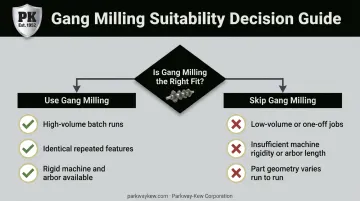
One warning sign worth watching for: if a shop keeps the same fixed arbor setup despite frequent part design changes, that's usually a signal a flexible CNC approach would serve the job better.
Frequently Asked Questions
What is gang milling?
Gang milling mounts two or more cutters on a shared arbor to machine multiple features on a workpiece in a single pass. This approach works best for repetitive batch production where identical features need to be cut across many parts.
What is the difference between straddle milling and gang milling?
Straddle milling uses two cutters positioned at opposite ends of an arbor to machine parallel outer faces, without cutting anything between them. Gang milling can combine any number of cutters performing different operations across the entire workpiece.
What is groove milling?
Groove milling is the operation of cutting a channel or slot into a workpiece. It can be performed as a standalone operation or as one of several individual features produced within a broader gang milling setup.
Is gang milling still relevant with modern CNC machines?
CNC machines with automatic tool changers have reduced reliance on manual gang setups for many jobs. However, gang milling remains cost-effective for large-diameter or high-volume repetitive parts where a fixed multi-cutter arrangement outperforms sequential tool changes.
What is the difference between gang milling and face milling?
Face milling uses a single cutter to machine a flat surface perpendicular to the spindle, while gang milling uses multiple cutters simultaneously to machine several different features on a workpiece at once.
What types of cutters are used in gang milling?
Common choices include side-and-face cutters, slab mills, and form cutters, selected based on the desired feature geometry and the workpiece material. The combination depends on what features need to be produced in a single pass.