Introduction
Turbine components and industrial molds operate in some of the most punishing conditions manufacturing has to offer. Thermal cycling, abrasive wear, corrosion, and constant mechanical stress combine to degrade even hardened surfaces faster than most engineers would like.
When a turbine blade erodes or a mold cavity loses dimensional tolerance, production stops, schedules slip, and replacement costs mount fast. According to GE Vernova, unplanned steam turbine outages add an average of 3.5 extra days of downtime and roughly $150,000 in lost generation and repair costs per event.
That cost burden is exactly what HVOF (High Velocity Oxygen Fuel) coatings are designed to reduce. By depositing low-porosity, high-bond-strength wear-resistant alloys onto component surfaces, HVOF extends service life without distorting or metallurgically altering the base metal.
This guide covers how HVOF works, the alloy systems used for turbines and molds, how the two applications differ, and how to select the right coating for your components.
Key Takeaways
- HVOF produces coatings with porosity below 0.5% and bond strength exceeding 80 MPa — among the densest thermal spray options available
- WC/Co and WC/CoCr dominate room-temperature to moderate-heat wear applications; Cr₃C₂/NiCr is the go-to choice above ~500°C
- MCrAlY alloys are the standard for turbine oxidation resistance and thermal barrier bond coats
- HVOF is a line-of-sight process: deep mold cavities and internal bores under 50mm diameter are out of reach
- Post-coating precision grinding is required on turbine shafts and mold surfaces to restore dimensional tolerances
What Is HVOF Coating and How Does It Work?
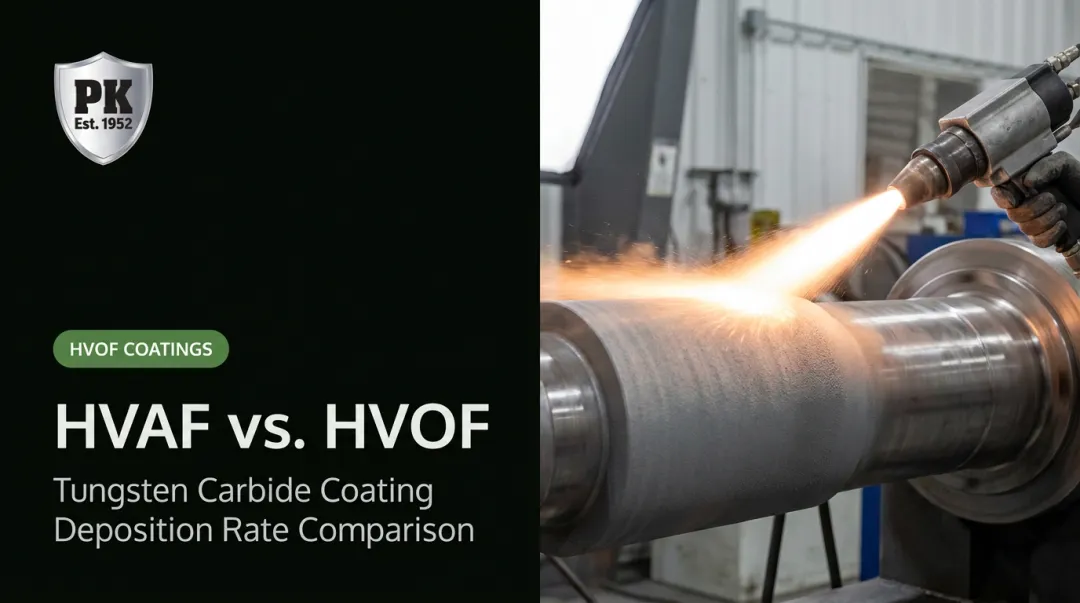
HVOF is a thermal spray process developed in the 1980s. Fuel and oxygen combust in a high-pressure chamber, generating supersonic gas velocities that propel powdered coating material onto a substrate at extremely high kinetic energy. The powder particles arrive partially molten and at high velocity, flattening on impact and interlocking with the prepared surface.
The Mechanical Bonding Mechanism
Unlike electroplating or welded overlays, HVOF forms a mechanical bond — not a metallurgical one. The substrate is grit-blasted to create an anchor profile, and the incoming particles lock into that texture without melting the base metal. This means:
- No heat-affected zone or substrate distortion
- No dilution of the base material chemistry
- Finished components retain their original metallurgical properties underneath the coating
Coating Characteristics
The supersonic deposition produces coatings with measurably superior properties compared to conventional thermal spray methods:
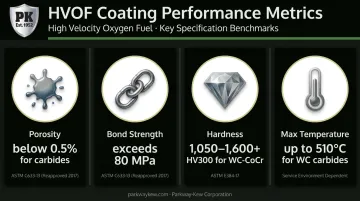
- Porosity: Oerlikon Metco reports HVOF coatings below 0.5% porosity for carbides; ferrous/non-ferrous alloys typically under 2%
- Bond strength: TWI confirms bond strength often exceeds 80 MPa; carbide coatings reach 83+ MPa
- Hardness: WC-CoCr coatings commonly achieve 1,050–1,600+ HV300
- Finish: As-sprayed surfaces can be precision-ground to achieve tight dimensional tolerances
Thickness and Geometry Constraints
Typical HVOF coating thickness runs 0.1–2 mm, though carbide systems can reach up to 5 mm. For precision components like fracking plungers, pump shafts, or wire drawing blocks, staying within a controlled thickness window is critical — the coating must leave enough stock for post-grinding while maintaining dimensional tolerances.
The most important limitation: HVOF is a line-of-sight process. The spray gun requires a standoff distance of approximately 150–300 mm, spray angles below 30° are not feasible, and internal bores under 50 mm in diameter cannot be coated. Any component evaluation must screen for these geometric constraints upfront.
Metal Alloys Used in HVOF Coatings for Industrial Applications
Alloy selection drives coating performance more than any other variable. The right choice depends on operating temperature, primary wear mechanism, and corrosion exposure.
Tungsten Carbide Alloys (WC/Co and WC/CoCr)
WC-based carbides are the workhorses of HVOF wear protection. WC-10Co-4Cr, one of the most widely specified grades, delivers:
- Hardness of 1,050–1,600+ HV300
- Porosity under 0.3–0.8%
- Bond strength over 80 MPa
- Maximum working temperature around 510°C
These coatings excel on compressor components, seal areas, pump plungers, and mold surfaces where service temperatures stay below the carbide oxidation threshold. Above ~500°C, a different alloy is needed.
Chromium Carbide / Nickel-Chrome (Cr₃C₂/NiCr)
When service temperatures climb, Cr₃C₂/NiCr steps in. Research documents its use for erosive and corrosive wear at temperatures up to 870°C, with oxidation resistance across the 650–1200°C range. It also maintains low friction from 25°C to 850°C — making it the preferred choice for hot gas erosion on turbine blades and compressor sections exposed to elevated temperatures.
MCrAlY Alloys
MCrAlY (where M = Ni, Co, or NiCo) are oxidation and thermal cycling protection systems, not wear coatings. The aluminum content forms a protective Al₂O₃ scale; yttrium stabilizes that scale through thermal cycles. A typical NiCoCrAlY composition runs approximately 22% Co, 17% Cr, 12.5% Al, 0.6% Y, balance Ni.
These alloys serve two roles in turbine systems:
- Bond coats beneath ceramic thermal barrier topcoats (typically yttria-stabilized zirconia applied by plasma spray)
- Standalone oxidation-resistant coatings on blades and vanes in high-temperature sections
Nickel-Based Alloys (Inconel 625, 718)
Inconel-class alloys handle environments combining heat, chemical exposure, and mechanical stress. HVOF Alloy 625 coatings have demonstrated significantly better seawater corrosion resistance than stainless steel or titanium spray coatings in TWI testing. Alloy 718 coatings are used for turbine shaft restoration and structural component dimensional build-up.
Cobalt-Based Alloys (Stellite-Type)
Stellite alloys offer a combination of wear resistance, corrosion resistance, and elevated-temperature stability. HVOF-sprayed Stellite 6 retains hardness up to approximately 500°C and has shown reduced sliding wear at high temperatures due to the formation of a protective debris glaze. These are candidate coatings for surfaces experiencing both abrasion and thermal exposure.
HVOF Coatings for Turbine Components
Turbine components face thermal cycling between ambient and extreme service temperatures, hot gas erosion, oxidation, and constant rotational fatigue. Uncoated or degraded surfaces lose material through multiple simultaneous mechanisms — erosion thins blade profiles, oxidation penetrates grain boundaries, and fretting wears seal contact zones. Uncoated or degraded surfaces lose material through multiple simultaneous mechanisms: erosion thins blade profiles, oxidation penetrates grain boundaries, and fretting wears seal contact zones. Each failure mode targets a different component — which is why alloy selection starts with understanding where and how parts actually degrade.
Components That Benefit Most
| Component | Primary Failure Mode |
|---|---|
| Compressor blades | Erosion from particle-laden air streams |
| Turbine blades/vanes | Hot gas corrosion, oxidation, thermal fatigue |
| Rotor shafts | Fretting wear, dimensional loss at bearing journals |
| Shroud segments | Abrasion at blade tip clearance zones |
| Seal areas | Fretting, oxidation at contact surfaces |
Alloy Selection for Turbine Applications
- Compressor blades and shafts: WC-CoCr for erosion resistance where temperatures stay below ~500°C
- Hot-section blades and vanes: Cr₃C₂/NiCr for high-temperature erosion; MCrAlY as bond coats under ceramic TBC topcoats
- Shaft restoration and dimensional build-up: Inconel 625 or 718 to restore journal diameters without altering the base alloy
Matching the alloy to the operating zone directly determines whether a coating holds up through thousands of thermal cycles or fails prematurely — which brings restoration into focus as both a coating challenge and an economic one.
Repair and Refurbishment
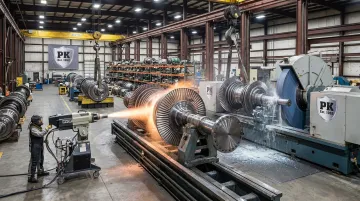
Component restoration is one of HVOF's most practical turbine applications. Worn or dimensionally undersized shafts and seal surfaces can be HVOF-coated and precision-ground back to original tolerances — avoiding costly full replacements. Parkway-Kew Corporation has offered this restoration workflow since introducing HVOF in 1989. Their in-house large-diameter grinding department handles components up to 65 inches in diameter and 12 feet in length, making post-coating dimensional restoration feasible for substantial rotating equipment.
Quality Requirements
Turbine coating specifications demand documented verification at every stage. Porosity targets, bond strength minimums, and hardness values must be measured and recorded — not approximated. Automated HVOF equipment with controlled spray parameters produces more consistent results than manual spray guns, particularly for rotationally symmetric components that require uniform coating thickness around the circumference.
HVOF Coatings for Molds and Tooling
Injection molds, die casting dies, and forming tooling wear through a combination of mechanisms: abrasive contact with filled resins or molten metals, thermal cycling during fill and release cycles, and chemical attack from process materials. Research confirms that surface deterioration from wear drastically reduces injected-part quality — dimensional loss in a mold cavity translates directly to out-of-spec parts.
Best Alloys for Mold Applications
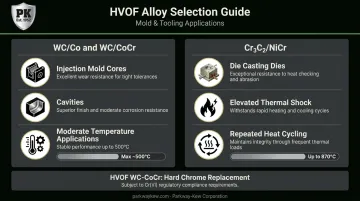
- WC/Co and WC/CoCr are the first choice for injection mold cores and cavities where abrasion dominates and service temperatures stay moderate
- Cr₃C₂/NiCr suits die casting dies at elevated temperatures, since aluminum die casting involves repeated thermal shock that exceeds WC carbide limits
- HVOF WC-CoCr coatings are displacing hard chrome in many mold applications — they outperform chrome in wear testing, and OSHA's Cr(VI) PEL of 5 µg/m³ (8-hour TWA) creates sustained compliance pressure on chrome plating operations
Alloy selection is only part of the decision — the geometry of mold tooling also determines whether HVOF is feasible at all.
Practical Constraints
Mold tooling presents the most challenging geometry for HVOF. Key screening criteria:
- Deep cavities, blind pockets, and undercuts block line-of-sight access and cannot be coated
- Internal bores under 50 mm diameter are not feasible for HVOF application
- Spray angles below 30° are not achievable with standard HVOF guns
Post-coating finishing is required for every mold surface. The as-sprayed HVOF finish is too rough for part release and too imprecise for cavity tolerances — precision grinding and polishing bring the surface to specification.
HVOF vs. Other Coating Methods
HVOF vs. Hard Chrome Plating
Hard chrome has historically been the default wear surface for precision components. HVOF carbide coatings offer a technically superior alternative:
- Higher hardness (WC-CoCr commonly reaches 1,000–1,400 HV vs. chrome's lower range)
- Lower porosity, meaning better corrosion barrier properties
- No hexavalent chromium process exposure
Industry research confirms that thermal spray — primarily HVOF — is the most commonly used technology for replacing hard chrome plating, driven by chromic acid and Cr(VI) regulatory concerns from both OSHA and the EPA.
HVOF vs. Plasma Spray
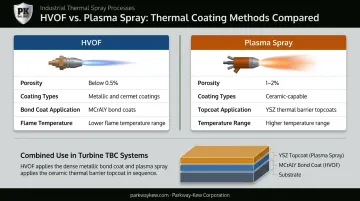
Plasma spray and HVOF serve different roles, and in many turbine applications they work together rather than compete. Plasma spray reaches temperatures capable of depositing ceramics that HVOF cannot handle — yttria-stabilized zirconia thermal barrier topcoats, for example, require plasma spray.
For metallic and cermet coatings, HVOF produces denser results: Oerlikon data shows HVOF porosity below 0.5% versus approximately 1–2% for typical plasma spray. In turbine systems, both processes are often used in sequence: MCrAlY bond coat by HVOF, ceramic TBC by plasma spray.
HVOF vs. Hardfacing/Weld Overlay
Weld overlay creates a metallurgical bond and handles heavy impact loads that would shear a thermal spray coating. For structural, impact-dominated applications, hardfacing wins.
For finished precision components, HVOF is the better choice. Key reasons:
- Dimensional control: Coating deposits are thin and predictable, preserving final dimensions
- No heat-affected zone: Substrate metallurgy stays intact, unlike weld overlay processes
- Heat-sensitive substrates: Components already near final size can be coated without distortion risk
Selecting the Right HVOF Coating
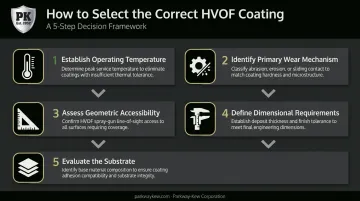
A structured selection process prevents costly mismatches between coating and application.
Step 1 — Establish the operating temperature: This is the single most important variable. WC-Co/WC-CoCr for services below ~500°C. Cr₃C₂/NiCr for elevated-temperature wear and corrosion up to 870°C. MCrAlY for turbine oxidation environments.
Step 2 — Identify the primary wear mechanism:
- Abrasion → WC-based carbides
- Hot gas erosion → Cr₃C₂/NiCr
- Oxidation/thermal cycling → MCrAlY
- Corrosion + mechanical stress → Inconel variants
Step 3 — Assess geometric accessibility: Screen the component for internal features, deep cavities, and tight angles before committing to HVOF. Surfaces with spray angles below 30° or bores under 50 mm diameter need an alternative approach.
Step 4 — Define dimensional requirements: Determine whether the goal is dimensional restoration (coating over worn material, then grinding to spec) or protective overlay on a new surface. The coating thickness and post-grinding allowance must be planned before application.
Step 5 — Evaluate the substrate: Surface preparation must precede alloy selection. Certain substrates require bond coats or specialized preparation. Providers who evaluate the full system — substrate, environment, coating material, and finishing process as a unit — catch specification gaps before they become field failures.
Parkway-Kew Corporation has applied HVOF coatings since 1989 and handles the complete restoration sequence in-house: coating application, CNC turning, and precision grinding up to 65 inches in diameter. That combination makes it straightforward to specify, apply, and finish a coating to exact dimensional tolerances without involving multiple vendors.
Frequently Asked Questions
What is the purpose of HVOF coating?
HVOF coatings extend the service life of industrial components by providing highly dense, strongly bonded wear-resistant, corrosion-resistant, or thermally protective surfaces. The process deposits coating without melting the base metal, preserving substrate geometry and metallurgical properties.
How thick is the coating on HVOF?
The general HVOF thickness range is 0.1–2 mm, though carbide systems can reach up to 5 mm. Typical WC-CoCr precision coatings are applied at 0.2–0.3 mm. The right thickness depends on dimensional restoration requirements, expected wear rate, and post-grinding allowance.
What is the difference between HVOF and HVAF?
HVAF (High Velocity Air Fuel) uses compressed air instead of oxygen, producing a flame temperature roughly 1,000°C lower — which reduces carbide oxidation and decarburization in temperature-sensitive alloys. HVOF remains more versatile across the full range of coating material types.
What alloys are most commonly used for turbine blade HVOF coatings?
The most common choices are Cr₃C₂/NiCr for high-temperature erosion resistance, MCrAlY alloys for oxidation resistance and TBC bond coats, and nickel-based superalloys like Inconel 625 and 718 for shaft and structural restoration.
Can HVOF coatings be applied to mold surfaces?
Yes. WC/Co and Cr₃C₂/NiCr work well on mold cores, cavities, and die casting dies, though deep cavities, blind features, and bores under 50 mm diameter are inaccessible due to the line-of-sight spray requirement. Post-coating grinding and polishing are required to achieve mold-quality surface finishes.
How does HVOF compare to hard chrome plating for wear-resistant applications?
HVOF carbide coatings typically outperform hard chrome in both hardness and wear life. They also eliminate hexavalent chromium process exposure, which is regulated by both OSHA (PEL of 5 µg/m³) and the EPA under the Chromium NESHAP. For most industrial wear applications, HVOF is now the preferred alternative.