Introduction
Picture a bronze wire drawing capstan bolted directly to a carbon steel frame in a mill washdown area. Within months, pitting shows up around every fastener, even though both metals are rated for industrial duty. That's galvanic corrosion at work.
Galvanic corrosion happens when two dissimilar metals touch in the presence of a conductive liquid, causing one metal to corrode faster than it would on its own. Left unchecked, it drives up part replacement costs and forces unplanned downtime; in structural applications, it creates real safety risks.
This guide breaks down the three conditions that cause galvanic corrosion, the warning signs to watch for, and the prevention strategies that work in the field. You'll see these tactics in action across wire mills, oil and gas operations, and heavy equipment fleets.
Key Takeaways
- Galvanic corrosion requires three factors: dissimilar metals, an electrolyte, and an electrical path
- A small anode paired with a large cathode, like a scratched coating, accelerates damage fast
- Ignoring it leads to accelerated part failure, downtime, and safety hazards
- Prevention combines material selection, insulation, coatings, and cathodic protection
- Routine inspection and documentation keep small problems from becoming full replacements
Common Causes of Galvanic Corrosion
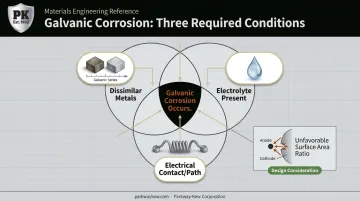
Galvanic corrosion (also called bimetallic or dissimilar-metal corrosion) doesn't happen randomly. It requires three specific conditions to occur simultaneously. Remove any one of them, and the reaction stops. Here's what typically brings all three together on industrial equipment.
Two Electrochemically Dissimilar Metals in Contact
The first condition is straightforward: every metal occupies a position on the galvanic series, a ranking of electrochemical potential in a given electrolyte. Metals far apart on that scale, like magnesium and gold, create a much stronger corrosive reaction than metals sitting close together.
A common example: aluminum fittings bolted against stainless steel, or bronze fittings against carbon steel piping. These pairings show up constantly in wire mills, marine equipment, and process piping, and the wider the gap on the series, the faster the anodic metal disappears.
| Relative Position (Seawater) | Metal Family |
|---|---|
| Most active (anodic) | Magnesium |
| Active | Aluminum alloys |
| Intermediate | Carbon/mild steel |
| More noble | Bronze |
| Near passive/noble | Stainless steel (passive) |
| Most noble (cathodic) | Gold |
According to the AMPP technical chapter on galvanic corrosion, this ranking is electrolyte-specific. A seawater chart doesn't automatically apply to process water or humid atmospheres, so the actual alloy condition matters as much as its position on the chart.
Presence of an Electrolyte
The second requirement is an electrolyte: any conductive liquid that lets ions move between the two metals. Seawater is the obvious example, but rainwater, condensation, process fluids, and even contaminated lubricants complete the circuit just as effectively.
Some environments make this almost unavoidable:
- Coastal and marine facilities with constant salt exposure
- Outdoor equipment exposed to rain and humidity swings
- Wire mill washdown areas where water and process fluids pool near joints
- Processing plants with high ambient humidity or condensation
Electrical Contact Combined with an Unfavorable Surface Area Ratio
The third condition ties the first two together: metals need direct contact, or another conductive connection, for ions to migrate between them. But the size of that contact area matters just as much as its existence.
A small anode paired with a large cathode concentrates the corrosive current into a tiny spot, accelerating damage far beyond what you'd expect. A scratched or worn coating that exposes a small patch of base metal next to a large, intact protected surface is a textbook setup for severe localized pitting. Most of the part can still look fine even as that one exposed spot corrodes rapidly.
What Happens If Galvanic Corrosion Is Ignored
Skip the early intervention, and galvanic corrosion doesn't stay small. It accelerates part failure, forces unplanned equipment downtime, weakens structural connections, and in bolted or load-bearing applications, introduces genuine safety hazards.
The Statue of Liberty offers a well-documented case. Its copper skin was originally separated from the iron support armature by a shellac coating.
Once that coating deteriorated, moisture and salt reached both metals, and the galvanic cell it created steadily corroded the iron framework. According to NIST's account of the statue's restoration, engineers ultimately replaced the corroded iron armature with stainless steel and restored proper isolation between the metals during the 1980s restoration.
Industrial equipment follows the same pattern on a smaller timeline. A capstan or fitting that looks fine on a Monday inspection can develop severe pitting within weeks if the right combination of metal contact and moisture is present.
Warning Signs You're About to Experience Galvanic Corrosion
Catching these early prevents a minor repair from turning into a full part replacement:
- Localized discoloration or pitting concentrated at metal-to-metal joints or fastener points, rather than spread evenly across the surface
- Uneven wear where one metal thins rapidly while an adjoining dissimilar metal part stays largely unaffected
- Recurring leaks or loosening at threaded or bolted connections between different metal types, often a sign the joint has been corroding from the inside
How to Prevent Galvanic Corrosion
Every prevention strategy works by interrupting one of the three required conditions: dissimilar metals, electrolyte contact, or the electrical path between them. Most facilities need a combination of these measures, not just one.
Select Metals with Similar Electrochemical Potential
The simplest fix happens before equipment is even built. Choosing metals close together on the galvanic series, or standardizing on a single metal type, minimizes the potential difference that drives current flow.
This is a design and procurement decision, best made when specifying new equipment rather than after it's already in service.
Electrically Insulate Dissimilar Metals
When dissimilar metals must be used together, breaking the electrical path physically stops the reaction. Non-conductive spacers, gaskets, plastic sleeves, and dielectric unions are the standard tools here.
Common application points include:
- Pipe joints and dielectric flange assemblies
- Fastener connections between structural members
- Structural interfaces where different alloys meet
Isolation only works if it's complete. A single conductive bolt or a wet, degraded gasket can restore the circuit and undo the whole effort.
Apply Protective Coatings and Barrier Layers
Coatings work by keeping the electrolyte away from the metal surface. The critical detail: coat the more noble, cathodic metal, not just the anodic one.
Coating only the anode leaves any defect, a pinhole or scratch, exposing a small active area next to a large cathode. That's the unfavorable area ratio that accelerates pitting.
This is where specialized industrial coatings earn their keep. HVOF, thermal spray, and plasma spray coatings hold up on wear-prone components like wire drawing blocks, capstans, and heavy equipment parts exposed to constant moisture and mechanical stress.
Parkway-Kew has applied HVOF tungsten carbide coatings to wire drawing blocks since 1989. Its nickel chrome alloy coatings are formulated specifically to address corrosion resistance on copper and aluminum wire drawing equipment, not just wear resistance.
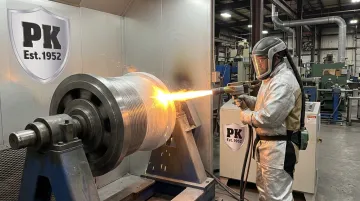
Whatever coating you choose, inspect it regularly. Even a small defect can worsen localized corrosion faster than an uncoated surface would corrode on its own.
Use Cathodic Protection with Sacrificial Anodes
Cathodic protection installs a more anodic metal, typically zinc, magnesium, or aluminum, so it corrodes preferentially and protects the structure it's attached to. Common applications include water heaters, buried pipelines, ship hulls, and offshore marine structures.
Sacrificial anodes need electrical continuity and periodic replacement once consumed. They work best alongside coatings: the coating reduces overall current demand, and the anode protects whatever gets exposed at a coating defect.
Tips for Long-Term Prevention and Control
One-time fixes only go so far. Long-term control depends on ongoing habits:
- Schedule routine inspections at known dissimilar-metal junctions, especially in humid or marine-adjacent facilities
- Train maintenance staff to recognize early warning signs and follow material-compatibility guidelines during repairs
- Document metal combinations and coating specs for each critical asset to track wear patterns over time
- Recoat or refurbish worn protective layers before full failure, rather than waiting for a breakdown
That last point matters more than it sounds. Parkway-Kew's Restore & Grind process, for example, targets just the worn drawline area on a wire drawing block instead of stripping the entire coating down.
Because the original coating is applied thicker than standard industry practice, a block can go through 5 to 7 of these targeted repairs before it ever needs a full recoat. This approach keeps corrosion-prone bare spots from forming in the first place.
Conclusion
Galvanic corrosion isn't mysterious once you understand the three conditions behind it: dissimilar metals, an electrolyte, and an electrical path. Every prevention strategy, from material selection to insulation to coatings, works by interrupting one of those links.
Get ahead of it with smart material choices and quality protective coatings like Parkway-Kew's HVOF and thermal spray systems, and you'll spend far less time and money replacing parts that should have lasted years longer.
Frequently Asked Questions
What is galvanic corrosion?
Galvanic corrosion is an electrochemical process where one metal corrodes faster than normal when it's in contact with a dissimilar metal, provided a conductive electrolyte is present. The less noble metal becomes the anode and wears away preferentially.
Which metals should not be used together to avoid galvanic corrosion?
Metal pairs far apart on the galvanic series carry the highest risk, such as aluminum with stainless steel or zinc with copper. These combinations should be avoided or electrically insulated from each other.
When should I worry about galvanic corrosion?
Risk rises whenever dissimilar metals sit in direct contact and get exposed to moisture, humidity, or conductive process fluids. Outdoor equipment and marine or industrial settings see this most often.
How do you fix galvanic corrosion?
Isolate or replace the affected metals, apply protective coatings or dielectric insulation at the joint, and recoat components with severe pitting using wear-resistant materials like HVOF or plasma spray, Parkway-Kew's specialty, rather than replacing them outright.
What's the difference between galvanic corrosion and regular (uniform) corrosion?
Uniform corrosion affects a single metal at roughly the same rate across its entire surface. Galvanic corrosion is localized and accelerated, concentrated specifically where dissimilar metals make contact.
Does galvanic corrosion require water or moisture to occur?
Yes. An electrolyte, often water-based, such as rain, condensation, or process fluid, is essential for the reaction. Without it, no galvanic circuit can form, regardless of which metals are in contact.