According to an ABB survey, unplanned industrial downtime costs businesses an average of $125,000 per hour. For high-cycle operations running continuous production, that number compounds fast.
Tungsten carbide coating addresses this directly. It has been a proven industrial tool for decades — not just in aerospace labs, but on wire mill floors, fracking pump components, and shipping terminal equipment where part performance determines throughput. This article covers what tungsten carbide coating actually is, the properties behind its performance, the operational benefits it delivers, and where it makes the biggest difference.
Key Takeaways
- HVOF-applied tungsten carbide coatings achieve porosity under 1% and bond strength exceeding 70 MPa
- WC-Co-Cr coatings produce 4–5x lower abrasive wear volume loss than hard chrome plating (ASTM G65)
- Extends component service life in wire drawing, oil & gas, and heavy industrial equipment
- Eliminates hexavalent chromium, reducing environmental and regulatory exposure
- Restoring worn parts with WC coating reduces costs compared to full part replacement
What Is Tungsten Carbide Coating?
Tungsten carbide (WC) is a chemical compound of tungsten and carbon atoms. As a bulk material, it ranks just below diamond in hardness among common industrial materials. As a coating, it transforms a standard metal substrate into a surface capable of withstanding severe abrasion, impact, and chemical attack.
How It's Applied
The dominant application method is High Velocity Oxygen Fuel (HVOF) thermal spray. In this process, WC-based powder is accelerated through a combustion gas stream — with particle velocities around 700 m/s and flame velocities reaching approximately 2,000 m/s — and deposited onto the substrate at near-supersonic speeds. The result is a dense, mechanically bonded coating layer rather than a melted or cast surface.
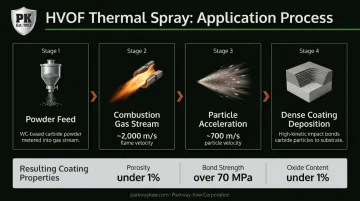
Key HVOF coating characteristics:
- Porosity: Under 1%
- Bond strength: Over 70 MPa (WC-CoCr systems)
- Oxide content: Under 1%
HVOF isn't the only option. Plasma spray delivers higher thermal energy and suits ceramic coatings, while sub-arc welding offers a cost-effective hardsurfacing path for high-volume applications like wire drawing blocks. The right process depends on the component geometry, operating environment, and required performance specifications.
What It Actually Does
Tungsten carbide coating is a functional engineering decision. It extends the service life of high-value components, restores worn parts to precise dimensional tolerances, and breaks the costly replacement cycle that stalls production. In operations where a single failed component means unplanned downtime, that difference shows up directly on the maintenance budget.
Key Properties That Make Tungsten Carbide Coating Exceptional
Hardness and Wear Resistance
HVOF WC-CrC-Ni coatings reach 1,000–1,450 HV0.3 in Vickers hardness. Hard chrome plating, by comparison, ranges from 940–1,210 HV. Hardened tool steel (AISI O1) comes in around 517 HV.
The practical gap shows up in wear testing. TWI's research found that HVOF WC-Co-Cr coatings produced 4–5x lower abrasive wear volume loss than hard chrome plating under ASTM G65 testing conditions. In practical terms, that gap means significantly longer intervals between component replacements — not incremental gains.
Components coated with tungsten carbide maintain dimensional tolerances far longer under continuous friction and impact. For precision applications like wire drawing, where surface geometry directly affects product quality, this matters beyond just service life.
Corrosion and Chemical Resistance
WC coatings provide a dense, low-porosity barrier against moisture, brine, acidic fluids, and oxidizing agents. TWI's salt spray testing showed HVOF WC-Co-Cr coatings at least matched hard chrome over 240 hours of exposure.
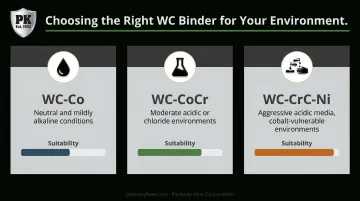
One important detail: binder chemistry controls corrosion performance. The right formulation depends on the service environment:
- WC-Co — suited for neutral and mildly alkaline conditions
- WC-CoCr — better performance in moderate acidic or chloride-exposed environments
- WC-CrC-Ni — preferred for aggressive acidic media where cobalt binders are vulnerable to attack
Low Porosity and Bond Strength
HVOF-applied WC-CoCr coatings achieve porosity under 1% with oxide content equally low. Porous coatings give corrosive agents and wear particles direct access to the substrate — low porosity eliminates that path. High bond strength — over 70 MPa for HVOF WC-CoCr — means the coating stays mechanically anchored under cyclic loading, vibration, and impact rather than delaminating.
Thermal Stability
WC-Co HVOF coatings perform reliably from room temperature up to approximately 600°C. Above that threshold, oxidation accelerates rapidly and coating integrity degrades. For higher-temperature environments, WC-CrC-Ni formulations extend the usable range to around 750°C.
Pump components, wire drawing equipment, and fracking plungers all fall comfortably within the 600°C range. Applications in hot gas paths or combustion-adjacent zones require careful formulation selection to stay within the coating's stable operating window.
Dimensional Stability and Surface Finish
Beyond thermal performance, dimensional precision matters just as much in service. WC coatings can be precision-ground after application to extremely tight tolerances — critical for components like wire drawing blocks and capstans, where surface geometry directly determines wire quality. A rough or dimensionally inconsistent coating creates uneven friction that transfers to the wire surface as defects, affecting the finished product regardless of how well the coating holds up mechanically.
Core Benefits of Tungsten Carbide Coating for Industrial Operations
The benefits below reflect operational and financial outcomes — fewer shutdowns, lower maintenance spend, better output quality rather than abstract material science claims.
Extended Component Life Through Superior Wear Resistance
Components coated with tungsten carbide consistently outlast uncoated and chrome-plated equivalents in abrasive, erosive, and high-impact service. The HVOF process bonds WC particles at near-supersonic velocities to build a coating that resists material loss even across sustained high-cycle operation.
The DTIC validation of HVOF WC/Co and WC/CoCr coatings as hard chrome replacements on aircraft landing gear provides a strong third-party benchmark. In aerospace, where component specifications are rigorously tested, HVOF tungsten carbide earned qualified status for some of the most demanding wear-surface applications in service.
For wire drawing specifically, Parkway-Kew Corporation has been applying HVOF tungsten carbide coatings to wire drawing blocks since 1989 , the first company to introduce this process in the wire industry. Their proprietary formulations (PK-675, PK-700, and PK-750) offer progressively increasing tungsten carbide content within a nickel chrome boron matrix, allowing operators to match coating hardness to specific wire type and drawing conditions.
KPIs impacted: component replacement frequency, mean time between maintenance events, production uptime.
Reduced Downtime and Total Cost of Ownership
WC coating costs more upfront than conventional treatments. Over time, that equation reverses: fewer replacements, longer service intervals, and reduced emergency labor accumulate into measurable savings. A DOE/PNNL maintenance study found that preventive maintenance programs save 12–18% compared to reactive approaches, and WC coating is a direct enabler of that shift from reactive to planned maintenance cycles.
For high-cycle operations, three cost drivers compound quickly:
- Unplanned downtime: $125,000/hour average across industrial operations
- Reactive procurement: Emergency parts orders carry cost premiums and lead time delays
- Repeated labor: Each replacement cycle requires skilled maintenance hours
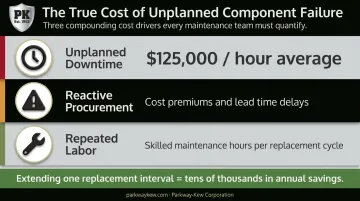
Extending part life by even one replacement interval (going from three changeouts per year to two, for example) compounds into significant savings across a production year. For operations running 24/7, that single interval reduction can represent tens of thousands of dollars in avoided labor and procurement costs annually.
KPIs impacted: maintenance labor cost, unplanned downtime frequency, total cost per operating hour.
Corrosion Resistance in Demanding Environments
AMPP data estimates annual corrosion costs in oil and gas production at $1.372 billion. The NACE IMPACT study puts global corrosion costs at $2.5 trillion annually — with 15–35% of that potentially preventable through corrosion-control practices.
In oil & gas, mining, and marine-adjacent operations, components face brine, acids, high-pressure fluids, and oxidizing agents that destroy conventional coatings quickly. WC coatings provide a dense chemical barrier that maintains part integrity in these conditions well beyond what chrome plating or unprotected metal can sustain.
There is a secondary advantage: tungsten carbide coating eliminates the need for hexavalent chromium. OSHA identifies Cr(VI) as a regulated occupational health hazard. The EPA's NESHAP regulations limit chromium compound emissions from electroplating operations. Switching to WC coating removes this compliance exposure while delivering equal or better performance , making it a straightforward compliance and performance upgrade in one.
KPIs impacted: corrosion failure rate, compliance risk, fluid seal integrity, safety incident rate.
Industries and Applications of Tungsten Carbide Coating
Wire Manufacturing
Wire drawing blocks and capstans absorb continuous friction as wire is drawn across their surfaces at high speed. Worn blocks lose dimensional precision, and that imprecision transfers directly to the wire — creating surface defects that increase rejection rates.
WC-coated blocks maintain the surface geometry required for consistent wire quality while lasting substantially longer than uncoated or conventionally surfaced blocks. Parkway-Kew, a member of Wire Association International (WAI), has driven innovation in this application since the 1950s. Their Restore & Grind process allows worn blocks to be repaired by filling only the worn drawline area — rather than grinding the entire surface — and enables 5–7 repair cycles before a full recoat is needed.
Oil and Gas
Fracking plungers, valve stems, and pump components operate under extreme pressure in chemically aggressive, abrasive slurry environments. HVOF WC coatings protect these components against simultaneous wear and corrosion.
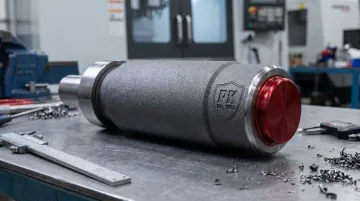
Parkway-Kew's PK-730 proprietary fused tungsten carbide coating is specifically engineered for fracking plungers in the harshest operating conditions. Key performance specs for PK-730 applications:
- Corrects alignment deviations of up to 0.015 inches — a common problem with standard centerless grinding
- Eliminates vibration and uneven operation caused by concentricity errors
- Engineered for simultaneous resistance to abrasive wear and chemical corrosion
Aerospace, Power Generation, and Heavy Industry
WC coating adoption has expanded well beyond wire drawing and oil and gas. The U.S. thermal spray coatings market was valued at $2.5 billion in 2023 and is projected to grow at a 4.9% CAGR through 2030, reflecting growing demand across sectors where wear resistance is non-negotiable.
Current applications span multiple industries:
- DTIC-validated HVOF WC/Co and WC/CoCr coatings replace hard chrome on aircraft landing gear and hydraulic actuators
- Thermally sprayed WC-Co coatings protect turbine and generator components in electric power generation facilities
- Wire rope pulleys, crane wheels, pump housings, and tooling surfaces across heavy manufacturing benefit from WC coating wherever wear determines throughput
How to Get the Most Value from Tungsten Carbide Coating
Match the Coating Process and Formulation to the Application
Not all WC coatings perform the same way in all environments. Key specification decisions include:
- Choose HVOF for maximum coating density and bond strength; plasma spray for ceramic applications; sub-arc welding for cost-effective hardsurfacing
- Use cobalt or nickel binders for standard wear applications; switch to Cr-containing binders in acidic or corrosive environments
- Keep WC-Co below 600°C service temperatures; use WC-CrC-Ni for applications approaching 750°C
- For wire drawing: specify higher WC content formulations (PK-750) for maximum wear resistance; use lower-content options for copper and aluminum wire where surface finish matters more
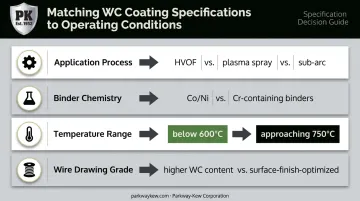
The right combination depends entirely on operating conditions. An operator running small plated wire in a high-speed, high-slip environment has fundamentally different requirements than a fracking operation pushing abrasive slurry at pressure. The coating specification should reflect that gap.
Invest in Precision Finishing Post-Coating
A WC coating is only as good as its final surface condition. Coating application is step one; precision grinding to dimensional tolerance is what makes it functional.
Rough or out-of-tolerance surfaces create uneven contact, friction hot spots, and accelerated wear, negating much of the performance benefit. Confirming your coating provider has in-house grinding capability matched to your component size is worth doing before committing.
For large wire drawing blocks, that means access to large-diameter grinding. Parkway-Kew's equipment handles components up to 65 inches diameter by 12 feet length, which covers most industrial block sizes in service.
Evaluate Restoration Before Replacement
For high-value components with structural integrity remaining, full replacement is often not necessary. Tungsten carbide coating can rebuild worn surfaces to original or improved specifications at a fraction of new-part cost.
Parkway-Kew's Restore & Grind process for wire drawing blocks illustrates this well. Rather than replacing a worn block or grinding the entire surface down to the deepest groove, the worn drawline area is filled with WC material and precision-ground flush with the existing coating. The block returns to operational condition without sacrificing functional material from the surrounding surface.
For structurally sound components, restoration should be the first option evaluated — not a fallback after replacement costs have already been quoted.
Frequently Asked Questions
How do you apply tungsten carbide coating?
Tungsten carbide is most commonly applied via HVOF thermal spray — WC-based powder is accelerated through a combustion gas stream at high velocity and deposited onto the substrate to form a dense, low-porosity layer. Other methods include plasma spray and sub-arc welding, with the right method depending on component geometry, operating environment, and coating requirements.
Is tungsten carbide coating rust and waterproof?
WC coatings resist moisture and most industrial chemicals effectively. The metallic binder (cobalt or nickel) can degrade in aggressive acidic or chloride-heavy environments, so binder selection is critical for corrosive service conditions.
What is tungsten carbide mostly used for?
Tungsten carbide is most widely used to protect high-wear industrial components — cutting tools, drill bits, pump plungers, wire drawing blocks, valve stems, and industrial wear surfaces — where hardness, dimensional stability, and wear resistance determine how long a component stays in service.
How does tungsten carbide coating compare to hard chrome plating?
WC coating produces 4–5x lower abrasive wear volume loss than hard chrome under ASTM G65 testing, with superior bond strength and porosity. It also eliminates hexavalent chromium, removing OSHA and EPA compliance exposure. That combination of performance and regulatory compliance is why aerospace, oil & gas, and precision industrial operators have shifted to WC as their standard.
Can tungsten carbide coating be applied to worn or damaged parts?
Yes. WC coating can restore worn components back to original or improved specifications — it is not limited to new parts. Experienced providers can rebuild worn surfaces with WC material and precision-grind them to required tolerances, making restoration a cost-effective path that typically costs a fraction of new-part replacement.
How long does a tungsten carbide coating last?
Service life depends on application, coating thickness, and operating conditions, but WC-coated components routinely last 2–5x longer than uncoated or chrome-plated equivalents. In wire drawing and oil & gas applications, that translates directly to fewer replacement cycles and lower maintenance costs.