The numbers back this up. AMPP (formerly NACE) puts the global annual cost of corrosion at more than $2.5 trillion, roughly 3.4% of world GDP. Between 15% and 35% of that cost is considered preventable using corrosion-control practices that already exist today.
Coatings and inhibitors get plenty of attention, but the two most powerful long-term defenses are upfront material selection and corrosion-conscious design. This guide breaks down which materials fail fastest, which hold up best, the design details that make or break service life, and how engineered coatings, including the ones Parkway-Kew has built its business on since 1952, extend the life of critical industrial components.
Key Takeaways
- Smart material choice and design prevent most corrosion before repairs are needed
- Untreated carbon steel and cast iron corrode fastest; titanium and nickel alloys resist longest
- Drainage, crevice design, and metal isolation matter as much as material choice
- Engineered coatings deliver corrosion and wear resistance at a fraction of alloy cost
Why Materials Selection Is the Foundation of Corrosion Control
Corrosion is an electrochemical reaction: metal reacting with its environment and gradually converting back to a more stable, oxidized state. Far from a cosmetic issue, it's progressive metal loss that eats away at wall thickness, load-bearing capacity, and dimensional tolerance until a part fails.
That failure mode is more common than most facility managers assume. A PHMSA review of significant pipeline incidents found that corrosion caused roughly 23% of failures across hazardous-liquid and gas-transmission systems. Nearly one in four pipeline failures traces back to a material or protection decision made years earlier.
Here's the uncomfortable part: no single material resists every corrosive environment. A grade that shrugs off sulfuric acid can pit within months in a chloride-rich brine.
A coating that handles abrasive slurry beautifully might blister under thermal cycling. Selection has to match the specific fluid chemistry, temperature range, and mechanical stress a component actually faces in service, not a generic "corrosion-resistant" label on a spec sheet.
Some industries feel this more acutely than others:
- Oil and gas operations deal with corrosive downhole fluids and fracking chemicals under constant pressure cycling
- Wire and cable manufacturers run metal-on-metal contact at high speed for years without interruption
- Shipping terminals combine salt air, moisture, and heavy mechanical loading in a single package
These are exactly the segments where Parkway-Kew has spent decades engineering surface solutions, because a plunger, a wire drawing block, or a festoon wheel that fails early doesn't just cost the part. It costs the downtime and labor around it too.
What Materials Are Most Susceptible to Corrosion
Some materials are corrosion risks by default. Understanding why helps clarify what to specify instead.
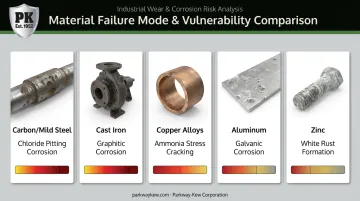
Carbon and mild steel are the most common industrial metals, and the most corrosion-prone. Moisture alone triggers electrochemical attack; add chlorides or acidic exposure and the reaction accelerates. At low pH, hydrogen evolution actually prevents a stable protective film from forming, so the attack continues unchecked instead of slowing over time.
Cast iron carries a specific failure mode called graphitic corrosion. The iron matrix corrodes away selectively, leaving behind a porous graphite network that can retain the part's original shape while losing nearly all its structural strength. A cast iron fitting can look intact and still crumble under load.
Copper and its alloys hold up well in many marine settings, but ammonia is their weak point. Certain copper alloys, particularly brasses, are susceptible to stress-corrosion cracking in ammonia-bearing atmospheres. Acid resistance isn't a blanket copper property either; it swings widely depending on the acid, concentration, and specific alloy.
Aluminum forms a protective oxide layer naturally, which is why it has a reputation for corrosion resistance. That reputation breaks down fast in chloride-rich environments, where chlorides locally disrupt the oxide film and trigger pitting, often hidden beneath deposits where it's hard to spot during inspection.
Zinc performs best in a narrow pH window, roughly 5.5 to 12. Outside that range, acidic conditions or ammonia-rich atmospheres like fertilizer environments cause rapid corrosion, especially when moisture and heat combine.
Galvanic Corrosion: The Risk That Multiplies the Others
Top Corrosion-Resistant Materials for Industrial Applications
When corrosion resistance is the priority, a handful of material families do the heavy lifting.
Stainless steel (304/316) relies on chromium to form a thin, self-healing passive oxide layer. The difference between the two grades comes down to molybdenum. 316 stainless contains molybdenum that significantly improves resistance to chloride pitting compared to 304. That makes it the better choice near seawater, de-icing salts, or chloride-heavy process chemicals.
Neither grade is chloride-proof, though. Warm, stagnant, concentrated chloride solutions can still overwhelm both.
For environments that overwhelm stainless steel, nickel alloys like Hastelloy, Inconel, and Monel are built to survive:
- Hastelloy C-276 targets severe uniform, localized, and stress-corrosion conditions in chemical reactors and heat exchangers
- Inconel 625 handles service from cryogenic temperatures up to 982°C (1,800°F), common in chemical processing and marine equipment
- Monel 400 combines nickel and copper for valves, pumps, and shafts in marine and chemical-processing settings
Titanium takes a similar approach, relying on a stable, tightly adherent oxide film that reforms instantly if scratched. That makes it a preferred choice for aggressive chemical processing and marine applications where stainless steel would eventually pit or crack.
Between standard stainless and pricier nickel alloys, duplex and super duplex stainless steels split the difference between strength and corrosion resistance. Their mixed ferritic-austenitic structure gives them roughly twice the yield strength of standard 300-series stainless, plus far better resistance to chloride stress-corrosion cracking. Welding heat input and phase balance need careful control during fabrication, though.
Tungsten carbide and hardfacing alloys take a different approach. Instead of using a solid exotic alloy throughout a component, these engineered surface treatments concentrate wear and corrosion resistance exactly where it's needed: at the working surface. A tougher, more affordable substrate handles the structural load underneath. That's the principle behind Parkway-Kew's tungsten carbide and nickel-chrome coating systems, covered next.
How Design Choices Prevent Corrosion (Beyond Material Selection)
The right material can still fail if the design around it works against it. Geometry, contact points, and fabrication details determine whether corrosion protection holds up in service.
Structural and Geometric Design Principles
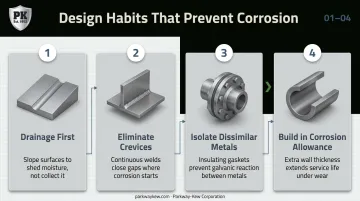
Four design habits consistently separate long-lived components from short-lived ones:
- Drainage first. Slope surfaces and equipment so liquid can't pool. Standing water, even leftover from a hydrotest that was never fully drained, creates a stagnant electrolyte that accelerates attack in one concentrated spot.
- Eliminate crevices. Lap joints, tight gaskets, and shielded dead zones trap moisture and deposits unevenly, which drives crevice corrosion. Continuous welds and open, cleanable joints are the fix.
- Isolate dissimilar metals. Avoid direct contact between metals with different electrochemical potentials. When unavoidable, add isolating gaskets or bushings, and never pair a small anodic area with a large cathodic one.
- Build in corrosion allowance. Codes like ASME B31.3 require extra wall thickness to absorb expected corrosion and erosion. It's not a substitute for controlling localized attack, but it buys time against general thinning.
Engineered Coatings as a Design-Level Corrosion Solution
Thermal spray, HVOF, and plasma spray coatings let engineers put a corrosion- and wear-resistant surface exactly where a part needs it, without upgrading the entire component to an expensive alloy. HVOF propels alloy powder at speeds beyond Mach 2, building a dense, virtually defect-free layer bonded to the substrate.
Parkway-Kew has built this strategy into its operations since introducing the first HVOF coating for wire drawing blocks in 1989. Wire drawing blocks and capstans face constant high-speed, metal-on-metal abrasion in the drawline groove. Parkway-Kew addresses that with a lineup running from nickel-chrome-boron alloys up through tungsten carbide-loaded formulations for the most demanding lines.
Fracking plungers present a different problem: high-pressure abrasion combined with corrosive downhole fluids. Parkway-Kew's standard PK-62 nickel chrome coating handles typical service, while the proprietary PK-730 tungsten carbide coating is reserved for the harshest wells.
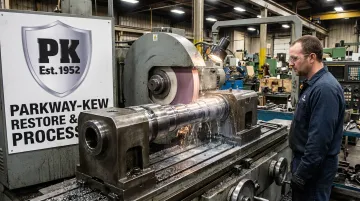
Both are finished in-house, with machining capacity up to 72 inches in diameter and grinding up to 65 inches by 12 feet. That precision matters: a plunger ground even 0.015 inches out of concentricity with its clamping end can vibrate and score prematurely.
Key Factors to Weigh When Selecting Materials for Corrosion Resistance
Choosing a material or coating comes down to three practical factors.
Environmental conditions. What temperature swings, chemical exposure, and moisture levels will the component actually see? A material tested in a lab at room temperature can behave very differently after years of thermal cycling and chemical exposure in the field.
Mechanical and performance requirements. Corrosion resistance can't come at the expense of the part doing its job. Strength, weldability, and ductility all have to be balanced against corrosion performance. A highly resistant alloy that cracks under normal operating stress isn't a solution.
Total cost of ownership. This is where the math often favors engineered coatings over solid exotic alloys. Parkway-Kew's urethane-coated festoon wheels, for example, are field-tested to last 2 to 3 years longer than OEM wheels in the same shipping terminal environment: fewer replacement cycles, less crane downtime, lower cumulative cost.
The company's Restore & Grind process extends that logic further. Wire drawing blocks go through 5 to 7 targeted repair cycles before a full recoat is needed, rather than replacing the block every time wear shows up.
None of these factors work in isolation. A material that's environmentally perfect but too brittle to fabricate, or too expensive to justify against its expected service life, isn't the right choice no matter how corrosion-resistant it looks on paper.
Frequently Asked Questions
How can you prevent corrosion with design and material selection?
Prevention combines choosing materials compatible with the specific process fluid and temperature with design features like proper drainage, crevice avoidance, and isolation of dissimilar metals. A resistant alloy in a poorly drained crevice will still fail early.
What materials are most susceptible to corrosion?
Carbon steel, cast iron, and untreated aluminum are among the most vulnerable, especially in moist, chloride-rich, or acidic environments. Zinc and certain copper alloys also corrode quickly outside their ideal chemical range.
What is the difference between corrosion resistance and wear resistance?
Corrosion resistance protects against chemical or electrochemical degradation, while wear resistance protects against mechanical surface loss from friction or abrasion. Some engineered coatings, like Parkway-Kew's tungsten carbide systems, address both at once.
Can coatings replace the need for corrosion-resistant base materials?
In surface-exposed applications, HVOF and thermal spray coatings can often substitute for solid exotic alloys, cutting material cost while maintaining performance. The base metal still has to handle the structural load underneath.
How do you choose between stainless steel grades for corrosion resistance?
304 stainless works for general industrial atmospheres and less aggressive process media. 316 adds molybdenum for better resistance in chloride-heavy or marine environments, though it isn't immune to pitting under extreme conditions.
What industries need the most robust corrosion control strategies?
Oil and gas, wire and cable manufacturing, marine and shipping, and heavy equipment all operate in high-exposure conditions that demand advanced material and coating strategies. These sectors combine chemical exposure and mechanical stress with little tolerance for failure.