Introduction
When a wire drawing block wears through its coating or a fracking pump plunger fails mid-run, the clock starts immediately. Every hour spent recoating a component — or waiting for one to come back from a coating shop — costs money. That pressure makes the choice of coating process more than a technical preference: it's an operational decision with direct throughput and cost consequences.
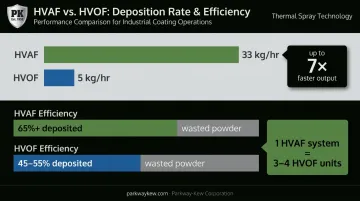
For tungsten carbide coatings specifically, the debate between HVAF (High-Velocity Air-Fuel) and HVOF (High-Velocity Oxy-Fuel) comes down to one critical variable: deposition rate. HVAF deposits WC coatings at up to 33 kg/hour. HVOF tops out around 4–5 kg/hour. That's roughly a 7x gap in output — a difference that reshapes turnaround times, cost structures, and equipment capacity requirements.
Understanding where that gap comes from — and what it costs you in practice — is what determines which process belongs in your operation.
Key Takeaways
- HVAF deposits tungsten carbide coatings at 15–33 kg/hour vs. HVOF's 4–5 kg/hour — roughly 4–5× faster
- HVAF's lower combustion temperature reduces carbide decomposition, producing lower porosity and higher hardness
- HVOF holds AMS 2447/AMS 2448 aviation certification — HVAF does not, restricting its use in regulated aerospace applications
- HVAF operating costs run 30–40% lower per hour, with deposited WC cost up to 2× less per kilogram
- The right choice depends on your production volume, certification requirements, and part specifications
HVAF vs. HVOF: Quick Comparison
The table below provides a working reference for engineers and procurement managers evaluating WC-CoCr or WC-Co coating processes. Values reflect WC-10Co-4Cr coatings. HVAF figures use Economy mode for the fairest throughput comparison against standard HVOF.
| Parameter | HVOF | HVAF (Economy Mode) |
|---|---|---|
| Deposition Rate | 4–5 kg/hr | 15–33 kg/hr |
| Deposition Efficiency | 45–55% | 65%+ |
| Coating Hardness (HV300) | 1,050–1,250 | 1,050–1,250 |
| Porosity | < 0.8% | < 0.8% |
| Combustion Temperature | > 3,000°C | ~1,960–2,010°C |
| Oxidant | Pure oxygen | Compressed air |
| Operating Cost/Hour | Baseline | 30–40% lower |
| Aviation Certification | AMS 2447/2448 ✓ | Not certified |
| Typical Applications | Precision components, aerospace, qualified specs | High-volume production, hard chrome replacement |
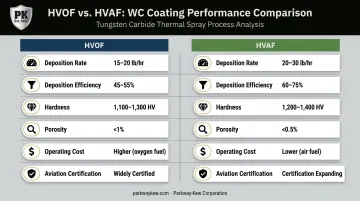
Note on HVAF modes: HVAF systems can operate in multiple modes that trade deposition rate for coating density. Balanced mode raises hardness to 1,250–1,350 HV300 with porosity below 0.5%; Ultra mode achieves 1,350–1,600+ HV300 with porosity below 0.3%, but at a lower deposition efficiency (36–42%). Economy mode figures are shown above for direct comparison with standard HVOF. These Economy/Balanced/Ultra designations are specific to Kermetico (an HVAF equipment manufacturer) and are not universal HVAF industry terminology.
What is HVOF?
HVOF combusts powdered tungsten carbide feedstock with oxygen and a hydrocarbon fuel (propane, hydrogen, or kerosene), propelling particles at supersonic velocities (typically 600–900 m/s) onto a prepared substrate. The result is a mechanically bonded, dense, low-porosity coating built up from successive impacting particles.
Coating Characteristics for WC Systems
Research on WC-10Co-4Cr deposited via HVOF documents the following properties:
- Hardness: 1,050–1,250 HV300 (JP8000 systems measured at 1,289 ± 107.6 HV0.3 in peer-reviewed testing)
- Porosity: Below 0.8%, with optimized processes achieving 0.32%
- Bond strength: Exceeding 80 MPa
- Fracture toughness: 4.87 ± 0.59 MPa·m^1/2 for high-end HVOF guns
These properties make HVOF the established benchmark for wear and corrosion protection on high-stress components across oil and gas, mining, and precision manufacturing.
Aviation Certification
SAE AMS2447D explicitly covers thermal spray coatings applied using the HVOF combustion process, and AMS2448D governs tungsten carbide coatings on ultrahigh-strength steels (220 ksi and above) via HVOF. Both specifications are required for aerospace landing gear and other flight-critical components.
Primary HVOF Applications
- Wire drawing blocks, capstans, and forming equipment
- Oil and gas pump plungers, downhole tools, and valve components
- Mining equipment exposed to abrasive slurry erosion
- Paper mill rolls requiring corrosion-wear protection
- Precision components requiring ultra-fine post-spray surface finish
Parkway-Kew Corporation introduced HVOF coating for wire drawing blocks in 1989 and applies it using proprietary grades PK-675, PK-700, and PK-750: each offers an increasing percentage of hard tungsten carbide in a nickel chrome boron matrix. The proprietary PK-730 fused tungsten carbide coating extends this capability to fracking pump plungers engineered for extreme cyclic pressure.
What is HVAF?
HVAF replaces pure oxygen with compressed air as the combustion oxidant, burning propane or another hydrocarbon fuel to generate a high-velocity gas stream. Two numbers define why this matters: HVAF combustion temperature sits around 1,960–2,010°C, roughly 1,000°C lower than HVOF's 3,000°C+, and the initial oxygen content in HVAF combustion gas is approximately 5× lower than in HVOF. Both factors reduce carbide decomposition and metal oxidation during spraying.
Wang et al.'s peer-reviewed comparison of WC-10Co-4Cr coatings quantifies this: the HVAF coating showed a W2C/WC peak ratio of approximately 0 (indicating minimal decarburization) versus 0.12 for JP8000 HVOF and 0.70 for older Jet Kote III HVOF systems.
HVAF Performance Modes for Tungsten Carbide
| Mode | Deposition Efficiency | Hardness (HV300) | Porosity |
|---|---|---|---|
| Economy | 65%+ | 1,050–1,250 | < 0.8% |
| Balanced | 48–58% | 1,250–1,350 | < 0.5% |
| Ultra | 36–42% | 1,350–1,600+ | < 0.3% |
Running all three modes on a single system lets operators shift between throughput and coating quality without changing equipment — something HVOF systems don't offer.
Aviation Certification Status
HVAF currently lacks AMS 2447/AMS 2448 aviation certification. This restricts its use in aerospace and specification-governed applications unless a convertible HVAF/HVOF system is used, which allows operators to switch modes and retain HVOF certification compliance when required.
Primary HVAF Applications
- High-volume carbide coating in steel mills and wire mills
- Oil and gas wear components: pump rods, plungers, valves
- Hard chrome replacement programs where as-sprayed surface finish (~1.5 µm Ra) reduces or eliminates post-spray grinding
- Any production environment where coating throughput and cost-per-kilogram drive the decision
HVAF vs. HVOF Deposition Rate: Why the Gap Is So Large
The 4–5× deposition rate advantage HVAF holds over HVOF isn't accidental — it traces directly to combustion physics and nozzle design.
The Combustion Mechanism
HVOF's oxygen-fuel combustion achieves a high flame temperature (~3,000°C+) but generates lower total gas volume. HVAF's air-fuel combustion runs cooler but produces higher volumetric gas flow. Gas flow volume, not flame temperature, is what determines how much powder can be fed per unit time without compromising coating integrity.
HVAF systems use axial powder injection into a wide combustion chamber with slow initial gas flow (below 40 m/s), followed by long nozzles for particle acceleration. This design allows for high powder feed rates while maintaining the acceleration path needed for dense coating formation.
The Core Numbers
- HVAF deposition rate: 15–33 kg/hour (some systems reaching 500 g/min, 30 kg/h)
- HVOF deposition rate: 4–5 kg/hour
- Practical implication: A single HVAF system can replace 3–4 HVOF units for equivalent throughput in high-volume facilities
Deposition Efficiency: The Companion Metric
Deposition efficiency (DE) measures what percentage of sprayed powder actually adheres to the substrate. This matters as much as raw spray rate for calculating real cost-per-kilogram:
- HVAF Economy: 65%+ DE
- HVOF: 45–55% DE
Higher DE means less powder waste, lower material cost per coated part, and faster buildup to required coating thickness. Combined with HVAF's higher spray rate, a facility running both metrics in parallel cuts material spend and cycle time simultaneously.
Particle Velocity and Coating Quality
HVAF accelerates particles to 800–1,000+ m/s (some systems reaching 1,100–1,200 m/s) through longer nozzle designs. Higher impact velocity drives mechanical bonding and coating density without relying on high-temperature particle melting — so coating integrity holds even at peak feed rates.
The peer-reviewed evidence confirms this: Wang et al. measured HVAF WC-10Co-4Cr at 1,362.6 ± 97.6 HV0.3 hardness and 0.3% porosity, versus 1,289 HV0.3 and 0.6% porosity for the best HVOF system tested.
Cost-Per-Kilogram Impact
HVAF's combined advantages — higher deposition rate, higher DE, and elimination of oxygen (compressed air costs approximately 10× less than oxygen) — translate directly to coating economics:
- Hourly operating cost runs 30–40% lower than HVOF
- Cost per kilogram of deposited WC coating can be up to 2× lower than conventional HVOF
These figures come from Kermetico manufacturer data — treat them as directional, not independently benchmarked — though the underlying cost drivers support the general magnitude.
HVAF vs. HVOF: Which Is Better for Tungsten Carbide Coatings?
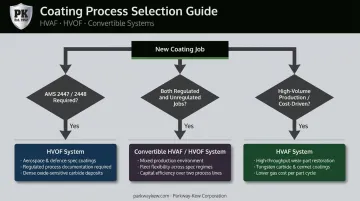
There's no universal answer. Four factors determine the right choice for a specific application:
- Production volume and throughput requirements
- Coating quality specifications (hardness, porosity, surface finish after grinding)
- Certification and specification compliance
- Total cost of ownership (equipment, gas supply, labor, powder efficiency)
Situational Recommendations
Choose HVAF (Economy or Balanced mode) when:
- Production volume is high and cost-per-kilogram is a primary decision driver
- Running hard chrome replacement programs where as-sprayed finish is acceptable
- Upgrading coating quality beyond standard HVOF without adding equipment units
- Applications don't require AMS 2447/2448 or equivalent aviation certification
Choose HVOF when:
- Working within existing qualified coating specifications (AMS 2447/2448)
- Aerospace or aviation components requiring certified processes
- Precision components where the tightest post-grind surface finish is required
- Established industrial standards explicitly specify HVOF
The Hybrid Option
Convertible HVAF/HVOF systems allow operators to switch between modes on the same equipment — running HVAF for bulk production work and switching to HVOF for certification-required jobs. Shops serving both regulated and unregulated markets can run both processes on one machine without committing to either.
What This Means for Wire Drawing and Oil and Gas Applications
For wire drawing blocks and capstans — where the primary concerns are coating hardness, surface density, and resistance to abrasive drawline wear — the critical performance thresholds are:
- Hardness: above 1,050 HV300
- Porosity: below 0.8%
- Bond strength: exceeding 80 MPa
Both HVOF and HVAF Economy mode meet these thresholds. HVAF Balanced mode exceeds them.
For high-volume wire mill operations, HVAF's throughput advantage directly reduces block changeout frequency and per-part coating costs. For shops already qualified on HVOF with established customer specifications — as Parkway-Kew has operated since 1989 — HVOF remains the right process unless a specific production volume or cost driver makes re-evaluation worthwhile.
Real-World Applications: HVOF Tungsten Carbide Coatings in High-Wear Environments
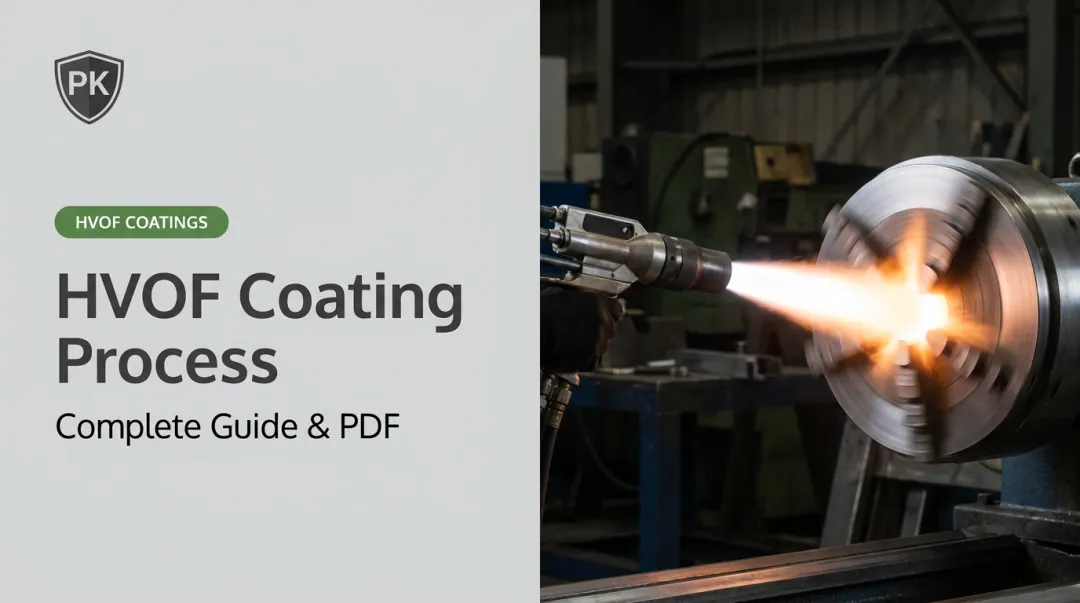
Wire drawing blocks, fracking pump plungers, and mill rolls share a common problem: aggressive surface degradation from abrasion, erosion, and corrosion that shortens service life and drives costly unplanned downtime. Where HVOF fits within that picture — versus newer HVAF processes — becomes clear when you look at how these coatings perform under real operating conditions.
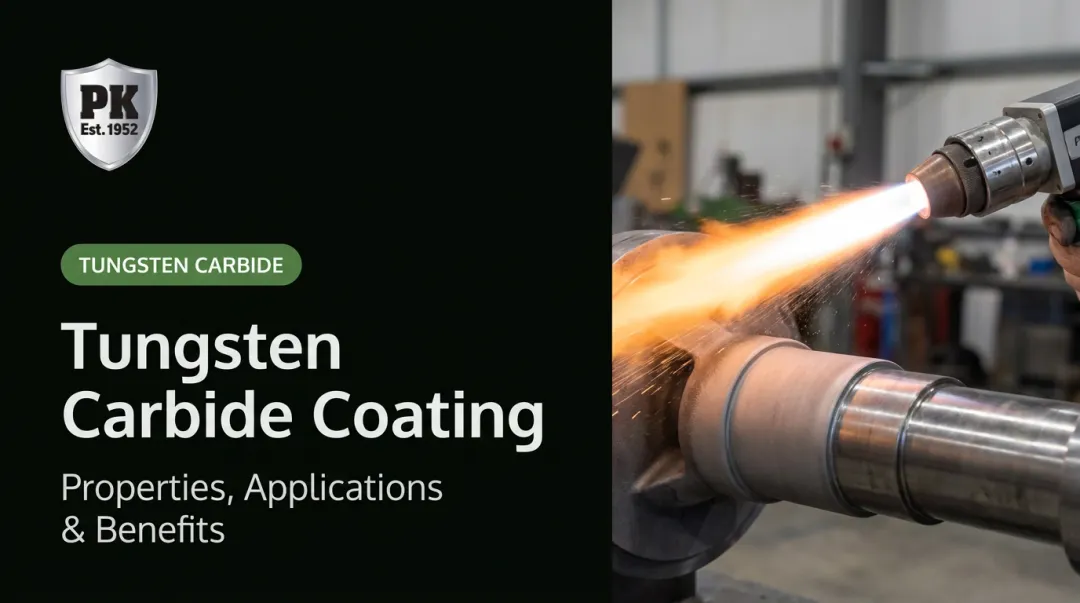
Parkway-Kew Corporation has applied HVOF tungsten carbide coatings to wire drawing blocks since 1989 — a 35+ year operational track record now spanning more than 500 companies worldwide. Three HVOF grades cover the range of wire drawing demands:
- PK-675: Lower tungsten carbide content within a nickel chrome boron matrix — suited for moderate wear applications
- PK-700: Mid-range carbide loading for standard production drawing environments
- PK-750: Highest carbide percentage for aggressive, high-speed, or fine-wire drawing where surface wear accelerates fastest
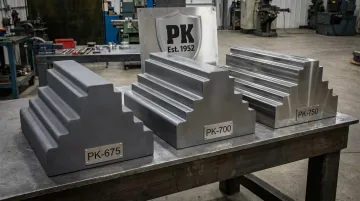
This grade structure allows the coating to be matched to the specific abrasion demands of each application rather than defaulting to a single formulation.
For fracking pump plungers, the challenge is more severe. High-pressure cyclic loading, abrasive proppant slurries, and chemically aggressive well fluids combine into an abrasion-erosion-corrosion environment that eliminates standard coatings quickly. Parkway-Kew developed the proprietary PK-730 fused tungsten carbide coating for exactly this condition, backing it with a track record of the longest fracking plunger service life in the industry.
The finishing process matters as much as the coating itself. Rather than conventional centerless grinding, Parkway-Kew holds the clamping end during surface finishing — correcting concentricity deviations of up to 0.015" that would otherwise cause vibration, scoring, and unpredictable service life in the field.
The decision between HVAF and HVOF ultimately turns on throughput requirements, specification compliance, and long-term cost-of-ownership for the specific component and environment. Contact Parkway-Kew Corporation at (732) 398-2100 for a coating assessment specific to your components and production demands.
Conclusion
HVAF's deposition rate advantage (15–33 kg/hour versus HVOF's 4–5 kg/hour) makes it the more cost-efficient choice for high-volume tungsten carbide coating production, particularly where throughput and cost-per-kilogram are primary decision drivers. HVOF remains the established process for precision applications with strict specification requirements, aviation certification needs, and existing qualified process documentation.
For manufacturers and operators in wire drawing, oil and gas, and heavy industry, getting the coating process right means fewer unplanned shutdowns, lower maintenance overhead, and components that stay in service longer. Parkway-Kew has applied HVOF-deposited tungsten carbide coatings to wire drawing blocks, fracking plungers, and industrial wear parts since 1989 — the kind of application history that informs which process actually fits a given job. The right answer depends on the component, the operating environment, and the production volume behind the decision.
Frequently Asked Questions
How does HVAF compare to HVOF for tungsten carbide (WC) coatings?
HVAF deposits WC coatings 4–5× faster than HVOF — 15–33 kg/hr versus 4–5 kg/hr — with deposition efficiency of 65%+ compared to 45–55% for HVOF. The lower cost per kilogram deposited is a direct result. Depending on the operating mode selected, HVAF can also achieve equal or superior coating hardness and lower porosity compared to standard HVOF.
What is the hardness of HVOF tungsten carbide coating?
HVOF WC-10Co-4Cr coatings typically achieve 1,050–1,250 HV300, with porosity below 0.8% and bond strength exceeding 80 MPa. High-end HVOF systems (such as the JP8000) have measured as high as 1,289 ± 107.6 HV0.3 in peer-reviewed testing.
How durable is HVAF coating?
HVAF WC coatings in Balanced or Ultra mode achieve hardness of 1,250–1,600+ HV300 with porosity below 0.3–0.5%. The lower combustion temperature preserves carbide integrity and coating toughness. Peer-reviewed data shows HVAF fracture toughness of 5.97 MPa·m^1/2 versus 4.87 MPa·m^1/2 for comparable HVOF systems.
What is the deposition rate of HVOF tungsten carbide coating?
Standard HVOF systems deposit tungsten carbide powder at approximately 4–5 kg/hour with a deposition efficiency of 45–55%. This is well-suited for precision coating work but creates a throughput ceiling in high-volume production environments.
Is HVAF better than HVOF?
HVAF is better for high-volume production due to its faster deposition rate and lower cost per kilogram deposited. HVOF is better for applications requiring aviation certification (AMS 2447/2448), existing qualified process specifications, or the finest post-spray surface finish after grinding. Neither is universally superior.
What industries use HVAF tungsten carbide coatings?
Key adopters include oil and gas (pump components, downhole tools), steel and wire mills (rolls, drawing blocks), mining (slurry handling equipment), and hard chrome replacement programs across precision engineering applications where environmental regulations and throughput both favor HVAF over electroplating.