Introduction
Heavy-duty operators running fracking pump engines, marine propulsion systems, and earth-moving equipment all face the same problem: turbochargers take a beating. Turbine housings swing from near-idle to full load dozens of times a shift, and every thermal cycle stresses the metal a little more.
That's why more maintenance teams are looking at ceramic-coated turbine housings: the real payoff is fewer emergency part swaps and longer stretches between overhauls.
This article breaks down what ceramic coating actually does for turbine housings and where the operational advantages show up in day-to-day use. It also covers how to make sure the coating holds up once it's put to work in continuous-duty service.
Key Takeaways
- Ceramic coatings insulate turbine housings against heat, corrosion, and fatigue cracking
- Retained exhaust heat improves turbo response in industrial engines
- Properly applied coatings cut unplanned downtime from cracking and pitting
- Process quality (HVOF vs. plasma spray) matters as much as material choice
- Periodic inspection, not a one-time application, sustains long-term protection
What Is Ceramic Coating for Turbine Housings?
Ceramic coating for a turbine housing is a thermal barrier layer, typically applied through plasma spray or HVOF (high-velocity oxygen fuel), bonded directly onto the housing's surface. It insulates against exhaust heat while resisting corrosion and abrasive wear.
You'll find it on:
- Turbocharger turbine housings on diesel engines powering fracking pump units
- Industrial power-generation turbines running long, continuous duty cycles
- Marine propulsion systems and shipping terminal machinery
- High-performance automotive and motorsport builds
For industrial operators, this coating delivers a direct operational outcome: longer component life, more predictable maintenance intervals, and better thermal efficiency in equipment that can't afford surprise failures mid-shift.
Key Advantages of Ceramic Coating for Turbine Housings
The advantages below aren't abstract performance claims. They're outcomes maintenance and operations teams already track: downtime hours, replacement frequency, and corrosion-driven failures. Each ties directly to a KPI you can measure against your current maintenance data.
Superior Heat Retention & Thermal Barrier Performance
A ceramic coating insulates the housing, trapping exhaust heat inside rather than letting it radiate into the engine compartment. Retained heat keeps exhaust gas moving faster on its way to the turbine wheel, which supports better spool response and less lag under load.
According to Oerlikon Metco, thermal barrier coatings on turbine housings reduce turbocharger thermal radiation, allowing more compact engine-bay layouts and less heat bleeding into surrounding components. That reduced radiation matters more than it might seem:
- Nearby wiring, hoses, and sensors sit inches from a housing that can run at exhaust temperatures far above ambient air
- Caterpillar notes that radiant heat from exhaust components can damage nearby wiring, hoses, and plastic parts if left unmanaged
- Containing that heat within the housing itself, rather than shielding around it, protects those same vulnerable parts
KPIs impacted: exhaust efficiency, surrounding component lifespan, engine bay temperature, fuel consumption.
These conditions show up most in continuous, high-load applications: fracking pump engines running back-to-back stages, marine propulsion under sustained cruise power, and industrial generator sets that rarely get a chance to cool down between cycles.
Corrosion and Oxidation Resistance in Harsh Environments
Bare turbine housings are vulnerable to moisture, salt, chemicals, and oxidation. A ceramic or metallic thermal-spray coating forms a barrier against all of it. That barrier matters most for equipment working near coastlines, in humid climates, or exposed to fracking fluids and jobsite debris.
Uncoated housings develop rust and surface pitting over time. Those pits become stress points, and stress points crack faster under repeated thermal cycling. A 2019 peer-reviewed study on HVOF-coated turbocharger-housing material put real numbers behind this risk:
After cyclic oxidation testing at 900°C for 50 cycles, coated gray cast iron gained just 2.10 mg/cm² in weight versus 123.4 mg/cm² for the bare material — nearly a 60-fold difference in oxidation resistance.
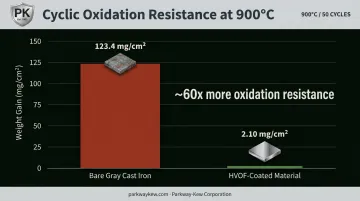
That's laboratory coupon data, not a guaranteed field result. But it illustrates why coated surfaces hold up so much longer under the same oxidizing conditions bare metal can't survive.
KPIs impacted: mean time between failures, maintenance spend, parts inventory turnover, safety incidents tied to component failure.
This matters most for coastal shipping terminal equipment, humid or offshore fracking sites, and any duty cycle that mixes wet and dry exposure on a regular basis.
Extended Component Life and Lower Total Cost of Ownership
Ceramic coating resists the thermal cycling fatigue that makes bare metal turbine housings brittle over time. A precision-applied plasma spray or HVOF coating also works as a lower-cost alternative to solid ceramic components, without the breakage or slippage risk that solid ceramics can carry under vibration.
Parkway-Kew has applied this same logic to heavy industrial wear parts for decades. Its fused HVOF coatings are documented as a viable lower-cost alternative to solid ceramics, avoiding the exact breakage and slippage problems solid ceramic parts are prone to in continuous-duty environments. That's the same engineering principle at work in a coated turbine housing.
Fewer replacement cycles compound quickly:
- Less unplanned downtime per replacement event
- Lower long-term parts and labor spend
- Fewer emergency orders at premium pricing
Parkway-Kew has applied HVOF coatings to heavy industrial components since 1989 and plasma-sprayed ceramic coatings since the late 1990s, over 35 years of process refinement built on a company history dating back to 1952. That kind of sustained, in-house process development is exactly what separates a coating that lasts from one that flakes off after a season.
KPIs impacted: total cost of ownership, replacement frequency, unplanned downtime hours, maintenance labor costs.
The payoff compounds fastest for high-utilization fleets and continuous operations, where small extensions in component life translate into real annual savings.
What Happens When Ceramic Coating Is Skipped or Poorly Applied
Skip the coating, or apply it poorly, and the consequences show up fast:
- Accelerated corrosion and pitting from environmental exposure, especially in coastal or humid conditions
- Premature cracking from unmanaged thermal cycling fatigue at wastegate bores and volute areas
- Radiated heat damage to nearby hoses, wiring, and sensors
- More frequent unplanned downtime for part replacement, often at the worst possible moment
- Rising long-term maintenance costs driven by reactive, unplanned part swaps instead of scheduled ones
None of these failure modes are hypothetical. Thermal gradients, oxidation, and cyclic stress are the well-documented causes of turbine housing cracking and pitting. A properly applied coating is specifically designed to manage these stresses.
How to Get the Most Value from Ceramic Coating on Turbine Housings
Coating performance depends heavily on the process used, whether that's HVOF, plasma spray, or general thermal spray, and on how precisely it's applied. The material alone doesn't determine the outcome.
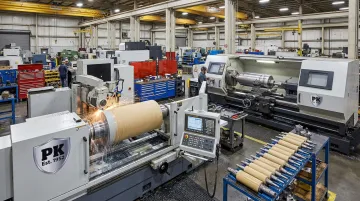
Work with a provider that machines as well as coats. Surface prep, uniform coverage, and dimensional accuracy all matter as much as the coating chemistry itself. A provider offering in-house CNC machining and grinding alongside coating application can hold tolerances that a coating-only shop simply can't guarantee.
Parkway-Kew's own capabilities illustrate this standard:
- HVOF and plasma spray coating expertise built over decades of continuous-duty industrial work
- In-house CNC machining up to 72 inches in diameter
- Large-diameter grinding up to 65 inches in diameter and 12 feet in length
On fracking plungers, for example, Parkway-Kew uses a proprietary finishing process that holds the clamping end during grinding. This corrects concentricity issues of up to 0.015 inches that standard centerless grinding can introduce.
That same precision, coating and finishing under one roof, keeps a coated surface running true under vibration and heat. The same principle applies whether the part is a plunger or a turbine housing.
Coating is not a one-time fix. Periodic inspection and planned reapplication sustain thermal and corrosion protection across a component's full operating life. Treat it as a maintenance cycle, not a single upgrade, and the performance gains hold up far longer.
Conclusion
The value of ceramic coating for turbine housings comes down to three things: heat control, corrosion resistance, and durability under repeated thermal cycling. None of these are marketing abstractions; they show up directly in downtime hours and replacement invoices.
Those advantages compound over time. Applied correctly, by a provider with real process discipline like Parkway-Kew, a coated housing costs less to own over its working life than an uncoated one ever will.
For operators running turbocharged industrial equipment, ceramic and thermal barrier coating functions as an ongoing maintenance strategy, one that pays for itself every time a housing keeps running instead of cracking.
Frequently Asked Questions
Can you ceramic coat a turbo?
Yes. Turbocharger components, including the turbine housing, can be ceramic coated using processes like plasma spray or HVOF to add heat resistance and corrosion protection. It's common practice for industrial equipment operating in high-heat, high-wear environments.
What are turbine blades coated with?
Turbine blades and housings are commonly coated with thermal barrier ceramics, often zirconia-based materials, applied via plasma spray or HVOF. The exact material depends on the substrate and operating temperature.
How long does ceramic coating last on a turbine housing?
Lifespan depends on the coating process, operating conditions, and duty cycle. Properly applied industrial-grade coatings can considerably outlast an uncoated housing, though exact figures vary by application and exposure.
Does ceramic coating improve turbo efficiency or reduce lag?
By retaining heat and keeping exhaust gas velocity higher on its way to the turbine wheel, coatings can support faster spool-up and reduced lag. The effect is most noticeable in continuous, high-load operation.
What's the difference between HVOF and plasma spray ceramic coatings for turbine housings?
HVOF typically deposits dense metallic or carbide coatings built for wear and corrosion resistance. Plasma spray handles higher-melting ceramic materials better, making it the go-to process for thermal barrier layers. Both add durability, but they serve different primary purposes.
Is ceramic coating worth the investment for industrial turbochargers?
For continuous-duty industrial equipment, reduced downtime and extended component life typically offset the upfront coating cost. The math favors coating most clearly in high-utilization fleets where replacement frequency drives total cost of ownership.