Ceramic tooling used to be a turning-only solution. Milling puts intermittent shock loads on a cutting edge that older ceramics simply couldn't survive. That changed as whisker-reinforced, phase-toughened, and SiAlON ceramic grades solved the brittleness problem that kept ceramics out of milling applications for decades.
This article skips the material science lecture. Instead, it covers what actually matters on the shop floor: speed, tool life, surface quality, and what breaks when setup goes wrong.
TL;DR
- Ceramic milling tools cut faster than carbide, boosting metal removal rates
- SiAlON and whisker-reinforced ceramics now hold up in milling, not just turning
- Rigid fixturing, dry machining, and correct speeds/feeds are essential for these gains
- Skip proper setup, and chipping, thermal shock, and poor results erase the savings
What Is Ceramic Milling
Ceramic milling uses ceramic-based cutting tools, including solid ceramic end mills, brazed ceramic inserts, and ceramic ball nose cutters, to remove material from workpieces that are hard, heat-resistant, or highly abrasive.
You'll find it applied most often in:
- Aerospace nickel alloys like Inconel
- Hardened tool steels
- Compacted graphite iron and gray/ductile cast iron
- Additively manufactured (3D-printed) hard alloys
What matters is the outcome: higher throughput, longer tool life, and lower cost-per-part on materials that grind carbide down fast.
That principle isn't new to industrial machining. Ceramic's hardness has been used to extend service life under wear long before it appeared in milling applications.
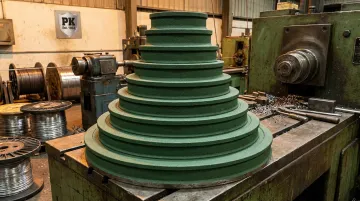
Parkway-Kew has applied plasma-sprayed ceramic coatings, including its PK-1500 chrome oxide formulation, to wire drawing blocks and capstans since the late 1990s. The coating was adopted because it holds up under the high-speed, high-slip conditions of wire drawing, where surface integrity is critical. The application differs, but the logic is the same: ceramic hardness solving a wear problem carbide and steel couldn't.
Key Advantages of Ceramic Milling
These advantages aren't abstract hardness claims. They show up in the numbers shops already track: cycle time, tool life, cost-per-part, and scrap rate. Here's how each one plays out in practice.
Higher Cutting Speeds and Metal Removal Rate
Ceramic retains its hardness at temperatures that would soften carbide outright. That thermal stability is the whole reason ceramic milling exists. It lets programmers push rpm well beyond carbide limits while newer toughened grades hold feed rates close to carbide-level chip loads.
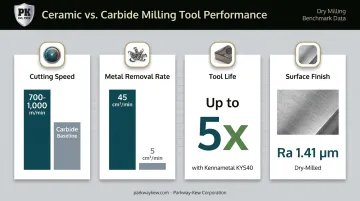
Sandvik reports ceramic milling speeds of 700 to 1,000 m/min on heat-resistant superalloys, roughly 20 to 30 times solid-carbide speed.
An independent study on aged Inconel 718 found similar results: ceramic tooling run at 600 m/min produced an MRR near 45 cm³/min, versus about 5 cm³/min for carbide at 50 m/min. Carbide lasted longer per edge, but ceramic moved nine times the material in the same window.
That speed differential compounds fast:
- Cycle time drops on identical part geometry
- Spindle utilization improves without buying new machines
- Parts-per-shift climbs on every batch run
- High-volume production benefits most, since every saved minute multiplies across aerospace blisks and turbine-component runs
Extended Tool Life in Hard and Abrasive Materials
Ceramic resists abrasive wear longer than carbide when cutting hardened steel or superalloys. That's the baseline advantage. What's new is that whisker-reinforced and phase-toughened microstructures now resist the chipping and fracture that used to sideline ceramic tools in interrupted cuts, which is exactly what milling is.
**Kennametal's KYS40 solid ceramic end mills claim up to 5x the tool life of solid-carbide end mills in nickel-alloy roughing. That's a manufacturer figure, worth validating against your own application, but it points at real potential.
Fewer tool changes mean:
- Less unplanned downtime and fewer inspection stops tied to edge wear
- Lower tooling spend per part
This advantage matters most on long, single-material production runs, where tool-change frequency has historically driven total cost. It's the same logic behind wear-resistant hardsurfacing on industrial components: material science decisions made once at the front end pay off across the entire service life of the part or tool.
Better Surface Finish and Reduced Thermal Damage via Dry Machining
Ceramic tools generally run dry. No coolant means no thermal shock hitting a hot ceramic edge, which is exactly the kind of shock that triggers microcracking or "white layer" formation on hardened parts.
Dry cutting paired with a well-tuned toolpath produces consistent, predictable finishes without adding secondary finishing passes. One independent study on dry-milled nickel alloy (GH4061) using a monolithic ceramic tool measured a surface finish of Ra 1.41 micrometers, solid results without coolant in the equation.
Why it matters for quality control:
- Avoiding thermal damage cuts scrap and rework, especially on fatigue-critical parts
- Fewer non-conformances mean less inspection time and faster part release
- On safety-critical components like turbine blades, surface integrity directly affects certification
Ceramic roughing isn't always the finishing step. Some manufacturers recommend leaving stock (Mitsubishi suggests at least 0.012 inch) for a dedicated finishing pass rather than taking ceramic roughing straight to final dimension.
What Happens When Ceramic Milling Best Practices Are Ignored
Ceramic milling punishes shortcuts harder than carbide ever did. Skip the setup discipline, and here's what shows up:
- Tool chipping or catastrophic fracture from insufficient rigidity or too much tool overhang
- Thermal shock and premature failure from accidental coolant exposure, even a brief mist
- Unpredictable tool life and cycle times from speed/feed parameters that don't match the specific ceramic grade
- Rising cost-per-part as scrap rates climb and unplanned tool replacements pile up
- Scaling problems when setup standards aren't documented, so results vary machine to machine and operator to operator
None of this is exotic. It's the same failure pattern seen anywhere a process gets treated casually instead of engineered. Ceramic just has less margin for error than the tooling most shops are used to.
How to Get the Most Value from Ceramic Milling
Ceramic milling only delivers on its promise when a handful of conditions hold steady, every time, not just on the first good run.
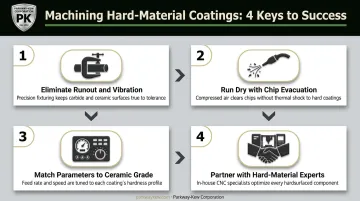
- Eliminate runout and vibration. Use rigid fixturing, keep tool overhang as short as the job allows, and standardize on shrink-fit or hydraulic toolholders. Collet chucks aren't rated for ceramic's demands.
- Run dry, with real chip evacuation. Pressurized air clears chips without the thermal shock risk that coolant introduces.
- Match parameters to the specific ceramic grade. Speeds and feeds aren't universal across ceramic types. Review and adjust as wear data comes in from actual production, not just catalog starting points.
- Work with partners who understand hard-material behavior. Parkway-Kew's in-house CNC milling and turning, rated up to 72 inches in diameter, plus large-diameter grinding up to 65 inches and 12 feet in length, reflect the equipment scale that hard-material work demands. Decades of hands-on experience with wear-resistant ceramic and hardfacing coatings back that capability, translating directly into disciplined ceramic milling setups.
Conclusion
Ceramic milling earns its keep through a combination of speed, tool life, and surface integrity, but only on the right hard materials and only with disciplined execution. The gains compound across production volume: faster cycles and fewer tool changes add up fast on long runs.
Treat ceramic milling as an evolving practice. Revisit your setup standards, speeds, and toolpaths each time a new ceramic grade or machine capability becomes available.
Frequently Asked Questions
Is ceramic hard to machine?
Ceramic itself is extremely hard and brittle, which makes it genuinely difficult to machine directly. That same hardness is exactly what makes ceramic cutting tools so effective at machining other hard materials.
What tools are used for ceramic milling?
Solid ceramic end mills, brazed or inserted ceramic milling heads, and ceramic ball nose cutters cover most applications. Solid end mills typically range from about 0.25 to 0.75 inch, often with 4, 6, or 7 flutes for added stability.
What is the difference between ceramic and carbide end mills?
Ceramic holds hardness and hot strength at much higher temperatures, enabling far higher cutting speeds. Carbide offers greater toughness and works reliably across a wider range of materials and setups, which is why it remains the default for general-purpose milling.
What are ceramic cutting tools made of?
Common materials include alumina-based (Al2O3) ceramics, silicon nitride, and SiAlON. Manufacturers boost toughness through reinforcement methods like SiC whisker-reinforcement or phase-toughening, which resist the cracking that limited early ceramic tools.
What speeds and feeds should be used for ceramic end mills?
Optimal parameters vary by ceramic grade and work material. Newer toughened ceramics can run effectively starting around 1,300 sfm in heat-resistant alloys, with feed rates approaching carbide-like chip loads, but always confirm against the specific tool manufacturer's data.
Can ceramic end mills be used with coolant?
Generally, no. Ceramic milling is run dry, using pressurized air for chip evacuation. Coolant applied to a hot ceramic edge can cause thermal shock, shortening tool life instead of extending it.