Many shop owners and engineers get tripped up trying to sort out VMCs, horizontal machining centers (HMCs), and other CNC mill configurations. Picking the wrong machine type for your parts can mean wasted floor space, slower cycle times, or a six-figure mistake.
This guide breaks down how VMCs work, their core components, the different types available, where they're used across industry, and how to choose and maintain one for your shop.
Key Takeaways
- VMCs use a vertical spindle and X/Y/Z axes to mill, drill, and bore partss
- 3-axis machines handle most jobs; 4- and 5-axis models add multi-face precision in one setup
- These machines cost less and need about a third of the floor space of comparable HMCs
- Industries from aerospace to heavy industrial restoration depend on VMC precision for wear-critical parts
- Choosing the right VMC depends on material, tolerance needs, production volume, and available space
What Is a Vertical Machining Center (VMC)?
A VMC is a CNC machine tool built around a spindle that sits vertically, perpendicular to the worktable, approaching the workpiece from above. That orientation is what separates it from a horizontal machining center, where the spindle runs parallel to the table.
Standard VMCs operate on three linear axes:
- X-axis — longitudinal movement, left to right along the table
- Y-axis — lateral movement, front to back
- Z-axis — vertical movement, driving the spindle and cutting tool down into the workpiece
The CNC control coordinates these three axes simultaneously, guiding the cutting tool through programmed toolpaths for milling, drilling, boring, and tapping operations. Executing those toolpaths well depends heavily on spindle performance, which varies widely by material.
A shop cutting aluminum or graphite electrodes for mold work often runs spindles well into the tens of thousands of RPM. Mikron's high-speed VMCs, for example, have run at 42,000 rpm for graphite electrode and aluminum core/cavity work.
Hardened steel demands rigidity more than raw speed. Makino's F5 hard-milling VMC is built for stiffness and chatter control at speed, since the deciding factor is the combination of material, cutter diameter, torque, and finish requirement. Newer high-speed five-axis models, like Hurco's BX40Ui, run 18,000 rpm spindles as standard.
Tool Holders and Automatic Tool Changers
Every VMC needs a way to hold and swap cutting tools, and the interface you choose affects rigidity and speed capability.
BT/CAT tapered holders use a conventional steep-taper interface and remain the industry standard for general-purpose milling. HSK (hollow shank) holders use a shorter shank that contacts the spindle at both the taper and the face simultaneously. The thin wall of an HSK holder expands under centrifugal force at high rpm, which helps it maintain contact and clamping force where a single-contact taper interface may lose rigidity. That's why HSK holders are commonly specified for high-speed machining applications, particularly in mold work and aerospace milling.
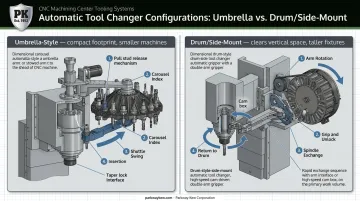
Automatic tool changers (ATCs) come in two common configurations:
- Umbrella-style ATC — a carousel mounted above or beside the spindle; a shuttle arm moves it into position during a tool change
- Drum/side-mount ATC — a double-arm gripper mounted outside the work envelope that swaps tools without occupying vertical space over the table
Side-mount changers keep the tool storage clear of the cutting zone, which can matter when you're running taller fixtures or parts. Umbrella changers remain popular on smaller machines where footprint and cost are priorities.
Core Components of a Vertical Machining Center
Every VMC, regardless of brand or size, relies on five core systems working together.
- Spindle — the heart of the machine, rotating the cutting tool and generating the torque needed for material removal. Capability (speed, torque, taper size) varies by machine class, from benchtop units to large-frame industrial VMCs.
- Worktable — mounts the workpiece and travels along the X and Y axes, often paired with fixtures, pallets, or rotary tables for multi-part setups.
- Automatic Tool Changer (ATC) — swaps cutting tools without manual intervention, letting a single setup run drilling, tapping, and finishing operations back to back.
- CNC Control System — interprets CAD/CAM programs to manage axis movement, feed rate, and spindle speed. Common options include FANUC, Mitsubishi Electric, Haas Control, Mazak's MAZATROL Smooth, Okuma's OSP, and Hurco's WinMax.
- Coolant and Lubrication System — pumps cutting fluid to the tool-workpiece interface to reduce heat and friction, then filters and recirculates it; a separate lubrication circuit keeps axis-motion components running smoothly.
Each of these systems has to be maintained on its own schedule. We'll cover that in more detail further down.
Types of Vertical Machining Centers
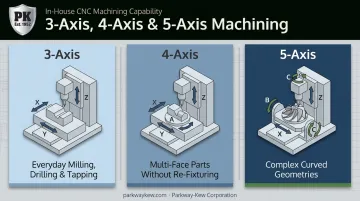
Not every job needs the same axis configuration. VMCs generally fall into three categories based on how many axes they move on simultaneously.
3-Axis, 4-Axis, and 5-Axis VMCs
Here's how the three configurations compare:
| Configuration | Axes | Best For |
|---|---|---|
| 3-axis | X, Y, Z | Everyday milling, drilling, and tapping |
| 4-axis | X, Y, Z + A-axis rotary | Multi-face parts without re-fixturing |
| 5-axis | X, Y, Z + two rotary axes | Complex curves: turbine blades, implants, aerospace parts |
3-axis VMCs move on X, Y, and Z only. This is the most common and most economical configuration, and it handles the majority of milling, drilling, and tapping work in a typical shop. Makino positions its three-axis line for everything from single-piece prototype runs to full production volumes.
4-axis VMCs add a rotary table (often called an A-axis) or a trunnion setup. This lets the machine index the workpiece to a new face without the operator removing and re-fixturing the part, cutting down on setup time and reducing the chance of alignment error between operations.
5-axis VMCs combine two rotary axes with the three linear ones, enabling either indexed 3+2 positioning or continuous simultaneous motion. These machines handle the complex, curved geometries you see in turbine blades, medical implants, and aerospace structural parts.
Owning a 5-axis machine doesn't guarantee those results on its own. Modern Machine Shop's 2021 benchmarking data found that top-performing 5-axis shops ran their machines 25% more hours and reported 50% lower setup times than shops that weren't top performers.
That gap reflects overall shop practices, not the machine alone. Still, it shows how much room there is to extract value from a 5-axis investment when it's paired with the right workflow.
Applications and Industries That Rely on VMCs
VMCs show up wherever tight tolerances and repeatable results matter more than raw throughput on a single giant part.
- Aerospace — turbine blades and structural components machined from titanium and stainless steel, where rigidity and volumetric accuracy prevent chatter on hard-to-cut alloys
- Automotive and mold making — aluminum molds, core/cavity inserts, and graphite electrodes, often on high-speed VMCs
- Medical device manufacturing — complex 3D geometries requiring tight blends and repeatable finishes
- Electronics and semiconductor equipment — precision parts for semiconductor manufacturing equipment
- Prototype and development work — short-run, single-piece jobs where flexibility matters more than volume
Common part categories machined on VMCs include mold cavities, curved impeller surfaces, plate and sleeve components, and short-run prototypes.
A Heavy-Industrial Example: Wear-Resistant Component Restoration
Precision machining isn't limited to aerospace and electronics. Parkway-Kew Corporation, a hardsurfacing and coating specialist based in North Brunswick, NJ, maintains in-house CNC milling (including vertical machining centers), CNC turning, and large-diameter grinding capabilityTheir process instead holds the clamping end while finishing the coated surface, mimicking how the plunger sits in the pump and correcting that misalignment before it causes vibration or premature wear. Heavy industry depends on this kind of machining precision just as much as aerospace does.
Advantages of Vertical Machining Centers (VMC vs. HMC)
VMCs and HMCs both mill metal, but they solve different problems. Here's how they stack up.
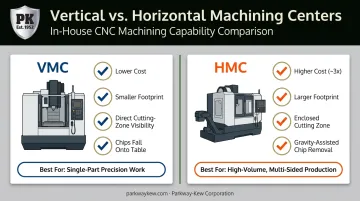
| Factor | VMC | HMC |
|---|---|---|
| Upfront cost | Lower | Higher (about 3x, per one shop's comparison) |
| Floor space | Smaller footprint per machine | Larger footprint per machine |
| Operator visibility | Direct view of the cutting zone | Enclosed, harder to monitor mid-cut |
| Chip removal | Chips fall onto the table, need clearing | Chips fall away from the workpiece by gravity |
| Ideal part complexity | Simple to moderately complex, single-face-heavy parts | Multi-face parts needing minimal repositioning |
| Best for | Smaller shops, lower volumes, prototyping | High-volume production, multi-op parts |
Space and cost are the two biggest reasons smaller shops start with a VMC. The vertical spindle also makes it easier to watch the cut in progress and simplifies setup and programming for less specialized parts.
HMCs earn their higher price tag when parts require multiple faces machined in one setup. One documented shop case found that moving an "elbow" part from seven operations across three VMCs to two HMC setups cut machining time from 14 hours to 6. A single operator could also keep two HMCs cutting more than 90% of the time, versus roughly 75% for two VMCs.
That's a real efficiency gain, but it's specific to multi-face, high-volume parts, not a universal rule.
As for capacity, don't assume VMCs can't handle large or heavy work. Large fixed-table and double-column VMCs handle substantial workpieces just fine. The better approach is comparing table load limits, travels, and door clearance on the specific models you're considering rather than assuming HMCs always win on size.
Choosing and Maintaining the Right VMC
Picking the right machine comes down to five questions:
- What material are you cutting? Aluminum and graphite favor high-speed spindles; hardened steel and titanium demand rigidity and torque over raw rpm.
- What tolerance do you need to hold? Tight aerospace or medical tolerances may justify a 5-axis machine even at higher upfront cost.
- What's your production volume? High-mix, low-volume shops often do fine with 3-axis VMCs; multi-face, high-volume work may justify a 4- or 5-axis machine or an HMC.
- How much floor space do you have? VMCs generally fit smaller footprints, which matters in older or leased facilities.
- What's your budget, including installation and tooling? Factor in tooling, fixturing, and control software, not just the machine price tag.
Maintenance Essentials
Choosing the right VMC is only half the equation. Keeping it running well requires consistent upkeep, since skipping maintenance is the fastest way to shorten spindle life and lose accuracy. A typical VMC maintenance schedule includes:
- Weekly: coolant level and concentration checks, chip clearing from the tool changer
- Monthly: spindle gearbox lubrication checks, axis lubrication reservoir inspection
- Every six months: coolant tank cleaning and replacement, lubrication line testing
- Annually: gearbox oil replacement, spindle drawbar force measurement
Operator training matters just as much as scheduled maintenance. A well-trained operator catches early warning signs, such as chatter, unusual noise, or coolant contamination, before they turn into costly downtime.
Cost extends beyond the machine itself, especially if you're outsourcing work rather than buying. CNC machining shop rates vary widely based on machine size, part complexity, tooling requirements, and regional labor costs. Rather than relying on a single national average, get quotes from a few shops in your region running the specific machine class and tolerance level your parts require.
Frequently Asked Questions
What is a CNC vertical machining center (VMC)?
A VMC is a CNC machine tool with a vertically oriented spindle used for milling, drilling, boring, and tapping operations. The spindle approaches the workpiece from above, moving along X, Y, and Z axes.
How much does CNC machining cost per hour?
Rates vary based on machine size, part complexity, tolerance requirements, and shop location. Get quotes from local shops running comparable equipment rather than relying on a single national average.
What is the difference between a vertical machining center and a horizontal machining center?
VMCs have a vertical spindle, cost less, and take up less floor space, making them ideal for simpler or lower-volume parts. HMCs have a horizontal spindle and excel at multi-face parts and high-volume production despite a higher upfront cost.
How many axes does a vertical machining center have?
Standard VMCs run on 3 axes (X, Y, Z). Adding a rotary table creates a 4th axis, and a second rotary axis enables full 5-axis simultaneous or 3+2 indexed machining.
What materials can a VMC machine?
VMCs commonly machine aluminum, graphite, titanium, stainless steel, and hardened steel, with material choice driving spindle speed and rigidity requirements.
How do I choose the right VMC for my shop?
Base your decision on the material you're cutting, required tolerance, production volume, available floor space, and total budget, including tooling and installation costs.