Corrosion is a leading driver of unplanned wind turbine maintenance and premature component degradation. According to NREL's 2024 Cost of Wind Energy Review, fixed-bottom offshore wind operations and maintenance costs reach $135/kW-year — a figure that reflects just how expensive it is to access and repair offshore assets. Preventing corrosion isn't optional; it's the first line of defense against costs that compound with every delayed inspection.
This guide explains not just that corrosion protection coatings protect turbines, but exactly how they work — the surface chemistry, the layered application process, and why each stage matters to long-term turbine performance across a 20–25-year design life.
Key Takeaways
- Corrosion coatings form physical and electrochemical barriers between turbine steel and salt, moisture, and oxygen
- Protection works in stages: surface prep → zinc-rich primer → barrier build coats → topcoat, with each layer serving a distinct function
- Zinc-rich primers provide sacrificial galvanic protection; epoxy and polyurethane layers block chloride and moisture diffusion
- Offshore turbines require zone-specific systems for atmospheric, splash, and submerged areas — not one universal coating
- ISO 12944-9, ISO 24656, NORSOK M-501, and DNV-RP-0416 set the governing standards for offshore wind coating specifications
What Is Corrosion Protection Coating for Wind Turbines?
A corrosion protection coating for wind turbines is an engineered multi-layer system: surface treatment, primers, intermediate coats, and topcoats selected specifically for the corrosive environment each turbine zone faces.
Why Steel Needs It
Turbine steel is inherently reactive. Exposed to oxygen and moisture, it produces iron oxide (rust) through electrochemical oxidation. Left unchecked, this progressively weakens structural integrity — a serious problem when the asset is designed to last 20–25 years. In marine environments, the problem accelerates sharply.
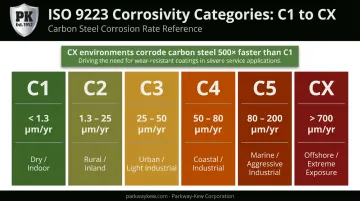
ISO 9223:2012 illustrates just how much the environment matters. Carbon steel corrosion rates range from less than 1.3 µm/year in the mildest conditions (C1) to over 700 µm/year in the most aggressive offshore categories (CX). That's not a minor variation — it's a difference of several hundred times, which is why coastal and offshore coatings require entirely different specifications than inland tower coatings.
Passive vs. Active Protection
Corrosion protection systems split into two categories:
- Passive systems — coatings, galvanizing, material selection — slow or block corrosion by forming a physical barrier or providing sacrificial protection
- Active systems — cathodic protection, corrosion inhibitors — electrochemically intervene to counteract ongoing degradation
Coatings are the primary passive defense. For most turbine zones, they are the first and most cost-effective line of protection, often working alongside cathodic protection in submerged areas.
What Makes Wind Turbine Coatings Different
That passive/active distinction matters because standard industrial coatings simply aren't built for what wind turbines face. Turbine systems must withstand UV exposure, salt spray, mechanical stress from rotation and vibration, and extreme temperature cycling — all at once. That combined stress profile is why multi-layer coating systems tested specifically to offshore wind standards are required, not just recommended.
How Corrosion Protection Coating Works
Corrosion protection coating works through a structured sequence. Each stage builds on the previous one, and skipping or rushing any step undermines the entire system.
Surface Preparation
Surface preparation is the most critical step — and the most commonly underestimated.
Abrasive grit blasting to Sa 2.5 or Sa 3 per ISO 8501-1 is the mandatory starting point. Blasting removes rust, mill scale, and surface contamination while creating a defined roughness profile that gives subsequent coating layers mechanical grip on the steel. Without that profile, adhesion fails, and adhesion failure is the most common cause of premature coating breakdown.
Salt contamination deserves equal attention. NORSOK M-501 — the offshore coating and surface preparation standard widely adopted in wind energy — requires soluble salt contamination not to exceed 20 mg/m² NaCl before coating begins. Even invisible chloride residues left on the surface will draw moisture under the coating film and initiate corrosion from beneath. Surface cleanliness is a hard requirement at this stage.
Primer Application
The primer does two jobs simultaneously: it anchors all subsequent layers and it starts protecting the steel immediately.
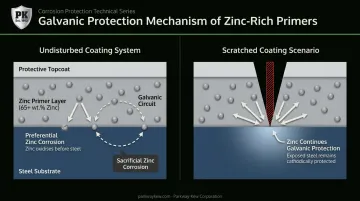
Zinc-rich primers achieve this through galvanic (sacrificial) protection. Zinc has a more negative electrochemical potential than steel, so it corrodes preferentially when both are in electrical contact. Research published in PMC confirms that zinc-rich primers require zinc content typically above 65 wt.% to maintain the electrical conductivity needed for this galvanic circuit to function. The practical result: even if the topcoat is scratched or breached, the zinc primer continues protecting the underlying steel until the damaged area is repaired.
Protective Coating Layers
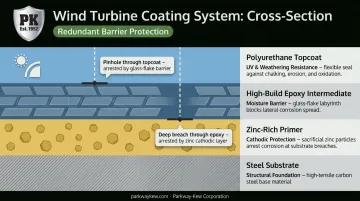
Intermediate and topcoat layers form the primary diffusion barrier. High-build epoxy and polyurethane coatings create a dense, low-permeability film that physically blocks moisture, oxygen, and chloride ions.
Glass-flake reinforced epoxy systems take this further through a "tortuous path" mechanism. Laminar glass flakes, aligned parallel to the surface during application, significantly extend the diffusion distance that corrosive species must travel to reach the steel. An ICorr-hosted coating presentation notes that ISO 24656 recommends greater than 20% lamellar glass flake content for the longest service life in the most demanding offshore exposure categories.
Why multi-layer systems outperform single-coat approaches:
- A pinhole in the topcoat is blocked by the intermediate coat beneath it
- A pinhole in the intermediate coat is arrested by the primer's sacrificial zinc
- Each layer compensates for defects in adjacent layers, creating redundant protection
For thermal spray methods — including Thermal Sprayed Aluminium (TSA) and HVOF — metallic particles are propelled at high velocity onto the prepared surface, where they flatten and solidify into interlocking lamellae forming a dense, tightly bonded metallic coating. TSA provides dual protection: a physical barrier plus sacrificial aluminium that corrodes preferentially to protect the steel substrate.
Curing and Long-Term Maintenance
In epoxy systems, curing is not simply drying. It is a chemical crosslinking reaction that builds the polymer network responsible for the coating's final mechanical strength, chemical resistance, and impermeability. Get the conditions wrong and the coating underperforms permanently.
EPA HERO-indexed research on aliphatic amine-cured epoxies identified adhesion failures driven by three variables:
- Relative humidity above 80% when cured above 21°C
- Humidity as low as 40% at 13°C
- Inter-coat cure time — insufficient dwell between layers
Rushing this stage produces soft, permeable films that fail years ahead of schedule.
Even well-applied coatings degrade over time through UV breakdown, abrasion, and mechanical microcracking. Scheduled inspection — coating thickness measurement, visual survey, corrosion mapping — combined with targeted maintenance recoating is essential to intercept degradation before it reaches the steel substrate.
Types of Corrosion Protection Coatings Used on Wind Turbines
Each coating type serves a distinct protective function — matching the right system to the right zone is what determines long-term performance.
Zinc-Rich Primers (Organic and Inorganic)
The foundation layer in virtually every multi-coat wind turbine system. Zinc particles in the coating must be in electrical contact with each other and the steel to complete the galvanic circuit. Organic zinc-rich primers use an organic binder; inorganic variants (typically ethyl silicate) offer higher zinc content and better heat resistance. Both provide cathodic protection that continues working even after surface damage.
Epoxy and Polyurethane Barrier Coatings
High-solids epoxies build film thickness efficiently in fewer coats, while polyurethane topcoats add UV resistance and surface hardness — making this pairing the standard choice for atmospheric zone protection. These systems are qualified against ISO 12944-9 offshore performance requirements — the primary standard governing protective paint systems for offshore and related structures.
Thermal Sprayed Aluminum (TSA)
TSA provides combined barrier and sacrificial protection. The metallization process creates a porous aluminum layer that seals against the environment while aluminum acts as the sacrificial anode. TSA has a long track record in offshore oil and gas and is increasingly specified for wind turbine splash and submerged zones. Upfront application costs run higher than paint systems, and the process requires specialist equipment — factors to weigh against TSA's extended service life.
Glass-Flake Epoxy and Polyester Systems
Specifically recommended for the most aggressive offshore exposure categories. The lamellar flake geometry creates the tortuous diffusion path described above, making these systems particularly suited for splash and buried zones where barrier performance is critical. ISO 24656 (which covers cathodic protection of offshore wind structures) calls for high-build glass-flake content to achieve the longest service life in splash and buried zones.
Coating System Comparison by Zone
| Zone | Recommended System | Relative Cost | Application Complexity |
|---|---|---|---|
| Atmospheric (tower, nacelle) | Zinc-rich primer + epoxy intermediate + polyurethane topcoat | Moderate | Low–Moderate |
| Splash/tidal (transition piece) | Glass-flake epoxy, TSA, or reinforced high-build systems | High | High |
| Submerged/buried (monopile) | Coating + cathodic protection; TSA or glass-flake epoxy | High | High |
| Onshore tower (interior) | Epoxy primer + polyurethane topcoat, lighter specification | Lower | Low |
Where Corrosion Protection Coatings Are Applied on Wind Turbines
The Three Offshore Corrosion Zones
Offshore turbines face three distinct corrosion environments, each requiring a different specification:
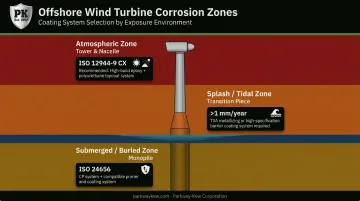
- Atmospheric zone (tower and nacelle) — UV radiation, rain, and salt spray drive degradation. ISO 12944-9 CX category applies; the standard system is a zinc-rich primer, high-build epoxy intermediate, and UV-stable polyurethane topcoat.
- Splash/tidal zone (transition piece, upper monopile) — The most aggressive zone on any offshore structure. Alternating wet/dry cycling with high salt loading prevents stable protective layers from forming. North Sea corrosion profiling research documents rates exceeding 1 mm/year, which is why this zone demands the highest-specification barrier systems or TSA.
- Submerged and buried zone (monopile foundation) — Continuous immersion, biofouling, and electrochemical activity combine here. ISO 24656 governs cathodic protection for these areas; coatings typically work alongside a CP system rather than standalone.
Onshore Turbines: A Different Challenge
Onshore turbines face lower salt exposure but still contend with real degradation mechanisms:
- UV radiation degrades tower and blade coatings over time
- Humidity cycling inside towers causes condensation corrosion on interior steel surfaces
- Particulate erosion from dust and sand abrades protective coatings on blade leading edges
A 2022 condition-monitoring study on a 6.0 MW onshore turbine tower in northern Germany modeled coating deterioration, uniform corrosion, and localized corrosion to assess structural degradation — showing that even inland turbines need regular coating assessment, not just periodic repainting.
Component-Level Considerations
Not all turbine components need the same coating approach:
- Bolted flange connections are particularly vulnerable to crevice corrosion. Research from ÉTS found that increasing gap thickness from 1.58 mm to 6.35 mm raised corrosion rates from 0.09 mm/year to 1.03 mm/year — an eleven-fold increase driven purely by gap geometry
- Nacelle internals face humidity and condensation despite being enclosed
- Rotor blades require flexible, erosion-resistant coatings rather than the rigid epoxy systems used on the tower, because rain erosion at blade tips involves fundamentally different stress mechanisms
These differences drive zone-specific coating strategies across what is, in physical terms, a single turbine structure.
Conclusion
Corrosion protection coating for wind turbines is a sequenced system — surface preparation, sacrificial priming, barrier build coats, and controlled curing — where the protection delivered by the whole depends on the integrity of every stage. A zinc-rich primer applied over contaminated steel fails at the substrate. A well-specified epoxy system rushed through curing risks premature delamination and adhesion failure, regardless of how well the coating was specified on paper.
Knowing how each coating type and application stage works gives turbine owners, engineers, and maintenance managers the foundation to select the right system for each zone, set realistic inspection intervals, and intervene before corrosion compromises structural integrity — protecting both turbine performance and a 20–25-year design life investment.
Frequently Asked Questions
What is the most common type of corrosion protection coating used on wind turbines?
Zinc-rich primers combined with high-build epoxy intermediate coats and polyurethane topcoats form the most widely used multi-layer system for atmospheric zones. For splash and submerged zones, thermal sprayed aluminium (TSA) or glass-flake epoxy systems are typically specified due to their superior barrier performance in continuous wet/dry cycling conditions.
How long does corrosion protection coating last on a wind turbine?
Coating system design life typically targets 15–25 years depending on coating type and exposure zone. Actual service life depends on surface preparation quality, application conditions, and scheduled maintenance recoating — splash zones see the highest degradation rates and require the most attention.
What standards govern corrosion protection coatings for wind turbines?
The primary standards stack is ISO 12944-9 (offshore protective paint systems), DNV-RP-0416 (wind turbine corrosion protection design and inspection), NORSOK M-501 (offshore surface preparation and coating workmanship), and ISO 24656 (cathodic protection of offshore wind structures). Most offshore wind projects reference multiple standards simultaneously.
What is the difference between offshore and onshore wind turbine coating requirements?
Offshore turbines require the most demanding multi-layer or metallic spray systems to handle salt immersion, splash cycling, and marine electrochemical activity across three distinct corrosion zones. Onshore turbines face UV degradation, humidity cycling, and blade leading-edge erosion, which call for engineered coating systems at a less aggressive specification level.
How is surface preparation done before applying corrosion protection coatings on wind turbines?
Abrasive grit blasting to ISO 8501-1 Sa 2.5 removes rust, mill scale, and contamination while creating the roughness profile needed for mechanical adhesion. NORSOK M-501 requires a Medium G profile of 50–85 µm and soluble salt contamination below 20 mg/m² NaCl before any coating is applied.
Can corroded wind turbine components be recoated without full replacement?
Recoating is possible and common practice. Surface preparation must re-establish a clean, properly profiled substrate, and the recoating system must be chemically compatible with any remaining original coating. The extent of underlying metal loss determines whether recoating alone is sufficient or whether structural repair is also required before any coating work begins.