Introduction
Precision machined parts are the hidden backbone of industries where failure isn't an option. A single out-of-spec fitting can ground an aircraft, stall a fracking operation for days, or put a surgical implant at risk.
The stakes keep growing. The global precision machining market was valued at $123.5 billion in 2025, according to a Grand View Research report published in June 2026. It's projected to reach $228.8 billion by 2033, reflecting an 8.1% annual growth rate.
Yet buyers still struggle. Marketing buzzwords make every shop sound "precision-capable." Vetting new suppliers eats up weeks. And picking the right process for a given part often feels like guesswork.
This guide covers everything you need to know:
- What precision machined parts actually are
- The processes and equipment behind them
- The materials shops rely on
- Where these parts show up across industries
- How to choose a manufacturing partner you can trust
Key Takeaways
- Precision measures repeatability across parts, while accuracy measures closeness to target dimensions.
- CNC milling, turning, and grinding form the core toolkit, alongside hardsurfacing and thermal spray coating.
- Aerospace, medical, oil & gas, and wire manufacturing depend on precision components for safety and longevity.
- The right partner combines certifications, broad in-house capability, and value-added wear-resistant coatings.
What Are Precision Machined Parts?
Precision machining is a subtractive manufacturing process. Cutting tools remove material from a solid workpiece (metal, plastic, or composite) until it matches an exact, repeatable specification. Unlike casting or molding, nothing gets added; material only comes off.
That sounds simple. But the terms used to describe machining quality get thrown around loosely, and the differences between them matter a lot to anyone specifying parts.
Precision vs. Accuracy vs. Tolerance
These three words get used interchangeably. They shouldn't be.
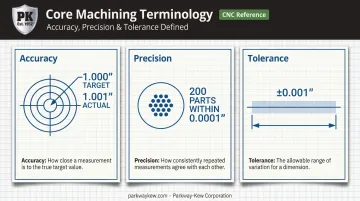
- Accuracy measures how close a single dimension lands to its target. A hole designed for 1.000 inch that measures 1.001 inches is highly accurate.
- Precision measures consistency across many units. If 200 parts all measure within a few ten-thousandths of each other, that's true precision, even if the average sits slightly off-target.
- Tolerance is the allowable range of deviation a designer specifies.
Here's the trade-off engineers often miss: over-specifying tight tolerances on features that don't need them drives cost up fast without improving function.
Machine Design reports that depending on the tolerance and geometry involved, cost can more than double compared to standard-tolerance work, driven by scrap risk, extra fixturing, slower cycle times, and added inspection. A good rule of thumb: reserve tight tolerances for function-critical features only.
Why Quality Control Systems Matter
Certifications create a structured framework for consistent output rather than a one-off lucky batch.
- ISO 9001 establishes a process-based quality management system covering quoting, production, inspection, and corrective action.
- AS9100D builds on that foundation with aviation, space, and defense-specific controls, including traceability and counterfeit-part prevention.
Certifications alone don't prove a shop's measurement claims are real, though. That's where Gage Repeatability & Reproducibility (GR&R) studies come in, separating variation caused by the measuring equipment from variation caused by different operators or conditions.
NIST cautions that a standard GR&R study isn't the same as full measurement uncertainty, so a passing GR&R percentage is a good sign, not a complete guarantee.
Types of Precision Machining Processes
No single machine handles every job. Matching the process to the part's geometry, material, and finish requirement is half the battle.
CNC Milling & Turning
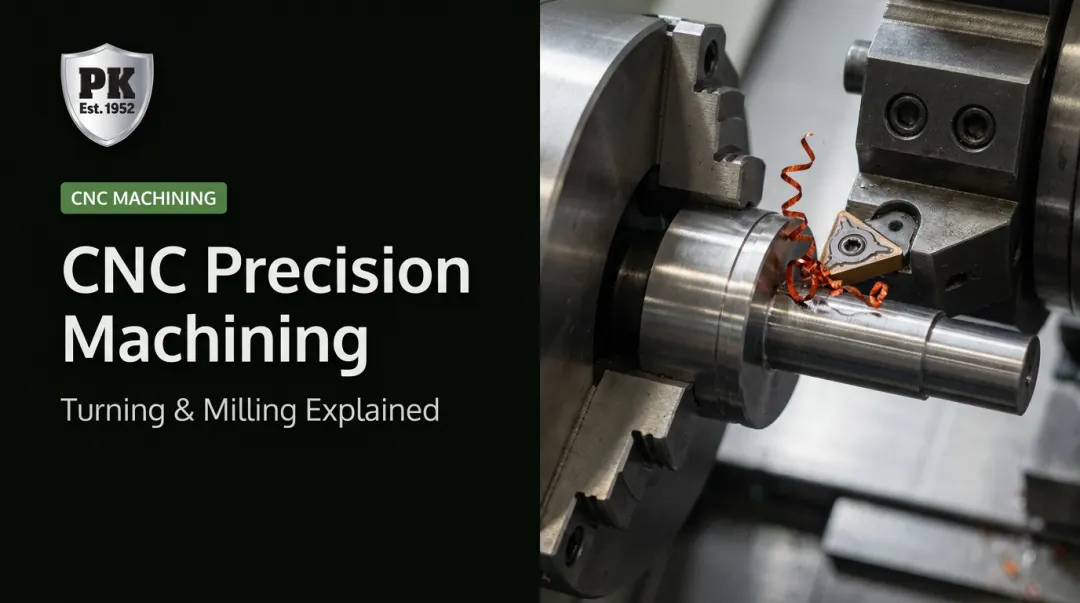
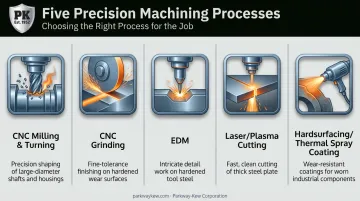
Multi-axis CNC mills and lathes remove material to create complex geometries: pockets, threads, contours, and rotational features alike. With enough rigidity and the right tooling, high-precision machines can hold tolerances down to a few microns. That said, axis resolution and finished-part tolerance are different metrics; a machine's spec sheet doesn't automatically translate into what a shop can guarantee on your actual part.
CNC Grinding
Grinding is a finishing process, not a roughing one. It shaves off tiny amounts of material with abrasive wheels to achieve tight tolerance surface finishes. This matters most on large-diameter cylindrical components like rollers, blocks, and shafts, where roundness and finish quality directly affect performance.
Shops handling oversized parts need grinding equipment built for scale. Parkway-Kew's large-diameter grinding department, for example, handles components up to 65 inches in diameter and 12 feet in length, supporting the heavy wire drawing blocks and industrial rollers common in its customer base.
EDM, Laser & Plasma Cutting
Three specialty processes cover the gaps that conventional cutting can't:
- EDM (Electrical Discharge Machining) uses electrical sparks to erode hardened, electrically conductive material into intricate shapes conventional tools struggle with.
- Laser cutting is a non-contact process ideal for fine detail work on thin sheet and plate.
- Plasma cutting uses a jet of superheated ionized gas to melt and eject material, but it's limited to electrically conductive metals.
Hardsurfacing & Thermal Spray Coating
Precision machining isn't limited to removing material. Value-added processes like HVOF, submerged arc welding, and plasma spray coating restore worn components back to exact tolerances while dramatically improving wear resistance.
Parkway-Kew pioneered submerged arc welding for hardsurfacing wire drawing blocks in the 1950s, then introduced HVOF coating for the same application in 1989 — a jump that produced a denser, virtually defect-free surface compared to earlier methods. These techniques matter most for heavy industrial equipment subject to constant wear, since restoring a worn part to spec often costs a fraction of full replacement.
Materials & Equipment Used in Precision Machining
The material and the equipment behind it determine what's achievable, and at what cost.
Common Materials
Machinability, strength, corrosion resistance, and wear demands all factor into material selection. Frequently machined metals include:
- Aluminum alloys
- Stainless steel
- Brass and bronze
- Copper alloys
- Titanium alloys
Common non-metals include ABS, nylon, PTFE, and polycarbonate — each offering a different balance of impact resistance, chemical resistance, and machinability.
Essential Tools & Equipment
A full-capability shop typically runs:
- Multi-axis CNC mills and lathes
- Grinding machines for finish and form control
- EDM, laser, and plasma cutting systems
- Coordinate measuring machines (CMMs) and micrometers for tolerance verification
Specialized shops like Parkway-Kew invest in thermal spray and HVOF equipment for coating-based precision work, capabilities most general job shops simply don't carry in-house.
Precision Machined Parts: Common Products & Industry Applications
Aerospace, Defense & Medical
Aerospace and defense manufacturing relies on precision machining for engine parts, landing gear, manifolds, and sensors, typically under AS9100 quality requirements. Medical device manufacturing carries similarly strict demands, producing surgical instruments and implantable hardware where tolerance failures aren't an option.
Electronics & Consumer Products
Dense, miniaturized electronics push tolerance requirements to their limit. Common applications include:
- Printed circuit boards
- Heat sinks and thermal management components
- Semiconductor manufacturing hardware
- Consumer electronics housings
Heavy Industrial, Oil & Gas, and Wire Manufacturing
Heavy equipment, fracking operations, and wire mills all depend on precision-machined, wear-resistant components to survive extreme abrasion and heat. Wire drawing blocks, capstans, and fracking plungers take constant punishment, and even small dimensional drift shortens service life fast.
Parkway-Kew's proprietary PK-730 fused tungsten carbide coating, developed for fracking plungers, addresses one of the industry's most persistent failure modes: off-center grinding that leaves plungers out of concentricity, causing vibration and scoring. The company's finishing process holds the plunger the same way it's clamped in the pump, keeping the wear surface true.
Shipping terminal equipment tells a similar story. Parkway-Kew's urethane-coated festoon wheels have logged 2 to 3 years longer service life than OEM equivalents in field testing, a small material change with an outsized effect on downtime.
Beyond heavy industrial settings, automotive and transportation manufacturing round out the picture, with engine and transmission components representing some of the highest-volume precision machining applications in the industry.
How to Choose the Right Precision Machining Partner
Picking a supplier shouldn't come down to who quotes the lowest price. A few factors separate reliable partners from risky ones.
- Track record and certifications. ISO 9001 and AS9100 are baseline indicators of consistency, but industry-specific experience and membership in trade organizations, such as Wire Association International, also signal credibility in a given sector.
- Breadth of in-house capabilities. Shops offering CNC milling, turning, grinding, and specialized coating under one roof cut out vendor handoffs and shorten lead times considerably.
- Value-added services. Wear-resistant coating and restoration processes extend component life and reduce downtime, which matters more than judging a partner solely on new-part fabrication.
Parkway-Kew illustrates this last point well. Since 1952, the company has served more than 500 companies worldwide, building its reputation less on volume and more on restoration expertise.
Its Restore & Grind process, for example, fills only the worn drawline area of a wire drawing block instead of grinding the entire surface down. This approach stretches a block's usable life through five to seven repair cycles before a full recoat is needed. That kind of specialized knowledge, built over seven decades, is hard to replicate overnight.
Frequently Asked Questions
What are precision machining products?
Precision machining products span nearly every industry, from aerospace and medical components to wire mill and oil & gas equipment. Any part requiring tight tolerances and repeatable quality falls into this category.
What are the different types of precision machining?
The main types include CNC milling, turning, and grinding, plus specialty processes like EDM, laser and plasma cutting. Hardsurfacing and thermal spray coating also count as precision processes for wear-critical parts.
What are the tools and equipment used in precision machining?
Core equipment includes CNC mills and lathes, grinding machines, and EDM or laser systems. Measurement tools like CMMs verify tolerances, while coating equipment handles wear-resistant applications.
What is the difference between precision machining and standard machining?
Precision machining emphasizes tight, repeatable tolerances backed by rigorous quality control. Standard machining allows looser tolerances suited to less critical applications where cost savings matter more than micron-level accuracy.
Which industries need precision machined parts the most?
Aerospace, defense, and medical sectors top the list due to safety-critical tolerances. Oil & gas, wire drawing, and shipping terminal operations follow closely, relying on precision parts for equipment longevity under heavy wear.
How much does precision machining typically cost?
Cost depends on material, tolerance requirements, part complexity, and production volume. Specifying tolerances tighter than the design actually requires is one of the fastest ways to unnecessarily inflate a machining quote.