Introduction
A wire drawing block that fails six months early doesn't just cost the price of a new block. It costs a production line, a maintenance crew scrambling on a weekend, and a customer wondering why their wire quality dropped.
In wear-critical industries, the hardfacing finish on a part determines whether it survives one season or five. Get the alloy or process wrong, and you're looking at premature failure, unplanned downtime, and a total cost of ownership that keeps climbing.
The stakes are real. A 2024 Siemens downtime study found that unplanned outages cost large industrial plants an average of $253 million per year, and heavy industry's hourly downtime cost quadrupled between 2019 and 2023. This guide breaks down how to pick the right welding finish for your part.
TL;DR
- "Welding finish" means hardfacing (SAW, HVOF, plasma spray, metallizing) for wear and corrosion protection, not cosmetics.
- Choice depends on wear environment, substrate compatibility, hardness needs, and tolerances.
- Choosing correctly reduces downtime, extends part life, and lowers long-term costs.
- Parkway-Kew has engineered hardfacing finishes for specific wear conditions since 1952.
What Is a Welding Finish in Industrial Hardfacing?
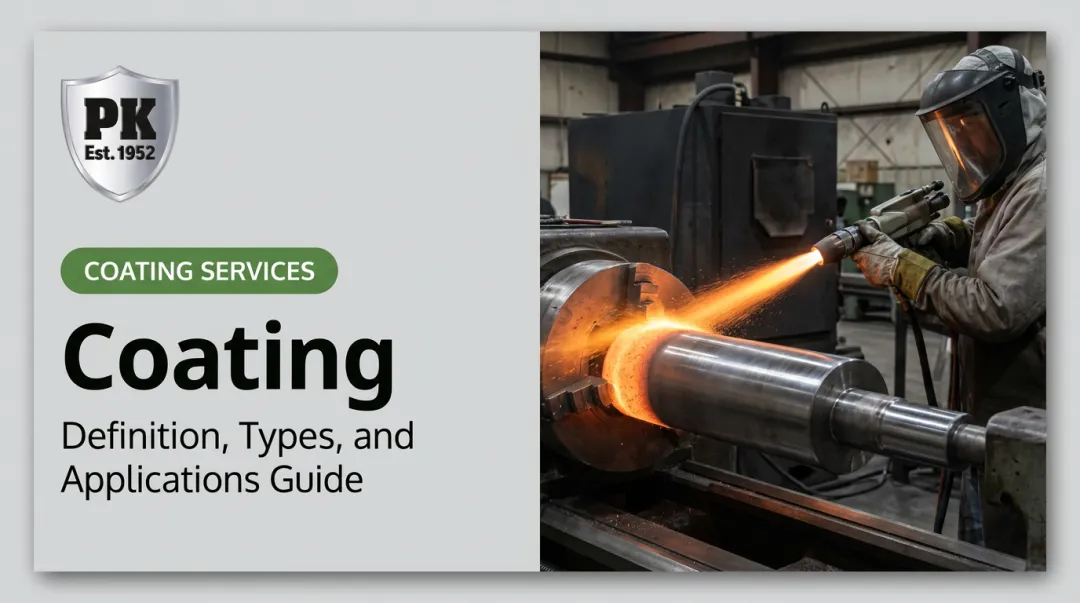
In industrial manufacturing, a "welding finish" isn't paint or polish. It's a wear-resistant metal overlay (deposited by welding or thermal spray) bonded to a component's surface to protect it from abrasion, corrosion, or heat before the base metal ever sees damage.
Four processes dominate this space:
- Submerged arc welding (SAW) hardfacing: a fusion-welding process that deposits thick overlays beneath a protective flux layer
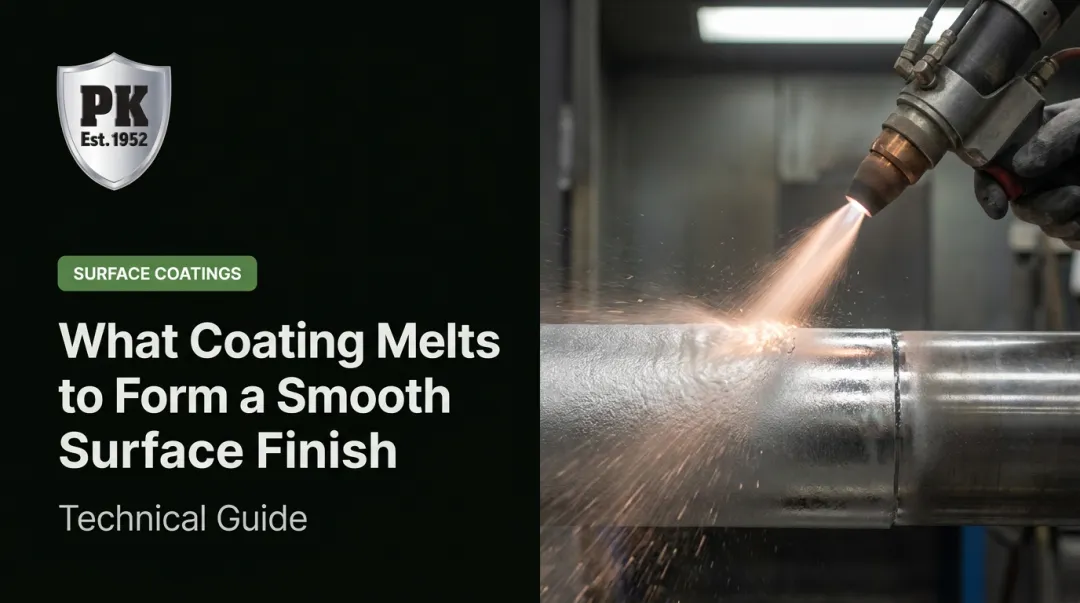
- HVOF (high-velocity oxygen fuel) coating: a thermal spray process that fires molten particles at supersonic speed to build dense, precise coatings
- Plasma spray: powder injected into an ionized gas plume and propelled onto the surface, useful for ceramics and heat-resistant materials
- Metallizing/thermal spray: conductive wire feedstock melted and sprayed for broad, cost-effective coverage
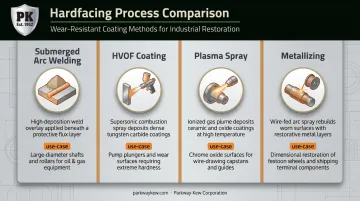
Each one produces a metallurgically or mechanically distinct bond. Confusing them is where a lot of selection mistakes start.
Core Components of an Industrial Hardfacing Finish
Every hardfacing job comes down to three technical decisions: how the surface is prepped, what alloy goes on it, and how it's applied. Get any one wrong and the whole finish underperforms.
Substrate Preparation
Cleaning, grinding, and pre-heating aren't optional steps: they're what determines whether the coating bonds or delaminates within months. According to Oerlikon's thermal spray surface preparation guidelines, blast profiles should be as fine as 3-8 µm Ra for HVOF, compared to 15-75 µm for combustion spray. Skip proper degreasing or blasting, and even a premium alloy will lift off the base metal early.
Overlay Alloy Selection
Tungsten carbide, chromium carbide, nickel chrome boron: the alloy choice sets the hardness ceiling and determines whether a part is built for abrasion, corrosion, or both. This is where most of the real engineering decision happens, and we'll dig into it in the next section.
Application Method & Thickness Control
A welded bead and a sprayed coating behave differently on precision components. Wire drawing blocks and capstans need tight, consistent thickness control. A sloppy deposition method here damages the wire being drawn, not just the block itself.
Why Heavy Industry Relies on the Right Hardfacing Finish
The right finish determines whether your maintenance schedule stays predictable or turns into constant firefighting. Operators who match the finish to the application see:
- Extended wear life: parts run longer between service intervals instead of wearing through prematurely
- Fewer change-outs: less unplanned downtime from emergency part swaps
- Better corrosion resistance: critical for fracking plungers and marine equipment exposed to aggressive fluids
- Lower cost than solid ceramics: coated components avoid the breakage and slippage risk that comes with solid ceramic parts
- Precision surface finish: smooth, consistent coatings that don't damage wire during high-speed drawing
Get any of these wrong, and the cost shows up later: extra downtime, wasted wire, and parts that fail long before they should.
What to Consider When Choosing the Best Welding Finish for Your Part
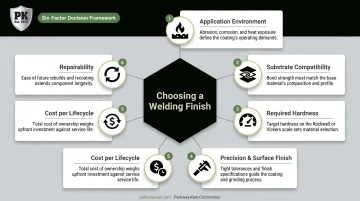
Finish selection isn't one-size-fits-all. It shifts based on industry, wear mechanism, and what the part actually does in service. The six factors below connect technical specs to outcomes you can measure on a maintenance report.
Factor 1: Application Environment (Abrasion, Corrosion, Heat)
Before picking an alloy, identify what's actually attacking the part. Is it friction from constant sliding contact? Chemical exposure from fracking fluid? Sustained high heat?
This single decision shapes everything downstream. It directly drives wear rate and mean time between failures (MTBF). Get the wear mechanism wrong, and you'll select an alloy that's strong in the wrong direction.
Factor 2: Substrate/Base Material Compatibility
Not every overlay alloy bonds equally well to every base metal. Some combinations create strong metallurgical adhesion; others set up long-term delamination risk.
- Key KPI: bond strength and delamination rate
- Steel substrates generally offer the widest compatibility range across SAW and HVOF processes
- Compatibility should be evaluated case-by-case, not assumed from a datasheet alone
Factor 3: Required Hardness and Wear Resistance Level
Higher hardness, measured in Rockwell C, typically extends service life, but it isn't the whole story. The American Welding Society notes that deposit hardness alone doesn't decide wear resistance; carbide percentage, particle characteristics, and distribution all matter too (AWS's hardfacing best practices guide).
- Key KPI: hardness rating paired with expected wear-life extension in operating hours or cycles
- A harder deposit can also mean higher brittleness risk under impact loads
- Chromium carbide systems, for instance, trade some hardness for service temperatures up to 870°C, versus roughly 500°C for tungsten carbide-cobalt-chromium systems
Factor 4: Precision and Surface Finish Requirements
Wire drawing blocks demand an exceptionally smooth, dimensionally accurate coated surface. A rough or inconsistent finish here doesn't just wear faster. It damages the wire passing over it.
- Key KPI: surface roughness (Ra) and dimensional tolerance
- HVOF-applied coatings, ground and finished properly, deliver the density and consistency this application demands
- Precision requirements are part-specific; a fracking plunger and a wire block have different tolerance needs
Factor 5: Cost per Part Lifecycle vs. Upfront Price
A cheaper finish upfront can end up costing more if it needs replacing every few months. Premium coatings often reduce total spend even though the invoice looks bigger on day one.
- Key KPI: cost-per-operating-hour and total cost of ownership
- Factor in downtime, labor for change-outs, and production losses — not just the coating invoice
- This is where the "cheapest option" trap catches a lot of maintenance budgets
Factor 6: Repairability and Restoration Potential
Finishes that can be restored rather than fully replaced offer serious long-term savings. This is a factor a lot of buyers overlook when comparing quotes.
- Key KPI: number of rebuild cycles achievable before full recoating is required
- Parkway-Kew's Restore & Grind process, for example, is engineered so only the worn drawline area gets filled and blended — not the entire coating stripped and reapplied
- This targeted approach can support multiple lower-cost repair cycles before a full recoat is ever needed
How Parkway-Kew Can Help
Parkway-Kew has been perfecting hardfacing and precision coating finishes since 1952 — long enough to have watched entire coating technologies come and go. That history matters when you're trying to choose a finish that has to work, not just look good on a spec sheet.
What sets Parkway-Kew apart from a generic coating shop:
- Pioneered submerged arc welding hardfacing for wire drawing blocks in the 1950s, a method that remains widely used for that application today
- First to introduce HVOF coating for wire drawing blocks in 1989, years ahead of broader industry adoption
- Proprietary PK-730 fused tungsten carbide coating, engineered specifically for fracking plunger applications in the harshest abrasive and corrosive conditions
- The Restore & Grind process, which blends targeted repairs seamlessly into existing coatings instead of requiring a full strip-and-recoat
- Urethane-coated festoon wheels field-tested to outlast OEM parts by 2-3 years
- In-house CNC milling, turning, and large-diameter grinding up to 65 inches in diameter and 12 feet in length, keeping precision machining and coating under one roof
For components like wire drawing blocks and fracking plungers, that combination of decades of application-specific experience and in-house finishing capability is what separates a finish that lasts from one that doesn't. Parkway-Kew's HVOF coating process guide breaks down the process in more detail.
Conclusion
The right welding finish matches your part's wear environment and hardness needs, then fits your production timeline — not whichever option is trending.
Weigh hardness and precision against cost-per-lifecycle, not just the number on the initial quote. A coating that's cheap upfront but fails in eight months isn't actually cheap.
Review finish performance periodically, not just when a part fails. Restoration processes like our Restore & Grind method, done right, can extend a coating's value well past its original service life.
Frequently Asked Questions
What is finishing in welding?
In industrial contexts, welding finishing refers to hardfacing or overlay processes applied after or during welding to boost wear resistance, hardness, or corrosion protection on a part's working surface.
What is the best welding finish?
There's no single "best" finish — it depends on the part's wear environment, required hardness, and precision needs. HVOF and SAW hardfacing are both strong options for high-wear industrial components, depending on whether density or thickness matters more.
What is the difference between HVOF and submerged arc welding hardfacing?
HVOF applies a thin, dense sprayed coating well-suited to precision components and corrosion resistance. SAW builds a thicker, highly durable weld overlay better suited for heavy abrasive wear on large surfaces.
How often should hardfaced wear parts be re-coated or restored?
Restoration frequency depends on operating hours and wear severity, so there's no fixed schedule. Processes like Restore & Grind let parts get renewed multiple times before a full recoat or replacement is necessary.
Can hardfacing be applied to any metal part?
Most steel and metal substrates can be hardfaced, but compatibility depends on the base material's composition and the part's geometry. A coating specialist should evaluate any unfamiliar substrate before committing to a process.
Which industries rely most on industrial hardfacing weld finishes?
Wire mills, oil and gas/fracking operations, heavy equipment manufacturers, and shipping terminal equipment operators all depend heavily on hardfacing finishes to keep wear-critical components running.