Newcomers researching machining often hit a wall of jargon almost immediately: G-code, feed rate, tolerance stack-up, ISO material groups. It's a lot before you even grasp the basic concept.
This guide breaks it down plainly. We'll cover what machining actually is, the core processes and tools behind it, the materials shops work with daily, and how to think about choosing the right process — or the right shop — for your project.
Key Takeaways
- Machining is subtractive manufacturing, removing material from solid stock to hit precise dimensions.
- Turning rotates the workpiece, while milling rotates the tool to shape most parts.
- CNC machining delivers repeatable precision at volume, while manual work still suits prototypes and repairs.
- Specialty shops pair cutting with grinding and hardsurfacing to extend part life in extreme-wear conditions.
What Is Machining?
Machining is a subtractive manufacturing process. A cutting tool removes material from a solid block of metal, plastic, or composite until what's left matches a specific design, down to thousandths of an inch in many cases.
Unlike casting or molding, where material is shaped while molten or soft, machining works on solid stock from the start. The result is a part with tight dimensional control and a repeatable finish, which is why it remains the go-to process for anything requiring precision fit.
That precision isn't a modern invention. The term itself traces back to the rise of machine tools during the industrial era. ASME, founded in 1880, formed specifically to address the technical challenges emerging from mechanization and factory-scale manufacturing.
By 1877, American Machinist was already covering an established machining trade. The profession was well underway more than 140 years ago, even if the word's exact origin isn't precisely documented.
The Two Fundamental Motions in Machining
Every machining operation comes down to two motions working together:
- Cutting: the actual removal of material as the tool's edge engages the workpiece
- Feeding: moving the tool or workpiece to continuously expose fresh material to the cutting edge
Three variables control how this plays out:
- Speed: how fast the cutting edge moves across the material surface
- Feed rate: how quickly the tool advances into the material
- Depth of cut: how much material is removed in a single pass
Get these three dialed in, and you get clean cuts, good tool life, and accurate parts. Get them wrong, and you get chatter, poor finishes, or a broken tool.
Why Precision Matters
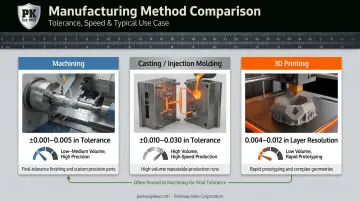
Precision is the entire point of machining. According to Modern Machine Shop, tolerances of +/-0.002 to 0.005 inch are generally easy for CNC shops to hold in production. Tighter bands of +/-0.001 to 0.002 inch demand closer attention to tool wear, especially across larger production runs.
Some specialist shops push even further, routinely holding tolerances under a micron for niche applications.
That level of control is hard to match with other manufacturing methods. Injection molding and casting can produce parts fast, but they can't consistently hit the same tight fits without secondary machining.
This is also where machining and 3D printing intersect rather than compete. Additive manufacturing builds parts layer by layer from a digital model, which is great for complex geometry and rapid iteration. But many production workflows still finish those printed parts with machining to hit final tolerances. The two methods complement each other more often than people expect.
What Do Machine Shops Do?
A machine shop takes raw stock or a blueprint and turns it into a finished part using lathes, mills, and drill presses. The industries relying on this work are broad: automotive, aerospace, energy, heavy equipment, and industrial repair all depend on machined components daily.
Not every shop operates the same way. Three general models exist:
- General job shops: low-volume, high-mix work; today a bracket, tomorrow a custom fixture
- Production machining: high-volume runs of identical parts, often for automotive or consumer goods
- Specialty shops: focused on niche repair, coating, or restoration work rather than one-off fabrication
Parkway-Kew Corporation falls into that third category. For over 70 years, the North Brunswick, NJ-based shop has combined in-house CNC turning and milling with proprietary thermal spray coating, including HVOF, plasma spray, metallizing, and submerged arc welding.
What sets this apart: most job shops cut and finish a part once. Parkway-Kew's machining departments handle parts with or without coatings. That means fabricating a solid tungsten carbide component from scratch, or restoring a worn wire drawing block by machining it, applying a wear-resistant coating, then finish-grinding it back to spec.
Their CNC and manual turning departments handle parts up to 72 inches in diameter, well beyond what most general shops accommodate. That capacity matters for the industries they serve:
- Oil & gas: fracking pump plungers coated with PK-62 nickel chrome or PK-730 tungsten carbide
- Wire mills: wire drawing blocks, capstans, and tuner rolls rebuilt with fuse welding and HVOF
- Shipping terminals: festoon wheels, crane wheels, and rope pulleys restored for extended service life
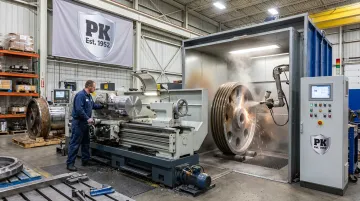
It's a model built around one idea: extending the life of expensive, wear-critical components rather than replacing them outright.
Types of Machining Processes
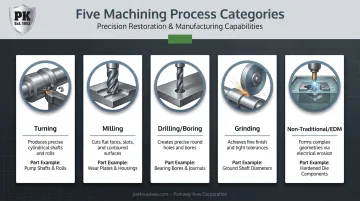
Machining processes fall into a few broad categories, generally grouped by the shape they create. Circular, symmetric shapes come from turning-based operations. Flat surfaces, slots, and complex 3D geometry come from milling-based operations. Then there's a smaller category of non-traditional methods reserved for materials too hard or delicate for conventional cutting.
Turning
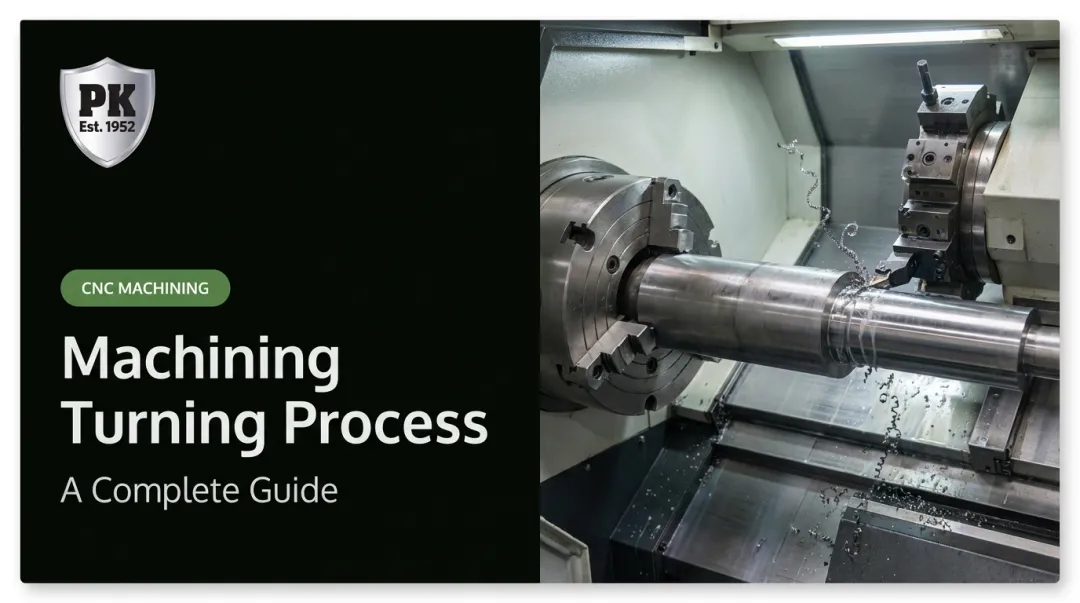
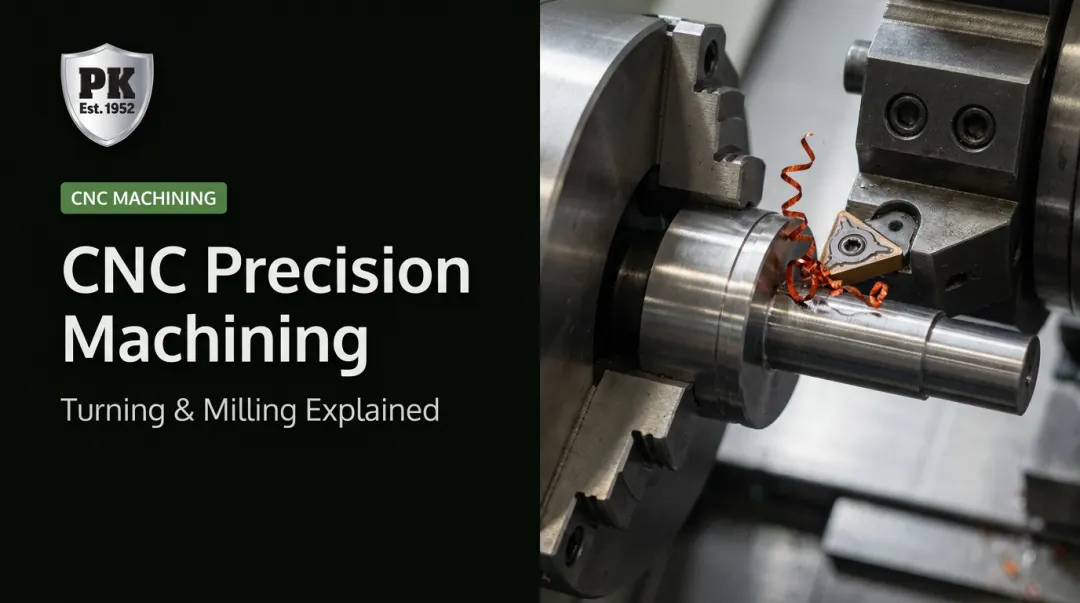
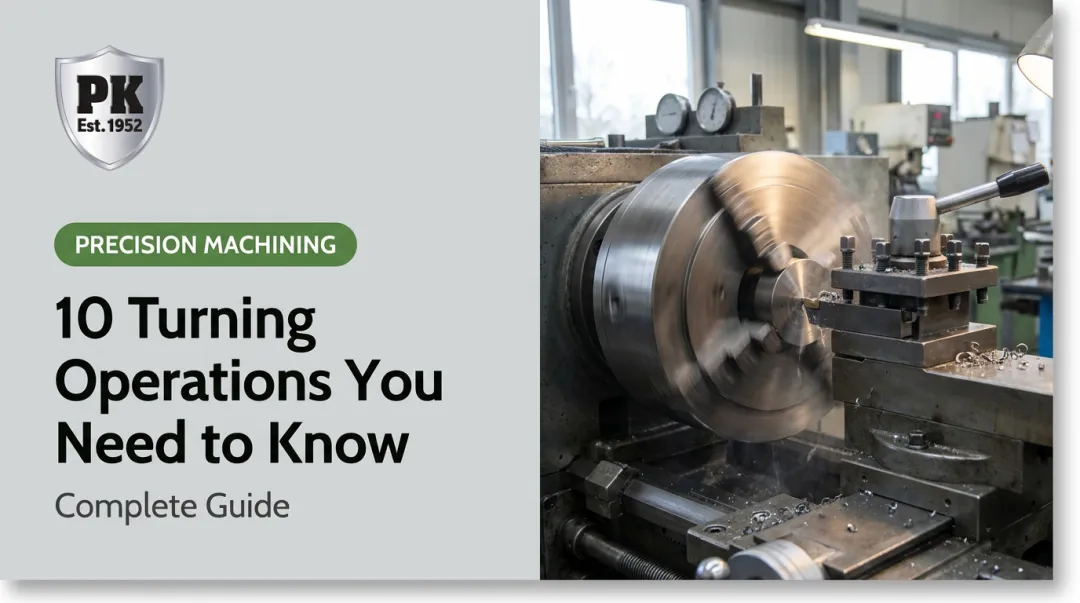
In turning, the workpiece rotates against a stationary cutting tool on a lathe. This makes it the natural choice for cylindrical parts: shafts, bushings, threaded rods, and round wear parts like wire drawing blocks.
CNC lathes add programmable precision to this process, allowing repeatable diameters and profiles across large production runs without an operator manually adjusting each pass.
Milling
Milling flips the motion: a rotating cutter removes material while the workpiece stays largely stationary (or moves in a controlled path). It's the most versatile process in most shops, capable of producing:
- Flat surfaces and shoulders
- Slots and pockets
- Complex 3D contours and profiles
- Threads and gear teeth
If a part isn't round, there's a good chance milling made it.
Drilling and Boring
Drilling creates round holes using a rotating drill bit. It's straightforward, fast, and common across nearly every part.
Boring is different: it enlarges or refines an existing hole to achieve precise diameter and concentricity. Boring is often the finishing step after drilling when a hole needs to hit a tight tolerance that drilling alone can't guarantee.
Grinding and Finishing Operations
Grinding uses an abrasive wheel rather than a single-point cutting tool, which allows it to achieve tighter tolerances and finer surface finishes than turning or milling alone. It's typically the last step before a part ships.
Most shops handle grinding on a modest scale. Parkway-Kew maintains large-diameter grinding capability up to 65 inches in diameter and 12 feet in length, sized specifically for oversized industrial components that have been coated and need precision finishing afterward. This is a niche capacity; plenty of general job shops simply can't accommodate parts that large.
Non-Traditional Machining (EDM and Beyond)
Some materials, such as hardened tool steel, resist conventional cutting entirely. That's where non-traditional methods come in.
Electrical discharge machining (EDM) uses rapid electrical discharges to erode material rather than physically cutting it. According to Makino, wire EDM is especially common in mold and die manufacturing, where intricate geometry and hardened materials make conventional milling impractical. Laser ablation works similarly, removing material layer by layer without any physical contact. This makes it useful for miniature molds, engravings, and textured surfaces.
Materials Used in Machining
Material choice shapes nearly every decision in the machining process, from tool selection to cutting speed to expected tolerance.
Common metals:
- Aluminum: lightweight, machines easily, widely used across industries; high-silicon grades run more abrasive
- Steel: generally good machinability, though it varies with hardness and carbon content
- Stainless steel: tougher to machine than standard steel, requiring more careful tool selection
- Titanium: strong and corrosion-resistant, but a larger share of cutting heat transfers into the tool, increasing wear
- Brass and copper: both machine relatively easily and are common in electrical and plumbing components
Common plastics and composites:
- Nylon and ABS: used in lightweight structural and consumer-facing parts
- PEEK: high-performance polymer for medical and electrical applications; carbon-fiber-reinforced versions are abrasive enough that some shops preheat it before cutting
- Fiberglass and carbon fiber: valued for strength-to-weight ratio in structural parts, though both wear tools down faster than metals and require diamond-coated or carbide tooling
Material selection ultimately comes down to hardness, thermal conductivity, and cost. Aluminum's forgiving nature makes it a default choice for prototyping, while titanium's heat sensitivity means shops build in extra tool-wear monitoring even on straightforward geometry.
Common Machine Shop Tools & Equipment
Before precision work even starts, raw stock needs sizing. Saws and shears cut bar stock or plate down to workable dimensions, prepping it for the lathe or mill.
From there, the core equipment splits into two categories:
- Manual lathes and mills — operator-controlled, ideal for one-off repairs, prototypes, and jobs where flexibility matters more than repeatability
- CNC-controlled lathes and mills — programmed toolpaths that hold tight tolerances across hundreds or thousands of identical parts
According to DATRON, CNC machining improves accuracy, repeatability, and efficiency across repeated production runs. Manual machining still depends heavily on operator skill, which is exactly why it remains the better choice for simple jobs or custom repair work where writing a CNC program isn't worth the time.
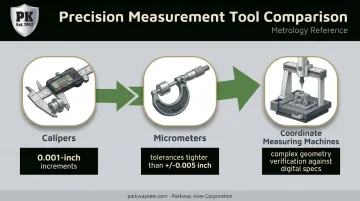
Once a part is cut, it still has to be checked. Quality control tools include:
- Calipers — general-purpose measurement, typically reading to 0.001-inch increments
- Micrometers — recommended once tolerance requirements tighten beyond +/-0.005 inch
- Coordinate measuring machines (CMMs) — combine a motion system and probe to verify complex geometry against digital specs
This full spectrum, from manual equipment to CNC systems to precision measurement, comes together in Parkway-Kew's own shop. The company runs manual and CNC turning departments alongside CNC milling in-house, with capacity to handle parts up to 72 inches in diameter for oil and gas, wire mill, and shipping terminal customers who can't afford downtime.
Frequently Asked Questions
What is a Machining Strategist?
Machining Strategist refers to CAM (computer-aided manufacturing) software used to generate and optimize CNC toolpaths from CAD models. It's a software tool, distinct from the human machinist who operates the equipment.
What is machining used for?
Machining produces precision parts across aerospace structures, engine components, medical devices, appliances, and industrial equipment repair. Anywhere tight tolerances matter, machining is likely involved.
What is the difference between machining and 3D printing?
Machining is subtractive: it removes material from solid stock. 3D printing is additive, building parts layer by layer. Many workflows use both: printing a rough shape, then machining it to final tolerance.
What's the difference between CNC and manual machining?
CNC machining uses programmed toolpaths for repeatable precision across large runs. Manual machining relies on operator skill, making it better suited to one-off prototypes and custom repairs.
What materials can be machined?
Metals, plastics, composites, wood, and even ceramics can all be machined, depending on the tool and process selected. Material hardness and thermal properties determine which approach works best.
How do I choose the right machining process for my project?
The right choice depends on material, required tolerance, part geometry, and production volume. Round parts favor turning, complex shapes call for milling, and high-volume runs favor CNC over manual methods. Shops with in-house turning, milling, and grinding, like Parkway-Kew's 72-inch machining capacity, can match the process to your exact specs.