Introduction
Industrial wheels and rims operate under conditions that accelerate failure fast. Crane wheels, festoon wheels, and wire rope pulleys face constant abrasion, heavy cyclical loads, and exposure to corrosive chemicals — and when their surface coatings fail, the damage goes well beyond cosmetic. Unprotected metal corrodes, tolerances drift, and replacement costs compound quickly.
Powder coating is one of the most widely used protective finishes for wheel components across manufacturing and heavy industry. It bonds to metal at the molecular level, resists chipping and chemical attack, and holds up in demanding operating environments where standard paint breaks down within months.
This article covers how powder coating is applied to industrial wheels, its real advantages and limitations, typical costs, how it compares to alternatives, and where high-wear applications require a more robust industrial coating solution.
Key Takeaways
- A 3-layer system (primer, color, clear coat) delivers significantly better corrosion resistance than single-layer liquid paint
- Aluminum rims need chemical stripping only; high-pressure blasting can warp alloy and create balancing issues
- Standard powder coating for automotive rims typically runs $98–$130 per rim, or $400–$520 for a set of four
- Powder coating can't be spot-repaired — any defect means stripping and recoating the entire rim
- Heavy-duty crane and shipping terminal wheels require industrial-grade coatings, not standard powder systems
Why Wheels Need More Than a Basic Coat
Wheels face a combination of threats that few other vehicle components experience simultaneously.
Research from the Colorado Department of Transportation found that magnesium chloride — the most widely used liquid de-icer — was 5–13 times more corrosive to steel than sodium chloride under SAE J2334 test conditions, and 1–2 times more corrosive to aluminum. The same study documented average annual wheel damage costs of $6,850 per trucking company — a figure that adds up fast across a fleet.
Steel vs. Aluminum: Different Failure Modes, Same Need for Protection
- Steel rims rust aggressively when exposed to moisture and chlorides — surface rust quickly advances to pitting and structural degradation
- Aluminum rims oxidize more slowly, but without protection, pitting corrosion and surface degradation still occur, and the oxidized surface becomes visually unsightly and harder to clean
- Both materials benefit from a sealed, durable coating system before corrosion takes hold
Corrosion isn't the only threat. Road debris impacts create micro-fractures in unprotected or thin coating systems, opening pathways for rust to spread laterally beneath the surface — often without visible signs until the damage is already advanced. A properly applied, sealed coating system breaks this cycle before it starts, protecting both the structural integrity and service life of the wheel.
How Powder Coating Works on Wheels: The Full Process
Getting powder coating right on wheels requires more preparation steps than most people expect. Skipping any of them is where problems originate.
Stripping and Surface Preparation
Existing coatings must be fully removed before new powder can be applied. Two primary methods exist:
- Chemical pretreatment — immersion in acid- or base-based stripping agents dissolves old coatings without mechanical force
- Mechanical pretreatment — sanding, brushing, or abrasive blasting removes coatings physically
Critical point for aluminum rims: Chemical stripping is the only safe option for alloy wheels. According to TIGER Coatings, high-pressure mechanical blasting can warp aluminum rims, creating balancing problems or rendering them unusable. After chemical stripping, a low-pressure "sweeping" blast at 2–3 bar using sharp-edged abrasive media roughens the surface to improve powder adhesion and removes residue.
Separate blasting booths per substrate material prevent cross-contamination and contact corrosion. An optional wipe-down with isopropanol, silicone cleaner, or acetone removes remaining separating agents — though wiping cloths on a roughened surface risks lint contamination.
The Coating Application Steps
Once the surface is clean and profiled, the process moves through several distinct stages:
- Masking: Screw holes, stop surfaces, and non-coat areas are covered to protect threads and mating surfaces
- Pre-baking (outgassing): Cast aluminum rims are heated to at least 20°C above the powder's curing temperature to drive out trapped moisture and gases from casting pores. Skipping this step causes pinholes and craters in the finished coat
- Primer application: A corrosion-protective primer is applied and "gelled" (50–70% of full cure time) rather than fully cured — improving inter-coat adhesion and saving energy
- Color/effect basecoat: Applied directly over the gelled primer
- Clear coat: Acrylic or polyurethane-based clear coats resist aggressive rim cleaners and winter conditions while protecting metallic and effect pigments from abrasion
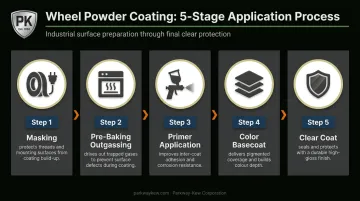
Each layer in this system serves a specific function — cutting any of the three compromises both protection and finish quality.
Key Advantages of Powder Coating Wheels
Powder coating offers wheel-specific advantages that liquid paint struggles to match — from corrosion protection to finish variety. Here's how each benefit breaks down.
Corrosion and Weather Resistance
The thick, uniform powder coat film creates a sealed barrier against road salt, moisture, de-icing chemicals, and UV radiation. PPG's HTE MAX Wheel White powder coating achieves 3,000 hours of ASTM B-117 salt spray resistance — a benchmark single-layer liquid paint systems cannot approach. The multi-layer system with an epoxy primer is especially effective: the primer provides a corrosion-resistant foundation even if the outer layers sustain surface damage.
Mechanical Durability
Powder coating's cross-linked polymer structure resists stone chip damage, scratches, and impact significantly better than conventional wet paint. The Powder Coating Institute notes that powder finishes reduce the risk of chipping, abrasion, and surface wear — a practical advantage on road-facing wheel surfaces that absorb constant debris impact. Fewer chips means fewer pathways for rust to start.
Chemical Resistance
Wheels get cleaned with some of the harshest products in any car care routine — pH-aggressive brake dust removers, wheel brighteners, and road film strippers. A properly formulated acrylic or polyurethane clear coat over powder survives this routine without losing gloss or adhesion, making it a durable option for fleet vehicles and daily drivers alike.
Aesthetic Versatility
Powder coating supports a wide range of colors, textures, and effects: metallics, pearls, gloss, matte, satin, bi-color, and more. The finish is solvent-free, meaning no volatile organic compounds (VOCs) during application — an environmental advantage over liquid paint systems.
Honest Drawbacks
Two limitations are worth knowing before committing:
- Spot repairs aren't possible. Hardened powder coating can't be blended or touched up locally. Any defect typically requires full recoating.
- Ultra-smooth or intensive metallic effects are still easier to achieve with wet paint. Modern powder technology has narrowed this gap, but liquid paint retains an edge on the most demanding high-gloss or complex-flake finishes.
Powder Coating Costs: What to Expect
Per-Rim Pricing
Per TIGER Coatings' published guidance, a standard 3-layer powder coating job (pre-treatment, primer, color, clear coat) typically runs $98–$130 per rim — putting a set of four in the $400–$520 range for standard finishes. Specialty work pushes costs higher:
| Finish Type | Relative Cost |
|---|---|
| Standard solid color, 3-layer system | $98–$130/rim |
| Metallic or pearl effects | Higher |
| Bi-color or two-tone | Significantly higher |
| Polishing + powder combination | Significantly higher |
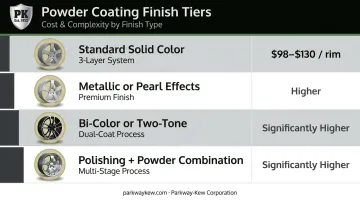
These figures reflect manufacturer guidance rather than a comprehensive market survey; actual shop pricing varies by region, shop volume, and current demand.
What Drives the Cost
- Rim size and material — Larger rims cost more to process; aluminum requires additional chemical pre-treatment steps
- Extent of pre-treatment needed — A rim that just needs a light scuff costs less than one requiring full chemical strip and corrosion remediation
- Finish complexity — Bi-color work or high-effect metallics require additional masking, application steps, or multiple curing cycles
- Turnaround time — A complete job from stripping through final cure can take 10–15 working days at a shop operating at capacity
The Value Proposition
Compare the one-time cost of quality powder coating against the recurring cost of touch-up painting, rust treatment, or full rim replacement. A properly applied 3-layer system on a well-prepped rim can last 10–15 years under normal road conditions with basic maintenance. Touch-up paint, by contrast, typically degrades within 1–2 years — making powder coating the lower-cost option over any wheel's full service life.
Powder Coating vs. Other Wheel Coating Options
| Option | Strengths | Limitations |
|---|---|---|
| Powder coating | Best overall durability, corrosion resistance, wide finish range, no VOCs | Spot repairs not possible; very smooth metallics harder to achieve |
| Wet/liquid paint | Easier spot repair, broader high-effect metallic range | Less durable, solvent-heavy, chips more readily |
| Hard anodizing | Creates an oxide layer integral to aluminum; excellent hardness | Aluminum only; limited color options; sealed layers can reduce wear resistance |
| Chrome plating | High visual impact | Significant environmental and regulatory concerns (hexavalent chromium); edge corrosion at scratches |
Clear Coats and Ceramic Top Layers
Acrylic and polyurethane clear coats work well as the top layer in a powder system or as a maintenance product over existing finishes. Consumer ceramic coatings can be applied over powder for additional protection, but they don't replace a full primer-color-clear powder system for base-level corrosion resistance.
For automotive wheel applications, the powder system is the foundation. A ceramic coat is an optional additive layer on top — not a substitute.
Industrial Wheel Applications: When Powder Coating Isn't Enough
Automotive powder coating is engineered for a specific performance envelope: corrosion protection and aesthetic durability under normal road conditions. Industrial wheels operate in a different category entirely.
The Performance Gap
Festoon wheels in overhead conveyor systems, crane wheels at shipping terminals, and wire drawing capstans face conditions that would destroy an automotive powder coat within weeks:
- Continuous heavy rolling contact under loads from crane trolleys carrying shipping containers
- Marine and industrial chemical exposure — saltwater spray, lubricants, airborne port contaminants
- High-cycle mechanical fatigue with minimal downtime for recovery between shifts
- Abrasive wear patterns concentrated in specific contact zones that deepen predictably over time
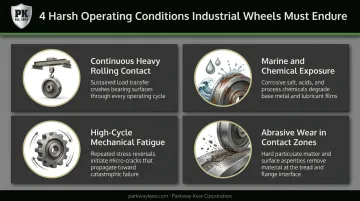
Standard powder coatings wear through quickly in these environments, turning a cost-saving measure into an expensive maintenance cycle of frequent replacements and operational downtime.
Advanced Coating Technologies for Industrial Wheels
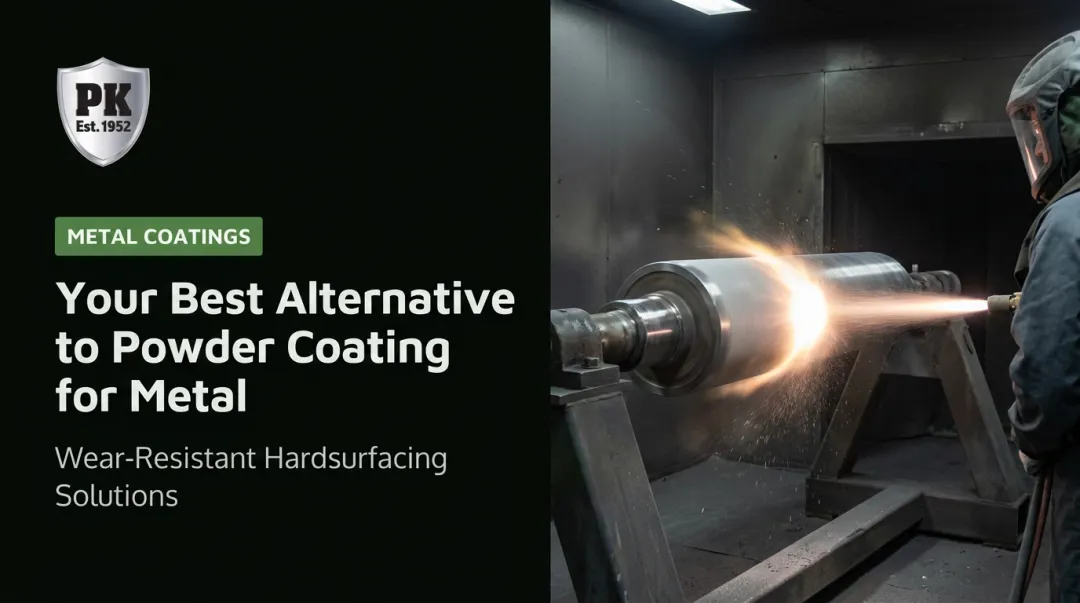
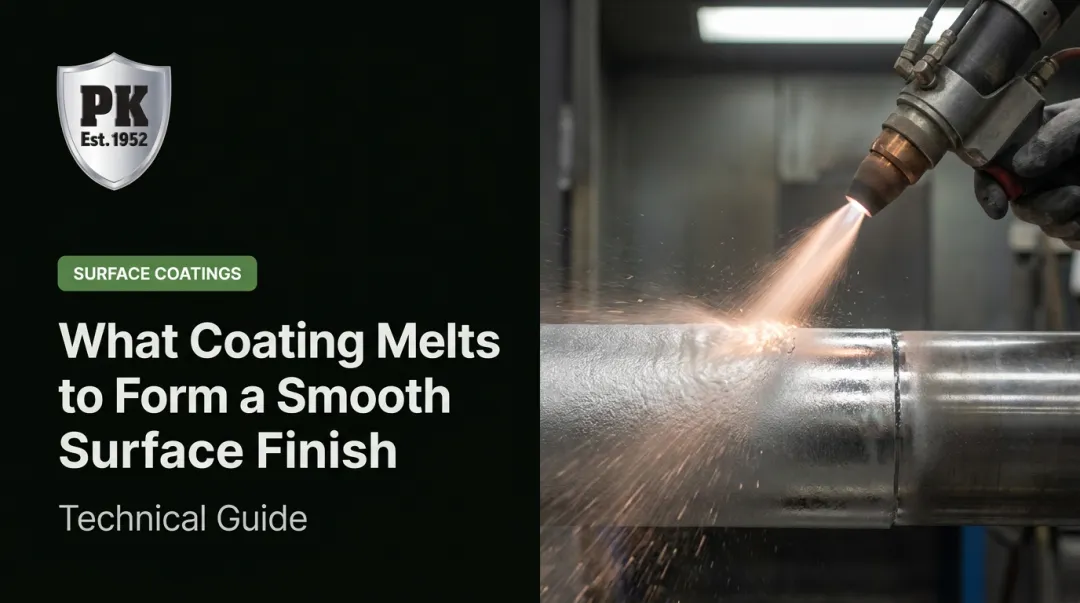
HVOF (High Velocity Oxygen Fuel) coatings, applied at speeds exceeding Mach 2, produce hard, dense films with porosity typically below 0.5% — well beyond what any powder coating system achieves. Tungsten carbide HVOF coatings reach microhardness values suited for sustained metal-on-metal wear environments.
Plasma spray and proprietary alloy coatings extend this further, covering wear profiles that HVOF alone may not address in every application.
For overhead crane and shipping terminal applications, Parkway-Kew Corporation — operating out of North Brunswick, NJ since 1952 and serving 500+ companies worldwide — manufactures and rebuilds urethane coated festoon wheels that deliver service lives 2 to 3 years longer than OEM wheels, validated through repeated field testing. Their crane wheel rebuilding and wire rope pulley restoration work applies HVOF, plasma spray, and proprietary alloy coatings — including tungsten carbide grades PK-675, PK-700, and PK-750 — to components that cannot afford the performance limitations of conventional powder systems.
For industrial operators dealing with premature wheel failure in port operations, wire mills, or heavy crane environments, the decision comes down to matching coating technology to actual operating conditions. Specifying the right thermal spray process upfront avoids the recurring cost of premature failure and unplanned downtime.
Frequently Asked Questions
What is the best coating for rims?
Powder coating is the best overall solution for most automotive rims, combining strong corrosion resistance, mechanical durability, and a wide finish range. For near-OEM high-gloss results, a powder primer with a liquid clear coat can close the aesthetic gap. Industrial rims under heavy mechanical wear require HVOF or thermal spray coatings.
What is the most corrosion-resistant plating for wheels?
Multi-layer powder systems with an epoxy primer offer the strongest automotive corrosion protection; PPG's wheel powder achieves 3,000-hour ASTM B-117 salt spray resistance. For extreme industrial environments, HVOF-applied tungsten carbide or chromium oxide coatings with a sealed bond coat deliver the highest wear and corrosion resistance available.
How long does powder coating last on rims?
Under normal conditions, a properly applied multi-layer powder coating typically lasts 5–15 years, with well-maintained wheels reaching 15+. Surface prep quality, coating thickness, and clear coat application are the main factors that determine longevity.
Can both steel and aluminum rims be powder coated?
Yes. Both materials are compatible with powder coating, but the pre-treatment process differs. Aluminum rims must be chemically stripped — not mechanically blasted at high pressure — to avoid warping. Steel rims can tolerate either chemical or mechanical stripping before coating.
How much does it cost to powder coat a set of four rims?
Standard 3-layer automotive powder coating runs $400–$520 for a set of four rims, or roughly $98–$130 per rim. Specialty finishes such as bi-color, high-effect metallics, or polishing combinations push costs higher, as do larger rim sizes and extensive pre-treatment work.
What are the disadvantages of powder coating rims?
Two main limitations apply. First, spot repairs aren't practical — hardened powder coating can't be blended or touched up locally, so defects typically require full recoating. Second, very smooth or intensively metallic finishes are still somewhat easier to achieve with wet paint, though modern powder technology has substantially narrowed this gap.