Get the distinction wrong, and you might spec a coating built for salt spray on a part that's actually failing from galvanic contact between dissimilar metals — or the reverse. That mismatch shows up later as unplanned downtime, premature part replacement, and coating budget spent on the wrong fix.
The stakes are real. Corrosion now costs the global economy more than $2.5 trillion annually, and proven control practices could recover up to 35% of that. Here's exactly where rust ends and corrosion begins, so you can match the right protection to the right equipment.
Key Takeaways
- Corrosion is the umbrella term for material decay; rust refers only to iron oxidation.
- Aluminum, copper, and plastics corrode, but only iron and steel can rust.
- Ferrous parts need targeted rust protection; mixed-metal assemblies need broader corrosion control.
- HVOF and hardfacing coatings guard ferrous components against both wear and rust.
Corrosion vs Rust: Quick Comparison
Before covering the mechanics, here's how the two terms stack up side by side:
| Factor | Corrosion | Rust |
|---|---|---|
| Scope | Metals, polymers, ceramics, wood | Iron and iron alloys only (steel) |
| Cause | Any chemical/electrochemical reaction: acids, salts, galvanic contact | Iron reacting with oxygen and moisture |
| Appearance | Varies by material — green patina on copper, white powder on aluminum | Consistent reddish-brown, flaky texture |
| Byproduct | Oxides, sulfides, or hydroxides depending on the material | Iron oxide, exclusively |
| Prevention | Material substitution, cathodic protection, coatings, environmental control | Galvanizing, painting, hardfacing, ferrous-specific coatings |
Every rust problem is a corrosion problem, but not every corrosion problem involves rust. That one-way relationship is the whole distinction.
What Is Corrosion?
Corrosion is the chemical or electrochemical deterioration of a material reacting with its environment. AMPP's own definition covers metals, polymers, and ceramics, not just steel, which is why the term applies to everything from copper busbars to composite housings.
For manufacturing and heavy equipment operators, diagnosing the actual mechanism is what lets an engineer pick the right resistant material or coating before a part fails, not after. Misread the failure mode, and the fix won't match the cause. The same failure just repeats.
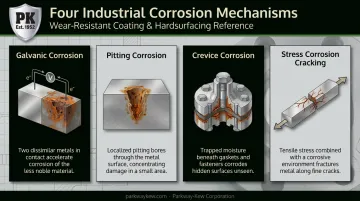
Four mechanisms show up repeatedly on industrial equipment:
- Galvanic corrosion: two dissimilar metals electrically coupled in a corrosive electrolyte, where one metal sacrifices itself to protect the other
- Pitting corrosion: localized attack that bores small cavities into an otherwise healthy-looking surface
- Crevice corrosion: hidden attack under gaskets, washers, fasteners, or deposits where stagnant fluid collects
- Stress corrosion cracking: cracking driven by tensile stress combined with a specific corrosive environment
Use Cases of Corrosion
Corrosion risk concentrates in a handful of industries: oil and gas production, shipping terminal equipment, wire mills, and earth-moving machinery. These operators run components in near-constant contact with aggressive chemicals, salt air, or dissimilar-metal assemblies.
Fracking is a clear example. Plunger components sit inside pumps forcing corrosive, abrasive well fluids down bore under extreme pressure.
A generic wear coating won't survive that combination for long. That's the exact problem Parkway-Kew's PK-730 fused tungsten carbide coating was engineered to solve: a fused, metallurgically bonded coating built for plungers facing abrasion and corrosive fluid exposure at once.
The financial exposure isn't small, either. A benchmark industry study estimated annual direct corrosion cost in U.S. oil and gas production at $1.372 billion, underscoring how quickly damage costs escalate in a single sector.
What Is Rust?
Rust is corrosion's most specific subtype: it only happens to iron and iron alloys like steel, when they react with oxygen and moisture to form iron oxide. Nothing else rusts. Aluminum, copper, and stainless steel corrode through entirely different chemistry.
That narrow definition matters because most heavy industrial equipment is iron-based. Wire drawing blocks, capstans, and structural steel at shipping terminals are all ferrous, meaning rust, not generic corrosion, is usually the actual threat in front of you.
Treating rust as rust, rather than defaulting to a broad corrosion-control strategy, lets you choose more targeted, cost-effective protection. Galvanizing, painting, and hardfacing are all purpose-built for ferrous surfaces, and they typically cost less than blanket corrosion measures designed for mixed-metal risk.
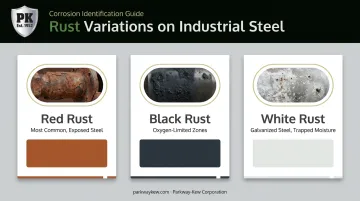
Rust isn't a single uniform product, either. Three variations turn up on industrial equipment:
- Red rust: the classic reddish-brown, flaky iron oxyhydroxide, and the most common form on exposed steel
- Black rust: magnetite (Fe3O4), a darker, denser oxide that forms in oxygen-limited zones, sometimes underneath the red layer
- White rust: not iron rust at all, but a zinc corrosion product on newly galvanized steel when moisture gets trapped between stacked or nested parts
Use Cases of Rust
Rust develops wherever ferrous components sit in constant contact with water, humidity, or process lubricants. Wire drawing blocks and capstans are a textbook case. They run continuously through coolant and drawing lubricant, and any break in the surface coating exposes bare steel to exactly the conditions rust needs.
Structural steel at shipping terminals faces similar exposure, just from marine humidity and salt air instead of process fluid. Wire mills and heavy equipment manufacturers running iron and steel components in constant water or coolant contact are the operations most exposed to this specific failure mode.
There's no single, well-supported statistic pinning down exactly what share of manufacturing failures traces back to rust alone; most published corrosion-cost data covers corrosion broadly, not rust in isolation. What decades of field experience do show: once a wire drawing block's coating breaches and bare steel starts drawing moisture, that part's usable life starts running out fast.
Which Should You Prioritize: Corrosion or Rust Protection?
Deciding between rust-specific protection and a broader corrosion-control strategy comes down to three questions:
- Material composition — Is the component ferrous (steel, cast iron) or a mixed-metal, non-ferrous assembly?
- Operating environment — How much moisture, chemical exposure, or temperature swing does the part actually see?
- Cost comparison — Does the coating investment cost less than the downtime and replacement cost of doing nothing?
As a general rule: iron and steel components like wire drawing blocks and capstans call for rust-specific protection — galvanizing, hardfacing, or HVOF coatings built for ferrous surfaces. Mixed-metal or non-ferrous assemblies need a broader corrosion-control approach: material substitution, cathodic protection, or environmental controls.
A Decision Parkway-Kew Was Built On
This isn't theoretical. It's how Parkway-Kew started. In 1952, CF&I's wire mill in Roebling, NJ, had 100 Vaughn wire drawing blocks worn down to the point of failure, vulnerable to both wear and rust.
Founder Eugene Walter Klein, then a welding supply salesman, identified the fix: a hardfacing wear-resistant weld alloy already proven on earth-moving equipment, not a generic corrosion treatment.
He tested the concept on a single piece in his own garage, then landed the order to rebuild all 100 blocks. That decision, matching a purpose-built ferrous protection method to a ferrous problem, became the foundation for a company now serving 500-plus manufacturers across North America.
The same logic holds today. Parkway-Kew's proprietary Restore & Grind process fills and blends only the worn drawline area of a wire drawing block instead of grinding down the entire surface.
That targeted approach delivers 5 to 7 lower-cost repair cycles before a block ever needs full recoating. It's a direct payoff of matching the repair method to the specific ferrous wear-and-rust problem instead of applying a blanket fix.
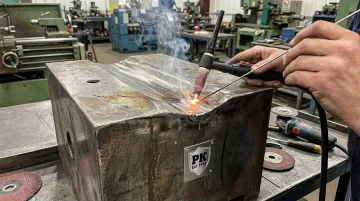
Cost reality: generic protection is rarely the cheapest option once downtime and replacement cycles are counted. Purpose-built hardsurfacing (HVOF, plasma spray, or hardfacing) consistently outperforms one-size-fits-all coatings on heavy-wear ferrous components.
If you're running wire drawing blocks, capstans, or other high-wear ferrous equipment and aren't sure whether you need rust-specific or broader corrosion protection, Parkway-Kew's engineering team can evaluate your components and recommend a coating strategy. Reach them at (732) 398-2100 or info@parkwaykew.com.
Conclusion
Corrosion is the umbrella term for any material's chemical or electrochemical breakdown; rust is the specific iron-oxide subset of it, limited to ferrous metals reacting with oxygen and moisture. Confusing the two leads to mismatched coatings, wasted budget, and equipment that fails sooner than it should.
For manufacturers running iron and steel components (wire drawing blocks, capstans, structural steel), correctly identifying rust versus broader corrosion determines the right fix:
- Rust alone: galvanizing or hardfacing usually solves the problem
- Broader corrosion: cathodic protection or material substitution may be necessary
Getting that call right before the coating goes on keeps downtime, replacement cycles, and total cost of ownership under control. Parkway-Kew's HVOF, plasma spray, and hardfacing services are built around matching the coating to the actual failure mode.
Frequently Asked Questions
What is the difference between rust and corrosion?
Corrosion is the broad term for any material's chemical or electrochemical breakdown when exposed to its environment. Rust is one specific type of corrosion, limited strictly to iron and iron alloys reacting with oxygen and moisture.
What is an example of corrosion and rusting?
Green patina forming on a copper roof is corrosion — a copper-specific reaction with air and moisture. Reddish-brown flaking on an exposed steel wire drawing block is rust, iron oxide forming once the coating wears through.
Does aluminum rust or corrode?
Aluminum can't rust since it has no iron content. It does corrode, though, typically forming a thin protective aluminum oxide layer that shields the metal underneath from further damage.
Can stainless steel rust?
Stainless steel resists rust thanks to a chromium oxide layer on its surface. That layer can break down from chloride exposure, welding scale, or surface contamination, allowing visible rust spots to form.
How can coatings like HVOF or hardfacing help prevent both corrosion and rust on industrial equipment?
Thermal spray, HVOF, and hardfacing build a dense, metallurgically bonded barrier over the base metal, blocking moisture and corrosive agents from reaching it. That barrier protects ferrous components from rust and non-ferrous ones from broader corrosion in one application.
How quickly does corrosion damage industrial equipment?
Corrosion rates depend on the metal, environment, and moisture exposure, ranging from years in mild conditions to just weeks in harsh marine or chemical settings. Regular inspections catch early-stage damage before it compromises structural integrity or forces a costly replacement.