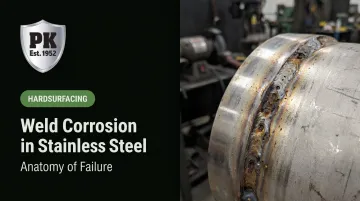
Welding disrupts the very chemistry that makes stainless steel "stainless." Heat drives chromium out of solution near the joint, leaving behind a weaker, more vulnerable microstructure long before any rust becomes visible.
Understanding this metallurgical chain of events, not just the symptoms, is what separates a fabricator who prevents leaks from one who chases them. This guide walks through why welds corrode, the warning signs that precede failure, and the prevention steps that actually hold up in service.
Key Takeaways
- Sensitization and heat tint deplete chromium near the weld, driving most stainless corrosion — not weld quality.
- Base metal, HAZ, and fusion zone each age differently under heat, creating uneven corrosion resistance.
- Low-carbon/stabilized grades, controlled heat input, and post-weld passivation prevent most failures.
- Ignored corrosion signs escalate to pitting, intergranular cracking, and structural failure in chloride-rich environments.
The Anatomy of a Weld Failure: How Corrosion Begins
Weld corrosion doesn't strike randomly. It follows a metallurgical sequence tied directly to heat exposure and how quickly the metal cools through specific temperature bands.
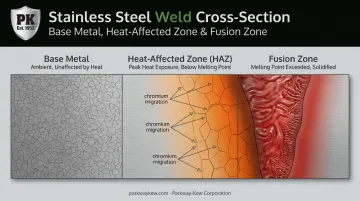
Understanding the Three Zones of a Welded Joint
Every stainless weld creates three distinct regions, and each behaves like a different material once the arc goes out:
- Base metal: Stays largely unaffected by welding heat and retains its original annealed structure and composition.
- Heat-affected zone (HAZ): Heated close to melting without actually melting, this band undergoes the most microstructural change.
- Fusion zone: The melted and re-solidified region, where filler metal and base metal mix through dilution.
The HAZ is the troublemaker. It experiences peak temperatures long enough for atoms to migrate and react, but never melts and re-homogenizes the way the fusion zone does. That combination of high heat without melting creates the exact conditions for chromium to abandon its post at the grain boundaries.
Sensitization and Galvanic Attack: The Root Mechanism
When austenitic stainless steel sits in the 425–815°C (797–1499°F) range for even a few minutes, chromium migrates toward carbon atoms at grain boundaries and forms chromium carbides, according to a 2011 failure analysis of a weld-decayed austenitic stainless steel.
That temperature window isn't a strict universal law: alloy chemistry and dwell time shift the boundaries. Still, it's the range fabricators need to respect.
Here's the problem: those carbides pull chromium from the metal immediately surrounding the grain boundary, not from far afield. The result is a chromium-depleted strip running along every grain boundary in the HAZ.
That depleted strip becomes anodic relative to the chromium-rich matrix around it. Introduce an electrolyte (moisture, chlorides, or process fluid) and you've built a galvanic cell right into the joint. The depleted boundary corrodes preferentially while the surrounding grains stay intact.
A lesser-known variant deserves mention: knife-line attack. In titanium- or niobium-stabilized grades like 321 and 347, the fusion line reaches temperatures high enough to dissolve the stabilizing carbides.
If that same narrow band later reheats into the sensitizing range, chromium carbides can precipitate there instead, producing a razor-thin corrosion path right beside the weld. Extra-low-carbon versions of 347 resist this more effectively.
Common Causes of Weld Corrosion in Stainless Steel
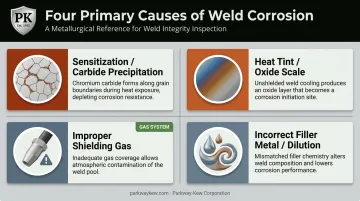
Most weld corrosion failures trace back to one or more of four root causes, and they often compound each other on a single bad joint.
Cause 1: Sensitization and Carbide Precipitation
Prolonged dwell time in the sensitizing range (during welding or slow post-weld cooling) triggers the carbide formation described above. This shows up most often in:
- Multi-pass welds, where later passes reheat earlier ones
- Thick sections that cool slowly by nature
- Joints without adequate heat sinking or cooling control
Cause 2: Heat Tint and Oxide Scale
Atmospheric oxygen reacts with hot metal near the weld to form heat tint, a chromium-depleted oxide layer sitting on top of already-compromised base metal. It typically appears as blue, brown, or gray discoloration fanning out from the bead.
Fabricators frequently dismiss this as cosmetic. It isn't. Dark blue and gray heat-tint colors in particular carry far lower corrosion resistance than the surrounding surface, since chromium diffuses outward into the oxide rather than staying in the metal where it belongs.
Cause 3: Improper Shielding Gas or Contaminated Welding Environment
Inadequate shielding or backing gas coverage lets atmospheric oxygen reach the molten and cooling weld, producing oxidation and porosity that weaken the passive layer. Typical culprits include:
- Root-side purging skipped entirely on pipe welds
- Drafty shop conditions blowing away shielding gas coverage
- Worn gas nozzles or damaged hose connections going unnoticed
Cause 4: Incorrect Filler Metal or Excessive Dilution
Fusion-zone chemistry is a blend of filler metal and melted base metal. Get that balance wrong (mismatched filler chemistry, excessive dilution, or standard non-low-carbon filler on 304L/316L base metal), and the weld deposit ends up lacking the chromium/nickel balance needed for corrosion resistance.
Welding dissimilar grades without adjusting filler selection is a common way this slips through.
What Happens If Weld Corrosion Is Ignored
Left unaddressed, sensitization and heat tint don't stay cosmetic problems. They progress into intergranular corrosion, pitting, and eventually stress corrosion cracking, especially in chloride-rich environments like marine equipment, food processing brine, or chemical piping.
The operational fallout is expensive and disruptive:
- Unplanned downtime for emergency weld repairs
- Product contamination risk in food and pharmaceutical piping
- Safety exposure in pressure vessels and process piping
Warning Signs You're About to Experience Weld Corrosion
Early detection is the difference between a grinding job and a full section replacement. Watch for:
- Visible discoloration: Rainbow or heat-tint coloring along the bead that was never cleaned up after welding.
- Localized rust staining or pitting: Concentrated along the HAZ band rather than spread across the base metal.
- Surface roughness or micro-cracking: Often surfaces during routine inspection near weld seams, before any visible leak develops.
How to Prevent Weld Corrosion in Stainless Steel Welds
Prevention works as a system, with material selection, welding technique, and post-weld treatment reinforcing each other rather than any single fix carrying the whole load.
Prevention Measure 1: Select Low-Carbon or Stabilized Grades
Specifying "L" grades — 304L, 316L — with carbon capped at 0.03% starves the sensitization reaction of the carbon it needs. Titanium- or niobium-stabilized grades (321, 347) achieve a similar result by tying up carbon before it can form chromium carbides. This decision belongs at the design and material-spec stage, driven by the corrosive service the part will actually see. The added material cost is typically marginal compared to standard grades, making it one of the cheapest safeguards available before fabrication begins.
Prevention Measure 2: Control Heat Input and Interpass Temperature
Limiting heat input reduces the time the joint spends inside the sensitizing window. Outokumpu's welding guidance points to roughly 2.5 kJ/mm as an upper heat-input threshold for many common austenitic grades, with stabilized and fully austenitic grades needing even tighter control. On multi-pass welds of thicker sections, this needs real-time monitoring, not a one-time procedure check. Recording interpass temperatures pass-by-pass, not just at qualification, catches drift before it pushes a joint into the sensitizing range.
Prevention Measure 3: Use Proper Shielding and Backing Gas Purging
Full inert gas coverage on both the weld face and the root side keeps atmospheric oxygen away from the passive chromium oxide layer while it forms. Sanitary welding guidance identifies 25 ppm oxygen or less as a practical benchmark for avoiding heat tint during root purging. This matters most during root-pass welding and in food or pharmaceutical tube and pipe fabrication, where the internal surface can't be inspected later without cutting the pipe open. Real-time oxygen monitors at the purge outlet catch a failing seal before the weld shows any discoloration.
Prevention Measure 4: Apply Post-Weld Treatment and Protective Coatings
Pickling, nitric or citric acid passivation, and electropolishing remove heat tint and restore the passive layer, following procedures outlined in ASTM A380 and A967. These treatments address the surface chemistry problem directly.
But corrosion is rarely the only threat a weld faces in service. Components exposed to both corrosive fluids and mechanical abrasion — fracking plungers, crane wheels, wire drawing blocks operating in marine or chemical-heavy environments — need something beyond standard passivation.
This is where engineered hardfacing comes in. Parkway-Kew Corporation has built its business since 1952 around exactly this combined challenge, applying HVOF and thermal spray coatings using nickel-chrome and tungsten-carbide alloys designed to hold up against wear and corrosion simultaneously. Their tungsten-carbide coatings, for instance, are commonly specified for fracking plungers running in chemically aggressive fluids, precisely because standard hardfacing alone won't survive that environment.
Long-Term Monitoring and Control Practices
Prevention doesn't end at fabrication. Sustained protection depends on:
- Schedule routine visual and dye-penetrant inspections for welds in corrosive service
- Train and qualify welders to WPS/PQR standards, keeping heat input consistent across operators
- Maintain weld traceability records — heat numbers, filler lot, inspection history — for faster failure analysis if something goes wrong
- Reserve stainless-only tools and grinding wheels to prevent carbon steel cross-contamination, which introduces free iron that rusts and stains the surface
Conclusion
Weld corrosion in stainless steel isn't mysterious once you know where to look. Sensitization, heat tint, and poor welding technique each leave a distinct fingerprint, and each has a proven countermeasure.
Combining the right grade selection, controlled heat input, proper shielding, and post-weld treatment stops the vast majority of failures before they start. That protects the asset value the joint was built to preserve in the first place.
Frequently Asked Questions
How do you prevent corrosion of stainless steel welds?
Select low-carbon or stabilized grades, control heat input and interpass temperature, maintain proper shielding and backing gas coverage, and finish with passivation or electropolishing to restore the passive layer.
How long does it take stainless steel welds to corrode?
Timelines vary widely based on chloride exposure, humidity, and whether heat tint was removed after welding. Onset can range from a few months in aggressive marine or chemical environments to several years in mild conditions.
Can corroded stainless steel welds be repaired?
Surface-level corrosion and heat tint can often be repaired through grinding, re-passivation, or careful re-welding. Advanced intergranular cracking, however, typically requires cutting out and replacing the affected joint entirely.
What are the main welding issues that cause corrosion of stainless steel welds?
Sensitization, heat tint formation, inadequate shielding gas coverage, and incorrect or mismatched filler metal are the four primary culprits, often occurring in combination.
What is sensitization in stainless steel welding?
Sensitization is chromium carbide precipitation at grain boundaries during welding heat exposure. It depletes chromium from the surrounding metal, leaving that area far more vulnerable to corrosion.
Is heat tint the same thing as corrosion?
No. Heat tint is an oxide layer formed by atmospheric reaction during welding, not corrosion itself. It is chromium-depleted, though, making it highly susceptible to corrosion if left untreated.