Introduction
Plant managers don't lose sleep over abstract wear curves. They lose sleep over the wire drawing block that seized at 2 a.m., the capstan that needs replacing again, the maintenance budget that keeps creeping up.
Unplanned downtime now costs a typical industrial operation roughly $125,000 per hour, according to a 2023 ABB survey of over 3,200 plant-maintenance decision-makers. That number changes how operators think about protective coatings.
Ceramic coating gets discussed a lot in consumer terms: car detailing, cookware, that sort of thing. But on a factory floor or a fracking site, the real value shows up differently: in fewer change-outs, tighter maintenance schedules, and wire that comes off the block without surface defects.
This guide skips the marketing language and looks at what ceramic coating actually does for heavy-duty industrial components (wire drawing blocks, capstans, oil and gas equipment, terminal machinery) and how operators get measurable returns from it.
Key Takeaways
- Ceramic coatings cut abrasive wear mass by 90%+ versus uncoated steel in lab testing
- Downtime costs $125,000 per hour on average, making longer component life a major cost saver
- Dense ceramic layers resist moisture and chemical attack better than bare metal
- Coated components avoid the breakage and slippage risks tied to solid ceramic inserts
- Results depend on proper application, the right coating process, and ongoing maintenance
What Is Ceramic Coating?
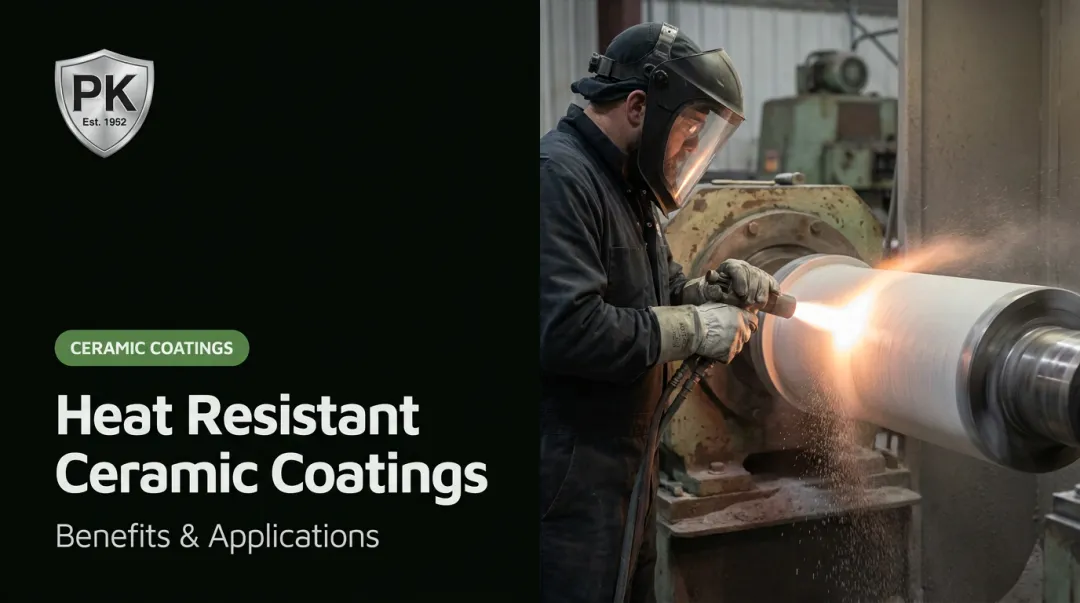
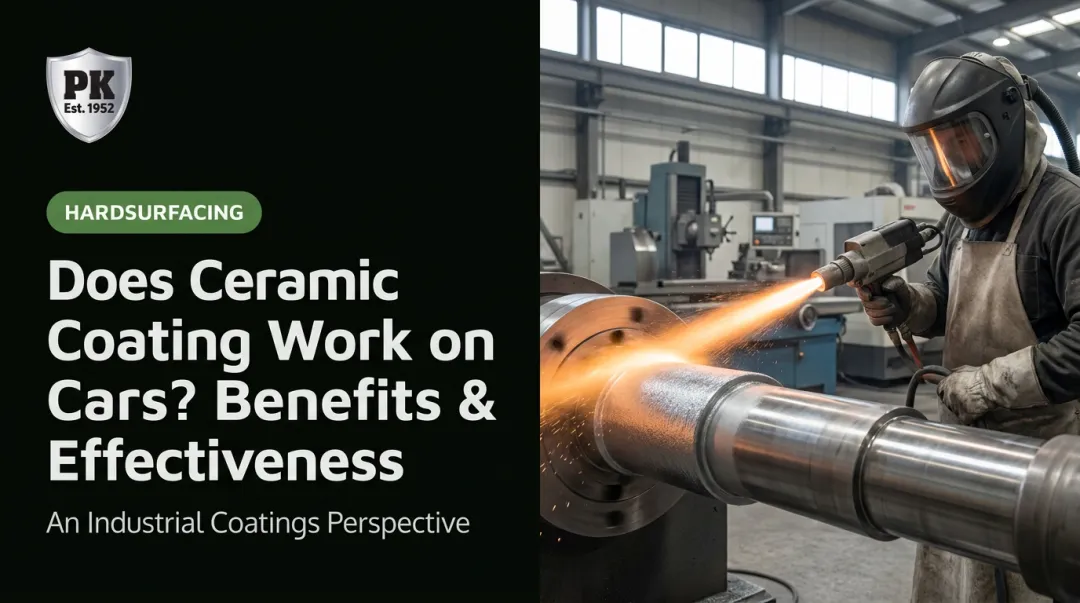
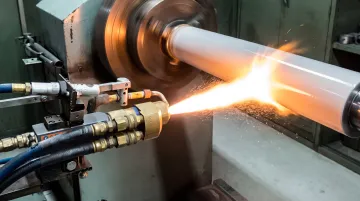
Ceramic coating is a thin, hard protective layer bonded to a metal surface through thermal spray, plasma spray, or HVOF (high-velocity oxygen fuel) application. Molten or semi-molten ceramic particles are sprayed onto a prepared substrate at high velocity, where they flatten, cool, and lock together into a dense, wear-resistant skin.
In industrial settings, you'll typically find it on:
- Wire drawing blocks and capstans
- Oil and gas pump components, including fracking plungers
- Shipping terminal equipment like crane wheels and rope pulleys
Across each of these applications, the engineering goal stays the same: increase surface hardness and chemical resistance without changing the part's core geometry.
For a plant running a wire mill or a fracking operation, that translates into a straightforward outcome. Parts last longer, fail less often, and produce a more consistent finish. Keep that standard in mind throughout this guide: a coating earns its place on a part only when it moves those numbers.
Key Advantages of Ceramic Coating
The advantages below aren't theoretical. Each one maps to something plant managers and procurement teams already track: cost per unit, mean time between failures, unplanned downtime hours, and defect rates on finished product. If a coating decision doesn't move one of those needles, it's not worth the line item.
Extended Wear Life and Durability
A ceramic coating raises surface hardness well above what the base metal offers alone. That matters most on high-friction components: wire drawing blocks, capstans, anything under continuous abrasive contact.
The coating bonds mechanically during thermal or plasma spraying, creating a surface that resists the forces that would otherwise gouge bare steel.
A 2024 study in Surface and Coatings Technology tested HVOF-sprayed tungsten-carbide cermet coating on industrial steel. Coated samples lost more than 90% less material in wet-rubber-wheel wear testing compared to uncoated controls, with hardness reaching over 1,200 HV.
Where this matters most:
- High-cycle wire drawing operations running continuous shifts
- Heavy equipment components under constant abrasive load
- Any part where replacement means a full production stop, not a quick swap
The practical metric here is mean time between failures. Parkway-Kew has built its business around this exact problem since 1952, when its first order was rebuilding 100 wire drawing blocks with a hardfacing alloy instead of replacing them outright. The logic hasn't changed: a harder surface, applied correctly, buys time before the next intervention.
Reduced Downtime and Lower Total Cost of Ownership
Wear life and downtime are two sides of the same coin. A component that lasts longer between rebuilds runs longer between stoppages, and stoppages are where the money disappears.
A 2023 ABB survey put the median cost of unplanned downtime at $125,000 per hour across sectors including oil and gas, metals, and marine operations. An eight-hour outage at that median rate runs $1 million. More than two-thirds of surveyed businesses reported outages at least once a month.
Coated components change that math by extending the interval between change-outs: fewer stoppages, fewer rush orders, fewer weekends lost to emergency rebuilds.
Parkway-Kew's Restore & Grind process pushes this further. Instead of grinding a worn wire drawing block down to the bottom of its deepest groove, which wastes plenty of good coating, the process fills and blends only the worn drawline area. This fill-and-blend approach supports 5 to 7 repair cycles before a full recoat is needed.
Practical effect on operations:
- Fewer full recoating jobs over the equipment's working life
- Faster turnaround per repair versus a complete regrind
- Lower cumulative cost per production hour
None of this eliminates downtime entirely. But it shifts maintenance from reactive scrambling to a scheduled, budgeted line item.
Corrosion and Chemical Resistance
A dense, non-porous ceramic layer blocks moisture, chemicals, and oxidation from reaching the substrate underneath. This barrier matters most where components face constant salt air, drilling fluids, or industrial chemicals.
Corrosion isn't a minor line item industry-wide. NACE's IMPACT study put the global cost of corrosion at $2.5 trillion annually (about 3.4% of global GDP), and estimated established corrosion-control practices could recover 15 to 35% of that figure.
Where corrosion resistance carries the most weight:
- Shipping terminal equipment exposed to salt air and moisture
- Marine hardware like crane wheels and wire rope pulleys
- Oil and gas field equipment exposed to drilling fluids and chemical additives
Parkway-Kew matches coatings to the exposure. Fracking plungers run PK-62 nickel chrome for standard conditions or PK-730 tungsten carbide when conditions get harsher, both chosen for combined wear and corrosion performance.
For shipping terminal hardware, sub-arc welded PK-200 goes on rope pulley rebuilds specifically because it produces a virtually crack-free deposit, closing off entry points corrosion would otherwise exploit.
Here, the metric to watch is inspection frequency. Components resistant to chemical attack need less frequent teardown, freeing up maintenance labor for other work.
Cost-Effective Alternative to Solid Ceramic With Superior Finish Quality
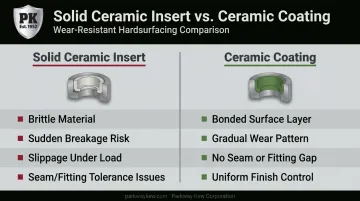
Solid ceramic inserts have a reputation problem: they're hard, but brittle. A small internal flaw or manufacturing defect can cause a solid ceramic ring to fail suddenly (through breakage or slippage inside its housing) rather than wearing gradually like a coated surface would.
A ceramic coating avoids that failure mode. Instead of a mechanically fitted insert that can crack or shift, the coating is engineered directly onto the block or capstan surface as a bonded layer. There's no seam, no fitting tolerance, and no brittle insert sitting loose in a pocket.
Parkway-Kew's plasma-sprayed PK-1500 chrome oxide coating illustrates this directly on wire drawing blocks. It's positioned as the most wear-resistant ceramic option in the company's lineup and suits high-speed, high-slip ferrous wire drawing, particularly for small, high-quality, or plated wire where finish can't be an afterthought.
Why finish quality matters here:
- A smoother block surface reduces surface defects transferred to the wire itself
- Consistent finish means fewer rejected runs and less rework
- Coating uniformity is easier to control than the fit tolerance of a solid insert
This advantage matters most where solid ceramic has already caused problems: breakage during operation, slippage under load, inconsistent wire finish tied to insert wear.
What Happens When Ceramic Coating Is Missing or Ignored
Bare or poorly protected metal doesn't fail gracefully. It wears faster, and that wear shows up first in product quality: surface defects in drawn wire, inconsistent finish, more frequent rejects.
Operators running uncoated or under-protected components tend to see the same pattern repeat:
- Rising unplanned downtime as parts fail without warning instead of on a predictable schedule
- Reactive maintenance replacing planned maintenance, with crews responding to failures instead of preventing them
- Higher long-term replacement costs, since frequent full replacements add up faster than periodic targeted repairs
- Difficulty scaling output, as production capacity ties directly to how often machines come offline for part swaps
The effect compounds. Concentricity problems on fracking plungers, for example, can run as much as 0.015 inches off when centerless grinding isn't done correctly, and that misalignment causes vibration and scoring that accelerates wear further. One problem creates the next.
This domino effect isn't confined to a single machine; it shapes how many operations approach maintenance overall.
Leaning on frequent manual part replacement as a default strategy is reactive maintenance, whether or not it's labeled that way. It works fine until volume increases or margins tighten, at which point the cost becomes very visible, very fast.
How to Get the Most Value from Ceramic Coating
Ceramic coating isn't a one-time fix you apply and forget. Getting real value from it depends on a few things happening in order.
- Get surface prep and application right first. Improper surface prep or a rushed application is the fastest route to premature coating failure; no coating material overcomes a bad application.
- Match the coating process to the job. Different processes suit different needs:
- Sub-arc welding: general wire drawing block hardsurfacing at the lowest cost
- Plasma spray: high-speed, high-slip ferrous wire
- Thermal spray (metallizing): best finish for very large wire
- HVOF: hardest, densest coating for maximum wear resistance
- Build in regular inspection. Catching drawline wear early allows targeted repair instead of waiting for full failure.
- Use targeted repair instead of defaulting to full replacement. Parkway-Kew's Restore & Grind approach fills and blends only the worn drawline area, supporting 5 to 7 repair cycles before a full recoat becomes necessary.
- Work with a provider who asks about your operating conditions before recommending a coating, not after. Wire type, wear severity, corrosion exposure, and required finish quality all change which process makes sense.
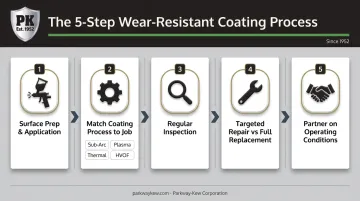
The common thread: ceramic coating performance depends on decisions made before, during, and after application, not just the coating material itself.
Conclusion
You can see the real case for ceramic coating in the maintenance log: fewer change-outs, predictable downtime instead of surprise failures, wire that comes off the block clean and consistent. These are outcomes you can track on a spreadsheet, not just claims on a data sheet.
Those advantages compound over time. A block that goes longer between rebuilds needs fewer full recoats across its working life. Matching the coating to the application correctly the first time also avoids the cost of redoing the job later.
That same logic extends beyond any single component: ceramic coating pays off most as part of an ongoing equipment strategy rather than a one-off purchase. Parkway-Kew has spent over 70 years refining coating processes for exactly this kind of industrial wear problem, giving you a proven set of options to build that strategy around.
Frequently Asked Questions
What are the benefits of ceramic coating?
Ceramic coating improves wear resistance and corrosion resistance while extending overall durability on industrial and mechanical components. It reduces replacement frequency and lowers total maintenance cost compared to uncoated parts.
How long will ceramic coating last?
Lifespan depends on the application, coating process, and maintenance routine. Industrial ceramic coatings can last several years with proper care, especially when paired with targeted repair methods instead of run-to-failure use.
What destroys ceramic coating?
Harsh chemical exposure, abrasive contact beyond the coating's design limits, improper original application, and severe mechanical impact are the most common causes of premature coating failure.
Is ceramic coating better than solid ceramic inserts?
Ceramic coatings avoid the breakage and slippage risks inherent to solid ceramic inserts while offering comparable wear resistance, typically at a lower total cost.
What industrial applications use ceramic coating?
Common applications include wire drawing blocks and capstans, oil and gas equipment like fracking plungers, and heavy machinery components exposed to abrasion or corrosion.
How is ceramic coating applied to metal parts?
It's applied through thermal spray, plasma spray, or HVOF processes. Each method sprays molten or semi-molten ceramic particles onto a prepared metal surface at high velocity, forming a bonded protective layer.