Introduction
Corrosion eats away at metal components in chemical plants, oil fields, and wire mills every single day. That's exactly why engineers keep turning to ceramics for parts that need to survive acids, alkalis, and high heat without breaking down.
But here's the catch: not all ceramics resist corrosion the same way. An alumina bushing and a silicon carbide seal face behave very differently in the same acid bath, and picking the wrong grade for the wrong environment leads to premature failure.
This article breaks down why ceramics resist corrosion at a molecular level, the technical properties that determine real-world performance, and where these materials get used across heavy industry. Just as important, it covers where that resistance actually runs out.
Key Takeaways
- Ceramics resist corrosion because their atoms already sit in a stable, oxidized state
- Resistance varies between oxide ceramics (alumina, zirconia) and non-oxide ceramics (silicon carbide)
- Extreme pH, hydrofluoric acid, or combined thermal-mechanical-chemical stress can still degrade ceramics
- Plasma-sprayed or HVOF coatings deliver corrosion resistance without the breakage risk of solid ceramics
- Application-specific test data, not generic datasheets, should drive material selection
What Corrosion Resistance Means for Ceramics
In technical terms, corrosion resistance is a material's ability to withstand chemical or electrochemical degradation when exposed to acids, alkalis, salts, or oxidizing agents. For metals, this typically means adding a coating, plating, or alloying element to block a reaction that would otherwise happen naturally.
Ceramics work differently. Their resistance is largely intrinsic, built into the material itself rather than bolted on afterward. That said, actual field performance still depends heavily on exposure conditions, temperature, and how the part was manufactured.
Why Ceramics Resist Corrosion at the Molecular Level
Metals corrode because their atoms want to bond with oxygen. Ceramics have already done that.
Oxide ceramics like alumina and zirconia rely predominantly on ionic bonding, while non-oxide ceramics such as silicon nitride and silicon carbide use high-energy covalent bonds. Both bonding types leave little room for further chemical reaction because the elements are already locked into stable compounds with oxygen, nitrogen, or carbon.
This is why silicon nitride shows up so often in bearings and engine components: its covalent structure holds up under sustained chemical and thermal attack. Hot-pressed silicon nitride can also reach near-zero porosity, which directly supports corrosion resistance at high temperatures since there's virtually no pathway for corrosive media to penetrate the surface.
Factors That Cause Real-World Performance to Deviate from Lab Data
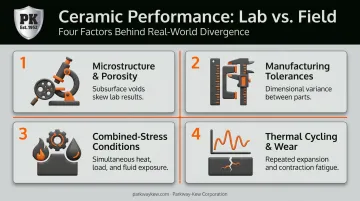
Lab-tested corrosion resistance rarely tells the whole story. Field conditions introduce variables that clean-room testing simply doesn't capture:
- Microstructure and porosity: sintering defects, pinholes, or microcracks give corrosive media a path to attack the material from within
- Manufacturing tolerances: inconsistent coating thickness means some areas of a part are better protected than others
- Combined-stress conditions: heat, mechanical load, and chemical exposure hitting a part simultaneously accelerates degradation far faster than any single-variable lab test predicts
- Thermal cycling and wear: repeated expansion and contraction exposes fresh surface area to renewed corrosive attack over years of service
Parkway-Kew has seen a version of this firsthand while rebuilding worn industrial components for over 70 years. Its PK-1500 chrome oxide ceramic coating illustrates the point: lab specs confirm the material's hardness and corrosion resistance, but field performance still depends on spray parameters and coating uniformity.
That's why two parts coated with the same ceramic material can perform differently in the field, even when their lab specs look identical.
Key Technical Properties of Corrosion-Resistant Ceramics
Corrosion resistance doesn't exist in a vacuum. It's tied to hardness, thermal stability, and toughness: properties that together decide whether a ceramic actually survives its intended application.
Chemical Inertness and Stability
Resistance to acids, alkalis, and salts varies significantly by composition. Kyocera's chemical resistance testing shows just how much these differences matter:
| Ceramic Grade | Nitric Acid (60%, 90°C) | Sulfuric Acid (95%, 95°C) | Sodium Hydroxide (30%, 80°C) |
|---|---|---|---|
| Alumina A479 | 0.10 mg/cm² | 0.33 mg/cm² | 0.26 mg/cm² |
| Zirconia Z201N | Not tested | 0.04 mg/cm² | Not tested |
| Si3N4 SN240 | 1.11 mg/cm² | 0.00 mg/cm² | Not tested |
| SiC (SC211/SC1000) | 0.04 mg/cm² | 0.01 mg/cm² | 0.00 mg/cm² |
Notice how silicon nitride performs beautifully in sulfuric acid but takes a measurable hit in nitric acid. That's the point: "chemically inert" is never a blanket claim.
Hardness and Wear Resistance Synergy
High hardness works alongside corrosion resistance to prevent erosion-corrosion, a combined failure mode common in pumps, valves, and fluid-handling equipment. Representative Vickers hardness values (HV0.3) include:
- Zirconia (Technox 2000): 1,300 HV0.3
- Silicon nitride (SSN): 1,500 HV0.3
- Alumina (Dynallox 100): 1,600 HV0.3
- Sintered silicon carbide (SSC): 2,800 HV0.3
Higher hardness alone won't prevent corrosion, but it does stop abrasive particles from tearing open fresh surface area for chemicals to attack, since the two failure modes feed off each other.
Thermal Stability and High Melting Point
Corrosion resistance means little if a ceramic can't hold its structure at operating temperature. Typical maximum use temperatures:
- Zirconia: 1,000°C
- SiAlON: 1,300°C
- Sintered silicon carbide: 1,400°C (up to 1,800°C under inert gas conditions)
This thermal headroom matters most in hot corrosive environments, like reactor linings or exhaust components, where chemical attack accelerates as temperature climbs.
Brittleness Trade-Off
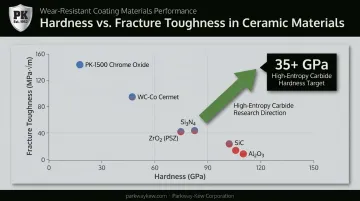
Here's the honest downside: the same strong bonding that resists corrosion also makes ceramics prone to cracking under impact. There's no getting around it: hardness and toughness pull in opposite directions.
Materials researchers are actively working on this. Recent high-entropy carbide studies have pushed hardness above 35 GPa while improving fracture toughness, though results vary by composition and none have fully solved the trade-off yet. For now, engineers dealing with mechanical shock risk often turn to coated solutions rather than solid ceramic parts — more on that next.
Applications of Corrosion-Resistant Ceramics Across Industries
Because chemical resistance, hardness, and thermal stability work together, corrosion-resistant ceramics get specified across several demanding industrial sectors.
Oil & Gas and Chemical Processing
Downhole pumps, bushings, and transfer components face constant exposure to corrosive fluids and abrasive sand. CoorsTek's engineered ceramics documentation reports zirconia and silicon carbide bearings achieving 100 times less wear and 85% fewer breaks than hardened-alloy equivalents in electric submersible pump service. In a separate Bass Strait pump application, zirconia components reportedly lasted four times longer than stainless steel.
Chemical processing plants face similar corrosive conditions. Reactors, metering valves, and nozzles handling aggressive acids like sulfuric and hydrochloric solutions rely on ceramic linings and components to avoid the pitting and dissolution that plague metal equivalents, stretching maintenance intervals between shutdowns.
Wire Manufacturing & Metal Forming
Wire drawing blocks and capstans take a beating from continuous friction, moisture, and oxidative wear. Solid ceramic blocks resist this well chemically, but they carry a known mechanical risk: breakage and slippage under sustained mechanical stress.
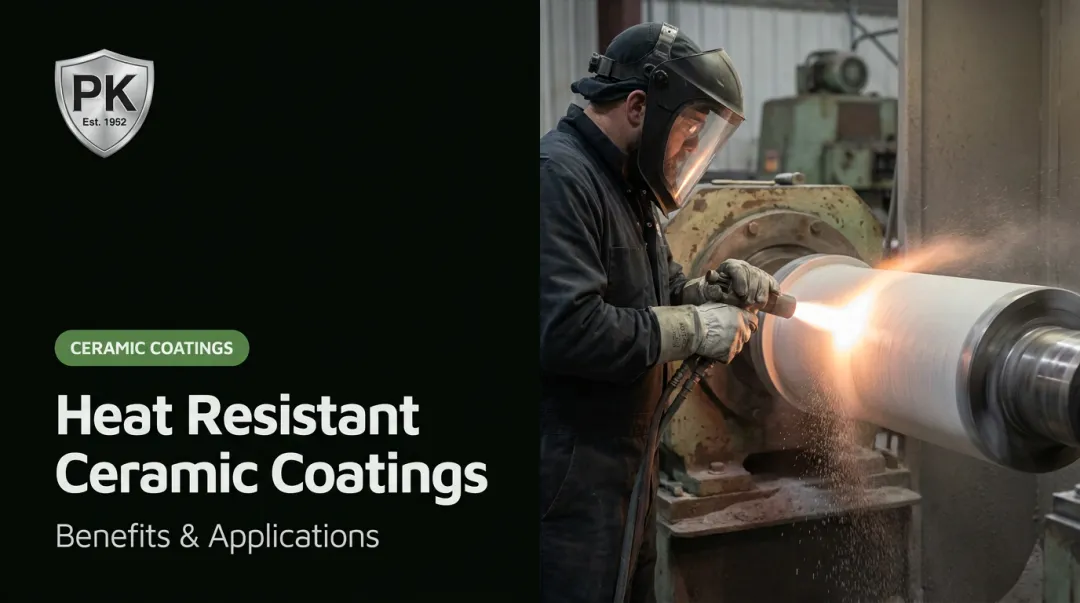
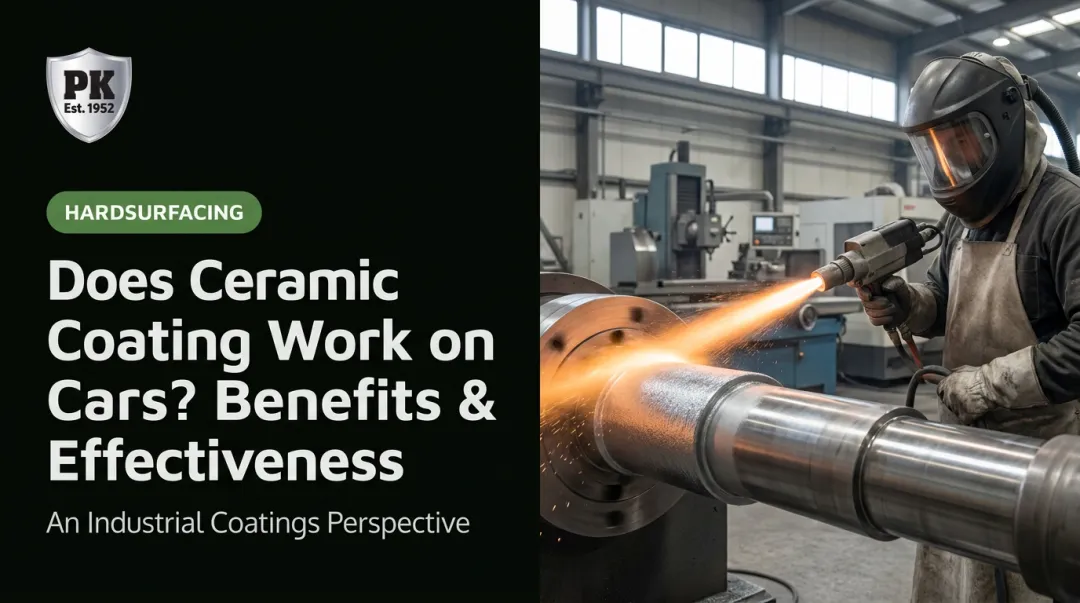
Parkway-Kew addresses this with plasma-sprayed PK-1500 chrome oxide ceramic coatings, introduced in the late 1990s as the most wear-resistant ceramic option in its lineup. It's applied to:
- Wire drawing blocks and capstans (especially high-speed, high-slip ferrous wire drawing)
- Tuner rolls and sheaves
- Step cones and guide devices
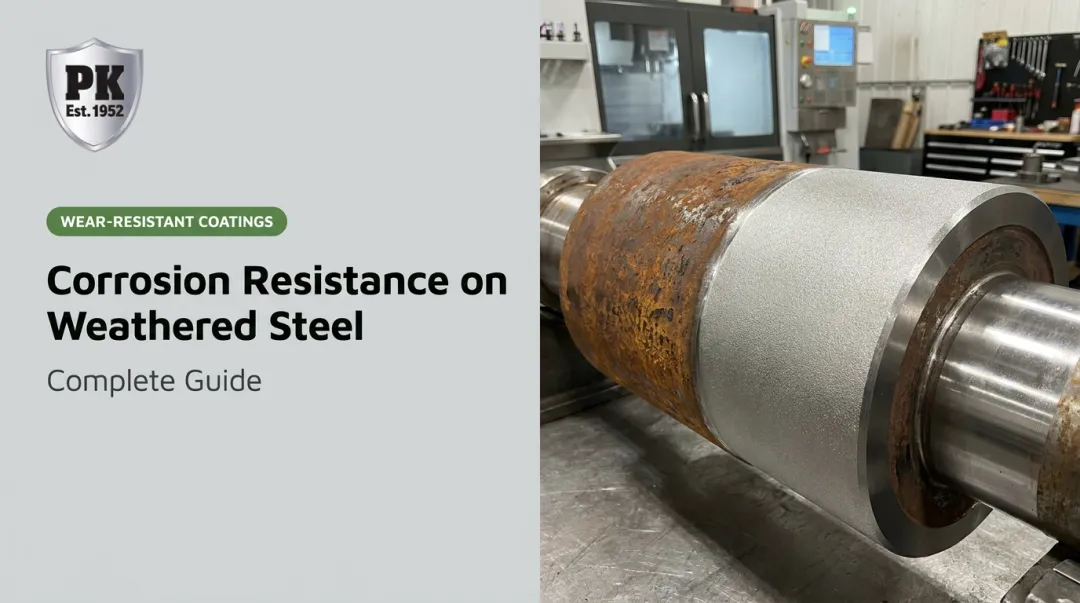
This coating delivers comparable corrosion and wear resistance to solid ceramic without the cracking or slippage risk. It also costs less, since only a coated layer (not an entire solid ceramic part) needs replacing when service life runs out.
Marine, Shipping Terminals & Heavy Equipment
Saltwater and outdoor exposure punish festoon wheels, crane wheels, and wire rope pulleys. Parkway-Kew's urethane-coated festoon wheels have shown a field-tested lifespan of 2 to 3 years longer than OEM parts, while PK-200-coated geared rope pulleys are built to exceed original OEM service life.
These same properties extend well beyond heavy industry. Corrosion-resistant ceramics also show up in thermal barrier coatings, insulating electronic substrates, and biocompatible implants, where chemical stability and biological inertness matter as much as mechanical strength.
Limits, Testing, and Common Misconceptions About Ceramic Corrosion Resistance
Despite their reputation, ceramics aren't universally "corrosion-proof." Misunderstanding where the limits are leads to premature failures or unnecessary over-specification.
Where Ceramic Corrosion Resistance Breaks Down
Certain conditions attack even the toughest ceramics:
- Hydrofluoric acid attacks glass and any silica-containing material. This is a documented, well-established exception, according to NOAA's chemical safety database
- Strong hot alkalis measurably degrade some oxide ceramics; alumina, for instance, shows quantifiable mass loss after 24 hours in 30% sodium hydroxide at 80°C
- Sustained immersion is far more damaging than brief incidental contact. Many ceramics tolerate short exposure to aggressive media but degrade under continuous exposure over weeks or months
How Corrosion Resistance Is Tested and Verified
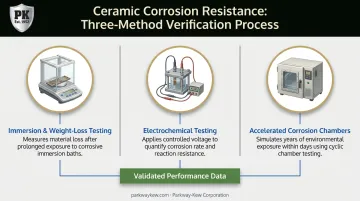
Standard evaluation methods include:
- Immersion and weight-loss testing tracks mass change after controlled acid or alkali exposure
- Electrochemical testing measures polarization resistance and impedance
- Accelerated corrosion chambers simulate years of exposure in weeks
ISO 17092 specifically tests monolithic fine ceramics in acid and alkaline solutions, while ASTM standards like B117, G31, and G59 cover narrower apparatus or metal-specific scopes. The gap between lab results and field validation is real. Always request application-specific test data rather than relying on a generic datasheet. Parkway-Kew validates its PK-1500 chrome oxide ceramic coating against the specific chemical environment each application will face, rather than citing generic corrosion ratings alone.
Common Misconceptions
- "Corrosion resistant" vs. "corrosion proof": These are not the same thing; every material has chemical and thermal limits.
- Composition matters: Not all ceramics behave the same; grade and formulation matter more than the word "ceramic" on a spec sheet.
- Erosion-corrosion: Combined wear and chemical attack accelerates failure faster than either mechanism acting independently.
Conclusion
Corrosion resistance is a defining property of ceramics, but it's not absolute. Composition, exposure conditions, and manufacturing quality all determine whether a given ceramic actually holds up in your application.
Matching chemistry to the specific corrosive environment matters more than assuming blanket protection. For applications that need both corrosion and wear resistance without the impact-brittleness risk of solid ceramics, engineered coating solutions like plasma spray and HVOF are worth evaluating. Look for a provider with real field performance, not just a datasheet — Parkway-Kew has coated wire drawing blocks, fracking plungers, and shipping terminal equipment since 1952.
Frequently Asked Questions
Does ceramic corrode easily?
Most ceramics highly resist corrosion thanks to their stable, already-oxidized bonding structure. Certain types can still degrade under extreme acids, alkalis, or sustained high heat.
Are all ceramics equally corrosion resistant?
No. Resistance varies by composition (oxide versus non-oxide) and by specific grade, so material selection should match the chemical environment.
Can ceramics be damaged by acids or alkalis?
Yes. Aggressive media like hydrofluoric acid or strong hot alkalis can attack specific ceramic types despite their generally strong resistance.
Why do ceramics resist corrosion better than metals?
Ceramic bonds are already in a stable, oxidized state. Metals, by contrast, actively oxidize when exposed to corrosive environments, which drives the corrosion process.
What is the difference between ceramic coatings and solid ceramic components for corrosion resistance?
Coatings like Parkway-Kew's PK-1500 chrome oxide combine a tough metal substrate with a corrosion- and wear-resistant ceramic surface layer. This avoids the brittleness and breakage risk that comes with solid ceramic parts.
Are ceramic coatings on wire drawing blocks better than solid ceramic blocks?
Parkway-Kew's plasma-sprayed PK-1500 chrome oxide coatings offer comparable corrosion and wear resistance at a lower cost, without the slippage or breakage issues common to solid ceramic blocks.