Introduction
Long before wire feeders and shielding gas cylinders existed, welders were already striking arcs with a stick of coated metal and a ground clamp. Shielded metal arc welding, better known as stick welding, has stayed in nearly every welder's toolbox for over a century.
Yet longevity alone doesn't guarantee the right fit for every job. Choosing the wrong welding process still costs money, whether that means a failed repair on a remote job site or a cracked weld on a load-bearing structure.
This guide breaks down what SMAW actually is, walks through how the process works step-by-step, and covers where it shines and where it falls short. We'll also touch on what happens when a worn part needs more than a standard stick repair can offer.
Key Takeaways
- Flux-coated electrodes self-shield the weld pool, so SMAW needs no external shielding gas
- Low equipment cost and portability make SMAW ideal for field repairs and remote sites
- Trade-offs include slower deposition rates and extra slag cleanup after each pass
- Extreme wear applications often demand hardsurfacing beyond basic stick welding
What Is Shielded Metal Arc Welding (SMAW)?
SMAW is a manual arc welding process that goes by several names: stick welding, manual metal arc welding (MMAW), and flux shielded arc welding. All refer to the same setup: a consumable electrode coated in flux, connected to a power source, forming an arc against the base metal.
An electric arc, running on either AC or DC depending on the electrode and equipment, strikes between the tip of the electrode and the workpiece. That arc generates enough heat to melt both the electrode and the base metal simultaneously, and the two mix together to form the weld.
The flux coating is what makes SMAW self-sufficient. As the electrode burns, that coating breaks down and does two jobs at once.
It produces a shielding gas that protects the molten weld pool from oxygen and nitrogen in the air, then forms a slag layer that solidifies over the bead as it cools. No tank of shielding gas, no separate feed system. It's built into the electrode itself.
History of SMAW
Consumable electrode arc welding traces back to the late 1880s. Charles L. Coffin patented the process now recognized as SMAW in 1890, according to UTI's history of welding overview.
Nikolay Slavyanov is often credited with earlier metal-electrode experimentation around 1888. Major welding authorities haven't independently confirmed that date, so treat it as commonly cited rather than settled history.
That gives SMAW well over 130 years of practical use. Despite semi-automatic processes like GMAW and FCAW dominating high-volume production shops, stick welding hasn't gone anywhere. Its simplicity and reliability keep it relevant on job sites where speed isn't the only priority.
How Does Shielded Metal Arc Welding Work?
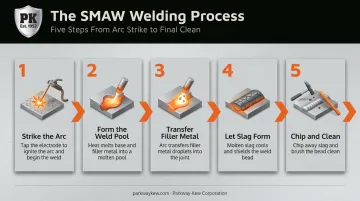
The process itself is straightforward, even if mastering it takes practice. Here's the basic sequence:
- Strike the arc by tapping or scratching the electrode against the base metal, then pulling back slightly to establish and hold the arc gap
- Form the weld pool as the arc heat melts the base metal and the electrode tip together
- Transfer filler metal from the electrode core across the arc into the molten pool, building up the joint
- Let the slag form over the cooling weld as the flux coating decomposes and floats to the surface
- Chip and clean the hardened slag off once the pass is complete, exposing the finished bead
Equipment needed is minimal compared to gas-shielded processes:
- A constant-current power source (AC or DC)
- An electrode holder
- A ground clamp
- Welding cables
- A chipping hammer and wire brush for slag removal
- PPE: welding helmet, gloves, and flame-resistant clothing
Unlike processes with preset wire speed and voltage, SMAW puts control in the welder's hands. Lincoln Electric notes that constant-current power sources are the preferred setup for manual stick welding, since arc length directly affects voltage as the welder moves the electrode.
There's no automated feedback loop adjusting things mid-weld. It's the operator's hand and eye doing that work in real time.
Electrode Types and Selection
Electrode coatings aren't interchangeable. Each type changes how the arc behaves and what kind of weld you end up with:
- Rutile: Easy to strike, smooth arc, low spatter, good for general-purpose work
- Cellulosic: Deep penetration, well-suited to root passes and pipe work, but rougher bead appearance
- Basic (low-hydrogen): Best mechanical properties and crack resistance, though it demands a steadier hand and proper storage to avoid moisture pickup
One defining quirk of SMAW: electrodes burn down and must be replaced mid-job. That stop-start rhythm is part of the process, not a flaw to engineer around.
As for intensity, ESAB reports that the arc in MMA/SMAW can reach temperatures up to 6,000°C. Actual amperage varies by electrode diameter and type. Rather than a single blanket range, manufacturers publish electrode-specific current charts, and dialing in the right setting depends on the specific rod you're running, not a generic number.
Advantages of Shielded Metal Arc Welding
SMAW earns its long shelf life through six practical strengths that other processes still struggle to match.
Portability and simplicity. The equipment is lightweight and doesn't require gas cylinders or complex feed systems. That makes it ideal for remote job sites, field repairs, and locations without reliable power infrastructure.
Lower cost. No external shielding gas to buy or haul around, and the equipment itself tends to run cheaper than comparable GMAW or TIG setups.
Versatility across metals and positions. SMAW handles:
- Carbon steel
- Stainless steel
- Cast iron
- Nickel alloys
- Select non-ferrous metals
It also performs across most standard welding positions, including overhead and vertical. That versatility matters on structural jobs where you can't always bring the work to a flat table.
Wind and outdoor reliability. Because the flux coating generates its own shielding gas, there's no external gas shield for wind to blow away. Gas-shielded processes like MIG often struggle outdoors; SMAW just keeps working.
Deep penetration on thick sections. Cellulosic and certain low-hydrogen electrodes drive deep into the joint, making SMAW a solid fit for structural and heavy-duty repair work where full penetration matters.
Minimal pre-cleaning. SMAW tolerates rust, mill scale, and dirty surfaces far better than TIG welding, which demands a clean base metal to avoid contamination.
Disadvantages and Limitations of SMAW
No process is a universal answer, and SMAW has real trade-offs.
Lower deposition rate. The Fabricator reports that SMAW averages around 65% deposition efficiency, with discarded electrode stubs cutting into that number further. Stopping to swap electrodes adds time that continuous-feed processes like FCAW or GMAW simply don't need.
Cleanup labor. Every pass leaves slag and spatter behind. That means:
- Requires extra time chipping and brushing between passes
- Risks slag inclusions hiding under a rushed cleanup job
- Adds more labor hours on multi-pass welds
Not ideal for thin material. The heat input involved makes SMAW prone to burn-through and warping on sheet metal. Welders reach for TIG or MIG when the stock gets thin, saving stick welding for heavier sections where that heat is an asset instead of a liability.
Common Applications and Materials Welded with SMAW
Despite its limitations, SMAW remains the standard in several heavy-industry corners:
- Construction and structural steel fabrication: field erection work where portability matters
- Pipeline welding: cellulosic electrodes handle root passes on pressure piping
- Shipbuilding: low-hydrogen electrodes for hull and structural joints
- Heavy equipment maintenance and repair: rebuilding worn components on-site
This versatility extends to materials, too. SMAW works across mild steel, low-alloy steel, stainless steel, cast iron, and hardfacing applications, though it favors medium and heavier stock over thin sheet since the heat input and manual control make burn-through harder to avoid on lighter gauges.
That said, its real staying power shows up in maintenance and repair work. When a worn shaft, bracket, or structural component needs rebuilding on-site, SMAW's portability and tolerance for dirty, imperfect surfaces make it the practical first choice for a lot of industrial teams.
Beyond Standard SMAW: Hardfacing and Wear-Resistant Repair Solutions
Standard stick welding hardfacing electrodes have rebuilt worn machine parts for decades, adding a layer of wear resistance to components that would otherwise need full replacement. It's a proven technique, and it's often exactly the right call.
But for parts facing extreme abrasion, corrosion, or heavy cyclical wear, such as wire drawing blocks, capstans, and crane wheels, standard stick hardfacing has its limits. That's where more advanced hardsurfacing processes come in.
Parkway-Kew Corporation was built on this exact idea. Since 1952, when founder Eugene Walter Klein welded a test piece in his own garage to rebuild 100 worn wire drawing blocks for CF&I in Roebling, NJ, the company has pushed past basic hardfacing into more specialized territory:
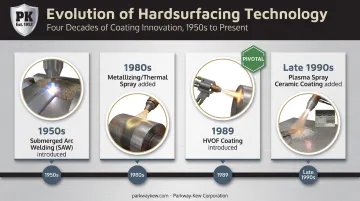
- Submerged arc welding (SAW): pioneered by Parkway-Kew in the 1950s, still considered the most cost-effective method for rebuilding wire drawing blocks
- HVOF coating: introduced in 1989, applying alloy powder at speeds exceeding Mach 2 for a dense, virtually defect-free surface
- Plasma spray ceramic coating: added in the late 1990s for high-speed, high-slip wire drawing applications
- Metallizing (thermal spray): used since the early 1980s, the only practical option for very large wire drawing components
These processes serve industries like oil and gas, wire mills, and shipping terminals, where a standard stick repair simply won't hold up under the cyclical load and abrasion these parts see daily.
If your SMAW repairs aren't delivering the wear life or downtime reduction a heavy-duty application demands, that's usually the signal it's time to look at a more specialized coating solution.
Frequently Asked Questions
What are the advantages of shielded metal arc welding?
SMAW offers portability, low equipment cost, and versatility across metals and positions. Its self-shielding flux also makes it reliable in outdoor and windy field conditions where gas-shielded processes struggle.
Is shielded metal arc welding (SMAW) stronger than MIG welding?
Weld strength depends more on welder technique and joint design than the process itself. SMAW often achieves deeper penetration on thicker sections, while MIG tends to offer faster, cleaner welds on thinner material.
What is SMAW also known as?
SMAW is commonly called stick welding or manual metal arc welding (MMAW). Both terms describe the same manual, flux-coated electrode process.
What materials and thicknesses can be welded using SMAW?
SMAW handles carbon steel, stainless steel, cast iron, nickel alloys, and some non-ferrous metals. It's generally used on medium-to-heavy stock rather than thin sheet metal, which is more prone to burn-through.
Is SMAW suitable for beginners?
SMAW is often recommended for beginners because the equipment is affordable and simple to set up. That said, producing clean, consistent welds still takes practice, since the welder manually controls arc length throughout.
Can SMAW be used for outdoor or field repairs?
Yes. Its self-shielding flux eliminates the need for external gas cylinders, making it a practical choice for pipeline repairs, ship hull work, and other remote sites where hauling gas tanks isn't feasible.