Most conversations about ceramic coatings focus on automotive exhaust wrap or header paint. That's not where the real engineering challenge lives. Industrial operations, wire mills, fracking sites, shipping terminals, need coatings that hold up under sustained heat, mechanical load, and corrosive exposure for years, not just a few thousand miles.
This article breaks down what heat resistant ceramic coatings actually do for heavy industry: where they get applied, what outcomes they produce, and how to get real value from them instead of just a spec sheet promise.
Key Takeaways
- Thermal spray ceramic and carbide coatings shield metal parts from friction, heat, and corrosion
- Coated parts in wire mills, fracking, and shipping terminals cut replacement rates and downtime
- Coatings deliver comparable protection to solid ceramics without breakage or slippage risk
- Value depends on correct process selection and consistent maintenance, not the material alone
What Is Heat Resistant Ceramic Coating
A heat resistant ceramic coating is a thin, engineered layer applied to a metal surface using thermal spray processes like HVOF (High Velocity Oxygen Fuel) or plasma spray. The spray gun heats or softens the coating material and propels it onto a prepared substrate, building a dense protective layer.
How much heat that layer can withstand depends on the material and process used. Product data sheets from major suppliers show notable variation across coating types:
- Tungsten carbide-cobalt cermets: around 930°F
- Chromium carbide variants: typically 1,560°F–1,800°F
- Pure alumina coatings: up to 3000°F
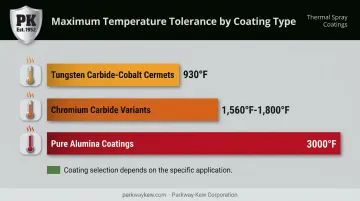
There's no single universal number: the right coating depends entirely on the application.
Coatings differ from solid ceramic parts in one critical way: they deliver similar heat and wear protection on a metal substrate without the breakage or slippage risk that comes with monolithic ceramic components. That distinction matters more in practice than most spec sheets let on.
Parkway-Kew's PK-1500 chrome oxide coating, for example, is applied via plasma spray specifically for high-speed and high-slip ferrous wire drawing, where a solid ceramic part would be impractical and prone to failure under those exact conditions.
Coating Is a Means, Not the Goal
A ceramic coating matters only for what it enables: equipment that runs longer between replacements, plants that avoid surprise shutdowns, and consistent product quality coming off the line. Evaluating a coating should start with those operational outcomes, not its theoretical hardness on a spec sheet.
Where Heat Resistant Ceramic Coatings Are Applied in Industry
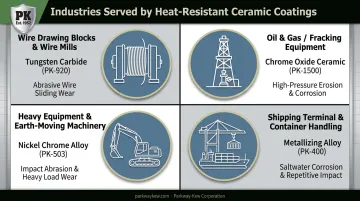
Four industrial sectors rely heavily on these coatings, each with distinct wear and heat challenges.
Wire Drawing Blocks & Wire Mills
Wire drawing blocks and capstans generate substantial friction heat as wire is pulled through at speed. The coating needs to handle that heat cycling while also delivering a fine, defect-free surface finish, since any roughness on the block transfers directly to the wire.
Parkway-Kew has applied HVOF tungsten carbide coatings to wire drawing blocks since 1989 and later introduced plasma sprayed ceramic coated blocks for the same purpose. Components like tuner rolls, sheaves, step cones, and guide devices are also prime candidates for hard coating specifically to reduce the downtime tied to frequent changeouts.
Oil & Gas / Fracking Equipment
Fracking plungers face a brutal combination: high pressure, abrasive proppant-laden fluid, and heat generated by constant reciprocating motion. HVAF and HVOF-applied tungsten carbide-cobalt-chromium coatings are the standard response, protecting the plunger surface from both corrosive attack and mechanical wear.
Parkway-Kew's PK-730 fused tungsten carbide coating was engineered specifically for this environment. Beyond the coating material, the company also addresses a mechanical issue that often gets overlooked.
Plungers ground with conventional centerless grinding can end up as much as 0.015 inches out of concentricity with the clamping end. That misalignment causes vibration and scoring, shortening plunger life regardless of how good the coating is.
Heavy Equipment & Earth-Moving Machinery
Hydraulic rods, wear plates, and other structural wear parts on heavy equipment take a combined beating from heat and mechanical stress under heavy loads. HVOF-applied chromium carbide-nickel chromium coatings are commonly specified for hydraulic rods in mining and construction vehicles, where abrasion, corrosion, and impact all occur simultaneously.
Shipping Terminal & Container Handling Equipment
Festoon wheels and crane wheel systems operate outdoors, exposed to salt air, humidity, and constant friction from cable and hose systems. Parkway-Kew manufactures and rebuilds urethane-coated festoon wheels for this exact environment, with field testing showing a 2 to 3 year lifespan extension over standard OEM wheels.
Key Advantages of Heat Resistant Ceramic Coatings
The value of these coatings shows up in numbers industrial buyers already track: downtime hours, maintenance spend, replacement frequency, and product yield. Below are the three advantages that matter most in practice.
Advantage 1: Extended Wear Life & Reduced Downtime
The coating forms a hard protective layer that slows wear from repeated friction and heat cycling. In practice, this means fewer part replacements and longer intervals between rebuilds.
Laboratory testing backs this up at the material level. One comparison of HVOF tungsten carbide-cobalt-chromium coatings against hard chromium on hydraulic rod specimens found the coated samples had microhardness of 1256 HV versus 952 HV for chromium.
Wear depth measured just 0.28 micrometers compared to over 10 micrometers, according to a 2018 hydraulic rod coating study. That's a meaningful gap in surface durability under equivalent testing conditions.
Real-world impact at Parkway-Kew:
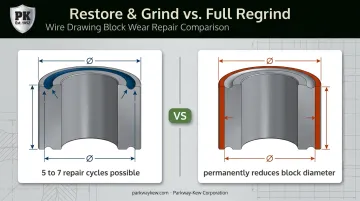
- Restore & Grind process enables 5 to 7 targeted repairs on wire drawing blocks before a full recoating is needed
- Urethane-coated festoon wheels last 2-3 years longer than OEM equivalents
- Rebuilt geared forged rope pulleys with PK-200 coating exceed original OEM hardened pulley life
KPIs impacted: component lifespan, mean time between failures, downtime hours, replacement frequency.
This advantage matters most in high-cycle equipment, continuous production lines, and remote locations where a service call means days of lost output, not hours.
Advantage 2: Corrosion & Oxidation Resistance at High Temperatures
A ceramic coating blocks oxygen and moisture from reaching the metal substrate, preventing rust and scale formation even when the part runs hot. This matters most in environments that combine heat with humidity or chemical exposure, exactly the conditions found at shipping terminals and oil field sites.
An 18-year seawater exposure study on thermal-sprayed marine coatings found that zinc coatings began degrading after 7 years. Aluminum and zinc-aluminum coatings, by contrast, maintained strong performance through the entire 18-year test period, according to research published in the AMPP Corrosion journal. Coating chemistry alone accounts for that 11-year difference in service life.
Why this matters for maintenance budgets:
- Fewer recoating cycles across the equipment's lifespan
- Reduced repair frequency on parts exposed to salt air or process chemicals
- Lower risk of premature part retirement due to corrosion damage
KPIs impacted: maintenance frequency, corrosion-related failure rate, overall asset lifespan.
This advantage matters most in outdoor or marine settings like shipping terminals, high-humidity plants, and any operation with chemical exposure.
Advantage 3: Cost-Effective, High-Precision Alternative to Solid Ceramics
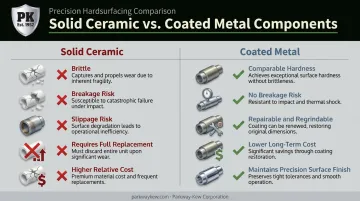
Coatings deliver comparable hardness and heat resistance to solid ceramic parts without the weight, brittleness, or breakage risk that comes with a monolithic ceramic component. On precision parts like wire drawing blocks, where surface finish directly determines wire quality, that reliability difference matters.
Solid ceramics carry inherent breakage and slippage risks. That's precisely why fuse-welded tungsten carbide alloys became the industry standard for copper and aluminum wire drawing rings, replacing solid ceramic rings that customers had struggled with. Parkway-Kew's PK-920, PK-675, and PK-700 formulations offer a lower-cost alternative that eliminates that failure mode entirely.
Why this changes the cost equation:
- No breakage risk means fewer unplanned production stops
- Coated metal parts can be reground and reused across multiple maintenance cycles
- Solid ceramic replacement means a full part swap; a coated part can often be restored instead
KPIs impacted: cost per unit, breakage/rejection rate, surface finish quality, product yield.
This advantage matters most in precision manufacturing like wire drawing, and on high-value equipment where downtime for part replacement carries a steep cost. Parkway-Kew Corporation specializes in precision-engineered coating solutions built for exactly these applications, using HVOF, plasma spray, and proprietary tungsten carbide formulations.
What Happens When Heat Resistant Ceramic Coating Is Missing or Ignored
Skipping proper coating, or deferring maintenance on existing coatings, produces a predictable pattern of problems:
- Inconsistent wear performance across otherwise identical equipment, making planning difficult
- Higher unplanned failure rates on critical components, often at the worst possible time
- Reactive repair cycles in place of planned maintenance windows
- Rising long-term costs from more frequent full part replacement instead of targeted repair
- Difficulty scaling operations without a repeatable, reliable protective process in place
One concrete example: wire drawing blocks left to wear past the point of targeted repair require a full regrind down to the deepest groove. This strips away large amounts of otherwise functional coating and permanently reduces the block's overall diameter. Catching wear earlier avoids that loss entirely.
How to Get the Most Value from Heat Resistant Ceramic Coatings
Coatings deliver their full value only when the process matches the application. HVOF, plasma spray, and standard thermal spray each suit different substrates, temperatures, and wear modes, and choosing the wrong one undercuts the investment before the part ever goes into service.
What to look for in a coating partner:
- In-house engineering that recommends alloys based on your specific corrosion and wear challenges, not a one-size-fits-all product
- Precision machining and grinding capability to ensure correct thickness, blending, and finish after coating
- A proven repair process that avoids premature full recoating
- Regular performance review against KPIs like wear rate, downtime, and corrosion incidents to time re-coating correctly
Parkway-Kew has built its process around these exact principles over 70+ years in business. In-house CNC machining and turning up to 72 inches in diameter, plus large-diameter grinding up to 65 inches by 12 feet, keep coating thickness and finish consistent from job to job.
The proprietary Restore & Grind process illustrates this well. Rather than grinding an entire wire drawing block down to its deepest groove, the process fills only the worn drawline area and blends it seamlessly with the original coating. This targeted repair enables 5 to 7 repair cycles before a full recoat is needed.
Knowing when to invoke that repair process depends on tracking performance over time. Track KPIs like wear rate, downtime, and corrosion incidents on a schedule rather than waiting for a failure to force the decision. The data shows exactly when re-coating is due, minimizing unplanned downtime.
Conclusion
The real value of heat resistant ceramic coatings lies less in the temperature rating printed on a data sheet than in what that rating enables: parts that run longer, resist corrosion in harsh environments, and cost less over their working life than solid ceramic alternatives or uncoated metal.
Those advantages compound over time. Fewer replacements translate into less downtime, more predictable production schedules, and better surface finishes that keep product quality consistent downstream. None of that happens from a single application, though. It happens when the right process is matched to the right part and reviewed on a regular schedule.
Heat resistant ceramic coating works best as an ongoing maintenance strategy, not a one-time purchase decision, executed with a partner who understands both the coating chemistry and the mechanical realities of your equipment. Parkway-Kew has applied that approach since 1952 across oil & gas, wire drawing, and shipping terminal equipment.
Frequently Asked Questions
Can ceramic coating withstand heat?
Yes. Industrial ceramic coatings are specifically engineered for high-heat environments, with product-rated tolerances ranging from around 930°F for tungsten carbide cermets up to 3000°F for pure alumina, depending on material and application.
What is the most heat-resistant ceramic?
Pure aluminum oxide (alumina) carries the highest documented ratings, up to 3000°F, thanks to its chemical stability and electrical insulation properties. Chromium carbide-nickel chromium blends rate up to 1,800°F for hot wear applications.
What temperature range can industrial ceramic coatings handle?
Ranges vary by coating type: tungsten carbide-cobalt cermets rate near 930°F, chromium carbide blends run 1,560°F to 1,800°F, and alumina reaches 3000°F. HVOF versus plasma spray application also affects the practical service limit.
How long do heat-resistant ceramic coatings last on industrial equipment?
Lifespan depends on heat exposure, mechanical load, and maintenance practices. Field-tested examples show meaningful gains, such as urethane-coated festoon wheels lasting 2 to 3 years longer than OEM parts when properly applied and maintained.
Are ceramic coatings a cost-effective alternative to solid ceramic components?
Yes. Coatings avoid the breakage and slippage risks inherent in solid ceramic parts while delivering comparable hardness and wear resistance. That reliability, combined with the ability to repair rather than fully replace coated parts, lowers total cost of ownership.
Which industries benefit most from heat resistant ceramic coatings?
Wire mills, oil and gas (particularly fracking equipment), heavy equipment manufacturing, and shipping terminal operations all rely heavily on these coatings for components exposed to combined heat, friction, and corrosive wear.