Introduction
Mold wear rarely announces itself. By the time dimensional drift is visible in finished parts or an unplanned changeout halts production, the damage is already done. Peer-reviewed research on injection mold wear identifies abrasion, erosion, and corrosion as the primary failure mechanisms, with high-value molds potentially costing more than €100,000 (approximately $110,000) to replace outright.
Surface engineering offers a more practical path. Rather than scrapping and replacing entire mold assemblies, applying a wear-resistant coating to the working surface extends service life at a fraction of that replacement cost.
Plasma spray has become one of the most effective techniques for this work, depositing hard ceramic and metallic coatings on complex mold geometries that other processes cannot easily reach.
This guide covers how plasma spray works, which coating materials perform best on molds, how it compares to HVOF, PVD, and hard chrome, and how to select the right approach for your specific application.
Key Takeaways
- Plasma spray feeds powder into a plasma jet reaching 12,000–16,000°C, then propels molten particles onto mold surfaces at up to 450 m/s
- Chromium oxide, aluminum oxide, and tungsten carbide each target different wear conditions — matching material to application is critical
- Plasma spray extends mold service life and allows dimensional reconditioning — worn molds are rebuilt rather than scrapped
- HVOF outperforms plasma spray for carbide coatings; plasma spray is the correct choice for ceramic wear and thermal barrier applications
- Specifying the right coating thickness for your mold's load and temperature conditions determines whether the coating lasts months or years
Why Mold Wear Is a Critical Challenge in Industrial Manufacturing
The Mechanisms That Destroy Mold Surfaces
Four distinct wear mechanisms attack molds in service:
- Abrasive wear — hard particles in the material being formed cut and scratch the mold surface, most severe in wire drawing dies and extrusion tooling processing reinforced or hard materials
- Adhesive wear — metal-to-metal contact causes material transfer between the workpiece and mold, common in forming dies
- Erosion — high-velocity material flow, particularly in die-casting gate areas where molten aluminum can reach 20–60 m/s, progressively removes surface material
- Thermal fatigue — repeated heating and cooling cycles induce heat-checking and cracking, a primary failure mode in die-casting and hot-forming tooling
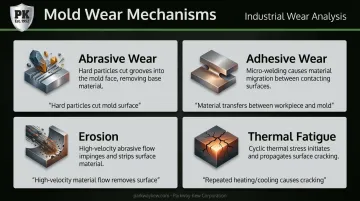
These mechanisms rarely act alone — an extrusion die may face simultaneous erosion and thermal fatigue, while a wire drawing die contends with abrasion and friction across thousands of production hours.
The Operational and Financial Consequences
When mold surfaces degrade, the consequences compound quickly:
- Dimensional drift causes finished parts to move out of specification
- Increased surface roughness on the mold transfers directly to the workpiece finish
- Unplanned production stoppages for emergency mold changeouts disrupt scheduling
- Premature replacement of high-value tooling drives up per-part manufacturing cost
A mold costing more than $100,000 that fails 30% earlier than expected represents a substantial avoidable cost — not counting the production downtime incurred during the swap.
The Surface Engineering Alternative
Instead of replacing entire molds, coating the working surface with a wear-resistant material extends service life at a fraction of the replacement cost. Plasma spray is one of the most versatile techniques for this application, depositing advanced ceramic and metallic coatings on complex mold geometries under production-realistic conditions.
The approach is especially practical for high-value tooling: the mold substrate is preserved while only the working surface is renewed, keeping material and labor costs well below full replacement.
What Is Plasma Spray Coating and How Does It Work?
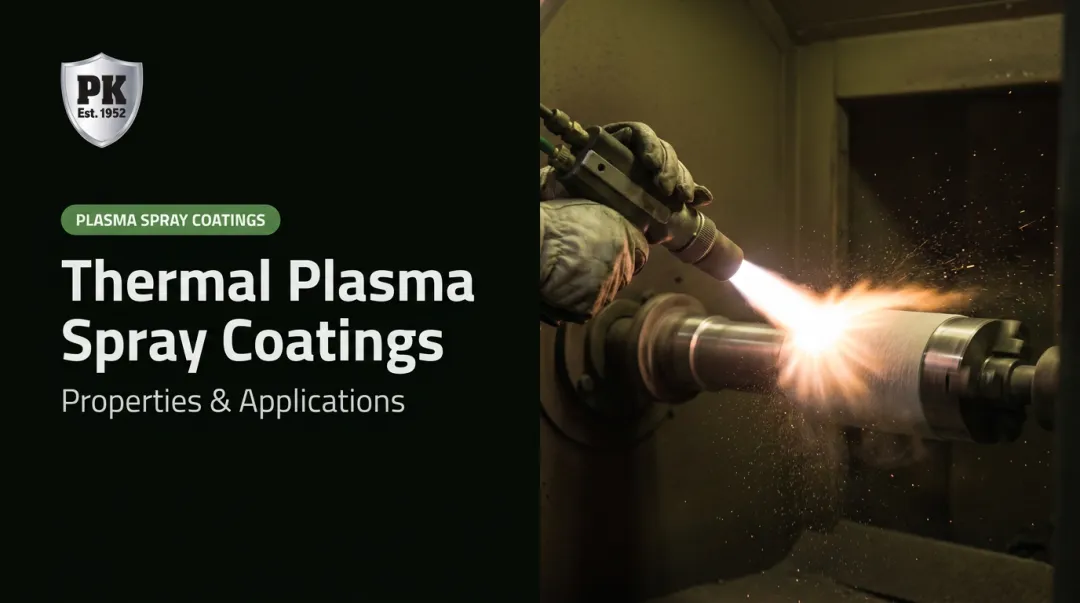
Plasma spray is a thermal spray process in which an electric arc ionizes inert gases — typically argon or nitrogen, sometimes with hydrogen or helium as a secondary gas — to generate a plasma plume reaching temperatures of 12,000–16,000°C. That extreme heat is what separates plasma spray from other thermal spray methods: it can melt advanced ceramics and high-melting-point materials that flame spray or arc spray simply cannot process.
Powdered coating material is injected into the plasma jet, melted, and propelled toward the mold substrate at velocities up to 450 m/s. On impact, the molten particles flatten into splats, solidify rapidly, and build up a layered coating structure.
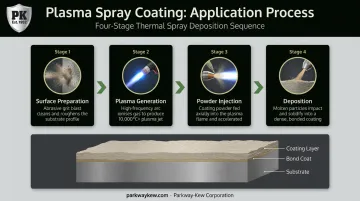
Those four mechanics — surface prep, plasma generation, powder injection, and deposition — each require tight control to produce consistent results on precision mold surfaces.
The Four Process Steps
- Surface preparation — Grit blasting and cleaning remove contaminants and create a surface profile for mechanical adhesion. This step directly affects bond strength.
- Plasma generation — Gases ionized by an electric arc form the plasma plume. Gas composition and power input control plume temperature.
- Powder injection — Coating material in powder form is fed into the plasma jet, where it melts and accelerates.
- Deposition — Molten particles impact the mold surface, flatten, and build up a coating of controlled thickness.
APS vs. VPS: Which Variant Applies to Molds?
| Variant | Environment | Best For |
|---|---|---|
| Atmospheric Plasma Spray (APS) | Open air | Ceramic wear coatings, most mold applications |
| Vacuum Plasma Spray (VPS/LPPS) | Controlled atmosphere | Oxidation-sensitive metallic coatings, maximum purity |
APS is the standard choice for mold wear coating work. VPS is reserved for applications where oxidation during deposition would compromise coating integrity — typically metallic bond coats or specialty alloys rather than oxide ceramics.
Why Process Control Matters on Precision Molds
According to Oerlikon Metco's APS data, porosity and bond strength in plasma spray coatings aren't fixed material properties — they're direct outputs of parameter choices. Key variables include:
- Plasma gas composition (argon, nitrogen, hydrogen ratios)
- Power input to the plasma arc
- Powder feed rate and particle size distribution
- Spray distance from gun to substrate
- Substrate temperature during deposition
On precision mold surfaces, where dimensional tolerances and surface finish matter, minor parameter variations translate directly into coating performance. Porosity can range from under 1% to roughly 20%, and bond strength from 17 MPa to over 83 MPa — a wide spread that reflects how much process discipline determines the final result. Before selecting an applicator, ask specifically how they document and repeat parameter sets across jobs.
Best Plasma Spray Materials for Mold Wear Resistance
Chromium Oxide (Cr₂O₃)
Chromium oxide is one of the hardest ceramic coating materials available through thermal spray. It combines excellent abrasion resistance, low friction, and strong corrosion resistance with a naturally smooth surface finish.
That surface quality makes it the preferred choice for molds processing abrasive materials — wire drawing dies, extrusion tooling, and forming components where surface defects transfer directly to wire finish.
Parkway-Kew's PK-1500 is a chrome oxide plasma spray coating specifically developed for high-speed, high-slip ferrous wire drawing applications. It's described internally as the most wear-resistant ceramic in their lineup for wire drawing blocks, and has proven cost-effective in demanding small-wire and plated-wire production environments.
Oerlikon notes that Cr₂O₃-25TiO₂ blends produce denser and smoother coatings than pure chromia, with a maximum service temperature of 540°C.
Aluminum Oxide (Al₂O₃) and Alumina-Titania Blends
Aluminum oxide provides good hardness and wear resistance at lower cost than chromium oxide. Key properties:
- Maximum service temperature of 1,650°C
- High chemical inertness
- Good abrasion resistance across most industrial environments
The alumina-titania (Al₂O₃-TiO₂) blend improves toughness and crack resistance compared to pure alumina — an advantage for molds subject to mechanical shock or thermal cycling.
Where the application demands a balance between surface hardness and coating toughness (rather than maximum hardness alone), alumina-titania blends are often the more practical choice.
Tungsten Carbide-Cobalt (WC-Co)
WC-Co coatings can be deposited by plasma spray, but the process comparison is worth understanding: HVOF produces denser WC-Co coatings with lower porosity (under 0.5% vs. approximately 2–3% for plasma spray) and higher bond strength. For molds where carbide coatings are the right material choice, HVOF is generally the preferred process. Plasma spray WC-Co is appropriate when HVOF equipment is unavailable or geometry constraints favor plasma spray deposition.
Zirconia-Based Thermal Barrier Coatings (YSZ)
The three materials above address abrasion and surface wear. YSZ addresses a different problem entirely: heat. Their role on molds is thermal protection — insulating the steel substrate from the temperature cycling that causes heat-checking and fatigue cracking in die-casting and hot-forming tooling. YSZ has thermal conductivity around 1 W/(m·K), and TBC literature reports substrate temperature reductions of 150–300°C in comparable applications.
For thermally cycled molds, YSZ addresses a different failure mode than abrasion. It's a thermal management solution, not a hardness solution.
Benefits of Plasma Spray Wear-Resistant Coatings for Molds
Extended Mold Service Life
A dense plasma spray ceramic coating significantly slows the rate of surface wear on mold working faces. The coating absorbs the abrasive and erosive contact that would otherwise act directly on the steel substrate. Oerlikon identifies wear and corrosion protection as primary APS functions — the coating creates a durable intermediate layer between the working environment and the underlying mold material.
Actual service-life gains vary based on operating conditions, coating material selection, and maintenance practice. A coating specialist can reference comparable application data to set realistic expectations for your specific use case.
Improved Workpiece Surface Finish
A hard, smooth plasma spray ceramic surface on the mold reduces roughness transfer to the product being formed. In wire drawing, where surface quality is a primary output specification, this is particularly significant. Parkway-Kew's PK-1500 chrome oxide coating is applied specifically to wire drawing blocks for this reason — the coating surface quality directly affects the quality of wire produced over millions of drawing cycles.
Cost-Effective Alternative to Solid Ceramics
Plasma spray ceramic coatings deliver the hardness and wear resistance of ceramic materials on a steel or cast iron substrate — without the brittleness, cracking risk, and high material cost of solid ceramic tooling.
Parkway-Kew introduced plasma sprayed ceramic coated blocks specifically to provide a more durable and practical alternative to solid ceramics. Customers using solid ceramic components for wire drawing experienced breakage and slippage problems common to solid ceramic components. A coated steel substrate eliminates those failure modes while maintaining the ceramic surface properties that high-wear applications require.
Reduced Downtime from Mold Changeouts
Fewer mold swaps mean longer uninterrupted production runs. Each avoided changeout delivers compounding returns:
- Reduces maintenance labor and crew time on the floor
- Eliminates the scheduling disruption of pulling a mold from production
- Defers the capital expenditure of replacement tooling
Across a multi-year production program, those avoided costs add up faster than most shops initially estimate.
Reconditioning and Recoating
Worn plasma spray coatings can be stripped and reapplied to restore molds to original dimensional specifications. Oerlikon lists repair and restoration among the documented functions of APS, and post-coating cylindrical grinding is a standard step for bringing restored components back to precise dimensions.
Parkway-Kew's in-house CNC grinding capability — up to 65 inches in diameter and 12 feet in length — supports this reconditioning workflow directly. A mold that can be recoated three or four times before the substrate becomes unserviceable represents a fundamentally different cost structure than one that must be replaced at each wear limit.
Plasma Spray vs. Other Coating Methods for Molds
Plasma Spray vs. HVOF
This comparison is worth getting precise on, because both processes are thermal spray but work best for different coating materials:
| Factor | Plasma Spray | HVOF |
|---|---|---|
| Temperature | 12,000–16,000°C | ~2,600–3,000°C |
| Particle velocity | Up to 450 m/s | Up to 700 m/s |
| Best material | Ceramics (Al₂O₃, Cr₂O₃, YSZ) | Carbides (WC-Co, WC-CoCr) |
| Carbide porosity | ~2–3% | <0.5% |
| Carbide bond strength | 55–69 MPa | 83+ MPa |
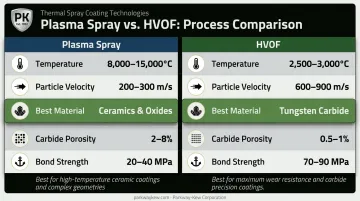
The practical decision point: use HVOF for carbide-based mold coatings requiring maximum density and bond strength; use plasma spray for ceramic wear coatings and thermal barrier applications where HVOF's lower temperature cannot melt the material.
Parkway-Kew offers both processes — which means the right technology gets selected based on the mold's actual material and performance requirements, not shop capability constraints.
Plasma Spray vs. PVD
PVD coatings are extremely thin (typically 2–10 microns), suited to precision cutting tools and injection mold cores where dimensional tolerances are tight and minimal thickness is the priority. Plasma spray deposits 50–500+ microns, making it the right choice when the application demands meaningful buildup or severe wear resistance.
Key differences in practice:
- Thickness range: PVD at 2–10 µm vs. plasma spray at 50–500+ µm
- Part size: PVD requires a vacuum chamber; plasma spray handles large, complex geometries
- Primary use case: PVD for surface hardness at tight tolerances; plasma spray for dimensional restoration and heavy wear protection
Plasma Spray vs. Hard Chrome Plating
Hard chrome was the default mold wear coating for decades. It remains effective, but faces increasing regulatory pressure: OSHA sets the Cr(VI) permissible exposure limit at 5 µg/m³ as an 8-hour TWA, and EPA's NESHAP regulations govern hexavalent chromium emissions from hard chrome electroplating operations.
Plasma spray ceramic coatings offer comparable or superior hardness and wear resistance without those regulatory complications — and with better performance at elevated temperatures where hard chrome softens.
How to Choose the Right Plasma Spray Coating for Your Molds
Four Variables That Drive Material Selection
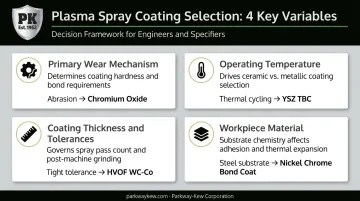
Getting the coating selection right requires evaluating four factors before specifying a material:
- Primary wear mechanism — Abrasion calls for hard ceramics like chromium oxide; thermal fatigue calls for YSZ TBCs; combined wear and impact shifts the decision toward carbides (and likely HVOF rather than plasma spray)
- Operating temperature — Ceramic TBCs are essential for hot-forming and die-casting dies; cold-forming applications don't require them
- Required coating thickness and dimensional tolerances — A restoration application needs more build-up than a new mold; both must be reconciled against the mold's tolerance stack
- Workpiece material — Hard abrasive fillers in injection-molded polymers accelerate wear differently than steel wire; the coating selection should account for what's in contact with the mold surface
Choosing a Coating Partner
Material selection is only part of the decision. The coating partner's process capabilities determine whether the specified material actually performs as expected.
Parkway-Kew Corporation has been applying wear-resistant coatings to industrial components since 1952, adding plasma spray ceramic capability in the late 1990s after introducing HVOF in 1989, metallizing in the early 1980s, and submerged arc welding in the 1950s.
Their in-house capabilities cover the full workflow — from worn component to finish-ground part — under one roof:
- Plasma spray and HVOF coating
- Metallizing and sub-arc welding
- CNC grinding up to 65 inches in diameter and 12 feet in length
No single coating technology is optimal for every mold application. A partner with genuine multi-process capability matches the technology to the mold — not the other way around.
Frequently Asked Questions
What is plasma spray coating?
Plasma spray is a thermal spray process that melts powdered coating materials in a high-temperature plasma jet (12,000–16,000°C) and deposits them onto a component surface at high velocity. The molten particles flatten and solidify on impact, building up a dense, wear-resistant coating layer.
What is the difference between PVD and plasma spray?
PVD deposits ultra-thin coatings (typically 2–10 microns) in a vacuum chamber, making it suited for precision cutting tools and tight-tolerance mold inserts. Plasma spray deposits much thicker coatings (50–500+ microns) in open air, making it better for large components, complex geometries, and applications requiring significant wear material buildup or dimensional restoration.
What is the best wear-resistant coating?
The best coating depends on the wear mechanism. Chromium oxide plasma spray excels for abrasion resistance; HVOF tungsten carbide suits combined wear and impact; YSZ thermal barrier ceramics are best for thermally cycled molds. Operating conditions determine the right choice, and no single coating suits every application.
How long does plasma spray coating last on molds?
Service life depends on operating conditions, coating material, and maintenance practices. Plasma spray coatings substantially reduce wear rates compared to uncoated tooling, and worn coatings can be reapplied to restore molds rather than replacing the substrate.
Can plasma spray coatings be reapplied to worn molds?
Yes. Worn plasma spray coatings can be stripped and recoated, restoring the mold to original dimensions. This makes plasma spray a cost-effective long-term maintenance strategy — especially for large or complex tooling where full replacement costs are significant.
What thickness of plasma spray coating is recommended for mold applications?
Typical plasma spray coating thickness for mold wear applications ranges from approximately 50 to 500 microns, depending on wear severity, dimensional restoration requirements, and operating tolerances. A coating specialist should determine the appropriate thickness for each specific application rather than applying a generic figure.