Introduction
When specifying a coating for industrial metal parts, one question comes up consistently: which coatings achieve smoothness through a melting and flow mechanism — and which just happen to produce smooth results through other means?
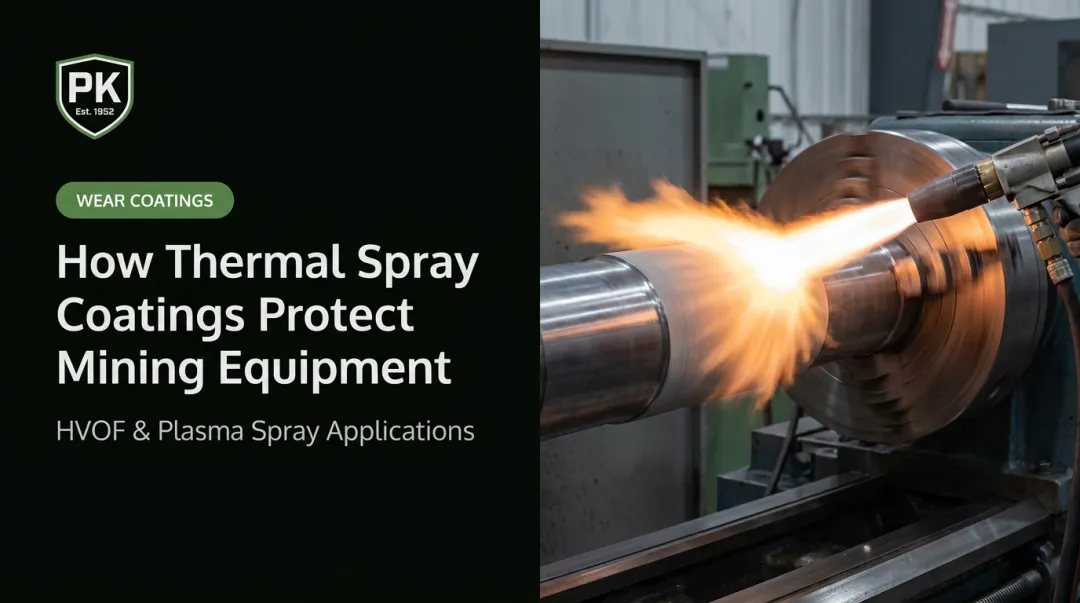
The answer involves two distinct processes. Powder coating melts after application in a curing oven, flowing and leveling before it solidifies into a smooth, continuous film. Thermal spray coatings — particularly HVOF and plasma spray — melt the feedstock during application, propelling semi-molten particles onto the substrate at high velocity.
These two approaches look similar on paper but serve completely different engineering purposes. Powder coating works well for corrosion protection, aesthetics, and general industrial use. Thermal spray is the right call for components facing extreme wear, heavy loads, or elevated temperatures that a polymer film cannot handle.
Getting this distinction wrong has real consequences. Specify powder coating where HVOF belongs, and a component fails prematurely. Over-engineer with thermal spray where powder coating would suffice, and costs climb unnecessarily.
Key Takeaways
- Powder coating melts in an oven at 160–200°C, flows to a smooth film, and cross-links permanently — it cannot be re-melted
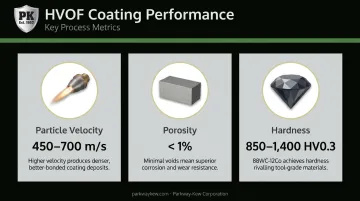
- HVOF sprays particles at 450–700 m/s, producing coatings with less than 1% porosity and hardness up to 1,400 HV0.3
- Plasma spray processes ceramics at temperatures reaching 30,000°C — materials no combustion process can melt
- Thermal spray coatings require post-spray grinding to hit precision tolerances — as-sprayed finishes are a starting point, not a final spec
- Always specify Ra and Rz target values on the drawing; these parameters determine whether a coating meets tolerance
How Melting Creates a Smooth Surface Finish
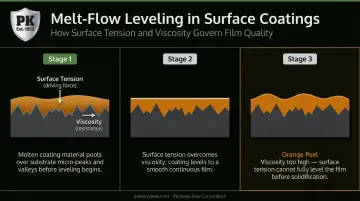
Even well-machined metal surfaces have micro-peaks and valleys at the microscopic level. A coating that melts and flows fills those irregularities before solidifying, producing a more uniform, lower-Ra surface than the substrate underneath.
When coating material transitions to a liquid or semi-molten state, surface tension drives lateral flow while gravity assists leveling. The material spreads across irregularities before it solidifies, inherently smoothing the surface profile.
Viscosity management is critical to this process. Surface tension is the driving force for leveling in powder coatings, while viscosity is the resistance. Too little surface tension relative to viscosity produces orange peel rather than a flat film.
How This Differs from Subtractive Finishing
Grinding, abrasive blasting, and electropolishing achieve smoothness by removing material from peaks. Melt-based coatings do the opposite — they add material while simultaneously smoothing. This distinction matters for dimensional control: a melt-based coating changes both the surface profile and the part's net dimensions, which must be accounted for in the design.
Why Surface Finish Matters Functionally
Smooth coatings aren't just aesthetic. In industrial applications, surface finish affects:
- Stress concentrations at rough contact points accelerate wear on mating components
- Surface defects on drawing blocks transfer directly to wire, affecting finished wire diameter and surface quality
- Crevices in rough coatings trap moisture and contaminants, creating corrosion initiation sites
- Hydraulic rod seals require Ra values of 0.05 to 0.30 µm to function without premature wear or leakage
Surface roughness is measured using a profilometer and reported as Ra (average absolute height deviation from the mean line, per ASME B46.1) or Rz (mean of five peak-to-valley values). Ra controls general finish quality; Rz is used where individual peaks matter, such as sealing surfaces or wire contact areas.
Powder Coating: The Coating That Melts After Application
Powder coating is the most widely used melt-to-smooth process for general industrial and architectural applications. The process separates into two distinct stages: application and cure. The cure stage is what creates the smooth result.
The Application Stage
Dry thermoplastic or thermoset powder is electrostatically charged and sprayed onto a grounded metal part. The opposite charges cause the powder to adhere uniformly across the surface before any heat is applied. At this stage, the coating looks like a fine, textured powder layer: no film continuity, no smoothness.
The Curing Stage: Where Smoothness Happens
The coated part enters a curing oven. For standard thermoset powders, typical cure parameters are 10 to 20 minutes at 160 to 200°C. AkzoNobel's Interpon 100, for example, specifies 15 minutes at 350°F (177°C). The powder particles melt, flow together, and chemically cross-link into a continuous, smooth film with no brush marks, drip lines, or texture from the powder particles themselves.
A cured thermoset powder coating will not re-melt when reheated. The cross-linking reaction is permanent, which separates thermoset powders from thermoplastic coatings that remain fusible after cure.
Typical cured film properties:
- Film thickness: 3.0 to 6.0 mils (architectural and industrial products)
- Pencil hardness: approximately 2H (ASTM D3363), sufficient for handling and moderate wear but not for abrasive industrial contact
Where Powder Coating Excels
Powder coating is the right choice for:
- Consumer goods, appliances, and automotive components where aesthetics and corrosion resistance drive the spec
- Architectural metalwork where color, gloss level, and weather resistance matter
- General industrial equipment where moderate wear resistance is sufficient
- Applications where cost-effectiveness and production throughput are priorities
Where It Falls Short
Powder coating is a polymer-based coating. Its hardness ceiling, roughly 2H pencil hardness, makes it unsuitable for components subjected to:
- Sliding abrasion under significant load
- Temperatures above standard service ranges (specialty silicone powders handle intermittent exposure to 800°F, but standard thermoset powders do not)
- Precision surface tolerances where post-coat grinding is required
- Contact with wire, seals, or mating metal surfaces in high-cycle applications
For components operating under those conditions — fracking plungers, wire drawing blocks, crane wheels, or any part subject to continuous abrasion and mechanical load — thermal spray processes such as HVOF or plasma spray are the appropriate technology.
Thermal Spray Coatings: Melting During Application
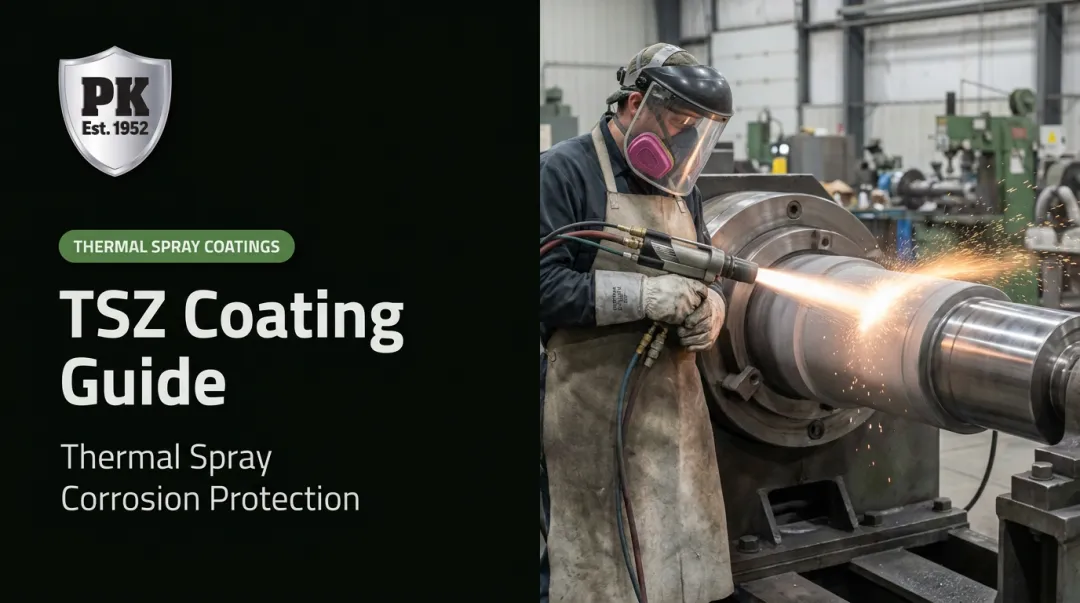
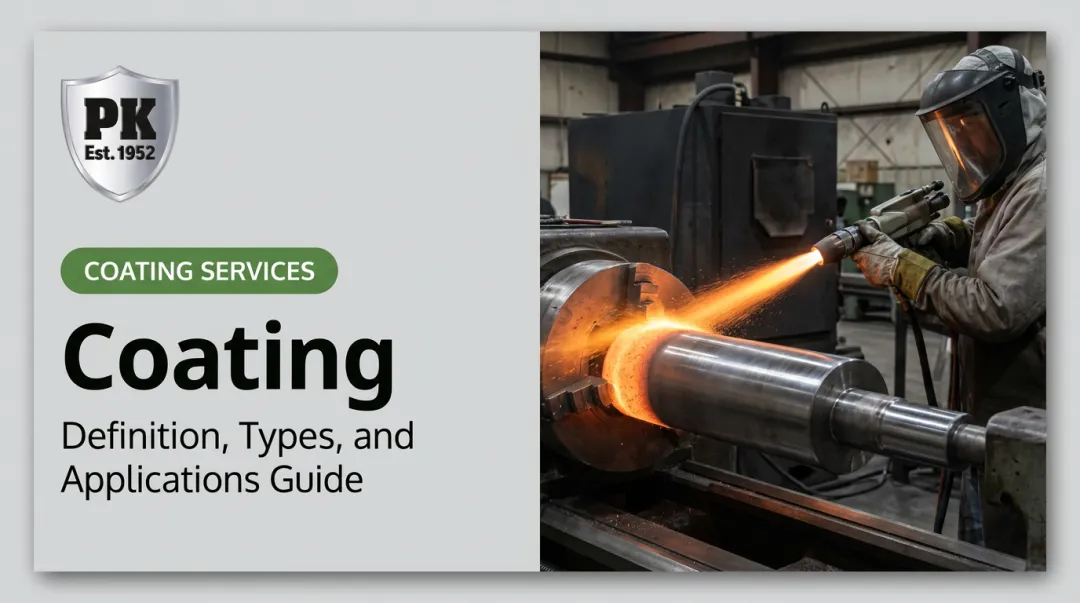
Thermal spray is a family of processes where feedstock — wire or powder — is fed into a heat source that melts or semi-melts it, then propelled at high velocity onto the substrate. The molten particles flatten on impact (forming splats), cool rapidly, and bond mechanically to build up a dense, layered coating.
Unlike powder coating, where melting happens in an oven after application, thermal spray melts the feedstock mid-flight — before it ever contacts the part.
HVOF: High Velocity for Dense, Hard Coatings
HVOF (High Velocity Oxygen Fuel) uses combustion of fuel and oxygen to accelerate molten particles at 450 to 700 m/s depending on whether gas-fuel or liquid-fuel systems are used. At those velocities, the kinetic energy of impact is substantial — particles deform into thin, tightly overlapping lamellae that produce an exceptionally dense coating structure.
The results are measurable:
- Porosity: less than 1% (some formulations achieve less than 0.5%)
- Hardness: 850 to 1,400 HV0.3 for 88WC-12Co coatings
- As-sprayed finish: Ra 1.5 to 2.5 µm for fine tungsten carbide powders
Parkway-Kew Corporation introduced HVOF coating for wire drawing blocks in 1989, the first time this technology was applied to that component type. Their HVOF lineup covers a family of nickel chrome boron matrix coatings (PK-920, PK-675, PK-700, PK-750) with progressively increasing tungsten carbide content, letting engineers match hardness to specific wear conditions.
Plasma Spray: Processing What Combustion Cannot
HVOF combustion temperatures top out well below what certain ceramics require. Plasma spray addresses that ceiling by using a DC electric arc to ionize gas into a plasma stream reaching 30,000°C — hot enough to melt feedstocks like alumina (~2,000°C), chromium oxide-silica (~2,435°C), and zirconia-titania-yttria (~2,535°C) that no combustion process can handle.
The trade-off is surface finish. Plasma spray produces rougher as-sprayed textures than HVOF:
| Ceramic Material | As-Sprayed Finish | After Grinding | Hardness |
|---|---|---|---|
| White alumina | 325–400 µin RMS | 45–50 µin aa | Rc60 |
| Chromium oxide-silica | 250–350 µin aa | 15–20 µin aa (lapped: 2–4 µin) | Rc65 |
| Zirconia-titania-yttria | 250–350 µin aa | 10–15 µin aa | Rc55 |
Parkway-Kew's plasma spray program centers on PK-1500 chrome oxide, specified for high-speed, high-slip ferrous wire drawing — particularly small, high-quality, or plated wires where surface integrity is critical.
Post-Spray Grinding: The Path to Precision Finish
Precision components don't ship as-sprayed. Grinding is the step that takes a functionally excellent but dimensionally rough coating to a final surface finish specification.
HVOF coatings can be ground to 1 µin Ra or finer in precision applications — a finish level that satisfies demanding sealing and wear surface requirements. Plasma spray ceramics, after lapping, can reach 2–4 µin aa on chromium oxide-silica.
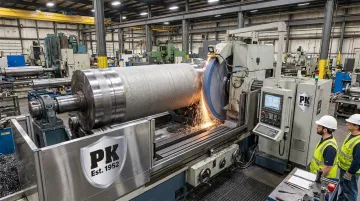
Together, thermal spray and precision grinding deliver what neither achieves alone: the wear resistance required for long service life paired with the smooth surface finish required for consistent wire quality. Parkway-Kew's in-house large-diameter grinding department handles workpieces up to 65 inches in diameter and 12 feet in length, completing the full coating-to-final-finish sequence under one roof.
Other Coatings That Produce Smooth Surface Finishes
Not every smooth coating involves melting. Three other processes produce smooth results through different mechanisms and serve specific applications where melt-based coatings would be impractical or unnecessary.
The table below compares the four most common non-melt smooth-finish coatings by hardness, achievable roughness, and primary use case:
| Coating | Hardness | Surface Finish | Primary Application | Standard |
|---|---|---|---|---|
| Hard chrome electroplating | 800–950 HV | Ra 0.15 µm | Precision sliding surfaces, hydraulic rod ODs, tight-tolerance assemblies | ASTM B177/B177M |
| Electroless nickel | 500–700 HV as-deposited; ~1,000 HV (69 HRC) heat-treated | Follows substrate profile | Complex geometries requiring uniform coverage and corrosion resistance | ASTM B733 |
| E-coat (electrocoating) | N/A (primer layer) | Uniform over all surfaces including recesses | Corrosion-protection primer in automotive and industrial assembly | PPG cathodic epoxy: 20-min bake at 375°F |
| Anodizing | Varies by type | Retains substrate profile | Aluminum and titanium surface protection; does not correct surface roughness | Type II: 0.0001–0.001 in.; Type III: ~0.002 in. |
A few distinctions worth noting:
- Hard chrome fills micro-irregularities during deposition, making it one of the few non-melt processes that actively improves surface finish.
- Electroless nickel conforms to the substrate exactly — it will not hide machining marks or correct dimensional errors.
- E-coat is a corrosion primer, not a wear coating. Its inclusion here reflects its smooth, uniform appearance rather than surface hardness.
- Anodizing converts the surface into an oxide layer rather than depositing a new material. Rough machined surfaces stay rough after anodizing.
How to Choose the Right Coating for a Smooth Surface Finish
Coating selection starts with defining what the surface actually needs to do — smoothness is typically one requirement among several that must be balanced against hardness, temperature, and geometry.
Key Selection Criteria
- Operating temperature — powder coating is not suitable above its thermal limit; HVOF WC-Co coatings are rated to 500°C service temperature
- Required hardness — powder coating achieves roughly 2H pencil hardness; HVOF tungsten carbide reaches 850–1,400 HV0.3; hard chrome reaches 800–950 HV
- Surface finish tolerance — does the coating alone meet the Ra spec on the drawing, or is post-coat grinding required?
- Wear mechanism — abrasion, sliding contact, erosion, and impact each favor different coating chemistries
- Post-coating feasibility — can the component be ground after coating? Large, irregular geometries may limit grinding options
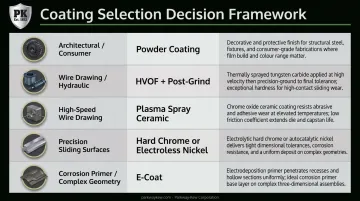
Practical Selection Framework
| Application Type | Recommended Coating | Reasoning |
|---|---|---|
| Architectural/consumer/general industrial | Powder coating | Cost-effective, aesthetically smooth, corrosion-resistant |
| Wire drawing blocks, pump plungers, hydraulic components | HVOF + post-grind | Hardness + precision finish achievable |
| High-speed ferrous/plated wire drawing | Plasma spray ceramic | Wear-resistant ceramic for high-slip conditions |
| Precision sliding surfaces, tight tolerances | Hard chrome or electroless nickel | Thin, dimensionally precise, very smooth |
| Corrosion primer over complex geometry | E-coat | Uniform coverage, good adhesion base |
Using Ra Specifications to Drive Decisions
When a technical drawing specifies a target Ra value, that number determines whether a coating alone will meet the requirement or whether post-coat grinding is needed. As-sprayed HVOF finishes (Ra 1.5–2.5 µm) will not satisfy a precision sealing surface spec of 0.1–0.2 µm without grinding. Aerospace dynamic sealing surfaces, for instance, require HVOF WC-Co-Cr finished to 2–4 µin Ra. That specification is only achievable with HVOF plus superfinishing — the as-sprayed deposit alone will not get there.
Always specify the final ground finish requirement on the drawing, not the coating process label.
Frequently Asked Questions
What are the different types of surface coatings?
Coatings broadly fall into three categories: melt-based (powder coating, HVOF, plasma spray), electrochemical (electroplating, electroless plating, e-coat, anodizing), and chemical/conversion coatings (phosphate, chromate). Process selection depends on the required hardness, operating temperature, and corrosion environment of the application.
What are the two main types of surface finishes?
Surface finish refers to both a measurable texture characteristic and a process. As a measurement, it describes roughness, waviness, and lay — with Ra and Rz being the most common quantification parameters. As a process, "surface finishing" encompasses everything applied to achieve desired properties: coating, grinding, plating, or polishing.
What is the difference between powder coating and thermal spray coating?
Powder coating melts a polymer film in an oven after application, producing a smooth decorative and corrosion-resistant finish. Thermal spray melts metallic or ceramic feedstock during application, creating a hard, dense coating suited for heavy wear. Hardness and service temperature ranges differ substantially between the two.
Does powder coating create a smooth surface finish on metal?
Yes — the oven-curing step melts and levels the powder into a smooth, even film free of brush marks or drip lines. Final smoothness depends on proper substrate preparation, powder particle size, and correct curing temperature and dwell time. Insufficient cure or wrong oven temperature produces orange peel rather than a flat film.
What is HVOF coating and why is it preferred for industrial wear surfaces?
HVOF propels molten particles at 450–700 m/s onto the substrate, producing a coating with less than 1% porosity and hardness up to 1,400 HV0.3. The high kinetic energy yields a denser, better-bonded, and smoother deposit than conventional flame spray. That combination of hardness and precision finish makes it the go-to process for wire drawing blocks, pump plungers, and hydraulic components.
How is surface finish measured after coating?
A profilometer drags a stylus across the coated surface and records height variations along the profile. The most common outputs are Ra (average roughness) and Rz (mean peak-to-valley depth over five sampling lengths). Coated parts are measured against the Ra specification on the engineering drawing to confirm acceptance before shipment.