

For high-wear industrial components like wire drawing blocks, capstans, and fracking plungers, a single undetected holiday can trigger premature corrosion and unplanned downtime. Plasma-sprayed coatings, for example, can carry porosity levels of 3% to 20% depending on process parameters, and interconnected pores are the ones that matter most for corrosion protection.
This guide covers the tools you need, three proven detection methods (wet sponge, high-voltage spark, and visual/dye penetrant), how to read your results, and the mistakes that cause false readings.
Key Takeaways
- Coating discontinuities expose bare metal to moisture and gases, speeding corrosion and wear
- Wet sponge testing works for thin films; high-voltage spark testing suits thick coatings
- Matching test voltage to measured dry film thickness (DFT) matters most
- Visual and dye-penetrant methods complement electrical testing on non-conductive substrates
- Established coating providers build holiday testing into QC before shipment
What You Need to Check for Pinholes and Holidays in Coatings
The right detector, electrode, and access setup depends on three variables: coating thickness, substrate conductivity, and whether you're testing in a controlled shop environment or out in the field. Get these wrong and you'll either miss real defects or generate false alarms all day.
Before you start any inspection, gather:
- Low-voltage and high-voltage holiday detectors (coverage depends on coating type)
- Wet sponge electrode with a conductive wetting solution
- Ground clamp or continuity cable
- Dry film thickness (DFT) gauge
- Dye penetrant kit with UV light source
- Bright inspection lighting or a magnifier for visual screening
Preconditions and Setup
Skipping prep work is where most bad readings originate. Three things need to happen first:
- Confirm full cure. Test the coating only after it has cured per the manufacturer's specified dry time. ASTM D5162 guidance is direct on this: retained solvent can form a conductive path, cause erroneous indications, and even create a fire hazard during testing.
- Clean the surface. Dust, oil, or residue can either mask a genuine holiday or trigger a false spark. Wipe the part down and let it dry completely before touching a detector to it.
- Verify grounding and voltage. Check continuity to bare substrate, then calculate your test voltage from measured DFT. This step alone determines whether your results mean anything.
Methods to Detect Pinholes and Holidays in Coatings
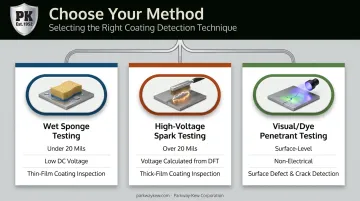
Method selection comes down to coating thickness, substrate conductivity, and whether you need a non-destructive or field-ready test. Here are the three approaches worth knowing.
Method 1: Low-Voltage Wet Sponge Testing
This method detects holidays in thin, non-conductive coatings, generally those under 20 mils (500 microns), by passing low DC voltage through a water-saturated sponge across the coated surface.
What you'll need: Wet sponge electrode, low-voltage holiday detector, ground clamp, conductive wetting solution.
Follow these steps:
- Saturate the sponge with wetting solution and attach the ground clamp to bare, unpainted substrate
- Set the detector to the voltage recommended for the measured DFT, then pass the sponge slowly and evenly over the entire coated surface
- Watch and listen for an audible buzz or visual spark. Either signals current has jumped through a holiday to reach the substrate
This method works well for thin coatings and tight, confined geometries. It falls short on thick, high-build coatings that need more voltage than a wet sponge can safely deliver.
Method 2: High-Voltage Spark (Holiday) Testing
For thick or high-build protective coatings, generally typically over 20 mils, high-voltage spark testing uses a dry electrode and a DC voltage calculated directly from the coating's film thickness.
What you'll need: High-voltage holiday detector, dry brush/coil/rolling-spring electrode sized to the part's geometry, DFT gauge, ground continuity cable.
The process:
- Measure DFT at multiple points across the part, then calculate test voltage using the applicable standard's formula
- Ground the detector to bare metal, then pass the electrode over the full surface at a controlled, even speed
- Mark and log the exact location of any point where a spark or alarm occurs
Voltage calculation isn't optional here. ASTM G62-23 provides the formula for calculating test voltage from coating thickness: V = 1500 + 1.5[170 + 63.0d + 293√d], where d is thickness in mils.
Get this wrong in either direction, and you risk missing real defects or arcing through sound coating, creating new pinholes where none existed.
This method reliably finds even microscopic holidays in thick thermal spray, HVOF, or plasma coatings. Parkway-Kew's HVOF process, for instance, sprays alloy powder at speeds exceeding Mach 2 to produce dense, hard coatings on wire drawing blocks and capstans — exactly the high-build application where spark testing is the correct call over wet sponge.
Method 3: Visual Inspection and Dye Penetrant Testing
This non-electrical method spots surface-level pinholes. It's especially useful on non-conductive substrates or as a quick preliminary screen ahead of electrical testing.
What you'll need: Raking light or magnifying inspection lamp, dye penetrant kit, UV light source, cleaning solvent.
Steps to follow:
- Clean and fully dry the surface, then apply dye penetrant and allow the prescribed dwell time
- Remove excess penetrant per kit instructions, applying developer if using a two-step system
- Inspect under UV or raking light for dye bleed-through indicating a pinhole or void
Dye penetrant is fast, low-cost, and good for surface screening. Its limitation matters, though: it cannot detect subsurface porosity or confirm true electrical continuity to the substrate the way electrical testing can. Treat it as a screening tool, not a substitute for holiday detection.
How to Interpret the Results
Misreading results carries real cost either direction. A missed holiday can ship a part with a hidden corrosion pathway. An overly cautious read can trigger rework that wasn't actually needed.
Every reading falls into one of three categories:
| Result | What You See | Action |
|---|---|---|
| Normal/Acceptable | No spark, buzzer activation, or dye bleed-through anywhere on the surface | Document as passed and release to service or the next process step |
| Minor Issues | Isolated, low-severity porosity in a non-critical zone within the coating standard's acceptance criteria | Log the location and proceed only if it falls within specified tolerance |
| Out-of-Spec | Repeated sparking, sustained alarm activation, or dye bleed at multiple points, signaling a holiday reaching the substrate | Perform a localized spot recoat or full strip-and-recoat before the part enters corrosion-critical or wire-contact service |
Not every reading fits neatly into these categories, though. Porosity and holidays aren't the same thing. A thermal-sprayed coating can carry internal porosity by design, particularly in thermal-barrier applications, without every pore constituting a true holiday reaching bare metal. Acceptance limits should come from the coating specification and the service environment, not a blanket percentage.
Common Errors and Safety Best Practices
Most bad test results trace back to a handful of repeat mistakes:
- Using the wrong voltage for the measured coating thickness
- Moving the electrode or sponge too fast to register a genuine holiday
- Testing before the coating has fully cured
- Losing continuous ground contact partway through the sweep
Environmental factors create traps too. High ambient humidity can produce false positives on wet sponge tests. Surface contamination, like oil film or dust, can mask a true holiday entirely. Neither of these will show up as an obvious problem until your readings stop matching what you'd expect.
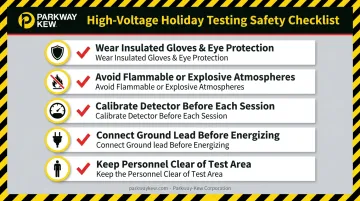
Accuracy isn't the only concern once the equipment is live — safety with high-voltage detectors matters just as much:
- Wear insulated gloves and eye protection when operating high-voltage detectors
- Never test near flammable vapors or in classified explosive atmospheres, common on oil and gas sites
- Verify detector output voltage against a calibrated reference before each session
- Connect the ground lead before energizing the unit, and keep other personnel outside the test area
If your operation doesn't have in-house testing capability, partnering with an experienced industrial coating provider closes that gap. Parkway-Kew has coated wire drawing blocks, capstans, and fracking plungers since 1952, building quality checks into every job before a part leaves the North Brunswick facility.
For components headed into corrosive service, that verification step matters as much as the coating itself.
Frequently Asked Questions
What are pinholes in coatings?
Pinholes are tiny surface-to-substrate discontinuities in a coating. They can be shallow surface flaws or full-depth voids that allow moisture and gas to reach the substrate below.
What causes pinholes in coating?
Common causes include surface contamination before application, outgassing or trapped air during cure, improper application technique, and uneven film thickness across the part.
What is a "holiday" in coating inspection?
A holiday is any discontinuity, thin spot, or void in a coating that electrical testing detects, exposing the substrate to the surrounding environment.
What voltage should I use for holiday testing?
Calculate voltage from the coating's measured dry film thickness using the applicable standard's formula. Using the wrong voltage can either miss real defects or damage otherwise sound coating.
Can pinholes be repaired without recoating the entire part?
You can often spot-repair isolated holidays if the surrounding coating passes inspection. Widespread porosity across the part typically requires full stripping and recoating instead.
How often should coated parts be tested for holidays?
Test immediately after full cure and before the part enters service. Retest components in corrosive or high-wear environments periodically throughout their service life.