Wire mills, fracking operations, and shipping terminal equipment don't operate in forgiving conditions. Continuous abrasive loads, extreme heat, and high-pressure cycles mean that a component slightly off-tolerance doesn't just fit poorly — it accelerates wear on adjacent parts, shortens replacement intervals, and eventually forces unplanned production stoppages at the worst possible moment.
Custom CNC turning addresses this problem directly. This article explains why it matters in practice — not as a technical exercise, but as a production reliability strategy — and what manufacturers actually risk by settling for off-the-shelf alternatives.
Key Takeaways
- Custom CNC turning produces parts to exact dimensional and surface finish specs, eliminating the compromises that drive premature failure
- Precision, part-to-part repeatability, and extended component life are the production gains that separate custom turning from generic alternatives
- Industries with high-wear, continuous-run applications — wire drawing, oil and gas, shipping terminals — benefit most
- Generic part substitution drives cost escalation: shorter replacement cycles, rework, and reactive maintenance that compounds over time
- Precision CNC turning compounds in value when paired with hardsurfacing treatments like HVOF or tungsten carbide coating
What Custom CNC Turning Actually Is
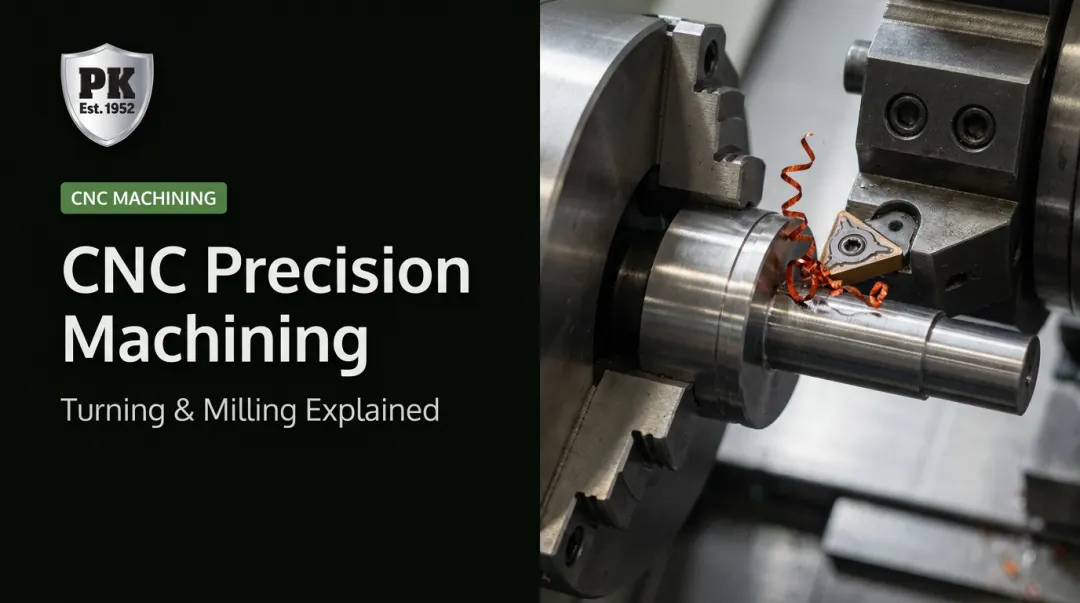
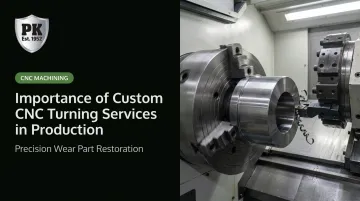
Custom CNC turning is a computer-controlled machining process in which a rotating workpiece is shaped by a stationary cutting tool to produce cylindrical components built to a customer's exact dimensional and material specifications, not general catalog dimensions.
It applies wherever a component must meet precise fit, function, or load-bearing requirements. Common examples include:
- Shafts, rollers, and plungers in hydraulic and mechanical systems
- Wire drawing blocks and capstans in wire mills
- Fracking plungers for oil and gas extraction equipment
- Crane wheels and festoon wheels in shipping terminal operations
Each of these components operates under specific load, speed, or environmental conditions that a catalog part cannot reliably meet. A custom-turned part is engineered for its exact application; a catalog part is adapted from a general specification, introducing dimensional compromises before it ever reaches the machine.
Three Production Advantages of Custom CNC Turning
Advantage 1: Dimensional Precision That Prevents Fit and Function Failures
CNC programs encode exact part geometry, and computer control eliminates the human variability that causes dimensional drift in manual turning — particularly over long runs or when machining large-diameter components. The result is a part that is dimensionally consistent with its application, not merely close enough to install.
Imprecise parts have predictable downstream consequences:
- Create fit issues at assembly that slow installation and require shimming or rework
- Generate uneven load distribution, accelerating wear on mating components
- Degrade wire quality in drawing applications when block or capstan geometry is off-spec
- Cause vibration, scoring, and erratic service life in hydraulic plunger systems
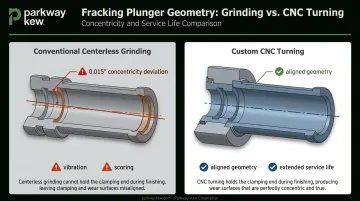
A concrete example is Parkway-Kew's fracking plunger work. Conventional centerless grinding can leave the wear surface up to 0.015 inches out of concentricity with the clamping end — a deviation that causes pump vibration and scoring. Parkway-Kew's CNC turning process holds the clamping end during finishing, mimicking how the plunger sits in the pump. That single geometric correction directly improves service life.
KPIs directly affected:
- Part rejection rate at incoming inspection
- Rework labor hours per production run
- Assembly downtime caused by poor fit
- Replacement cost per unit over 12 months
This matters most for rebuilt parts returning to in-service machines, where the replacement must match existing machined surfaces exactly — there is no margin for geometric approximation.
Advantage 2: Repeatability and Production Consistency at Scale
Once a CNC turning program is established, the machine reproduces identical dimensions and surface characteristics every cycle — whether the run is 10 parts or 10,000. Operator-to-operator variation disappears. Fatigue-driven drift doesn't accumulate. Mid-run surprises don't derail production.
According to NIST research on manufacturing machinery maintenance, manufacturers with the highest reliance on reactive maintenance experience 16 times more defects and 3.3 times more downtime than those with the lowest reliance. Inconsistent part quality is one of the primary drivers that pushes facilities into reactive maintenance cycles — because variable components create unpredictable failure patterns that defy planning.
Consistency at the part level translates directly into consistency at the system level. When every replacement component is dimensionally identical to the previous one:
- Reassembly is faster and requires less adjustment
- Performance after changeout is predictable
- Maintenance scheduling becomes more reliable
- Less-experienced personnel can execute replacements without improvising
KPIs directly affected:
- First-pass yield rate
- Scrap and rework percentage per production run
- Production schedule adherence
- Cycle time per part
Repeatability delivers its highest return in high-volume programs where a facility regularly replaces the same worn component. Wire drawing blocks, festoon wheels, and fracking plungers are prime examples — facilities replacing these parts on regular cycles cannot afford dimensional variation between one replacement and the next.
Advantage 3: Extended Component Life and Reduced Unplanned Downtime
A part turned to the correct geometry, surface finish, and material specification performs closer to its theoretical service life. An off-the-shelf substitute that approximates required dimensions wears faster and fails earlier — not because the material is inferior, but because the geometry is wrong for the application.
The financial exposure from unplanned stoppages is substantial. Siemens' 2024 downtime report places the average annual downtime loss for a large heavy industry plant at $59 million, with automotive manufacturing reaching $2.3 million per hour of unplanned downtime. One avoidable stoppage per quarter typically costs far more than the price difference between a custom and a generic component.
Custom CNC turning extends component life in two ways:
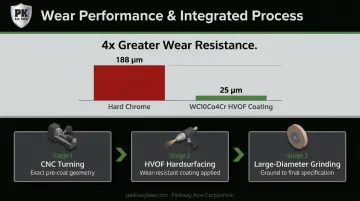
- Pre-coating geometry: Machine the part to exact spec first — uniform bonding depends on it, and a dimensionally correct substrate is what allows hardsurfacing to perform consistently under load
- Pairing with advanced coatings: Precision-turned surfaces feed directly into treatments like HVOF tungsten carbide, producing durability neither process achieves independently
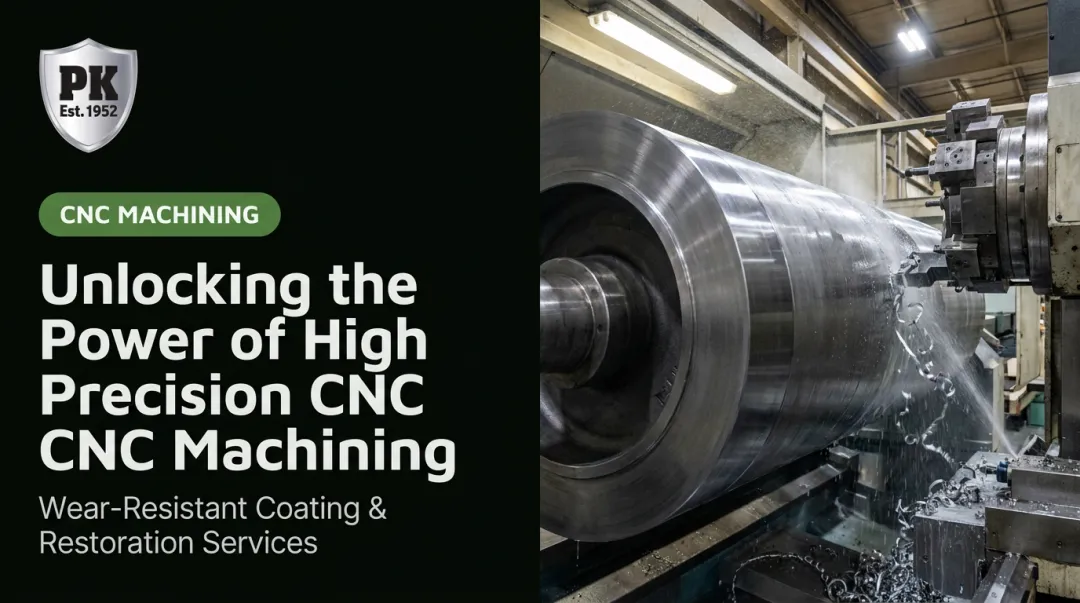
Parkway-Kew's in-house CNC turning capability handles components up to 72 inches in diameter, allowing large industrial parts — wire drawing blocks, fracking plungers, crane wheels — to be machined to exact pre-coating geometry before hardsurfacing treatments are applied. A research study on HVOF coatings found WC10Co4Cr coating wear depth of just 25 µm compared to 188 µm for hard chrome — more than four times the wear resistance. For high-cycle components like fracking plungers and wire drawing blocks, that difference translates directly into fewer changeouts and less unplanned downtime.
Operational metrics this drives:
- Mean time between failures (MTBF)
- Unplanned downtime hours per month
- Total cost of ownership per component
- Maintenance labor cost per production run
What Happens When Custom CNC Turning Is Skipped
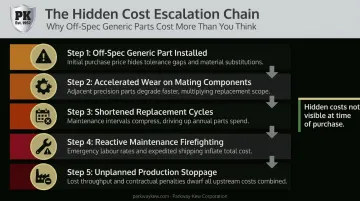
The failure pattern is predictable. Generic or imprecise parts create accelerated wear on mating components, replacement cycles shorten, and maintenance teams shift from planned changeouts to reactive firefighting.
Each off-spec part generates a chain of downstream costs:
- More frequent replacement labor
- Potential damage to surrounding equipment from a failing component
- Increased inspection frequency as failure patterns become erratic
- Production losses during unscheduled stoppages
None of these costs show up in the original purchasing decision. The part looks cheaper. The full cost only becomes visible over time — and by then, the facility has normalized a maintenance burden that was avoidable.
The scaling problem compounds quickly. As output expands or production lines are added, the cumulative impact of imprecise parts grows proportionally. Maintenance schedules become impossible to stabilize, and operational costs turn unpredictable.
The institutional knowledge required to manage that variability ends up concentrated in a few experienced technicians. That's a fragile arrangement — and one that becomes harder to sustain as the facility grows.
How to Get the Most Value from Custom CNC Turning
Custom CNC turning delivers its best outcomes when specifications are locked in before machining begins — exact tolerances, surface finish requirements, and material grades established from the operating environment, not adapted after the fact from a catalog part.
Partnering with a provider whose CNC turning integrates directly with coating and hardsurfacing services removes the coordination burden of managing multiple vendors. Parkway-Kew Corporation's in-house workflow — CNC turning, hardsurfacing (HVOF, plasma spray, submerged arc welding, metallizing), and large-diameter grinding — allows a worn or raw component to move from substrate preparation through final wear-resistant finishing in a single supply relationship.
That integration matters most for large components. Their CNC turning handles parts up to 72 inches in diameter, with grinding finishing coated surfaces to final dimensional spec.
Three practices that compound the value over time:
- Measure MTBF before and after — track downtime incidents and replacement frequency to build the cost justification needed to standardize custom turning as a procurement practice
- Specify consistently across wear-critical components — addressing every failure point, not just the most visible ones, prevents hidden cost accumulation from gradual performance degradation
- Revisit specs as conditions change — equipment age and shifting production parameters can make original tolerances obsolete; periodic review keeps parts optimized
Conclusion
The case for custom CNC turning in production comes down to three variables manufacturers can control: dimensional accuracy, part-to-part consistency, and the service life of components operating under demanding conditions.
These advantages compound. A facility that standardizes on custom CNC turned parts reduces its reactive maintenance burden and stabilizes production scheduling. Over time, that consistency builds a real cost-of-ownership advantage over operations still relying on generic substitutes.
Custom CNC turning is an ongoing manufacturing practice, not a one-time procurement decision. The returns grow as specifications are refined, performance data accumulates, and the quality bar for every critical part on a production line is deliberately pushed higher.
Frequently Asked Questions
What is the importance of custom CNC turning services in production?
Custom CNC turning ensures parts are produced to the exact dimensional and surface finish specifications required for their operating environment. This directly improves component lifespan, production consistency, and uptime reliability — particularly in high-wear industrial applications where off-the-shelf substitutes cause premature wear and unplanned failures.
How does custom CNC turning differ from standard CNC turning?
Standard CNC turning produces parts to catalog or generic dimensions. Custom CNC turning engineers geometry, tolerances, and surface finish to the unique requirements of a specific application, eliminating the performance compromises that come with off-the-shelf alternatives.
What industries benefit most from custom CNC turning services?
Industries where tight tolerances and component longevity are critical benefit most: oil and gas (fracking plungers, drill components), wire manufacturing (drawing blocks, capstans), heavy machinery, shipping terminal equipment, and aerospace and automotive applications.
How does custom CNC turning help reduce production downtime?
Parts machined to exact specifications perform closer to their theoretical service life, reducing unplanned replacements and giving maintenance teams predictable changeout intervals instead of reactive emergency stoppages.
What materials can be used in custom CNC turning?
Common materials include carbon steel, stainless steel, aluminum alloys, brass, copper, titanium, heat-resistant superalloys, and hardened steel. Material selection is driven by the mechanical and wear requirements of the specific application.
How do I choose the right custom CNC turning service provider?
Evaluate machine capacity (diameter and length range), tolerance capabilities, material expertise, and whether the provider integrates turning with complementary processes like HVOF coating or hardsurfacing. A single-source provider that handles machining through final coating — such as Parkway-Kew, which offers in-house CNC turning up to 72" diameter alongside HVOF and thermal spray services — eliminates vendor coordination and ensures specifications hold through every stage.