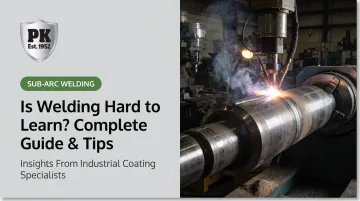
The reality is more forgiving. Welding has a real learning curve, but it's not the mystery it appears to be from across the shop floor.
This guide breaks down what actually makes welding difficult, how long it realistically takes to get good, whether you need to be a math whiz, and practical tips that flatten the learning curve.
Key Takeaways
- MIG welding is the easiest entry point; TIG demands the most simultaneous coordination
- Basic competency takes weeks to months; true mastery across positions and materials takes years
- Steady hands and patience matter more than raw physical strength
- Welders lean on practical math (fractions, angles, measurements), not calculus
- Metal prep and fit-up often trip up beginners more than the actual weld
So, Is Welding Hard to Learn? The Honest Answer
Welding has a moderate learning curve for the basics and a much longer runway toward mastery — similar to picking up guitar or starting martial arts. You can bang out a rough bead in your first session. Getting that bead to pass an X-ray inspection is a different story entirely.
"Hard" depends entirely on your goal:
- Hobbyist repairs (patching a trailer hitch, fixing a gate): learnable in a few weekends
- AWS (American Welding Society) certification: requires structured practice and a hands-on performance test
- Professional pipe or structural welding: years of repetition across positions and materials
Formal welding programs show this variance clearly. According to federal graduation data for one accredited welding school, full-time student retention ran at 81%, with 83% of students graduating within 150% of normal program time. Other institutions report lower numbers, but the pattern holds.
Outcomes improve with structured instruction, not trial and error alone.
Modern equipment also helps: inverter-based machines are lighter, more portable, and offer finer arc control than the transformer-rectifier units of decades past. They don't shrink your total learning time on their own, but they do remove some of the friction that used to frustrate beginners.
Here's the good news: welding doesn't require brute strength or exceptional natural talent. It requires precision, control, and a willingness to practice. Most people with normal hand-eye coordination can learn it.
Key Factors That Affect Welding Difficulty
Several variables determine how steep your personal learning curve will be. Some you can control (which process you start with); others you just need to plan around (physical demands, prep work).
The Welding Process You Choose
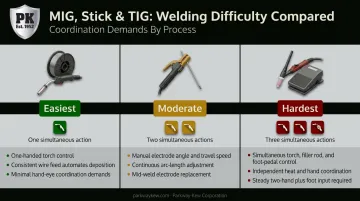
Not all welding is created equal. Manufacturer comparisons consistently rank the three main processes in the same order of difficulty:
| Process | Difficulty | Why |
|---|---|---|
| MIG (GMAW) | Easiest | Wire feeds automatically at a constant speed, removing one variable to manage |
| Stick (SMAW) | Moderate | You must strike and maintain the arc manually while managing electrode burn-off |
| TIG (GTAW) | Hardest | Requires separate control of torch position, filler rod, and often a foot pedal simultaneously |
Miller Electric identifies MIG as the easiest welding process to learn precisely because the wire feed removes a major coordination burden from the beginner. TIG, by contrast, asks your hands to do two completely different jobs at once: one hand guides the torch while the other feeds filler metal, and your foot (or thumb) modulates amperage at the same time.
Touch the tungsten to your work and you've contaminated it, meaning you stop and reprep before continuing.
Physical and Sensory Demands
Reading a weld puddle through a dark auto-darkening lens takes practice your eyes simply haven't done before. You're tracking puddle shape, color, and flow rate in real time, all while keeping your hand steady.
Position matters too. Difficulty increases as gravity works against you:
- Flat: easiest, puddle stays put
- Horizontal — some sag control needed
- Vertical — up or down, requires travel speed adjustments
- Overhead: hardest, molten metal wants to fall on you
Add in standing or kneeling for hours, working in heat while wearing heavy leathers and a hood, and the physical toll becomes real. Endurance and fine motor control under uncomfortable conditions matter more than raw strength.
Do Welders Need a Lot of Math?
Short answer: some, but nothing close to calculus. Welders regularly use:
- Fractions and decimal conversions for measuring stock
- Angle calculations for bevels and pipe layouts (45, 60, and 90 degrees show up constantly)
- Basic geometry for area and volume on fabrication jobs
- Blueprint reading, including weld symbols and dimension callouts
One community college welding math course runs 108 total hours covering exactly this: measurement tools, algebraic ratios, right-triangle trig, and print-based fabrication layout. That's a real time investment, but it's applied shop math, not abstract theory.
Certification tracks differ, too. The AWS Certified Welder program is purely a hands-on performance test with no formal math exam attached. Welding inspector certification is a different animal: it dedicates a meaningful chunk of its exam to symbols, drawings, and calculations. Don't confuse the two paths when planning your own math prep.
Metal Preparation: The Overlooked Challenge
Ask any experienced welder what trips up beginners most, and prep work tops the list almost every time. Before the arc ever strikes, the metal needs to be:
- Cleaned of rust, mill scale, paint, and oil
- Cut to accurate dimensions
- Beveled or grooved for proper penetration
- Fitted with consistent, tight gaps
Skip or rush this step and even a technically perfect bead will fail. Poor fit-up creates gaps that no amount of welding skill can fully compensate for. This is one of the most common reasons beginner welds crack, show porosity, or fail under stress, and it's rarely about the arc itself.
How Long Does It Take to Learn Welding?
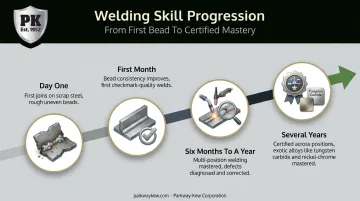
Expect a rough but real progression:
- Day one: You can join two pieces of scrap. It won't be pretty.
- First month: Heat settings click, bead consistency improves noticeably.
- Six months to a year: Comfortable across multiple positions, able to diagnose why a weld went wrong.
- Several years: True mastery — exotic materials, code-quality structural or pipe work.
Your timeline shifts depending on the path you take:
| Learning Path | Typical Length | Notes |
|---|---|---|
| Community college certificate | 8 months (full-time) to 2 years | Named programs range widely by credential type |
| Registered apprenticeship | 2 to 4 years | Longer for specialized roles like welder-fitter |
| Self-taught (online + practice) | Highly variable | No verified benchmark exists; progress depends entirely on repetition and feedback |
Certification adds time on top of basic proficiency. Passing an AWS Certified Welder test means you're demonstrably good at a specific process and position combination, not proof that you've mastered welding broadly. Plan for additional structured practice before you sit for any certification exam.
Tips to Make Learning Welding Easier
A few adjustments can shave real time off your learning curve:
- Start with MIG, since its forgiving, semi-automatic wire feed lets you focus on travel speed and angle before tackling Stick or TIG's added variables.
- Invest in proper PPE and workspace setup first, because a clean, well-lit, ventilated area with good clamps and plenty of scrap metal for repetition matters more than fancy equipment.
- Pair practice with structured instruction, as self-teaching works, but a class or mentor catches bad habits like poor torch angle or rushed travel speed before they become permanent.
- Prioritize metal prep and cleanliness, since spending extra minutes grinding and fitting properly improves weld quality faster than obsessing over arc technique alone.
None of these shortcuts skip the practice requirement. They just make each practice session count for more.
Why Learn Welding? Career Paths Worth the Effort
Welding skills open doors across construction, shipbuilding, manufacturing, and oil and gas. The Bureau of Labor Statistics projects steady demand for welders through 2034, driven mainly by retirements rather than explosive job growth:
- 457,300 welding jobs held in 2024
- 45,600 average annual job openings projected through 2034
- Manufacturing accounts for 61% of all welding jobs
- Specialty trade contractors post the highest median pay, at $57,310
Beyond entry-level shop work, experienced welders can specialize into high-value niches most people never encounter. Hardfacing and wear-resistant coating work is one example: precision submerged arc welding and HVOF techniques used to extend the life of industrial machine parts.
Parkway-Kew Corporation has built its business around this kind of specialized welding since 1952. Founder Eugene Walter Klein proved out a hardfacing alloy on a test weld in his own garage, then landed an order to rebuild 100 wire drawing blocks for a New Jersey steel mill.
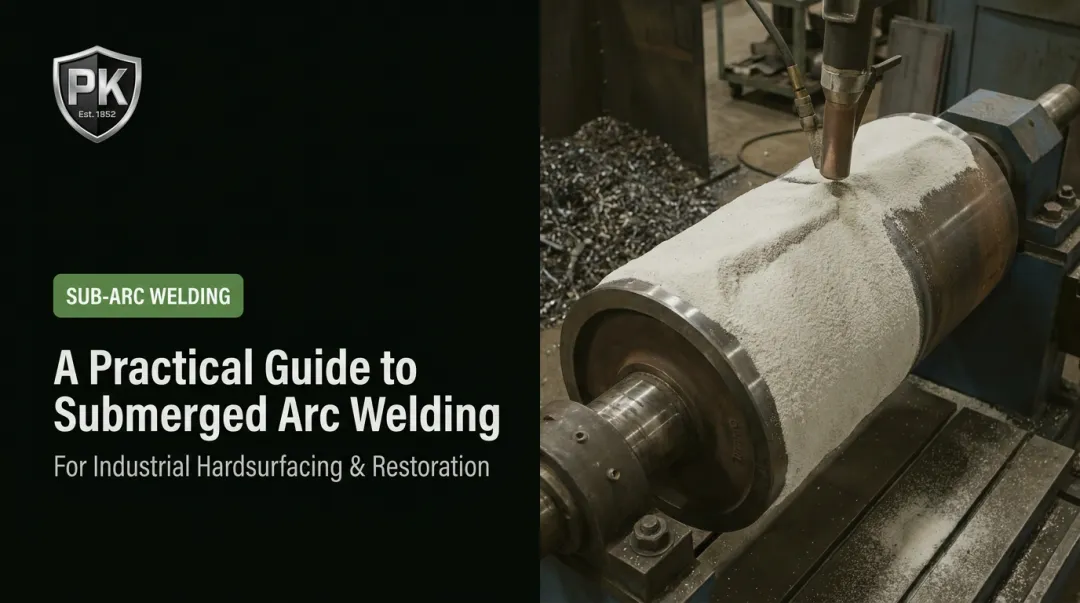
The company pioneered submerged arc welding for hardsurfacing wire drawing blocks in the 1950s. It later added HVOF coating in 1989, reaching spray speeds exceeding Mach 2 for dense, defect-free finishes on parts serving wire mills, oil and gas, and heavy equipment industries.
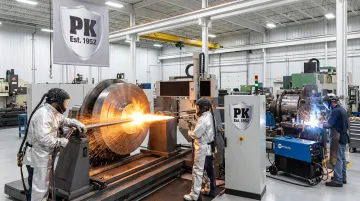
That kind of precision work doesn't happen by skipping steps. It requires mastering fundamentals like arc control, alloy selection, and fit-up before scaling into demanding, high-stakes applications. Master those basics, and specialties like Parkway-Kew's hardfacing work become a reward for the effort, not a barrier to entry.
Frequently Asked Questions
How difficult is it to learn welding?
Basic welding can be learned in a matter of weeks with consistent practice. Mastering multiple processes, positions, and materials to a professional standard takes years of hands-on repetition.
Do welders do a lot of math?
Welders use practical math like measurements, angles, and fractions rather than advanced calculus. Reading blueprints and weld symbols does require basic arithmetic and geometry.
Can I learn welding in 3 months?
Entry-level competency in one process, typically MIG, is achievable in three months with regular practice. Full versatility across processes and positions takes considerably longer.
Is 30 too old to become a welder?
No. Welding is a skill-based trade where age isn't a barrier, and many welders start their careers in their 30s or later. Physical fitness and willingness to practice matter far more than age.
Can welding be self-taught?
Yes, using online tutorials and consistent scrap-metal practice. However, structured instruction helps you build safer, more correct habits faster than trial and error alone.
What is the easiest type of welding to learn?
MIG welding is the most beginner-friendly option because its semi-automatic wire feed simplifies technique compared to Stick or TIG. Most instructors recommend starting here before progressing further.