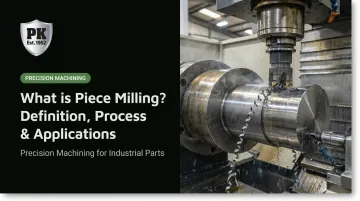
This distinction matters more than most buyers realize. Many industrial purchasers confuse piece milling with standard production milling, which creates friction with machine shops over cost estimates, turnaround promises, and precision expectations. A quote for batch work simply doesn't translate to a one-off repair job.
This article defines piece milling, walks through its step-by-step process, and covers real-world applications in heavy industry, from wire drawing blocks to oilfield plungers.
Key Takeaways
- Piece milling machines each component to precise, part-specific dimensions rather than fixed tooling.
- The workflow includes inspection, custom CNC programming, tooling setup, material removal, and quality checks.
- Common uses include equipment repair, prototyping, and low-volume specialty part production.
- Large-capacity, experienced shops deliver better precision and durability on oversized parts.
What is Piece Milling?
Piece milling is a machining approach where the machinist mills each individual workpiece according to its own dimensions, wear pattern, or design requirements. There's no shared tooling program running the same cuts across hundreds of identical parts.
The name breaks down simply. "Piece" reflects the fact that each workpiece stands as its own distinct job. "Milling" refers to the material-removal process itself, performed with rotating cutting tools on a milling machine. Put together, the term describes custom, job-by-job machining rather than a standardized operation name.
This approach sits closely within what's formally known as job-shop manufacturing. Oracle defines job-shop work as producing smaller batches of customized products that require unique setup and sequencing for each job, as opposed to repetitive manufacturing's constant, low-changeover flow. That's the established category piece milling fits inside.
What sets piece milling apart:
- Tool paths built around one specific part's geometry, not a reusable template
- Individualized measurements taken before any cutting starts
- A blend of CNC programming with hands-on machinist judgment, especially on worn or irregular parts
- No assumption that the next part coming through the door looks anything like the last one
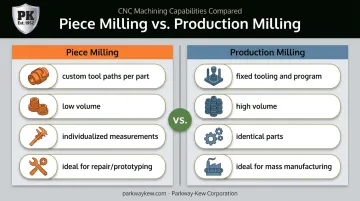
Piece Milling vs. Production (Batch) Milling
Production milling runs identical parts through fixed tooling and a single program, over and over. Piece milling does the opposite: custom setup, low volume, heavy attention on each individual unit.
That difference determines where each method applies. Piece milling fits repair, refurbishment, and prototyping work, such as restoring a worn wire drawing block or a fracking plunger, where every incoming component might show different wear or dimensional quirks. Batch milling suits mass manufacturing runs where uniformity is the entire point.
The Piece Milling Process: Step by Step
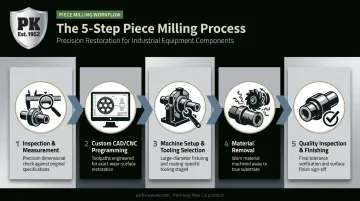
Piece milling follows a staged workflow. Each stage matters more here than in batch production, since there's no second identical part to catch a mistake against.
Step 1 – Inspection and Measurement
Machinists measure and inspect every incoming piece individually before any cutting begins, checking for wear, damage, or dimensional deviations unique to that part.
As equipment maker Renishaw explains, precision measurement probes track workpiece position, dimensions, and features before, during, and after machining, providing exactly the verification a one-off job depends on.
Step 2 – Custom CAD/CNC Programming
Machinists build a tailored machining program around that single piece's exact dimensions and tolerances. None of it comes from a shared template library.
Step 3 – Machine Setup and Tooling Selection
Machinists select the correct cutter, workholding fixture, and cutting parameters (speed, feed rate, depth of cut) based on the piece's material and geometry. A worn steel capstan and a tungsten carbide insert call for entirely different setups.
Step 4 – Material Removal
This is the actual milling operation. Depending on the piece's shape, machinists might use:
- Face milling for flat surfaces
- Peripheral milling along a cutter's circumference for contoured edges
- Profile milling for complex two- or three-dimensional forms
Step 5 – Quality Inspection and Finishing
After milling, dimensional and surface-finish checks confirm the piece meets exact specifications.
Piece milling frequently doesn't end here, either. It often integrates with precision grinding or hardsurfacing/coating to fully restore or enhance a worn component, particularly on repair jobs where the goal is restoring original wear resistance, not just cutting metal. Parkway-Kew's Restore & Grind process follows this same logic, blending precision machining with hardsurfacing to bring a worn wire drawing block or capstan back to its original specification without a full replacement.
Applications of Piece Milling Across Industries
Piece milling shows up wherever equipment wears unevenly or where a single custom part needs machining before a full production commitment.
Common applications span several industries:
- Repair and refurbishment of heavy industrial components: Wire drawing blocks, capstans, and rollers wear unevenly, with no two incoming units showing identical damage. Each rebuild uses targeted machining to restore diameter and surface profile before recoating, since replacement stock for legacy machinery rarely exists.
- Custom or prototype part manufacturing: A single unit or small run often needs production and validation before a full-scale commitment. This approach confirms tolerances and finish quality before committing to volume runs, and prototyping shops regularly run lot sizes as small as one part.
- Oil and gas equipment machining: Custom plungers, fittings, and wear components for fracking and drilling demand tight tolerances on individual parts. Frac-pump plungers, for example, often require finishes near ±0.0005 inch, with surface requirements varying by material and downhole duty cycle.
- Shipping terminal equipment machining: Festoon wheels, crane wheels, and wire rope pulleys wear differently depending on load history and usage patterns. Off-the-shelf replacements rarely match this wear profile, particularly at high-traffic container terminals, making individualized machining the practical choice.
A practical example: Wire drawing capstans that develop drawline wear are a textbook piece milling case. Parkway-Kew's Restore & Grind process fills in just the worn groove and blends it seamlessly with the surrounding coating, restoring functional geometry and extending service life by years instead of requiring full replacement.
Benefits of Piece Milling
Piece milling isn't cheaper than batch production on a per-unit basis, but for the right job, it's the only sensible option.
- Cost efficiency for low-volume or one-off jobs: avoids the expensive tooling and setup costs that only make sense when spread across hundreds of identical parts
- Extended equipment life: targeted, precise repair of individual worn parts, such as Parkway-Kew's Restore & Grind process for wire drawing blocks, avoids the need for full replacement
- Flexibility for unique tolerances: accommodates design changes or legacy part specifications without retooling an entire production line
The trade-off is straightforward: setup and programming time gets concentrated on very few units, so per-piece cost runs higher than mass production. For a one-off repair or a legacy part nobody makes anymore, that's still the more economical path.
Why Choose Parkway-Kew for Precision Piece Milling
Parkway-Kew has operated as a machine shop and hardsurfacing specialist since 1952, and its piece milling capabilities reflect decades of handling parts that don't come in matching sets.
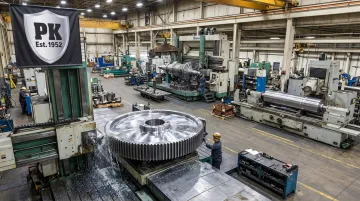
In-house capacity built for oversized components. Parkway-Kew's shop floor handles equipment most job shops can't touch:
- CNC milling and CNC turning up to 72 inches in diameter
- Manual turning at the same 72-inch capacity
- Large-diameter grinding up to 65 inches in diameter by 12 feet in length
That range matters for industrial customers whose worn components, such as wire drawing blocks, capstans, and crane wheels, don't fit through a standard job shop's door.
The Restore & Grind process. Regrinding an entire wire drawing block down to its deepest wear groove strips away good coating and shrinks the diameter more than necessary.
Parkway-Kew's proprietary Restore & Grind process avoids that waste, filling and blending only the worn drawline area. This targeted approach, made possible by the enhanced thickness of Parkway-Kew's coatings, allows 5 to 7 lower-cost repair cycles before a full recoating is needed.
Decades of trust across heavy industry. Since 1952, Parkway-Kew has served more than 500 companies worldwide across oil & gas, wire mills, and shipping terminal sectors. That history includes pioneering submerged arc welding for wire drawing blocks in the 1950s and introducing HVOF coating in 1989. Each innovation, including the more recent Restore & Grind process, has focused on making machine parts last longer.
Frequently Asked Questions
What does piece milling mean?
Piece milling refers to machining individual components to their own unique specifications, rather than mass-producing identical parts using fixed tooling. Each piece is treated as its own job from setup through finishing.
Why is it called piece milling?
The name reflects that each workpiece, or "piece," receives dedicated setup and programming during the milling process. It's not run through a standardized production template like batch parts are.
How is piece milling different from batch milling?
Piece milling is custom and low-volume, with tailored setup for each part. Batch milling uses fixed tooling and programs to produce identical parts at scale, which lowers per-unit cost but sacrifices flexibility.
What materials can be piece milled?
Common materials include steel, stainless steel, and other metals typically found in heavy industrial components. Specialty applications may also involve tungsten carbide or other wear-resistant alloys.
What industries commonly use piece milling?
Oil and gas, wire mills, heavy equipment manufacturing, and shipping terminal operations all rely on piece milling for repair, refurbishment, and custom part production.
How long does a typical piece milling job take?
Turnaround varies based on part size, condition, and complexity, along with a shop's current workload. Parkway-Kew's in-house CNC machining and grinding capabilities, handling parts up to 72 inches in diameter, let us give you an accurate estimate during your initial consultation.