Pick the wrong one, and you're looking at more downtime, more frequent replacements, and a total cost of ownership that keeps climbing. A high-speed wire drawing block faces a completely different wear mechanism than a fracking plunger sitting in saltwater brine, and a coating that thrives in one environment can fail fast in the other.
This guide breaks down what each coating is made of, how it performs, and where it fits best, so you can match the right technology to your application instead of guessing.
Key Takeaways
- Ceramic coatings deliver top hardness and finish for abrasive, high-friction wear
- Titanium coatings resist corrosion and cut weight in marine and chemical settings
- Wear type, environment, and budget determine which coating wins — neither is universal
- Parkway-Kew has plasma-sprayed ceramic coatings onto wire drawing blocks and capstans since the late 1990s
Ceramic Coating vs Titanium Coating: Quick Comparison
Here's how the two technologies stack up across the factors buyers care about most.
| Factor | Ceramic Coating | Titanium Coating |
|---|---|---|
| Composition | Metal oxides (aluminum oxide, chromium oxide) fused via plasma spray | Titanium metal or compounds (TiN, TiC) via thermal spray or PVD |
| Hardness | Up to 1,300 Vickers for chromium oxide; roughly 690 DPH for alumina | 2,800 HV for PVD TiN; 3,000-4,000 HV for PVD TiC |
| Wear resistance | Excellent against abrasive, sliding wear | Strong, with added toughness for impact-prone loads |
| Corrosion resistance | Good, but depends heavily on coating density and sealing | Outstanding in marine, saline, and chemical environments |
| Cost driver | Lower feedstock cost; standard plasma spray equipment | Higher, due to titanium price volatility and specialized PVD/HVOF setups |
Cost
No supplier publishes a standardized per-part price list for either coating, since thickness, part geometry, and surface prep all change the quote. A useful proxy comes from raw material pricing: titanium sponge, the base material behind titanium coatings, was priced at an estimated $12.00 per kilogram in 2023, according to USGS Mineral Commodity Summaries data.
Ceramic feedstocks like aluminum oxide and chromium oxide carry no such volatility, since they're sourced as stable, commodity-grade powders. That price swing, paired with specialized PVD and HVOF equipment, pushes titanium coating costs well above plasma-sprayed oxide ceramics.
Composition & Hardness
Ceramic coatings are built from metal oxides such as aluminum oxide and chromium oxide, fused onto a substrate through atmospheric plasma spray. Titanium coatings instead use titanium metal or compounds like titanium nitride and titanium carbide, applied via PVD or modified HVOF.
Hardness figures aren't directly comparable across test methods, but published vendor data shows:
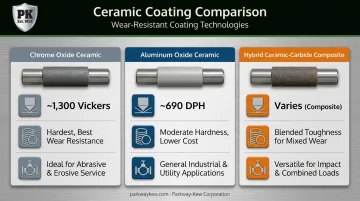
- Plasma-sprayed chromium oxide: around 1,300 Vickers
- Plasma-sprayed alumina: roughly 690 DPH300
- PVD titanium nitride: about 2,800 HV
- PVD titanium carbide: 3,000 to 4,000 HV
Corrosion Resistance
Ceramic oxide coatings resist chemical attack reasonably well, but a 2022 study on plasma-sprayed Cr2O3 coatings found that unsealed coatings offered little long-term protection, and porous formulations spalled during extended saltwater immersion. Titanium's natural oxide layer, by contrast, delivers a corrosion advantage that doesn't lean as heavily on sealing quality.
What is Ceramic Coating?
Ceramic coating, in an industrial context, is a thermally sprayed layer of metal oxide, commonly aluminum oxide or chromium oxide, fused onto a metal substrate to create an extremely hard, wear-resistant surface. In plasma spray, the ceramic powder is heated to a molten state and blasted onto the part, where it cools into a dense, glass-hard layer.
Parts that see constant sliding contact, like wire drawing blocks and capstans, wear down fast without protection. A quality ceramic coating cuts that friction-related wear dramatically, which means fewer maintenance calls and less unplanned downtime.
Core benefits include:
- Extended component life under high-friction, high-speed conditions
- Reduced replacement frequency, lowering total cost of ownership
- Improved surface finish that protects wire and material from marking or scratching
- Increased resistance to abrasive, particulate wear
Ceramic coatings aren't one-size-fits-all. Common variations include:
- Chrome oxide ceramic – the hardest and most wear-resistant of the common oxide ceramics
- Aluminum oxide ceramic – slightly softer, often chosen where cost matters more than peak hardness
- Hybrid ceramic-carbide composites – blend ceramic hardness with a tougher matrix for mixed wear profiles
Parkway-Kew introduced plasma-sprayed ceramic coated wire drawing blocks in the late 1990s, using its PK-1500 chrome oxide formulation. It gave wire mills a durable, cost-effective option for high-speed, high-slip ferrous wire drawing, particularly for small, high-quality, or plated wires.
Use Cases of Ceramic Coating
Ceramic coatings dominate wherever parts face constant sliding friction at high speed:
- Wire drawing blocks and capstans
- Tuner rolls, sheaves, and step cones
- Rollers and guide devices in metal forming lines
Industries where ceramic coating leads:
- Wire and cable manufacturing
- Textile machinery
- Metal forming operations that need a smooth, non-marking surface
The wire industry has documented plasma coating's value for decades. A 1968 Wire and Wire Products paper described how plasma plating brought new life to worn draw blocks and capstans.
Thermal spray providers have continued refining low-friction, non-sticking ceramic coatings for wire-drawing capstans, sheaves, pulleys, and guides ever since. For wire mills, the payoff shows up as fewer block changeouts and a cleaner finish on the wire itself.
What is Titanium Coating?
Titanium coating refers to a layer of titanium metal or a titanium-based compound, such as titanium nitride or titanium carbide, applied via PVD, thermal spray, or modified HVOF to boost surface hardness and corrosion resistance. Unlike solid titanium components, the coating delivers titanium's protective qualities at a fraction of the weight and cost.
Components exposed to moisture, chemicals, or saltwater fail fast without protection. Titanium's natural oxide layer resists that kind of attack far better than bare steel, which is why the coating shows up so often on parts destined for harsh environments.
Core benefits include:
- Reduced corrosion-driven part failure
- Extended service life in marine, offshore, and chemical settings
- Lower weight than solid titanium components
- Strong wear resistance with added toughness for impact loads
Common variations:
- Titanium nitride (TiN) – a thin, extremely hard PVD layer used on cutting tools and fasteners
- Thermal-sprayed titanium – applied to structural wear parts needing a metallic corrosion barrier
- Titanium carbide composites – built for high-load applications where extra toughness matters
Use Cases of Titanium Coating
Titanium coatings prove most valuable wherever moisture or chemical exposure is the primary threat:
- Shafts and fasteners in offshore equipment
- Processing equipment operating in marine and chemical plants
- Parts requiring both corrosion resistance and light weight
Industries where titanium coating leads:
- Aerospace
- Marine engineering
- Oil and gas
- Medical equipment manufacturing
Laboratory testing backs up titanium's reputation. Researchers who deposited pure titanium onto steel using a modified HVOF spray process found the coating remained rust-free for more than a month in artificial seawater after polishing.
Results like this are lab-based rather than proven across years of offshore service. Still, they explain why titanium coatings remain the default choice for saline and chemically aggressive conditions.
Ceramic vs Titanium Coating: Which is Better for Your Application?
There's no universal winner. The right coating depends on four factors:
- Type of wear – Is the part fighting abrasive, particulate wear or corrosive chemical attack?
- Operating environment – Dry friction and high-speed contact, or moisture and chemical exposure?
- Precision requirements – Does the part need a fine, non-marking surface finish?
- Budget – Titanium's material and processing costs typically run higher than plasma-sprayed ceramics.
Choose ceramic coating if:
- Abrasion resistance and surface finish are the priority
- The part runs at high speed with constant sliding friction, like a wire drawing block or capstan
- You need a cost-effective option for high-volume wear parts
Choose titanium coating if:
- Corrosion resistance in marine, offshore, or chemically aggressive settings is the priority
- Weight reduction matters as much as durability
- The part faces fluctuating or impact loads on top of ordinary wear
Real-World Example: Choosing the Right Coating
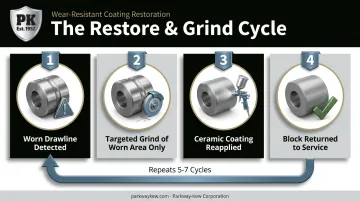
Wire mills running high-speed ferrous lines often hit the same wall: ceramic-coated blocks wear unevenly. Once the drawline groove goes, the whole block traditionally needs replacing, even though most of the surrounding coating is still good.
That's the exact problem Parkway-Kew's Restore & Grind process was built to solve. Instead of regrinding an entire block down to the bottom of the worn groove, which strips away good coating and shrinks the block's usable diameter, the process targets only the worn drawline area. It blends the repair seamlessly into the surrounding ceramic coating.
Parkway-Kew applies coatings at an enhanced thickness from the start. That extra margin lets a single block go through 5 to 7 restoration cycles before it ever needs a full recoat. For a wire mill replacing blocks on a fixed schedule, that adds up to years of extended service life from equipment that would otherwise be scrapped.
That's the payoff when the numbers work in your favor. Rising downtime or climbing replacement invoices are usually the first sign it's time to bring in a coating specialist before the next changeout. Parkway-Kew's team can review your specific wear pattern and recommend whether ceramic, tungsten carbide, or another hardsurfacing option fits best.
Conclusion
Neither ceramic nor titanium coating is inherently better. Ceramic wins on abrasion resistance and surface finish, making it the go-to for high-speed, high-friction parts like wire drawing blocks and capstans. Titanium wins on corrosion resistance and weight savings, which is why it dominates marine, offshore, and chemical processing applications.
What matters is matching the coating to the wear mechanism your parts actually face. Get that wrong, and you're stuck with more downtime and a higher total cost of ownership than necessary.
Parkway-Kew has been solving exactly this kind of problem since 1952, from pioneering submerged arc welding for wire drawing blocks to introducing HVOF coatings in 1989 and plasma-sprayed ceramic coatings in the late 1990s. If you're weighing ceramic, tungsten carbide, or another hardsurfacing option against your specific wear mechanism, our team can help you match the coating to the job.
Frequently Asked Questions
Is titanium coating good for industrial wear resistance?
Titanium coatings offer strong wear and corrosion resistance, especially in moisture-heavy or chemically aggressive environments. Ceramic coatings, however, typically outperform titanium in pure abrasion resistance.
Does titanium coating rust or corrode over time?
No. Titanium and titanium-based coatings are highly corrosion-resistant and don't rust like steel, which makes them well-suited to marine and chemical processing applications.
Which coating lasts longer, ceramic or titanium, in high-wear applications?
It depends on the wear type. Ceramic usually outlasts titanium in high-friction, abrasive environments like wire drawing, where constant surface contact dominates wear. Titanium, by contrast, holds up longer in settings where saltwater or chemical exposure drives corrosion.
Can ceramic coatings be applied to restore worn industrial parts?
Yes. Parkway-Kew's Restore & Grind process reapplies ceramic coating to worn drawline areas on wire drawing blocks, extending part life for 5 to 7 cycles without a full replacement.
What is the cost difference between ceramic and titanium coating for industrial equipment?
Ceramic coatings are generally more cost-effective for high-volume wear applications. Titanium's higher material cost is usually justified only when corrosion resistance is the priority.
Which coating offers better corrosion resistance in marine or oil & gas environments?
Titanium coatings generally outperform ceramic in corrosive, saline, or chemically harsh environments, thanks to titanium's natural resistance to oxidation.