Unplanned downtime already costs Fortune Global 500 manufacturers an estimated $1.4 trillion a year, according to Siemens' 2024 downtime report. A coating that flakes, cracks, or wears through months ahead of schedule is one of the more preventable contributors to that number.
Wire mills, oil & gas operators, and shipping terminals all depend on coated components staying intact between scheduled maintenance stops. When a coating fails early, operators face unplanned downtime, degraded wire quality, and expensive emergency part replacement.
Most failures trace back to one of four root causes. This post breaks down each one, covers the warning signs to watch for, and lays out practical steps to prevent them before they cost you a production run.
TL;DR
- Coating failure typically stems from poor prep, coating mismatches, faulty application, or unmanaged wear
- Early signs like drawline grooving or flaking signal trouble long before full failure hits
- Prevent most failures with proper prep, correct coating selection, precise application, and routine restoration
- Partnering with an experienced hardsurfacing specialist reduces the risk of premature recoating
Common Causes of Coating Failure
Coating failure means the coating no longer does its job. That can look like loss of adhesion, cracking, wear-through exposing bare metal, or delamination. Whatever form it takes, the root cause almost always falls into one of four categories: bad prep work, the wrong coating for the job, inconsistent application, or wear that went unaddressed too long.
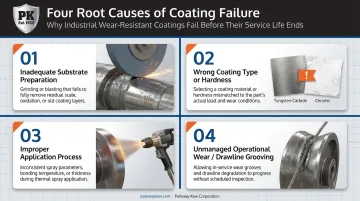
Cause 1: Inadequate Substrate Preparation
Before any HVOF, plasma spray, or weld overlay coating goes on, the base metal needs to be clean, roughened, and free of contamination. Thermal spray coatings bond mostly through mechanical interlock rather than chemistry, so a properly cleaned and roughened substrate is a baseline requirement, not an optional step.
A common scenario: a customer sends in an old wire drawing block for recoating, and the shop doesn't fully strip residual coating, oxidation, or oil contamination before spraying the new layer. The new coating looks fine on day one. Weeks later, it starts flaking off in sheets because it never actually bonded to the metal underneath.
Cause 2: Wrong Coating Type or Hardness for the Application
Not every coating suits every job. A ceramic built for high-speed, high-slip ferrous wire drawing won't hold up the same way in a highly abrasive fracking or shipping terminal environment. A lower-grade nickel chrome coating, in turn, won't survive conditions that call for tungsten carbide.
Picture a component running in a frac plunger application, exposed to abrasive slurry and corrosive fluid. Specify it with a standard-duty coating instead of a harder-wearing tungsten carbide grade, and it can wear through in a fraction of the expected service life.
Matching hardness and composition to the actual operating conditions, not just the component type, is what determines whether a coating lasts.
Cause 3: Improper Application Process
Even the right material fails if it's applied inconsistently. HVOF and plasma spray both depend on tightly controlled variables: gas flow, powder feed rate, spray distance, particle velocity, and thermal management all interact. Getting any one of them wrong builds internal stress that exceeds the coating's bond strength.
In practice, this shows up as porosity, uneven thickness, or micro-cracking across the surface. A block coated with inconsistent spray parameters might look fine visually but develop an uneven surface finish in service, one that shortens both wire life and coating durability well before it should.
Cause 4: Unmanaged Operational Wear (Drawline Grooving)
Even a well-prepped, well-matched, well-applied coating wears out eventually. Continuous wire contact cuts a groove, called the drawline, into the coating surface over time. That's normal. What's not normal is letting that groove deepen unchecked until it compromises the entire coating layer.
Components left in service too long between inspections tend to fail suddenly instead of wearing down predictably. Instead of a straightforward, low-cost repair, operators end up needing a full replacement, plus the unplanned downtime that comes with it.
What Happens If Coating Failure Is Ignored
Ignoring early signs of coating failure doesn't just mean an eventual part swap. It compounds.
Downtime stretches longer because a failed component often takes the whole line down, not just the one part. Wire surface finish and quality degrade as the coating beneath the wire path deteriorates, showing up as increased scrap and rejected product on the floor.
Replacement costs climb too. Full recoating or a new part costs considerably more than a scheduled repair would have. In some cases, sudden component failure also creates a safety risk for whoever's standing near the line when it happens.
Warning Signs You're About to Experience Coating Failure
Catching these signs early is the difference between a scheduled repair and an emergency shutdown.
- Visible grooving or uneven wear along the drawline: the clearest, earliest indicator that the coating surface is thinning unevenly
- Flaking, blistering, or small chips exposing base metal: a sign the bond has already failed in that area, not just the surface finish
- Declining wire surface quality or rising scrap and reject rates: often the first thing production notices, even before anyone inspects the block itself
How to Prevent Coating Failure
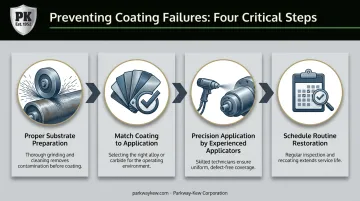
Preventing coating failure takes proper prep, the right material selection, precise application, and ongoing maintenance, applied consistently rather than as an afterthought.
Prevention Measure 1: Proper Substrate Preparation
Strip, clean, and grind the substrate to the correct surface profile before recoating, every time, not just on new parts. This step ensures a strong mechanical and chemical bond and prevents the early delamination that comes from coating over contamination or old, unprepped surfaces. It applies before every recoating job, whether it's a brand-new block or the tenth time a capstan has come back through the shop.
Prevention Measure 2: Match the Coating to the Application
Select a coating based on wire type, drawing speed, and environmental exposure, not habit or convenience. A high-speed ferrous line running small or plated wire calls for something different than a corrosive frac plunger environment.
Parkway-Kew's engineering team, for example, matches grade to wear condition:
- PK-675, PK-700, or PK-750 tungsten carbide for varying abrasion levels in wire mill applications
- PK-1500 chrome oxide ceramic for high-speed, high-slip ferrous wire drawing
This decision belongs at the specification stage, ideally with input from a provider who has seen how each material actually performs in the field.
Prevention Measure 3: Ensure Precision Application by Experienced Applicators
Controlled spray parameters, correct film thickness, and proper thermal management during application minimize the porosity, internal stress, and uneven bonding that lead to cracking or flaking down the line. This isn't something to leave to a shop running a job for the first time.
Parkway-Kew has applied HVOF coatings since 1989, when it introduced the process to wire drawing blocks, and has refined its spray parameters across four proprietary tungsten carbide alloys since. That kind of repeatable process control is what keeps coating quality consistent from the first block in a batch to the last.
Prevention Measure 4: Schedule Routine Restoration Instead of Waiting for Full Failure
Inspect components on a regular schedule and address drawline grooving while it's still localized, rather than waiting for full failure. Targeted restoration extends component life and avoids the unplanned downtime that comes with an unexpected full replacement.
Parkway-Kew's Restore & Grind process is built around this idea. It fills only the worn drawline area and blends it seamlessly with the surrounding original coating, instead of grinding the entire block down to the bottom of the deepest groove. Because coatings are applied at an enhanced thickness from the start, this targeted repair can typically be repeated five to seven times before a full recoat is ever necessary.
Tips for Long-Term Prevention and Control
Beyond the four prevention measures above, a few ongoing practices help prevent coating failure from becoming a recurring problem:
- Set routine visual and dimensional inspection schedules for coated components so wear gets caught before it becomes failure
- Train operators and maintenance staff to recognize early signs of coating distress, like drawline grooving or surface flaking, and report them immediately
- Keep records of coating type, application date, and inspection history for each component to track performance and spot patterns over time
- Work with a hardsurfacing provider that offers precision CNC grinding and turning, not just generic recoating, so restored parts meet exact tolerances
Parkway-Kew's machining departments handle turning up to 72 inches in diameter and grinding up to 65 inches by 12 feet, which supports restoring large-diameter components to precise, functional tolerances.
Conclusion
Coating failure on high-wear industrial components almost always traces back to one of four causes: poor prep, the wrong coating for the job, inconsistent application, or wear left unmanaged too long. None of them are mysterious, and every one is preventable with the right process in place.
Consistent prevention practices, paired with periodic professional restoration, protect uptime and keep long-term costs down.
Parkway-Kew has been coating, restoring, and machining wire drawing blocks, capstans, frac plungers, and shipping terminal components since 1952. That history shows in how the work gets specified, applied, and maintained. Getting components coated and restored correctly the first time is still the cheapest fix there is.
Frequently Asked Questions
What does ceramic coating failure look like?
Ceramic coating failure typically shows up as chipping, cracking, or flaking that exposes the underlying metal. It's usually caused by impact or thermal shock, especially when the original bond wasn't strong enough to begin with.
How long does a coating last?
Lifespan depends on coating type, application quality, and operating conditions, so there's no single number that applies across the board. Proper selection paired with routine restoration, like Restore & Grind, extends service life well beyond a single coating cycle.
What causes a coating to peel off metal?
Peeling almost always traces back to inadequate surface preparation, leftover contamination, or poor adhesion between coating layers. A clean, properly profiled substrate is what gives the coating something to actually bond to.
Can a failed coating be repaired instead of fully replaced?
Localized wear, like drawline grooving, can often be restored through targeted processes such as Restore & Grind rather than a full recoat. Widespread failure across the whole surface typically requires stripping and recoating the entire component.
How do I know if my wire drawing block or capstan needs recoating?
Watch for visible grooving along the drawline and declining wire surface quality, both often paired with rising scrap rates during production. Regular inspection intervals catch these signs before they force an unplanned shutdown.
What is the difference between HVOF and plasma spray coatings?
HVOF uses supersonic combustion to produce very dense, hard coatings, well suited to tungsten carbide wear layers. Plasma spray uses a high-temperature ionized gas and works well for ceramic coatings like chrome oxide, especially on high-speed or high-slip wire.