A coating specification is the technical blueprint that determines whether a wear-resistant or corrosion-resistant coating survives the field or fails prematurely. For heavy equipment components exposed to abrasion, chemical attack, or cyclic loading, that document controls everything from surface cleanliness to acceptance testing.
Yet vague, contradictory, or incomplete specifications remain a leading cause of unplanned downtime and costly rework. AMPP research cited in industry publications puts poor surface preparation alone behind a significant share of coating failures—and preparation is just one line item in a proper spec.
This article breaks down what a coating specification is, its core components, how it's structured around industry standards, and the mistakes that undermine even well-funded projects.
Key Takeaways
- A coating specification captures product, surface prep, application, and acceptance criteria in one document.
- Performance-based specifications reduce disputes compared to prescriptive ones.
- ISO 12944, SSPC/NACE, and ASTM standards reduce ambiguity and give inspectors clear enforcement authority.
- Read specs for performance requirements and QC checkpoints, not chemical jargon.
- Treating nominal thickness values as absolute limits is a common, preventable cause of failure.
What a Coating Specification Represents in a Project
A coating specification is the documented set of requirements covering the coating product, surface preparation, application procedure, and inspection or acceptance criteria for a structure or component. It's not a suggestion.
AMPP describes it as the project's road map, and the term is accurate: contractors, inspectors, and owners are all contractually bound to follow it (AMPP).
That's what makes a poorly worded spec dangerous. It's a legal document as much as a technical one, and ambiguity in it can trigger disputes long before anyone talks about coating failure.
Prescriptive vs. Performance-Based Language
Specifications generally fall into two camps:
- Prescriptive specifications dictate exact means and methods: specific products, exact mixing steps, precise application sequences.
- Performance-based specifications define measurable outcomes (adhesion strength, salt-spray hours, service life) and leave execution methods to the contractor.
- Hybrid specifications blend prescriptive product requirements with performance-based acceptance testing, often used on complex retrofit or repair projects.
Performance-based, CSI-style language tends to work better on industrial projects because it holds the contractor accountable for results rather than for following a script that may not fit field conditions.
That said, no single body mandates one approach universally. Project complexity and owner risk tolerance still matter.
Writing a specification doesn't require a universal license, but it does require demonstrated technical expertise. Credentials like the AMPP Protective Coatings Specialist certification signal that the author understands coating design, oversight, and life-cycle cost, not just chemistry.
Why the Coating Type Itself Must Be Precisely Specified
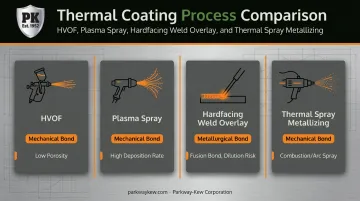
For wear and corrosion applications on heavy equipment, "coating" isn't one thing. HVOF, plasma spray, thermal spray metallizing, and hardfacing weld overlay each have distinct bonding mechanisms:
- HVOF and plasma spray deposits bond mechanically, with powder propelled at extreme velocity to form dense, low-porosity layers.
- Hardfacing weld overlay creates a fusion, metallurgical bond affected by dilution, heat input, and cracking risk.
- Thermal spray metallizing deposits molten metal particles via combustion or electric-arc spraying, forming a mechanically bonded layer similar to HVOF but at lower particle velocities.
A specification that just says "thermal spray" without naming the process variant is incomplete.
Parkway-Kew Corporation, which has engineered precision HVOF, thermal spray, and proprietary tungsten carbide coatings such as PK-730 since 1952, works from detailed specifications to match coating type and alloy to the load, wear, and environmental conditions of each component, whether that's a fracking plunger or a wire drawing block.
Core Components of a Coating Specification
Regardless of format, a complete specification is organized around four questions: what product goes on, how the surface is prepared, how it's applied, and how compliance is verified.
Product and Material Requirements
This section names specific products and manufacturers, generic coating type, mixing ratios, pot life, and coverage rates. Vague terms like "or equivalent" have no place here: they invite substitution disputes down the line.
Dry film thickness (DFT) requirements live in this section too. Under SSPC-PA 2, spot measurements may range from 80% of the specified minimum to 120% of the specified maximum at certain restriction levels, but area averages must still fall within the specified range (SSPC-PA 2 guidance). That 80% figure is often misread as a blanket rule for every individual reading. It isn't.
Surface Preparation Requirements
This is where most failures actually start. The section should reference recognized cleanliness standards, such as:
- SSPC-SP10 (Near-White Blast): tighter cleanliness, minimal residual staining allowed
- SSPC-SP6 (Commercial Blast): more staining tolerance, suited to less severe exposure
- SSPC-SP5 (White Metal Blast): strictest standard, reserved for the most severe service environments
It should also specify anchor profile depth independently of the cleanliness grade, plus the environmental conditions (temperature, humidity, dew point) that must be controlled and documented during prep.
Application, Quality Control, and Supporting Standards
Here the spec defines application method (spray, brush, roller), number of coats, wet film thickness targets, recoat windows, and ambient condition limits during application. Missing a recoat window isn't cosmetic: it can forfeit the chemical bond between coats entirely.
Once the coating is down, the spec still needs to prove it was applied correctly.
This section assigns inspection responsibility and sets acceptance criteria for film thickness, adhesion, and documentation. A clearly written spec is genuinely an inspector's greatest asset, and without numeric acceptance values and a defined test method, there's nothing concrete to verify compliance against.
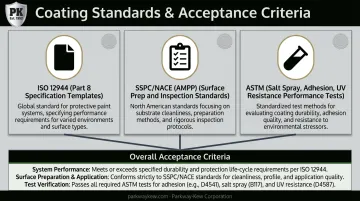
These acceptance criteria aren't invented case by case. Most specifications draw from a common set of reference documents:
- ISO 12944, particularly Part 8's specification templates
- SSPC/NACE (AMPP) standards for surface prep and inspection
- ASTM performance tests, including salt spray, adhesion, and UV resistance
Sector-specific bodies also inform accepted practice. WAI, Inc. (Wire Association International), of which Parkway-Kew is a member, contributes to accepted material and process knowledge for specialized applications like wire drawing block hardsurfacing.
How to Read, Measure, and Verify a Coating Specification
Start with the overview section: project description, performance requirement, and system summary table. Understanding scope before addressing technical detail saves time and prevents misreading isolated numbers.
From there:
- Check DFT/WFT figures and recoat windows against the product's technical data sheet rather than assuming standard values apply.
- Verify coverage rates and mixing ratios—these vary by manufacturer and batch, and shouldn't be estimated.
- Translate ASTM-referenced criteria into real expectations. A salt-spray hour figure or adhesion psi value means nothing without the evaluation method and pass/fail rule attached.
Lab salt-spray results have seldom correlated cleanly with real-world corrosion behavior, per the ASTM B117 salt-spray testing standard. Treat these figures as test conditions, not service-life guarantees.
Red flags to watch for:
- Vague language ("suitable coating," "or equivalent")
- Missing environmental conditions during prep or application
- No inspection or acceptance criteria stated
- Performance claims that sound unrealistic for the exposure category
Before work begins, confirm specified products are actually available for the project's region and timeframe, and check that local environmental conditions match the assumptions built into the spec.
Common Mistakes That Undermine Coating Projects
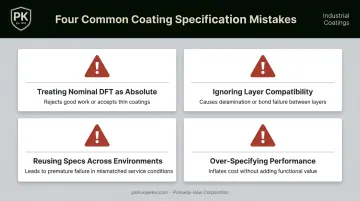
Even well-written specifications fail in execution when these mistakes go unaddressed:
- Treating nominal DFT as an absolute limit. Averaging and tolerance rules exist for a reason; misapplying them rejects good work or accepts thin, under-protected coatings.
- Ignoring compatibility between coating layers. Primers, intermediates, and topcoats from different manufacturers don't automatically work together, and mismatches are a common cause of adhesion failure.
- Reusing a spec across mismatched environments. A specification written for one exposure category needs adjustment before use in a project with different service conditions.
- Over-specifying without understanding trade-offs. Demanding performance beyond what's required drives up cost and creates unrealistic contractor expectations without adding real protection.
This is where an experienced coating provider earns its keep. At Parkway-Kew, that means translating a spec's intent into an alloy and process selection (HVOF, plasma spray, or tungsten carbide) that actually fits the load, wear, and environment involved. It's a matter of choosing what works, not what's cheapest or most familiar.
Conclusion
A coating specification is the governing document of a project. It determines material selection, surface preparation, application, and long-term performance. It's not paperwork filed away after the fact.
Reading and writing specifications well requires understanding both the applicable standards and the practical trade-offs of real-world execution. That's a different skill set than simply knowing coating chemistry.
Parkway-Kew Corporation has spent over 70 years translating specifications into field-proven wear-resistant coatings, from the introduction of HVOF for wire drawing blocks in 1989 to proprietary tungsten carbide systems like PK-730 for fracking plungers today.
Partnering with a provider who understands both the spec and the shop floor helps ensure requirements on paper become results in the field.
Frequently Asked Questions
What is the coating procedure specification?
It's the documented procedure defining the product, surface preparation, application method, and inspection steps a contractor must follow to apply a coating system correctly and consistently.
What are the four types of coatings?
Categorization varies by industry standard, but commonly referenced groups include protective/anti-corrosive, decorative, functional/wear-resistant, and specialty coatings.
What is the ISO standard for coating?
ISO 12944 is the internationally recognized standard for corrosion protection of steel structures through protective paint systems. Part 8 specifically addresses specification development.
What is the difference between a prescriptive and a performance-based coating specification?
Prescriptive specs dictate exact means and methods; performance-based specs define measurable outcomes and leave methods to the contractor. Performance-based specs reduce disputes because they hold the contractor accountable for results, not just process.
Who is responsible for writing a coating specification?
No universal license is required, but the author should have demonstrated technical expertise, since the document functions as a binding legal and technical project record.
What happens if a coating is applied outside the specification's requirements?
Deviations typically accelerate wear, corrosion, or delamination, and can affect warranty terms or require costly rework. Regular on-site inspection against the spec catches these deviations before they turn into failures.