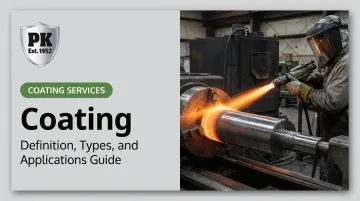
A coating is any substance applied to a surface, called a substrate, to protect it, decorate it, or give it a new function. Simple concept. Enormous consequences when it's missing.
Uncoated metal rusts. Wood rots. Machine parts grind themselves into scrap. The price tag on this neglect is staggering: NACE International's IMPACT study put the annual global cost of corrosion at $2.5 trillion, equal to 3.4% of global GDP in 2013.
This guide breaks down what coatings are, the main types by purpose and application method, where they show up across industries, and how specialized industrial coatings keep heavy machinery running long after standard finishes would have failed.
Key Takeaways
- Coatings serve three core purposes: protective, decorative, and functional
- Application method (liquid, powder, vapor deposition, thermal spray) shapes what a coating can achieve
- Standard paints and platings often fail fast under extreme heat, abrasion, or chemical exposure
- HVOF and hardfacing coatings rebuild worn components instead of requiring full replacement
- Choosing the right coating depends on substrate, environment, and the real cost of downtime
What Is a Coating? Definition, Purpose, and Key Components
A coating is a liquid, liquefiable, or mastic material that converts into a solid film once applied, forming a protective, decorative, or functional layer on a surface. That's how AMPP defines it in its CoatingsPro terminology guide, and ISO 2080:2022 uses the same three-purpose framework for metallic and inorganic coatings.
The Three Core Purposes
Every coating exists for one, or a combination, of these reasons:
- Decorative — color, gloss, texture, or finish quality on visible surfaces
- Protective — corrosion resistance, wear resistance, UV stability
- Functional — electrical conductivity, anti-fouling properties, magnetic behavior
Four Ingredients That Make Up a Coating
Most coating formulations rely on four components, based on EPA's raw-materials research on coatings manufacturing:
- Binder (resin) — converts the liquid into a solid film and bonds everything together
- Pigment — provides color and often adds a layer of protection
- Additives — boost performance, such as UV resistance or flow control
- Solvent — carries the mixture so it can be applied
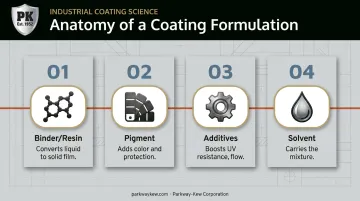
Not every coating uses all four. Powder coatings skip the solvent almost entirely, and clear coats often contain no pigment.
Coating selection has to match the substrate. A flexible urethane coating suits rubber components that flex and stretch, while a hard tungsten carbide coating suits steel machine parts under abrasive load.
Put a rigid coating on a flexible substrate, and it cracks. Put a soft coating on high-wear steel, and it wears through in days.
In consumer products, aesthetics often drive the decision. In heavy industrial settings, that priority flips entirely: wear resistance and corrosion protection become the whole point. That's exactly where the rest of this guide is headed.
Types of Coatings: By Purpose and Application Method
Coatings get classified two ways: by what they're meant to do, and by how they get onto the surface. Both matter when you're specifying a coating system.
Classified by Purpose
Protective coatings guard against corrosion, biological fouling, and fire. Anti-corrosion systems on structural steel are the most common example. According to FHWA's 100-Year Coating Study, some three-coat systems using zinc-rich primers can protect structural steel for up to 30 years before major maintenance is required.
Decorative coatings include paints, varnishes, and lacquers chosen for gloss, satin, or matte finishes. Think architectural paint on a building façade or a lacquer finish on furniture.
Functional or specialty coatings solve a specific engineering problem:
- Non-stick coatings: cookware surfaces that resist food adhesion
- Anti-microbial coatings: hospital equipment and touch surfaces
- Electrically conductive coatings: electronics housings requiring grounding or shielding
Classified by Application Method
How a coating gets applied determines its thickness, durability, and cost structure.
| Method | How It Works | Best For |
|---|---|---|
| Liquid (paint/lacquer) | Brush, roller, or spray | Dual decorative/protective finishes |
| Powder coating | Electrostatic spray, then heat-cured | Near-zero VOC industrial finishing |
| PVD/CVD | Vapor deposits ultra-thin films | Electronics, cutting tools |
| Thermal/plasma spray | Molten particles fused onto surface | High-performance wear resistance |
Powder coating deserves a specific callout here. EPA's technology review confirms dry powder application releases no VOCs during spraying, with only minute quantities released during the curing stage, making it a 100%-solids finish.
Vapor deposition (PVD and CVD) builds ultra-thin, precision films by condensing vaporized material onto a substrate. It's how semiconductor manufacturers deposit metallic layers on wafers and how tool makers coat cutting inserts for wear resistance.
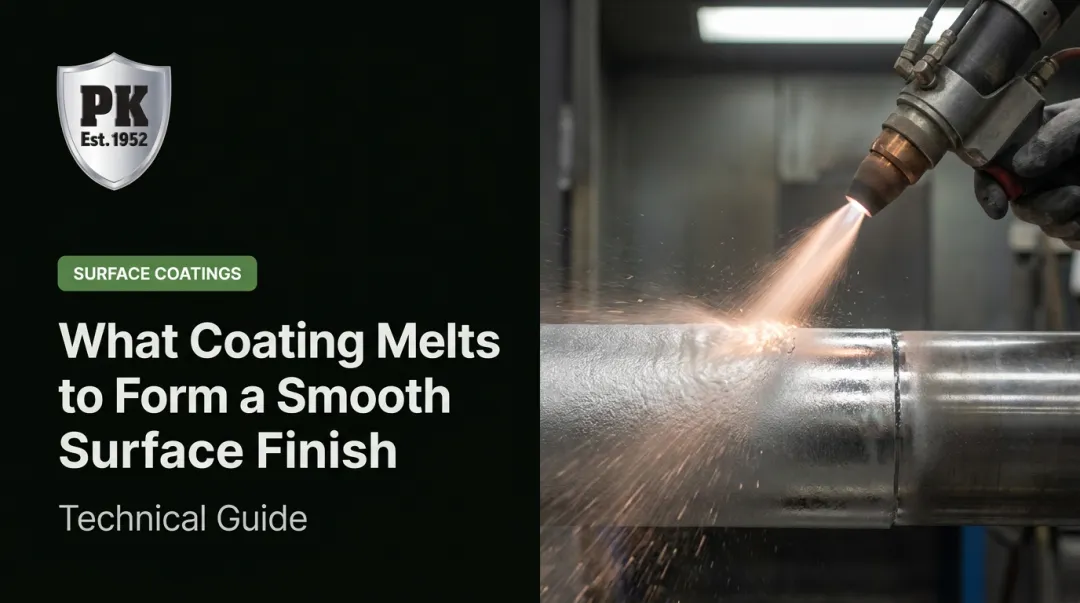
Thermal and plasma spray coatings sit at the other end of the spectrum: thick, dense, engineered layers built for punishment. That's the technology behind the industrial coatings covered later in this guide.
Common Applications of Coatings Across Industries
Coatings show up everywhere manufactured surfaces meet the elements, or each other.
Construction and infrastructure rely on coatings to fight water intrusion. Bridge deck sealers fall into two categories, per FHWA: penetrating sealers that soak into concrete pores, and film-forming sealers that create a surface barrier.
Both target moisture and chloride penetration, though performance varies with material and deck condition. Roofing membranes serve a similar waterproofing role on a different structure entirely.
Automotive and consumer goods depend on multi-layer coating systems. EPA describes the standard vehicle assembly process as pretreatment, electrodeposition primer, primer-surfacer, then a pigmented basecoat topped with clearcoat. Cookware uses a similar layered logic, just swap corrosion resistance for non-stick performance.
Heavy industrial and energy sectors push coatings into territory paint was never designed for:
- Drilling and fracking equipment facing constant abrasion and downhole corrosion
- Wire mills running metal stock across coated blocks and capstans thousands of times a day
- Valves and pump components in oil and gas extraction, where Oerlikon notes thermal-sprayed coatings protect against corrosion, erosion, and wear simultaneously
Parkway-Kew applies HVOF and plasma-sprayed tungsten carbide coatings to this hardware, rebuilding fracking plungers, wire drawing blocks, and festoon wheels for oil and gas, wire mill, and shipping terminal customers.
That last category, where standard coatings simply can't survive, is where the real engineering challenge begins.
Industrial & Wear-Resistant Coatings for Heavy Machinery
Standard paint and plating are built for moderate conditions. Drop them into oil and gas extraction, wire drawing, or heavy equipment operations and they fail fast. High heat, constant abrasion, and aggressive chemical exposure eat through thin films in weeks, not years.
That's why heavy industry turns to engineered thermal spray and hardfacing systems instead.
HVOF: Dense, Bonded, Built for Wear
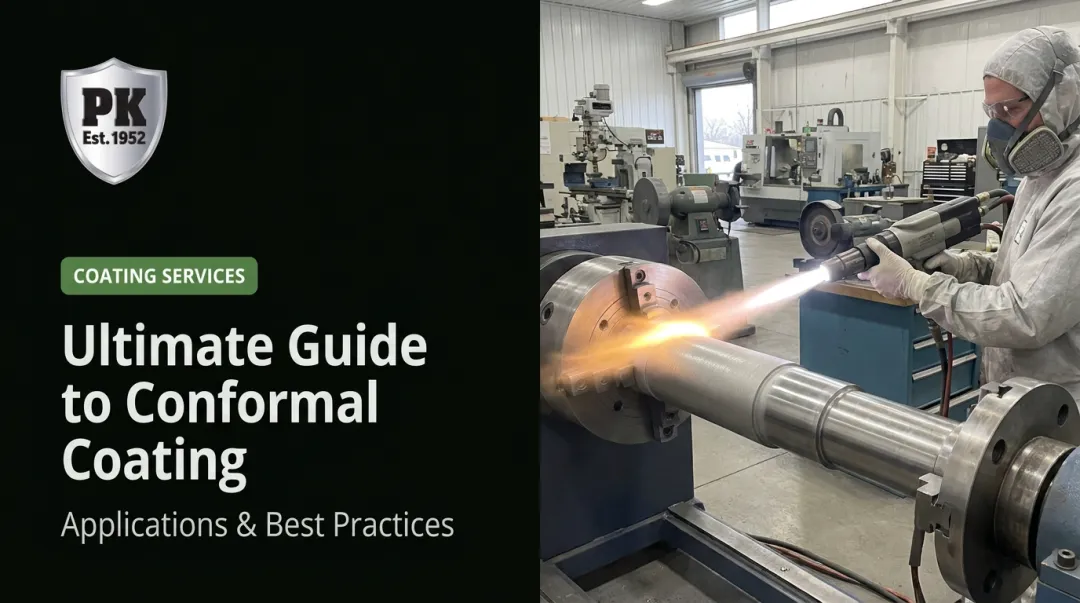
High Velocity Oxygen Fuel (HVOF) spray expels alloy powder at speeds exceeding Mach 2, so the particles slam into the substrate and build a coating layer with minimal porosity and strong adhesion. The result is a dense, tightly bonded surface suited to rollers, wire drawing blocks, and other components under constant abrasive load.
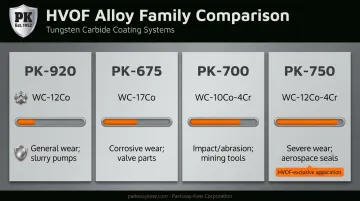
At Parkway-Kew, the PK-920, PK-675, PK-700, and PK-750 family of alloys puts this HVOF process into practice:
- PK-920: nickel chrome boron base with no carbide content, a solid baseline for moderate wire drawing demands
- PK-675 and PK-700: add tungsten carbide into that same matrix for higher wear resistance
- PK-750: pushes carbide content to its highest level and is applied exclusively via HVOF, since that Mach 2+ velocity is needed to build a defect-free coating with such a hard composite
Rebuilding Instead of Replacing
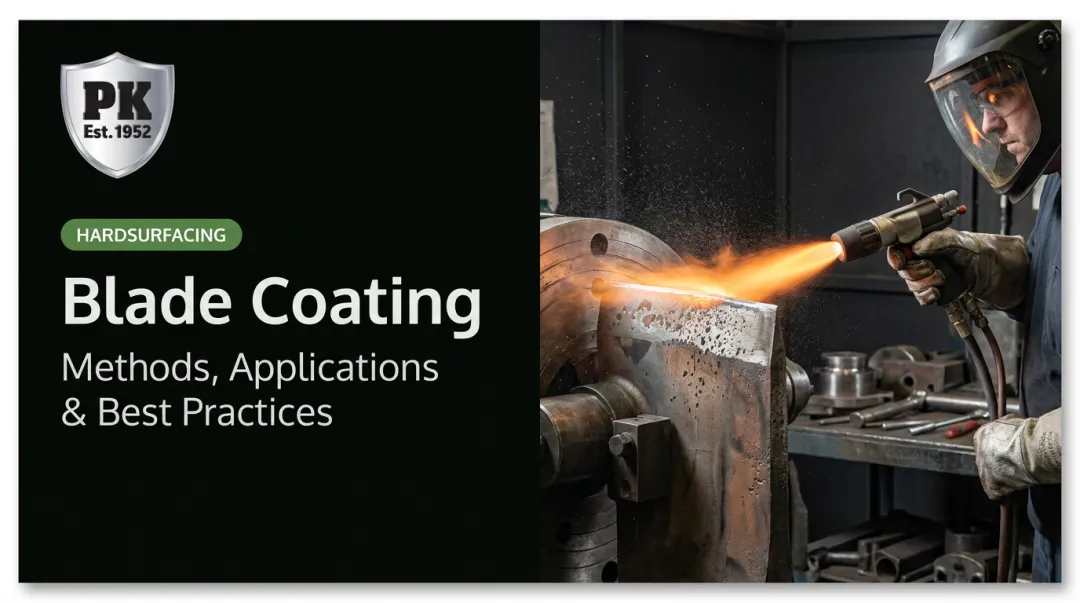
Thermal spray and submerged arc welding hardfacing exist for one core reason: rebuilding worn parts costs far less than replacing them. Submerged arc welding, a technique Parkway-Kew pioneered for wire drawing blocks back in the 1950s, deposits weld metal directly onto a worn surface rather than spraying discrete particles, making it well-suited to thicker rebuilds.
One documented field case from voestalpine Böhler Welding found that a supermartensitic weld overlay doubled the service life of continuous-casting rollers exposed to thermal shock, corrosion, and mechanical wear. Results vary by application, but this case shows what hardfacing can achieve in the field.
Parkway-Kew's Approach in Practice
Parkway-Kew has been rebuilding worn industrial components since 1952, and its coating lineup reflects decades of application-specific refinement:
- PK-730: a proprietary fused tungsten carbide coating for fracking plungers in the harshest downhole conditions, paired with a finishing process that corrects concentricity deviations up to 0.015 inches to cut vibration and scoring.
- Restore & Grind: fills in only the worn drawline area of a wire drawing block instead of grinding the entire surface down to the deepest groove, letting operators run 5 to 7 lower-cost repairs before a full recoat is needed.
Both examples point to the same principle: engineered coatings extend the useful life of expensive equipment well beyond what standard surfaces can withstand.
How to Choose the Right Coating for Your Application
Picking a coating isn't guesswork, though plenty of buyers treat it that way. Three factors should drive the decision every time.
Substrate and operating environment. What's the base material, and what is it actually exposed to? Temperature swings, moisture, abrasive contact, and chemical exposure each favor different coating chemistries. A coating built for dry indoor use won't survive downhole fracking conditions.
Desired lifespan. Some applications need years of maintenance-free service before a rebuild ever comes into play. Others tolerate a shorter-lived coating if it's cheaper to reapply on a set schedule. Match the investment to the actual performance window the part needs to survive.
Cost versus downtime risk. A pricier coating system often pays for itself many times over once you factor in:
- Avoiding unplanned downtime from premature part failure
- Comparing full replacement cost against a rebuild or recoat
- Cutting the labor and logistics needed to swap out heavy components
For heavy-duty applications, spec sheets only go so far. Working with an experienced provider matters more than picking a coating off a datasheet. Parkway-Kew, in business since 1952, matches HVOF, thermal spray, or hardfacing systems to the specific wear mechanism, budget, and equipment lifespan a customer actually needs. No two applications get the same recommendation.
Frequently Asked Questions
What do you mean by coating?
A coating is a layer of material applied to a surface for protective, decorative, or functional purposes. It can be a liquid film, a powder-cured layer, a vapor-deposited film, or a thermally sprayed metal or ceramic layer.
What are the three types of coating?
Coatings are classified by purpose into three categories: protective (corrosion and wear resistance), decorative (color and finish), and functional (conductivity, anti-fouling, and similar performance properties).
What is the difference between a coating and paint?
Paint is one specific type of coating, a pigmented liquid that forms a solid film. "Coating" is the broader term, covering paints along with powders, platings, thermal sprays, and vapor-deposited films.
How long does an industrial wear-resistant coating typically last?
Lifespan depends heavily on the coating type and operating conditions, so there's no single universal number. Specialized systems like HVOF or hardfacing extend component life compared to uncoated or standard-coated parts.
What is the most durable industrial coating for heavy equipment?
HVOF and tungsten-carbide-based thermal spray coatings rank among the most durable options for high-wear, high-corrosion environments. The best choice still depends on the specific wear mechanism and temperature involved.
Can any material be coated?
Most metals, woods, plastics, and concrete can be coated. The coating type has to match the substrate's properties and intended use. A flexible coating for rubber won't perform the same job as a hard coating for steel.