There's a common mix-up worth clearing up first. This guide covers industrial/technical blade coating — spreading liquid solutions, slurries, or pastes into thin films. It has nothing to do with knife blade finishes like PVD or DLC coatings, which use "blade coating" to mean something else entirely (more on that in the FAQ).
Below, we'll walk through the process, equipment design, real-world applications, and how blade coating stacks up against other coating technologies — including the heavy-duty hardsurfacing methods used on industrial equipment.
Key Takeaways
- Blade coating uses a fixed-gap blade to spread liquid into a uniform wet film
- Film thickness depends on flow rate, blade gap, coating speed, and substrate width
- It delivers large-area coverage with low material waste, but struggles below tens-of-microns thickness
- Slot-die coating offers greater precision for thin functional films
- HVOF hardsurfacing solves a different problem entirely: mechanical wear resistance, not thin-film deposition
What Is Blade Coating?
Blade (or doctor blade) coating spreads a liquid, slurry, or paste into a thin, uniform film by dragging a blade across a substrate. The blade sits at a fixed gap above the surface : everything above that gap gets scraped off, and what remains becomes the wet film.
The core principle is straightforward: gap height controls deposited material. Narrow the gap, and you get a thinner film. Widen it, and more material passes through. Viscosity, blade angle, and coating speed all interact with that gap to determine the final result. The gap alone doesn't guarantee a specific thickness.
Blade coating earned its popularity because it's simple, scalable, and cheap compared to vacuum-based or precision-metered alternatives. A 2023 review projected the flexible electronics market at $250 billion by 2025 . That figure covers the whole flexible electronics sector rather than blade coating specifically, but it signals how much room exists for solution-processed thin films across printed electronics and batteries.
Blade Coating vs Other Thin-Film Techniques
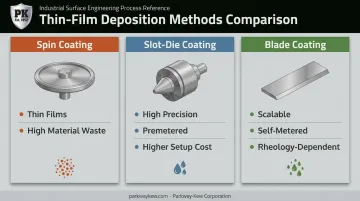
Three techniques dominate solution-based thin-film work, and each serves a different purpose:
- Spin coating: Excellent for small, very thin lab films, but wasteful. Most of the solution gets flung off during spinning.
- Slot-die coating: A closed, premetered system fed through a narrow slot. More precise, more material-efficient, but higher setup cost.
- Blade coating: Open and self-metered. Cheaper tooling, easier to scale to large areas, but more dependent on rheology and gap calibration.
Bar coating (using Mayer rods) is a close cousin: a wire-wound cylindrical bar meters the liquid instead of a flat blade edge. It's gentler on delicate or flexible substrates and remains a go-to for pilot-scale coating trials.
The Blade Coating Process: Step-by-Step
Getting a clean, uniform film comes down to four stages, each affecting the final result.
- Solution preparation: The coating material needs the right viscosity and consistency. Too thick, and it won't spread evenly; too thin, and it spreads unevenly or lets particles settle before drying.
- Equipment and substrate set-up: Blade coaters work with single sheets, batches of substrates, or continuous rolls (web). Whatever the format, the blade must align precisely and evenly across the substrate.
- Spreading and smoothing: The blade moves across the substrate at a set height, angle, and speed, dispensing and leveling the material as it goes.
- Drying/curing: Heat, UV light, or simple air drying locks the film in place. The drying rate matters as much as the deposition itself: a rate that's too aggressive can pull binder toward the surface, weakening adhesion underneath.
Calculating Wet Film Thickness
The relationship engineers use to estimate wet film thickness is:
h = Q / (v × w)
Where h is wet thickness, Q is volumetric flow rate, v is coating speed, and w is substrate width. Thickness rises with flow rate and falls as speed or width increases.
Worked example: Say you're running a flow rate of 50 mL/min across a 20 cm wide substrate at 5 mm/s. Double your coating speed to 10 mm/s without changing anything else, and your wet film thickness roughly halves. Slow the line down, and thickness increases, assuming flow rate stays constant.
One caveat: this formula is a mass-balance target, not a guarantee. Elastic rebound, surface tension, and puddle behavior at the blade edge all shift the actual result away from the calculated number.
On speed: lab-scale doctor blade coaters often run in the range of 0.05 to 250 mm/s, according to equipment specifications from Ossila. Industrial web-based systems can push into the range of several meters per minute. The trade-off is consistent across scales — push speed too high relative to your rheology, and you sacrifice uniformity for throughput.
Viscosity matters just as much as speed. Battery electrode slurries, for instance, are typically coated at shear rates of 100 to 500 per second , a reminder that viscosity specs only mean something when paired with a stated shear rate and coating speed.
Blade Coating System Design: Blade Types, Angles & Setup
The blade itself, its angle, and how the substrate is handled all shape coating quality.
Blade materials shape both durability and coating quality:
- Stainless steel: durable, corrosion-resistant, and the workhorse choice for most setups
- Ceramic: holds up better against abrasive slurries
- Plastic: gentler on delicate substrates, reducing scoring risk
- Fixed blades: suit simple R&D setups
- Adjustable and rotary blades: give production lines flexibility to change gap settings on the fly
Blade angle effects:
| Angle | Effect | Best For |
|---|---|---|
| 90° (perpendicular) | Maximum shear force; very thin, highly uniform films | High-precision thin coatings |
| 15°-30° (shallow) | Lower pressure, allowing thicker coatings | Viscous materials like battery slurries or adhesive formulations |
Substrate handling matters more than most people expect. A substrate that isn't flat or properly tensioned changes the effective blade gap as it moves, causing wrinkles, streaks, or thickness variation. This becomes especially critical on continuous web lines, where tension control and roller alignment need to stay tight at higher speeds.
Manual vs automated coaters. Manual doctor blading remains standard in R&D labs: it's cheap, flexible, and fast to set up for small batches. Automated, software-controlled systems dominate high-volume manufacturing, where reproducibility across thousands of meters of substrate matters more than upfront cost.
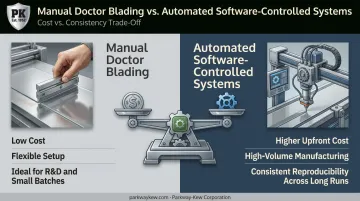
The trade-off is straightforward: manual setups sacrifice consistency for low investment, while automated lines cost more but deliver repeatable results run after run.
Applications, Advantages & Disadvantages of Blade Coating
Where Blade Coating Is Used
Blade coating shows up across a surprising range of industries:
- Printing and packaging: inks, varnishes, and laminate layers on paper and film substrates
- Electronics: OLED, LCD, and touchscreen functional layers
- Battery manufacturing: electrode slurry casting for both lab-scale cells and pilot production
- Academic research: thin-film materials science, including colloidal crystal-polymer nanocomposites
Key Advantages
Blade coating's staying power comes down to a few clear strengths:
- Large-area coverage at relatively fast throughput compared to batch processes
- Versatility across a wide viscosity range, from thin inks to thick battery slurries
- Lower material waste — spin coating, by contrast, discards roughly 90% of the solution used, making blade coating far more economical for scale-up work
- Low equipment and tooling cost relative to premetered systems
Limitations to Keep in Mind
No process is perfect for everything. Blade coating runs into trouble when:
- Films need to go below the tens-of-microns wet-thickness range, which is slot-die or spin coating territory
- Viscosity is too high, impairing uniform spreading (and too low, which invites settling)
- Reproducibility matters more than cost: closed, premetered slot-die systems simply offer tighter control
Blade Coating vs Other Coating Methods: Choosing the Right Process
| Metric | Blade Coating | Slot-Die Coating | Spin Coating |
|---|---|---|---|
| Precision | Gap/rheology dependent | Highest (closed, pre-metered) | Good for small substrates |
| Thickness range | Tens of microns and up | Nanometers to microns | Nanometers to microns |
| Speed | Lab: 0.05-250 mm/s; industrial: several m/min | cm/s to several m/s | 100-6,000 rpm (batch) |
| Material waste | Moderate | Minimal | High (~90% discarded) |
| Typical materials | Battery slurries, ceramic pastes, inks | Photovoltaic and LED functional inks | Photoresists, small-batch films |
Blade and slot-die coating both serve thin, functional film applications: electronics, batteries, printed layers. But an entirely different category of coating technology exists for one specific goal: long-term mechanical wear resistance on heavy equipment components. That's where methods like HVOF (high-velocity oxygen fuel), plasma spray, and submerged arc welding hardsurfacing come in.
Parkway-Kew Corporation is a good illustration of that distinction. Operating since 1952 from North Brunswick, NJ, the company has spent over 70 years applying HVOF, plasma spray, and metallizing coatings to industrial equipment like wire drawing blocks, capstans, and fracking plungers.
Its HVOF process, introduced in 1989, expels alloy powder at speeds exceeding Mach 2 to form dense, wear-resistant layers, a world apart from a blade spreading a liquid solution at microns of thickness. Instead of nanometer or micron-scale functional films, these coatings need to survive years of abrasion, corrosion, and mechanical load on rotating industrial components.
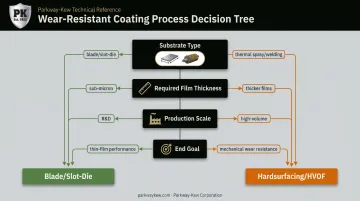
How to choose:
- Substrate type: flat sheets and rolls favor blade or slot-die; complex 3D metal parts need thermal spray or welding
- Required film thickness: sub-micron functional layers push toward slot-die; thicker functional coatings suit blade coating
- Production scale: high-volume precision manufacturing favors slot-die; R&D and moderate-scale work favors blade coating
- End goal: functional thin-film performance calls for blade or slot-die; mechanical wear resistance on heavy equipment calls for hardsurfacing methods like HVOF or plasma spray
Frequently Asked Questions
How fast is doctor blade coating?
Speed varies widely — lab-scale manual coaters typically run from 0.05 to 250 mm/s, while automated industrial systems can reach several meters per minute. Faster speeds boost throughput but can compromise film uniformity if rheology isn't matched to the line speed.
What is a PVD blade coating?
PVD (Physical Vapor Deposition) is a vacuum-based process, completely distinct from doctor blade coating. It's used to apply thin, hard, wear-resistant layers onto tools, knife blades, and industrial components, not liquid films spread by a blade.
What is the best coating for knife blades?
DLC (diamond-like carbon), PVD, and Cerakote are the most popular knife blade coatings, each trading off hardness, corrosion resistance, and appearance differently. These are unrelated to the industrial thin-film blade coating covered in this guide.
What is the difference between blade coating and slot-die coating?
Slot-die coating uses a sealed, metered die for greater precision and thinner films, while blade coating is simpler, cheaper, and better suited to thicker or less critical coatings. Slot-die also wastes far less material.
What materials can be applied using blade coating?
Blade coating handles liquids, slurries, and pastes across a wide viscosity range, including inks, adhesives, battery electrode slurries, and polymer solutions used in electronics research.
Can blade coating be used for industrial wear-resistant coatings?
No. Traditional blade coating is built for thin functional films, not heavy-duty wear resistance. Applications like wire drawing blocks or fracking plungers rely on specialized processes such as HVOF, plasma spray, or submerged arc welding instead.