Many buyers compare coating quotes the way they'd compare quotes for office supplies: lowest number wins. But a cheaper quote can mean a thinner coating, a generic alloy, or a shorter warranty — costs that show up later as downtime and reorders.
The stakes are real. Siemens estimates that the world's 500 largest companies lose nearly $1.4 trillion annually, or 11% of revenue, to unplanned downtime, according to its 2024 True Cost of Downtime report. For wire mills, oil and gas operators, and heavy equipment fleets, a coating failure isn't an inconvenience. It's a line item that dwarfs the original quote.
This article breaks down what actually belongs in a coating quote and how to compare them without getting fooled by a low sticker price.
Key Takeaways
- Quotes vary by process, alloy, precision, lead time, and warranty — not just price per unit
- The lowest bid rarely wins once downtime and reorders raise the total lifecycle cost
- Apples-to-apples comparison requires knowing what each vendor includes in scope, testing, and finishing
- Vendors with in-house machining, grinding, and proprietary alloys typically deliver better long-term value
What Is a Coating Quote?
A coating quote is a detailed estimate covering the surface engineering process, material, machining, and terms for protecting a component, such as wire drawing blocks, capstans, fracking plungers, rollers, or festoon wheels.
Industrial hardsurfacing quotes typically cover one or more of these process families:
- HVOF (high-velocity oxygen fuel spray)
- Plasma spray
- Thermal spray/metallizing
- Submerged arc weld hardfacing
- Urethane coatings (for rollers and wheels, not metal wear surfaces)
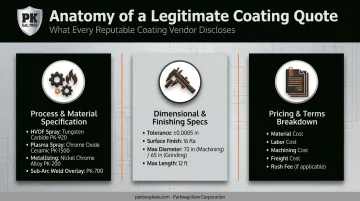
Here's what should appear in any legitimate industrial coating quote, so you know what you're actually comparing.
Process & Material Specification
The quote should state the exact coating technology and alloy being applied, not just "coating." Tungsten carbide via HVOF behaves nothing like a weld overlay, and the two aren't interchangeable on a spec sheet or a price sheet.
Parkway-Kew's engineering team, for example, matches alloy families to application:
- PK-920 through PK-750 for HVOF wire drawing blocks, with tungsten carbide content increasing for higher wear resistance
- PK-1500 chrome oxide via plasma spray for high-speed ferrous wire
- PK-730 fused tungsten carbide for fracking plungers in the harshest downhole conditions
Dimensional and Finishing Specs
A comparable quote lists:
- Grinding and turning tolerances
- Surface finish requirements
- Maximum part size the vendor can actually handle
A vendor quoting a 60-inch wire drawing block needs equipment rated for it. This isn't a minor detail: it determines whether the part comes back balanced and true or requires rework.
Pricing and Terms Breakdown
A transparent quote itemizes:
- Material cost (alloy type and volume)
- Labor for application
- Machining and finishing charges
- Freight
- Any rush fees or minimum-order charges
If a quote is a single lump-sum number with no breakdown, you have no way to know where the savings (or the shortcuts) are coming from.
Benefits of Comparing Coating Quotes Carefully
Taking the time to compare quotes line-by-line pays off in measurable operational terms:
- Extended wear life on high-cycle components like wire drawing blocks and rollers
- Fewer changeouts, reducing planned and unplanned downtime
- Better corrosion resistance in harsh environments like fracking sites or marine terminals
- A cost-effective alternative to solid ceramics without the breakage or slippage risk solid inserts can introduce
- Higher surface finish quality, which matters directly for downstream processes like wire drawing
Parkway-Kew's urethane-coated festoon wheels, for example, have been field tested with a documented lifespan 2 to 3 years longer than OEM equivalents. That kind of performance gap only becomes visible when quotes are compared line-by-line, not judged on price alone.
What to Consider When Comparing Coating Quotes
Coating needs vary by application. A fracking site, a wire mill, and a shipping terminal each demand different wear and corrosion performance. The "best" quote isn't the cheapest one; it's the one that matches technical specs to your operational priorities.
The following factors connect what's written in a quote to outcomes you can actually measure, like uptime and cost per cycle.
Coating Process & Technology Fit
HVOF, plasma spray, thermal spray, and weld hardfacing each deliver different wear and corrosion performance. Comparing quotes on price alone, without accounting for process suitability, is comparing the wrong things.
This factor drives KPIs like:
- Wear life extension (hours or tons before recoat)
- Hardness rating (Rockwell C or equivalent scale)
The American Welding Society notes that hardness alone doesn't predict performance: the dominant wear mechanism, base metal, and operating conditions all matter, according to AWS hardfacing guidance. A quote that only cites a hardness number without context is giving you half the picture.
Material & Alloy Composition
Proprietary or specialized alloys (fused tungsten carbide blends, for example) can significantly outperform generic coatings in abrasive or corrosive environments. This is where quotes diverge most sharply, even when they name the same base process.
Relevant KPIs include:
- Coefficient of friction
- Corrosion resistance rating
- Resistance to chemical exposure (critical in fracking fluids or marine saltwater)
A controlled study comparing WC-10Co4Cr coatings applied by different HVOF systems found meaningfully different friction and corrosion-current results from the same nominal chemistry, according to research published by Kermetico. In other words, naming the alloy isn't enough: the spray parameters matter too.
Dimensional Capability & Finishing Precision
Not every vendor can grind or turn large-diameter parts to tight tolerances. This affects fit, balance, and post-coating performance, especially on rotating equipment like capstans and pulleys.
Watch for:
- Dimensional accuracy (specified in thousandths of an inch)
- Achievable surface finish (Ra)
- Maximum part envelope the vendor can actually process
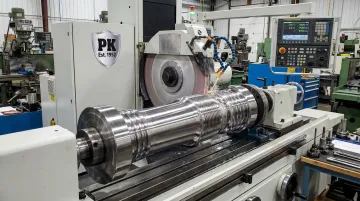
Parkway-Kew handles CNC machining up to 72 inches in diameter and large-diameter grinding up to 65 inches in diameter and 12 feet in length. That capacity matters for oversized wire drawing blocks and long plunger assemblies, where concentricity errors as small as 0.015 inches can affect performance.
Lead Time & Production Capacity
Turnaround time directly determines how long a machine sits idle. This should be a specific, comparable line item, not a vague promise.
Relevant KPIs:
- Mean time to repair (MTTR)
- Cost of downtime per hour or day for your specific operation
A quote with a lower price but a longer lead time may end up costing more once idle equipment is factored in. Ask each vendor for a firm turnaround estimate tied to your part's size and process, not a generic range.
Warranty, Testing & Quality Documentation
Quotes should specify:
- Warranty length
- Hardness and dimensional testing reports provided with the finished part
- Industry affiliations that signal quality assurance
Membership in bodies like the Wire Association International signals ongoing engagement with industry standards. Parkway-Kew has held this membership for decades, and its Latin America director is a WAI former president. Still, membership isn't a substitute for asking a vendor directly about their warranty terms and defect history.
Total Cost of Ownership vs. Upfront Price
A cheaper coating that needs replacing twice as often can cost more over its lifecycle than a premium process with longer service life. This is the factor most often overlooked when a buyer fixates on the quote total.
Useful KPIs for real comparison:
- Cost per ton produced
- Repair cost per cycle
- Total cost per part life-year
Parkway-Kew's Restore & Grind process illustrates this well. Instead of stripping an entire wire drawing block down to its deepest wear groove, it selectively fills and blends only the worn drawline area. This enables 5 to 7 lower-cost repair cycles before a full recoat is needed, stretching the value of the original coating investment considerably further than a one-and-done recoat cycle.
How Parkway-Kew Can Help
Parkway-Kew has spent over 70 years helping wire mills, oil and gas operators, and heavy equipment fleets move past price-only comparisons. Since 1952, the company has built its quotes around technical transparency: naming the exact process, alloy, and finishing specs so buyers know precisely what they're paying for.
What sets Parkway-Kew's quotes and capabilities apart:
- PK-730 proprietary fused tungsten carbide coating built specifically for fracking plungers in the harshest downhole environments
- Restore & Grind process that extends wire drawing block life without a full recoat, cutting both cost and downtime
- In-house CNC turning, milling, and grinding up to 72 inches in diameter (machining) and 65 inches in diameter by 12 feet in length (grinding)
- A full range of processes under one roof (HVOF, submerged arc welding, thermal spray, plasma spray) so the alloy and process match the application, not what one vendor happens to offer
- A track record with 500+ companies worldwide, spanning wire mills, fracking operations, and shipping terminals
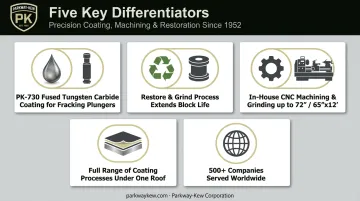
That range matters when comparing quotes. A vendor limited to one process will always recommend that process, regardless of fit.
Conclusion
Comparing coating quotes means looking beyond the number on the page. Focus on finding an option that matches the wear, corrosion, and precision demands of your application.
Process fit, material quality, and total cost of ownership matter more than the sticker price every time. A quote that looks like a bargain today can turn into a costly reorder six months down the line.
Vendor performance deserves ongoing review, not a one-time decision. Operating conditions change and part specifications evolve, so revisit your coating comparisons periodically rather than sticking with the same vendor out of habit.
Frequently Asked Questions
How much does coating cost?
Cost varies widely based on coating process, material/alloy, part size, and finishing requirements. Request an itemized quote so you can compare true cost drivers instead of a single bottom-line number.
What does "coating" mean in an industrial context?
Industrial coating means applying a protective or wear-resistant layer, using methods such as HVOF, plasma spray, thermal spray, or weld overlay, onto a metal component to extend its service life and performance.
What is the best type of coating?
It depends on the application's wear, corrosion, and friction demands. HVOF works best for high-wear precision parts, weld hardfacing handles heavy-impact components needing a thick overlay, and plasma spray fits high-speed ferrous wire drawing.
What information should I provide to get an accurate coating quote?
Part dimensions, material, current wear condition, operating environment, and desired turnaround time all help a vendor generate a precise, comparable quote rather than a rough estimate.
Can I directly compare quotes that use different coating processes?
Direct price comparison across different processes can be misleading. Compare based on expected service life and total cost of ownership instead, since a cheaper process may need replacing far sooner.
How long does it typically take to receive an industrial coating quote?
Turnaround varies by vendor and part complexity. Detailed technical quotes usually require part specs and sometimes an inspection, so providing accurate information upfront helps avoid delays.