There's no flat rate because there's no flat job. Machine type, part complexity, material, tolerances, and even your shop's zip code all move the number. A simple aluminum bracket and a titanium aerospace fitting don't belong on the same price sheet.
This article breaks down realistic hourly ranges, the factors driving them, a full cost stack beyond the hourly rate, and how to budget smart — including what changes when you're machining oversized industrial parts like wire drawing blocks or capstans.
Key Takeaways
- Hourly CNC rates typically range $40–$300+, based on machine axis, complexity, and region
- Simple 3-axis work costs less; 5-axis, tight-tolerance, or oversized jobs cost more
- Project cost equals hourly rate times machining hours, plus setup, tooling, and finishing
- Oversized components often need specialized shops with large-capacity equipment
How Much Does CNC Machining Cost Per Hour? (Pricing Overview)
CNC machining doesn't have one fixed hourly price. Rates shift based on the machine's axis capability, the part's geometry, the material being cut, and where the shop is located.
Buyers get burned when they misread this. Three common mistakes:
- Comparing only the headline hourly rate without accounting for total machining hours
- Choosing an underpowered machine configuration for a part that actually needs more axes or capacity
- Getting blindsided by setup and post-processing charges that weren't in the initial quote
Typical Hourly Ranges by Process
| CNC Process | Typical Hourly Range | Notes |
|---|---|---|
| 3-axis milling | $40-$100 | Lower end for simple geometry |
| Horizontal CNC milling | $80-$150 | Mid-range capability |
| CNC turning (mid-sized lathe) | $50-$110 | Standard lathe work |
| Swiss turning | $100-$250 | Precision small-diameter parts |
| 5-axis machining | $120-$300+ | Complex geometry, multi-face work |
| 4-axis milling, EDM, large-diameter grinding | Quote-dependent | No standard published benchmark; request a direct quote |
These figures cover machine time and basic setup only. They exclude raw material, tooling wear, finishing, inspection, and shipping, all of which add to your final invoice.
Pricing Tiers by Complexity
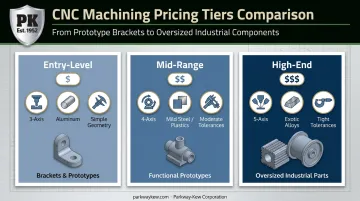
Entry-level setup covers 3-axis milling or turning, standard materials like aluminum, and simple geometry with minimal inspection. This tier fits brackets, simple prototypes, and low-complexity production parts where tolerances aren't critical.
Mid-range setup involves 4-axis machining, moderate tolerances, and standard-to-mid-tier materials such as mild steel or engineering plastics. It suits functional prototypes and mid-volume runs needing decent precision without exotic requirements.
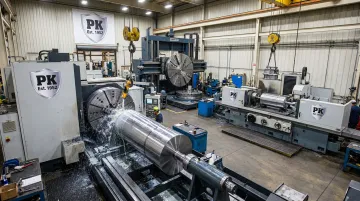
High-end setup covers 5-axis machining, tight tolerances, exotic alloys, or specialized large-diameter capacity. Heavy industrial parts (wire drawing blocks, capstans, crane wheels) often fall here simply because of scale, not complexity. Parkway-Kew, for instance, maintains in-house CNC turning and milling up to 72 inches in diameter and grinding up to 65 inches diameter by 12 feet in length specifically to handle this class of oversized industrial component.
Key Factors That Affect CNC Machining Cost Per Hour
Hourly pricing blends technical factors (machine and tooling), operational factors (labor and volume), and business factors (location and overhead). Understanding each helps you evaluate whether a quote is fair.
Machine Type and Axis Capability
More axes mean more capability, and a higher rate. A 3-axis mill is simpler to program and cheaper to run than a 5-axis machine, which needs complex toolpaths and collision-avoidance planning. But 5-axis work can finish a part in one setup instead of three, sometimes lowering total cost even at a higher hourly rate.
Part Size, Scale, and Production Volume
Oversized or heavy-duty parts (large-diameter shafts, wire drawing blocks, capstans) require specialized large-capacity CNC and grinding equipment that standard shops simply don't have. This shifts both the rate and the number of hours required. Parkway-Kew maintains in-house milling, turning, and grinding capability specifically sized for this class of heavy industrial work, avoiding the need to farm parts out to multiple specialty vendors.
One-off or prototype orders also cost more per part than continuous production runs, since setup costs get spread across fewer units.
Material and Machinability
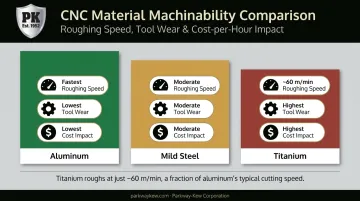
Aluminum and plastics cut fast and easy on tooling. Titanium and stainless steel are a different story: titanium roughing speeds run around 60 m/min, several times slower than aluminum in optimized applications, according to Sandvik Coromant's machining data. Harder materials mean slower cycles, faster tool wear, and higher cost per hour of actual output.
Design Complexity and Tolerances
Tight tolerances, thin walls, deep pockets, and multiple setups all add machining time. Xometry's cost-reduction guidance identifies machining time as often the single largest cost driver, bigger than material or finishing. Applying tight tolerances only where functionally necessary keeps programming and inspection time in check.
Geographic Location and Labor Rates
Labor costs vary widely across the U.S. and factor directly into shop rates. According to the U.S. Bureau of Labor Statistics, machinists in high-wage regions such as California and the Northeast often earn considerably more per hour than those in lower-cost areas like the Midwest or South. That regional gap is a reminder that where a shop operates matters as much as how it machines.
Cost Breakdown of CNC Machining
The quoted hourly rate is just one line in the total project cost. Here's what else typically factors in:
| Cost Component | Billing Type | What It Covers |
|---|---|---|
| Programming and Setup | One-time | CAD/CAM programming, fixture setup, tool calibration |
| Machine/Operating Time | Recurring | The per-hour rate tied to machine type and cycle time |
| Tooling and Material Costs | Consumable | Cutting tool wear, replacement, raw material |
| Post-Processing and Finishing | Periodic | Deburring, anodizing, polishing, coatings |
| Quality Inspection and Logistics | Recurring | Dimensional checks, CMM testing, packaging, shipping |
Skip any of these in your budget planning, and you'll be surprised by the final invoice. This is especially true for coated or hardsurfaced parts, where finishing is the entire point of the job, not an optional extra.
Low-Cost vs High-Cost CNC Machining — What's the Difference?
A cheaper hourly rate doesn't guarantee a lower total cost. It often means you're trading upfront savings for downstream risk.
| Factor | Lower-Cost Shops | Higher-Cost Shops |
|---|---|---|
| Precision & Tolerance | Standard tolerances, basic 3-axis capability | Tight tolerances, multi-axis precision for critical components |
| Turnaround Reliability | Longer lead times, more batch-to-batch variability | Faster, more consistent output from experienced operators and calibrated equipment |
| Long-Term Value | Higher risk of rework, scrap, or premature failure | Better durability, fewer replacements, less downtime |
This last point matters most for wear-prone industrial components. A worn wire drawing block or crane wheel that fails early costs more than a replacement part; it costs production hours on the line. That's the logic behind hardsurfaced, wear-resistant coatings: paying more upfront for a part engineered to last extends the interval between replacements.
How to Estimate the Right Budget and Avoid Overpaying
The goal is fit-for-purpose machining: paying for exactly the capability your part needs, no more and no less.
Weigh these factors before requesting quotes:
- Intended use and load requirements
- Batch size versus one-off need
- Required tolerances (only as tight as functionally necessary)
- Whether the part needs standard-capacity or oversized/heavy-duty machining
Common budgeting mistakes to avoid:
- Focusing only on the quoted hourly rate
- Ignoring setup, post-processing, and logistics costs
- Over-specifying tolerances that don't affect function
Work with a manufacturing partner that provides transparent, itemized quotes and Design for Manufacturability feedback upfront.
For large-diameter or heavy industrial components, look for a shop that combines in-house CNC turning, milling, and grinding with wear-resistant coating expertise. Parkway-Kew applies this approach for wire drawing blocks and capstans, cutting out the multi-vendor shuffle entirely. One shipment in, one finished part out, instead of coordinating between a machine shop, a coating vendor, and a grinding specialist separately.
Frequently Asked Questions
How much does machining cost per hour?
Rates typically range from $40 to $300+ per hour, depending on machine type, complexity, and region. Simple 3-axis work sits at the low end; 5-axis or specialized large-format machining sits at the high end.
How do you calculate machining cost per hour?
Add up machine time, labor, tooling wear, material cost, and shop overhead, then divide by billable hours. Most shops build this into a single quoted rate rather than itemizing every input.
What is the meaning of machining cost?
Machining cost is the total expense of turning raw material into a finished part. It covers setup, machine time, tooling, and any finishing work — not just the hourly rate.
How much does a machinist charge per hour?
Skilled machinist wages ranged from $17.64 to $36.45 per hour across percentiles as of May 2023, according to BLS wage data. Shops bundle this labor cost into their overall hourly rate rather than billing it separately.
Is CNC machining more expensive than manual machining?
CNC carries higher upfront setup and equipment costs, but it's more cost-effective at scale and for precision work thanks to automation and repeatability. Manual machining can be cheaper for simple, one-off jobs.
What's the best way to reduce CNC machining costs without sacrificing quality?
Optimize your design to avoid unnecessary tight tolerances, batch orders to spread setup costs, and choose standard materials where performance allows. Small design changes often save more than switching vendors.