Introduction
Industrial equipment fails in predictable ways: wear, corrosion, and surface degradation grind down components that were never designed to be disposable. For wire mills, oil and gas operators, shipping terminals, and heavy equipment manufacturers, the wrong coating choice triggers unplanned downtime, emergency component replacement, and production losses that compound fast.
Siemens' True Cost of Downtime 2024 report puts heavy-industry downtime costs at roughly $59M per plant — context that reframes coating decisions as operational risk management, not procurement.
The thermal spray coating equipment and services market alone is sized at $14.0B in 2024, projected to reach $17.8B by 2030, according to MarketsandMarkets. Buyers are no longer just comparing prices — they're scrutinizing technology depth, rebuild capability, and application-specific track records.
This guide breaks down the major coating technologies used across heavy industry, profiles five established providers, and gives you a practical framework for evaluating vendors before committing.
Key Takeaways
- Industrial metal coatings protect components from wear, corrosion, and surface degradation — the right technology depends on operating environment and component type
- Core technologies include HVOF, thermal spray, plasma spray ceramics, sub-arc welding, electroplating, and powder coating — each suited to different conditions
- Evaluate providers on coating technology range, in-house machining, industry specialization, and rebuild/restore capability — not just price
- Providers who pioneered a specific technology have more application cycles and failure data behind them — that translates to fewer costly surprises on your parts
- This guide profiles five companies, including Parkway-Kew Corporation, which has specialized in hardsurfaced wire drawing blocks and capstans since 1952
Overview of Metal Coating & Finishing Services in Industrial Applications
Industrial metal coating and finishing refers to the application of protective, wear-resistant, or performance-enhancing layers onto metal components using thermal, chemical, or mechanical processes — extending equipment service life and reducing replacement costs.
The major service categories relevant to heavy industry fall into distinct groups based on function and application method:
| Category | Primary Use Case |
|---|---|
| Hardsurfacing / Sub-arc welding | Rebuilding worn components with wear-resistant weld overlays |
| HVOF thermal spray | Precision wear and corrosion resistance on new or refurbished parts |
| Plasma spray ceramics | Non-metallic surface properties — maximum hardness for high-speed applications |
| Thermal spray / Metalizing | Surface finish quality; the only viable method for very large wire drawing applications |
| Electroplating / Anodizing | Corrosion resistance, decorative or functional metal deposition |
| Powder / Liquid coatings | General corrosion protection for structural and fabricated components |
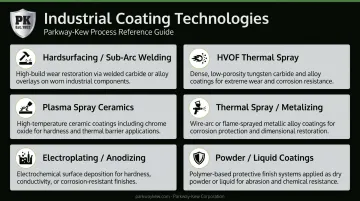
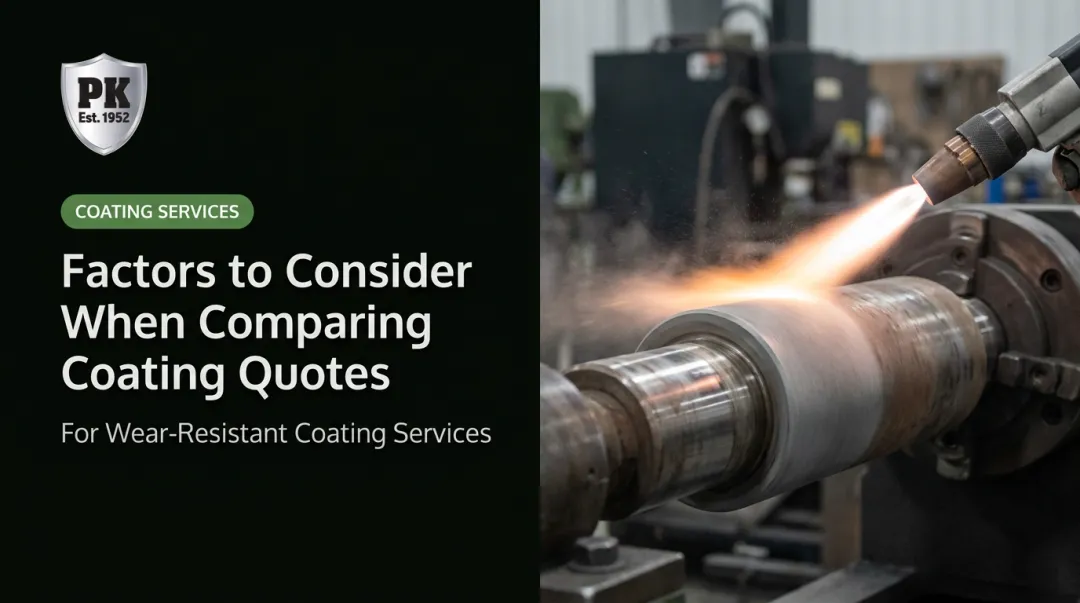
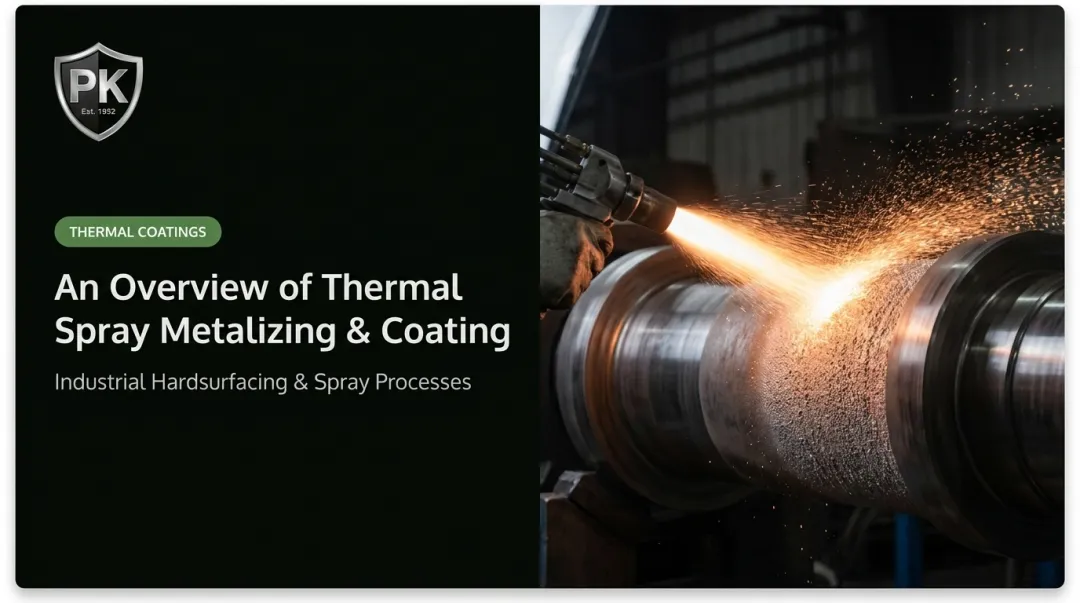
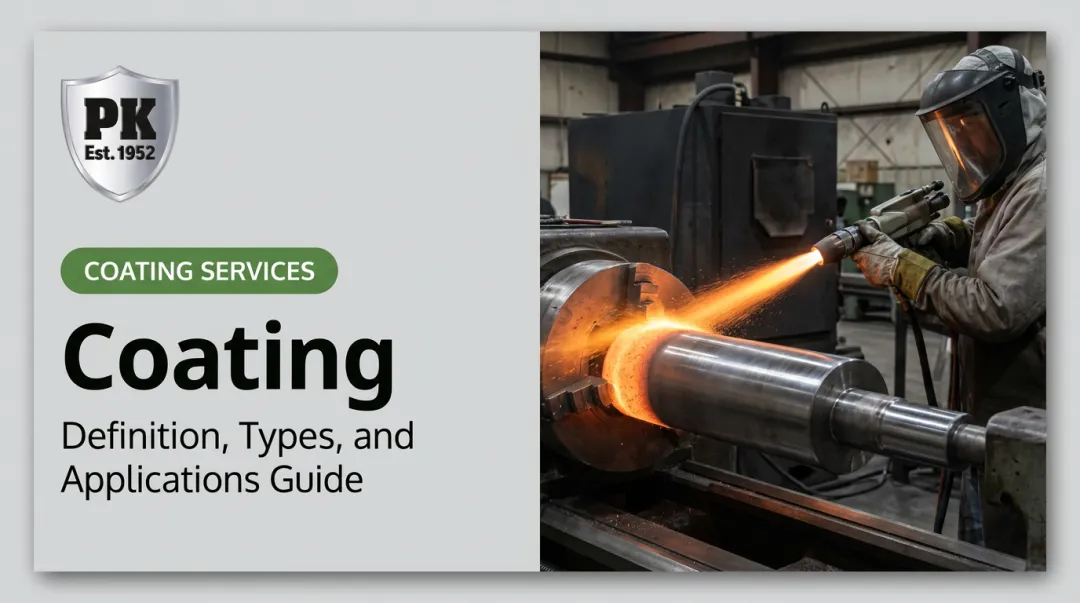
These technologies differ substantially in bond strength, coating density, heat input, and application method. HVOF, for example, propels powder particles at speeds up to approximately 700 m/s, producing porosity generally under 0.5%, far denser than conventional flame spray. Plasma spray uses an electric arc plasma with plume temperatures reaching roughly 16,000 K, making it the right tool for high-melting ceramics like chrome oxide.
The first question buyers need to answer is whether they need component rebuild or new part protection. Those are different challenges with different provider requirements — and the sections below break down each category to help narrow the field.
Top Metal Coating & Finishing Companies to Know
These five companies were selected based on demonstrated technology capability, industry specialization, longevity of operation, and depth of service beyond standard coating application.
Parkway-Kew Corporation
Established in 1952 in North Brunswick, NJ, Parkway-Kew Corporation is recognized as the world leader in hardsurfaced wire drawing blocks and capstans, serving more than 500 companies worldwide across wire mills, oil and gas (fracking), shipping terminals, and heavy equipment manufacturing.
Founder Eugene Walter Klein pioneered submerged arc welding for wire drawing block rebuilding in the 1950s using the proprietary PK-503 super-hard alloy. In 1989, under President Eugene Edward Klein Sr., Parkway-Kew introduced the first HVOF coating for wire drawing blocks. This addressed a core limitation of sub-arc welding: PK-503's characteristic heat-checked surface could compromise wire quality in sensitive applications.
HVOF produces a hard, dense, virtually defect-free coating applied at speeds exceeding Mach 2.
What distinguishes Parkway-Kew from generalist coaters:
- Restore & Grind process: targets only the drawline wear zone (the localized groove formed by repeated wire contact), filling and blending it with the surrounding original coating rather than grinding the entire surface down to the deepest point. Applied coatings support 5–7 Restore & Grind cycles before full recoating is required
- Proprietary PK-730 fused tungsten carbide: engineered for fracking plungers operating under the harshest high-pressure, abrasive-slurry conditions in pump operations
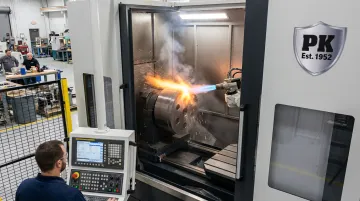
- In-house machining: CNC milling and turning up to 72" diameter; large-diameter grinding up to 65" diameter × 12' length, fully integrated into pre- and post-coating workflow
- Festoon wheels: urethane-coated shipping crane wheels field-tested to last 2–3 years longer than OEM parts
| Core Coating Technologies | HVOF (PK-920, PK-675, PK-700, PK-750), sub-arc welding (PK-503, PK-200), thermal spray/metalizing (PK-400), plasma spray ceramics (PK-1500 chrome oxide), proprietary PK-730 tungsten carbide |
| Key Industries Served | Wire mills, oil and gas/fracking, shipping terminals, heavy equipment, container ship operations |
| Signature Capabilities | Restore & Grind process, integrated CNC/grinding up to 65" diameter, urethane festoon wheels with 2–3 year extended lifespan vs. OEM |
Oerlikon Metco
Oerlikon Metco traces its history to 1933 and operates as a competence brand of the Swiss-headquartered Oerlikon Group, which acquired Sulzer Metco in 2014. The company provides thermal spray materials, surface technologies, coating equipment, and coating services across aerospace, power generation, and industrial markets globally.
In 2021, Oerlikon Metco consolidated U.S. thermal spray and laser cladding services at a facility in Huntersville, North Carolina, focused on aerospace and power-generation customers. Oerlikon Metco Coatings GmbH in Salzgitter, Germany holds Nadcap Merit Status for coatings (active since October 2014), and U.S. locations carry site-specific certifications including ISO 9001, ISO 14001, EN 9100, and Nadcap where applicable.
For North American buyers, Oerlikon Metco is a strong fit for aerospace and energy sector applications requiring certified thermal spray processes. Its global footprint and materials science depth make it well-suited for high-specification new-part coating. It is not structured as a component rebuild/restoration provider — buyers needing worn-part refurbishment with integrated grinding should look elsewhere.
| Core Coating Technologies | HVOF, atmospheric plasma spray, electric arc wire spray, laser cladding |
| Key Industries Served | Aerospace, power generation, oil and gas, industrial |
| Notable Differentiators | Nadcap Merit Status, ISO 9001/14001/EN 9100, global materials and equipment portfolio, Huntersville NC facility for North American aerospace |
Toefco Engineered Coating Systems
Founded in 1955 and based in Niles, Michigan, Toefco Engineered Coating Systems is an applied industrial coating service provider offering 400+ coating types across small parts, large components, one-piece jobs, and high-volume production runs.
Toefco's specialization is fluoropolymer and specialty polymer coatings, a fundamentally different category from wear-resistant hardsurfacing. Verified offerings include PTFE/Teflon, FEP, Excalibur, Xylan, and Halar/ECTFE, as well as high-temperature coatings. The company is a Whitford-approved ExcalNet applicator and operates an ISO-certified quality system with overhead conveyor lines, chain-on-edge lines, bulk coating via rolling barrel, and 20+ ovens.
Toefco is best suited for chemical release, non-stick, and corrosion-resistant coating applications: food processing equipment with FDA-compliant coatings, chemical processing components, and parts requiring low-friction surfaces. For wire drawing blocks, fracking plungers, or crane components requiring wear-resistant hardsurfacing and rebuild capability, Toefco's service model does not apply.
| Core Coating Technologies | PTFE/Teflon, FEP, Excalibur, Xylan, Halar/ECTFE, high-temperature polymer coatings |
| Key Industries Served | Food processing (FDA-compliant coatings verified), chemical processing, industrial manufacturing |
| Notable Differentiators | 400+ coating types, Whitford-approved ExcalNet applicator, ISO-certified QMS, 20+ ovens, bulk coating capability |
PPG Industries (Industrial Coatings Division)
PPG Industries is one of the largest global coatings manufacturers, reporting $15.9B in 2025 net sales across more than 50 countries, with R&D investment of $446M (approximately 2.8% of net sales). Its protective and marine coatings division covers specialized products for demanding environments: infrastructure, oil and gas, marine, mining, rail, and water/wastewater.
Important distinction for industrial buyers: PPG is a coating product supplier, not an applied coating service provider. Products like the PPG AMERCOAT 68HS zinc-rich epoxy primer are specified by engineers and applied by contractors. PPG does not rebuild worn components or perform in-house machining — its value lies in protective coating system formulation, global technical support, and product availability across large infrastructure and new-construction projects.
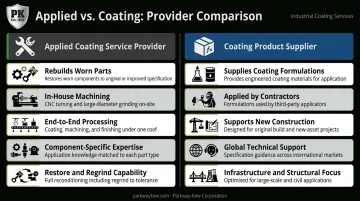
PPG is the right call for corrosion protection on structural steel, marine environments, and large-scale asset protection. Component-level wear restoration, hardsurfacing, and precision rebuild work fall outside its scope.
| Core Coating Technologies | Zinc-rich epoxy primers (AMERCOAT 68HS), epoxy systems, polyurethane topcoats, marine coatings |
| Key Industries Served | Infrastructure, oil and gas, marine, automotive OEM, mining, rail, water/wastewater |
| Notable Differentiators | $446M annual R&D, global presence in 50+ countries, ISO 12944 coating system documentation, comprehensive protective/marine product lines |
Progressive Surface
Progressive Surface has provided process-specific systems since 1967 and is headquartered in Grand Rapids, Michigan. The company's official positioning is as a global leader in the design and manufacture of automated machinery and closed-loop process controls for thermal spray coating, shot peening, abrasive grit blasting, and ultra-high-pressure waterjet stripping. The company is ISO 9001:2015 certified.
Progressive Surface's thermal spraying systems support plasma spray, HVOF, arc spray, and high-enthalpy spray, and the company demonstrates robotic HVOF coating capabilities (including landing gear components). Its Procise Process and PRIMS Pro systems represent proprietary process control technology.
Framing note for buyers: Progressive Surface is fundamentally an equipment and automation systems provider. Companies looking to build or upgrade in-house thermal spray capacity would evaluate it as a systems integrator — not as an outsourced coating service for worn industrial components. It is not a direct comparison to Parkway-Kew or Toefco.
| Core Coating Technologies | Plasma spray systems, HVOF systems, arc spray systems, high-enthalpy spray |
| Key Industries Served | Aerospace, automotive, industrial, energy (via equipment customers) |
| Notable Differentiators | ISO 9001:2015, automated closed-loop process controls (Procise/PRIMS Pro), robotic HVOF integration, 55+ years of systems experience |
How We Chose These Metal Coating & Finishing Companies
This list prioritized companies with demonstrated expertise in applied coating services and a verifiable track record in high-demand industrial environments. A common mistake in vendor selection is choosing based on brand recognition or price without verifying whether the provider has hands-on experience with the specific coating technology your application requires.
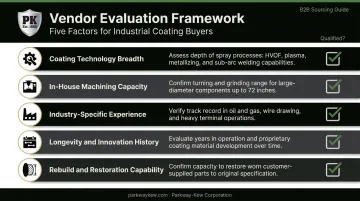
Evaluation factors used:
- Breadth and specialization of coating technologies offered
- In-house machining and surface prep capabilities (not just coating application)
- Industry-specific experience — verified, not just claimed
- Longevity and innovation history — companies that pioneered processes carry institutional knowledge that generalists cannot replicate
- Rebuild and restoration capability alongside first-coat application
For heavy industrial buyers — particularly in wire manufacturing, oil and gas, and shipping — the ability to rebuild and regrind worn components is as important as the coating chemistry itself. A provider with integrated CNC and large-diameter grinding (some facilities offer up to 65" capacity) can accept a worn block, restore the drawline zone, finish it to dimensional spec, and return a component ready for service. A finisher without that machining infrastructure cannot offer the same.
Physical capability alone isn't the whole picture. AMPP's QP accreditation programs — QP 1 for field coating, QP 3 for shop coating, and QP 6 for thermal spray/metallizing contractors — offer a complementary pre-qualification framework that asset owners can use to reduce risk when selecting vendors for complex applications.
Conclusion
The right metal coating partner must match the specific wear mechanism, operating environment, and maintenance cycle of your components — not simply quote the lowest price per part.
Before committing, evaluate potential partners on:
- Technology depth for your specific application (not general coating capability)
- Rebuild and restoration capacity alongside new-part coating
- In-house machining that enables end-to-end processing
- Verifiable experience with comparable components in similar operating environments
Once you've built your shortlist, ask each vendor for application-specific case studies or references from your industry. A provider who has coated hundreds of wire drawing blocks or fracking plungers will approach your component differently than one treating it as a generic cylindrical part.
For industrial buyers in wire manufacturing, oil and gas, or shipping terminal operations looking for a coating partner with 74 years of hardsurfacing expertise — including HVOF coating development for wire drawing blocks dating to 1989 and proprietary processes like the Restore & Grind technique and PK-730 tungsten carbide coating for fracking plungers, contact Parkway-Kew Corporation at (732) 398-2100 or info@parkwaykew.com to discuss your specific component needs.
Frequently Asked Questions
What are the different types of metal coatings?
The main categories are thermal spray coatings (HVOF, plasma spray, metalizing/arc spray), hardsurfacing/weld overlays, electroplating, powder coating, liquid/paint coatings, and ceramic coatings. Each differs in bond strength, hardness, and temperature tolerance — the right choice depends on the application's wear, corrosion, and surface finish requirements.
What is the best metal coating?
There is no single best coating. HVOF is widely regarded as one of the densest and most durable options for industrial wear and corrosion resistance, while hardsurfacing weld overlays are the preferred choice for rebuilding heavily worn components. Powder coating suits general structural protection where extreme wear resistance is not required.
What is the difference between HVOF coating and thermal spray?
HVOF (High Velocity Oxy-Fuel) is a subset of thermal spray. It uses high-velocity combustion gases to propel coating particles at speeds up to approximately 700 m/s, producing a denser, harder, and more adherent coating — with porosity generally under 0.5% — than conventional flame or arc spray methods.
What is hardsurfacing and what industries use it?
Hardsurfacing (also called hard facing or weld overlay) deposits wear-resistant alloys onto a base metal via welding to rebuild worn components or prevent wear on new ones. Primary industries include wire drawing, mining, earth-moving equipment, and oil and gas — wherever abrasion and impact resistance are critical.
How do I choose a metal coating company for heavy industrial applications?
Evaluate the vendor's technology capabilities for your specific application, their in-house machining and surface preparation capacity, and direct experience with comparable components. Confirm they can restore and rebuild worn parts, not just coat new ones — that distinction matters for total cost of ownership.
How long do industrial metal coatings typically last?
AMPP notes that properly specified protective coating systems may be designed for a 25-year service life when the system matches the environment and application quality is high. Thermal spray aluminum in offshore applications has documented service life exceeding 30 years with zero maintenance in some cases.