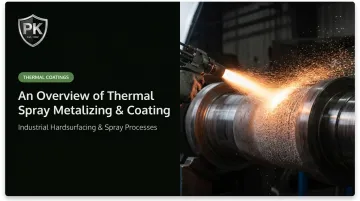
Thermal spray metalizing — also called thermal spray coating — addresses this directly. By heating a feedstock material (metal wire or powder) to a molten or semi-molten state and propelling it onto a prepared substrate, operators can build up a durable, wear- and corrosion-resistant surface on components that would otherwise require frequent replacement.
This article covers how the process works, the main process types, common coating materials, key applications, and how to evaluate thermal spray metalizing against alternative surface treatment methods.
Key Takeaways
- Thermal spray metalizing deposits heated metallic or composite materials onto a substrate to build wear- and corrosion-resistant coatings with minimal heat distortion.
- Process types include flame spray, arc wire, HVOF, and plasma spray, each suited to different performance requirements.
- Common materials include zinc, aluminum, tungsten carbide, chrome carbide, and ceramics.
- Applications span oil and gas, wire manufacturing, infrastructure, marine, and heavy industrial sectors.
What Is Thermal Spray Metalizing?
Thermal spray metalizing is a family of industrial coating processes in which a feedstock (metal, alloy, or ceramic in wire or powder form) is heated by electrical or combustion energy and sprayed as molten or semi-molten particles onto a prepared substrate. The particles solidify on contact, building up into a layered, bonded coating.
The terms "metalizing" and "thermal spray coating" are used interchangeably across the industry.
How It Differs from Other Coating Methods
Thermal spray sits in a distinct category compared to other common surface treatments:
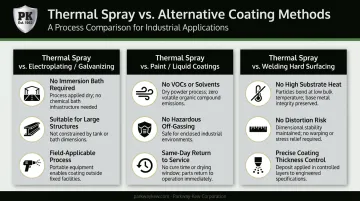
- vs. Electroplating or hot-dip galvanizing: Thermal spray is a spray-applied process with no immersion requirement, making it suitable for large, complex, or assembled structures that can't fit in a bath.
- vs. Painting or liquid coatings: Thermal spray uses no solvents and produces no volatile organic compounds (VOCs), and there is no cure time — coated assets return to service the same day.
- vs. Welding-based hard surfacing: Thermal spray does not require the substrate to reach high temperatures, so there is minimal risk of thermal distortion to the base component.
Regardless of which process is selected, coating quality is assessed across four properties: porosity, bond strength, hardness, and surface roughness. These vary with particle velocity during application. Faster particles generally produce denser, harder, better-bonded coatings.
How the Thermal Spray Metalizing Process Works
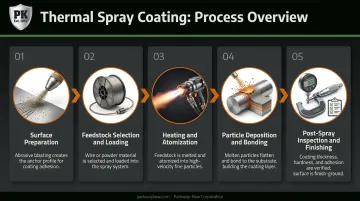
Step 1: Surface Preparation
Surface cleanliness is non-negotiable. The substrate must be free of oil, grease, and oxidation before any coating is applied. Per the SSPC-CS 23.00/AWS C2.23M/NACE No. 12 thermal spray coating specification:
- Marine or immersion service: SSPC-SP 5 White Metal Blast Cleaning required
- Other service applications: SSPC-SP 10 Near-White Metal Blast Cleaning minimum
- Blast profile: A minimum 2.5 mil (65 micrometer) sharp angular profile is required to create the mechanical anchor for the coating
Without this profile, even a chemically clean surface won't provide adequate adhesion.
Step 2: Feedstock Selection and Loading
The coating material — wire or powder — is selected based on the application's wear, corrosion, or thermal requirements. This choice is the single biggest variable in coating performance; the wrong material for the operating environment will fail regardless of how well the rest of the process is executed. Once selected, the feedstock is loaded into the spray system.
Step 3: Heating and Atomization
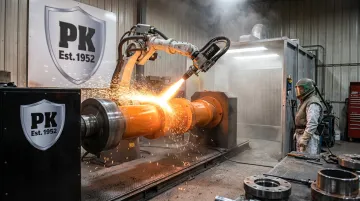
The feedstock enters a heat source (combustion flame, electric arc, or plasma), where it melts or reaches a semi-molten state. Compressed air or gas then atomizes the molten material into fine particles and propels them toward the substrate.
Step 4: Particle Deposition and Bonding
On impact, molten particles flatten into thin "splat" layers (lamellae), rapidly cool, and build up a layered coating. The bond is primarily mechanical — not metallurgical — created by kinetic energy acting on the blasted surface profile.
Step 5: Post-Spray Inspection and Finishing
- Coating thickness is measured with calibrated instruments
- Adhesion may be tested via pull-off testing (ASTM D4541) on sample coupons
- A sealer or topcoat may be applied in some applications
- In many cases, machining or grinding follows to bring the part to final dimensions
Types of Thermal Spray Metalizing Processes
The four primary thermal spray processes differ in heat source, particle velocity, coating density, and best-fit applications.
Flame Spray
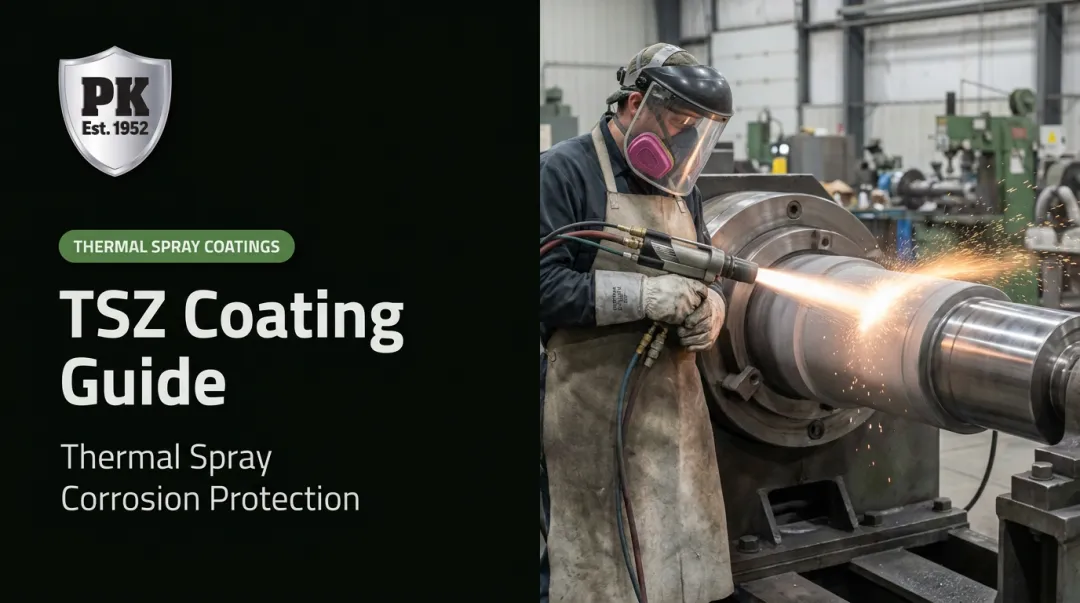
Flame spray (wire or powder) uses a combustion flame — typically acetylene-oxygen or propane-oxygen — to melt the feedstock, with compressed air accelerating particles toward the substrate.
One of the oldest and most accessible thermal spray methods, it trades performance for simplicity: flame-sprayed coatings generally have lower bond strength and higher porosity than other processes. Best suited for less demanding corrosion protection and field repairs where portability matters.
Arc Wire Spray
Twin arc spray feeds two conductive metal wires into a gun. An electric arc between the wire tips melts the material; compressed air atomizes and propels the molten metal onto the substrate. Arc wire coatings achieve higher bond strength than flame spray — with some materials exceeding 69 MPa (10,000 psi).
This process is efficient for applying metallic coatings (zinc, aluminum, stainless steel) over large surface areas and is widely used for infrastructure corrosion protection on bridges and marine structures.
High Velocity Oxy-Fuel (HVOF) Spray
HVOF uses high-pressure combustion of fuel and oxygen to produce a supersonic gas jet. Particle velocities can exceed 800 m/s, with certain systems reaching 1,200 m/s according to TWI. That velocity produces a very dense coating with low porosity and high bond strength, making HVOF the preferred process for demanding wear- and corrosion-resistant applications.
HVOF is the preferred choice for tungsten carbide and chrome carbide coatings on high-wear components. Parkway-Kew introduced HVOF coating for wire drawing blocks in 1989, the first application of this technology in that sector, because HVOF's superior coating density matched the demands of continuous high-friction wire drawing.
Their HVOF lineup includes four proprietary alloys:
- PK-920, PK-675, PK-700: Tailored for varying wear and corrosion requirements
- PK-750: Highest tungsten carbide content for maximum wear resistance
Plasma Spray
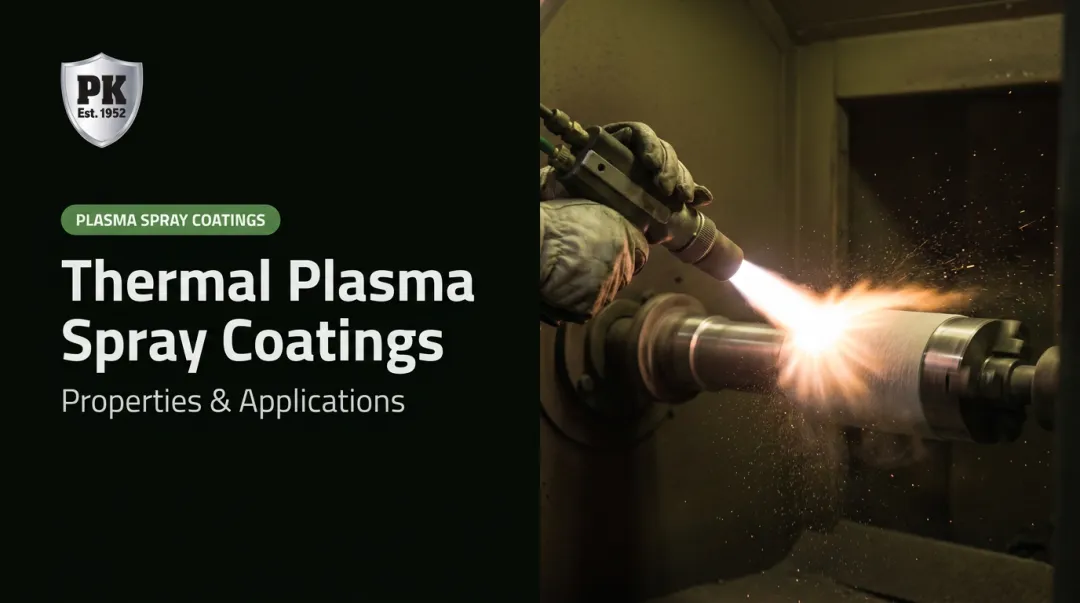
Plasma spray uses a torch generating temperatures up to approximately 15,000 K, enabling deposition of materials with very high melting points, including ceramics that no other thermal spray process can handle.
Applications include:
- Thermal barrier coatings on turbine and engine components
- Electrical insulation coatings
- Ceramic-surfaced wear parts requiring hard, low-friction surfaces
Parkway-Kew introduced plasma-sprayed ceramic-coated wire drawing blocks in the late 1990s using PK-1500 chrome oxide — the most wear-resistant ceramic in their lineup — which proved especially cost-effective for high-speed, high-slip ferrous wire drawing applications.
Common Materials Used in Thermal Spray Metalizing
Material selection should always be driven by the operating environment: load, temperature, chemical exposure, and the specific failure mode being addressed.
| Material Category | Common Materials | Primary Use |
|---|---|---|
| Pure metals & alloys | Zinc, aluminum, copper, nickel | Sacrificial corrosion protection; electrical conductivity |
| Wear-resistant composites | Tungsten carbide, chrome carbide (with Ni or Co binders) | Severe abrasion, sliding wear, high-friction components |
| Ceramics | Alumina (Al₂O₃), chromium oxide (Cr₂O₃), zirconia-based | Thermal barriers, electrical insulation, hard low-friction surfaces |
| Nickel-based alloys | Nickel chrome boron | General industrial wear; matrix base for carbide coatings |
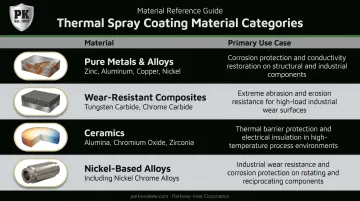
The categories above each serve distinct failure modes. Here's how the key materials perform in practice.
Zinc and aluminum are the workhorses for corrosion protection on structural steel.
ISO 2063-1:2019 specifically covers thermal-sprayed zinc, aluminum, and alloy coatings for iron and steel corrosion protection.
Tungsten carbide coatings, applied via HVOF, routinely reach hardness levels of HRC 68–72, well beyond what conventional metals can deliver. Peer-reviewed research published in Surface and Coatings Technology confirms that HP/HVOF tungsten carbide coatings show superior abrasive wear performance compared to conventional hard chromium electroplating.
Ceramics via plasma spray provide thermal barrier and insulation properties : yttria-stabilized zirconia is the standard for turbine TBCs, while chromium oxide serves applications requiring hardness, chemical resistance, and anti-galling behavior.
Key Benefits of Thermal Spray Metalizing
Extended Service Life
The most direct benefit is reduced replacement frequency. FHWA data on metallized bridge coatings shows that properly applied metallized zinc, 85% zinc/15% aluminum, or aluminum coatings at a minimum 6 mils thickness provide at least 20 years of corrosion protection on steel bridges. AASHTO/NSBA S8.2-2017 sets the minimum at 8 mils for steel bridge applications.
For wear applications, the same principle holds: denser, harder coatings extend intervals between repairs or replacements — directly reducing maintenance costs over the asset's life.
No Distortion, No VOCs, No Cure Time
Thermal spray avoids three operational headaches common to other coating and joining processes:
- Substrate temperatures stay low, eliminating the distortion risk associated with hot-dip galvanizing or welding
- No solvents are used, so there are no VOC emissions or associated handling requirements
- Components return to service immediately — no waiting on cure time
Versatility
Thermal spray works on metals, concrete, and some composites. It applies to large or complex structures that can't be immersed. Coating thickness is precisely controlled, and the range of available materials means you can engineer the exact combination of properties a specific component needs.
Cost-Effectiveness Over the Asset Lifecycle
Upfront costs are higher than paint-based systems. The difference narrows quickly when you account for reduced replacement frequency and less unplanned downtime. For high-wear components — fracking plungers, wire drawing blocks, crane wheels — a single coating job that doubles service life typically costs less than two replacement cycles plus the associated labor and lost production time.
Industrial Applications of Thermal Spray Metalizing
Infrastructure and Marine
Bridges, locks and dams, offshore platforms, piers, and marine vessels rely on thermal spray zinc and aluminum coatings to protect steel in harsh atmospheric and immersion environments. The Federal Highway Administration (FHWA) specifically recommends thermal spray coatings over zinc-bearing paint systems for severe environments, citing superior long-term corrosion protection.
Common infrastructure applications include:
- Bridges and highway overpasses exposed to road salt and moisture
- Locks, dams, and marine piers in continuous water contact
- Offshore platforms and marine vessels subject to saltwater immersion
The spray-applied process works directly on assembled components in the field, making it practical for large structures that cannot be disassembled for treatment.
Heavy Industrial and Wire Manufacturing
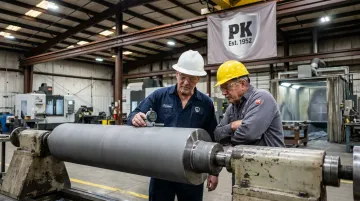
Machine components — rollers, shafts, pump parts, hydraulic cylinders, and wire drawing equipment — are coated with wear-resistant thermal spray materials to withstand continuous abrasion and friction.
Parkway-Kew Corporation has applied HVOF, plasma spray, and metalizing technologies to these components since 1952. Their work spans wire drawing blocks, fracking plungers (coated with their proprietary PK-730 fused tungsten carbide formulation), and other high-wear parts for more than 500 companies across North America and internationally.
Oil and Gas, Aerospace, and Power Generation
- Oil and gas: HVOF tungsten carbide coatings on downhole tools, pump components, and valve seats extend service intervals in extreme-pressure, abrasive environments. WC-Co coatings are well-established for drill bits, downhole tool assemblies, and gate-valve sealing faces.
- Aerospace and power generation: Plasma spray thermal barrier coatings (TBCs) on turbine airfoils reduce heat transfer into air-cooled components — a critical function in high-performance gas turbines. Next-generation porous TBC formulations continue to advance fuel efficiency and thermal tolerance in both commercial and military turbine programs.
- Dimensional restoration: Worn parts can be rebuilt to original specifications by applying new coating material and precision-machining to exact dimensions — avoiding full component replacement.
Frequently Asked Questions
What is the process of thermal spray metalizing?
A feedstock material (wire or powder) is heated to a molten or semi-molten state by a flame, electric arc, or plasma, then propelled by compressed gas onto a prepared substrate. It solidifies on contact, building up a layered, mechanically bonded coating.
What materials are used in thermal spray metalizing?
Common feedstock materials span several functional categories:
- Corrosion protection: zinc, aluminum
- Wear resistance: tungsten carbide, chrome carbide
- General industrial use: stainless steel, nickel alloys
- Thermal barrier / dielectric: alumina, chromium oxide, zirconia
How does HVOF differ from flame spray and arc spray?
HVOF uses a supersonic combustion jet to propel powder particles at much higher velocities than flame or arc spray, producing denser, harder coatings with lower porosity and higher bond strength. This makes it the preferred process for high-performance wear applications, particularly tungsten carbide coatings.
What industries use thermal spray metalizing?
Infrastructure (bridges, marine structures), oil and gas, wire manufacturing, aerospace, power generation, and heavy industrial manufacturing all rely on thermal spray metalizing for corrosion protection, wear resistance, and component repair.
How does thermal spray metalizing compare to hot-dip galvanizing or chrome plating?
Unlike hot-dip galvanizing, thermal spray applies to large assembled structures without immersion or substrate-distorting heat. Compared to hard chrome plating, it is more environmentally sound: OSHA and EPA classify hexavalent chromium as a significant health hazard. Thermal spray also accommodates a broader range of thicknesses and material types.
Does thermal spray metalizing require surface preparation?
Yes. The substrate must be cleaned of all oil, grease, and oxidation, then abrasive-blasted to a sharp angular profile — minimum 2.5 mils (65 micrometers). That textured surface provides the mechanical anchor the coating requires to bond.