Introduction
Wire drawing blocks wear out. Fracking plungers erode. Crane wheels grind down under load, cycle after cycle. That's the reality of running heavy industrial equipment — constant abrasion, corrosion, and friction quietly chip away at component life until a replacement becomes unavoidable.
Unplanned downtime is expensive. ABB's industrial survey found unplanned downtime costs manufacturers an average of $125,000 per hour across sectors that rely on continuous-running machinery.
Thermal plasma spray (TPS) coating is one answer to that problem. It's an engineered surface treatment that extends component life across wire drawing, oil and gas, and shipping operations, without the heat distortion that comes with traditional welding.
This article breaks down how TPS actually works, what properties make it valuable, and where it gets used in the field. It also covers how TPS stacks up against other hardfacing methods like HVOF and submerged arc welding.
Key Takeaways
- An electric arc ionizes gas into plasma over 12,000°C, melting powder before impact
- Coating thickness ranges from 0.05mm to 5mm, depending on material
- Chrome oxide ceramic coatings excel in high-speed wire drawing wear resistance
- The substrate stays cool, preserving the part's original mechanical properties
- TPS, HVOF, or sub-arc welding selection depends on geometry, budget, and conditions
What Is Thermal Plasma Spray Coating and How Does It Work?
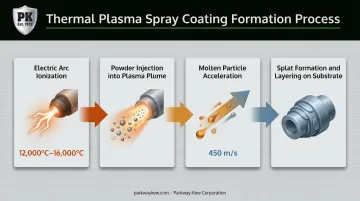
TPS starts with electricity, not fire. A high-frequency electric arc strikes between a tungsten cathode and a water-cooled copper anode inside a plasma gun. That arc ionizes a process gas (typically argon, helium, hydrogen, or nitrogen), turning it into a superheated plasma jet.
The numbers here are extreme. Oerlikon reports atmospheric plasma spray gas temperatures reaching 12,000-16,000°C (21,500-29,000°F), with plume temperatures spiking as high as 16,000 Kelvin in some configurations. That's hotter than the surface of the sun.
Coating powder gets injected directly into this plasma plume. The particles melt almost instantly, then get propelled toward the substrate at velocities up to 450 meters per second. On impact, each molten particle flattens into a thin "splat," and thousands of these splats stack layer by layer to form a dense coating.
Why the Substrate Stays Relatively Cool
Unlike welding, which fuses filler material into the base metal, TPS bonds mechanically. The substrate itself stays in a controlled range, generally 38-260°C (100-500°F), managed through gun distance, torch movement, and air-jet cooling.
That's a meaningful distinction from the common assumption that plasma spray always keeps parts under 150°C. The real number depends on the setup and material being coated.
This lower thermal load matters because it:
- Minimizes warping or distortion on precision-machined parts
- Preserves the substrate's original hardness and grain structure
- Allows coating of heat-sensitive or dissimilar metals that couldn't survive a weld pass
Materials and Equipment
TPS handles a wide material range: ceramics like aluminum oxide and chrome oxide, carbides such as tungsten carbide-cobalt, and both ferrous and non-ferrous metal alloys. A typical industrial setup includes a plasma gun, a dedicated power supply (often 40-100 kW), a powder feeder, and a control console to manage gas flow and arc parameters.
Key Properties of Thermal Plasma Spray Coatings
Not every TPS coating behaves the same way. Thickness, porosity, hardness, and bond strength all shift depending on what material is being sprayed and what the part needs to survive.
Thickness and Porosity Are Engineered, Not Standard
There's no single "correct" thickness for plasma spray. Instead, thickness gets matched to the wear demands of the application:
| Material Category | Typical Thickness Range |
|---|---|
| Ceramics | 0.1-2.0mm |
| Carbides | 0.15-0.8mm |
| Ferrous alloys | 0.4-2.5mm |
| Non-ferrous alloys | 0.05-5.0mm |
A component facing constant sliding friction, like a wire drawing block, generally needs a thicker ceramic layer than a part facing light abrasion.
Porosity follows a similar logic. Plasma spray coatings aren't perfectly solid; they contain microscopic pores that vary by material:
- Ceramic coatings: 1-2% porosity
- Carbide coatings: 2-3% porosity
- Alloy coatings: 2-5% porosity
Lower porosity generally means better wear resistance and corrosion protection. But controlled porosity can help in specific cases, like coatings designed to hold lubricant or improve initial bonding during application.
Hardness, Corrosion Resistance, and Bond Strength
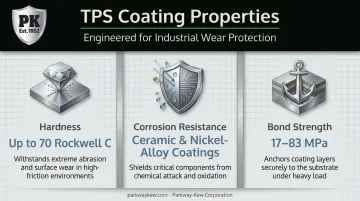
Hardness varies by feedstock but can reach up to 70 Rockwell C, making ceramic and carbide coatings well-suited to abrasive environments involving sand, grit, or continuous metal-on-metal contact.
Corrosion resistance comes largely from ceramic and nickel-alloy coatings, which resist moisture, chemical exposure, and outdoor weathering far better than bare steel.
Bond strength depends heavily on surface preparation. Grit blasting the substrate before spraying creates an anchor profile that molten particles can mechanically grip, and skipping this step lets even a well-applied coating delaminate under load.
Reported bond strength for atmospheric plasma spray ranges from roughly 17 MPa to over 83 MPa, though actual performance always depends on the specific test method and coating system used.
Surface Finish for Precision Applications
Post-coating grinding brings plasma-sprayed surfaces to a fine finish, which matters enormously for wire-contact surfaces. A rougher finish can scratch or mar wire as it passes through a drawing block at high speed — precision grinding after coating is what makes the surface production-ready.
Industrial Applications of Thermal Plasma Spray Coatings
TPS shows up wherever parts face relentless friction, abrasion, or corrosion. Some applications are well-documented across the industry; others are more specific to certain processes and equipment.
Wire Drawing Blocks and Capstans
This is where Parkway-Kew has direct, decades-long experience. The company introduced plasma-sprayed ceramic coated blocks in the late 1990s, using PK-1500 Chrome Oxide, its most wear-resistant ceramic option for wire drawing applications.
This coating proved especially cost-effective for high-speed, high-slip ferrous wire drawing, particularly with small, high-quality, or plated wire. Compared to solid ceramic inserts, plasma-sprayed ceramic coatings avoid the breakage and slippage risks that come with rigid ceramic components bonded to a metal core.
Oil and Gas Equipment
Erosion from abrasive, high-pressure conditions is a constant threat in oilfield equipment. A 2022 SPE technical paper documented plasma-sprayed ceramic and hard-metal coatings applied to wire-wrapped sand-control screens, reporting improved erosion resistance while preserving slot geometry and installation strength.
Heavy Equipment and Shipping Terminal Wear Parts
Rollers, wheels, and load-bearing surfaces on container-handling equipment face nonstop friction cycles. Heavy industry broadly relies on thermal spray technology to protect these rotating components, though the right process (plasma spray, HVOF, or another method) depends on the specific part and its operating conditions.
Parkway-Kew serves this exact space too, rebuilding festoon wheels, crane wheels, and wire rope pulleys for shipping terminal operations using whichever hardsurfacing process best fits each component's demands.
Thermal Plasma Spray vs. Other Hardfacing Methods
Plasma spray isn't the only hardfacing option, and it isn't always the right one. Here's how it compares to two common alternatives.
HVOF Coating Compared to Plasma Spray
HVOF (High Velocity Oxy-Fuel) and plasma spray solve similar problems through different mechanisms.
| Factor | Plasma Spray (APS) | HVOF |
|---|---|---|
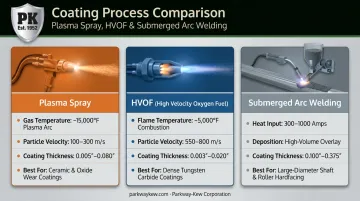
| Gas temperature | 12,000-16,000°C | 2,600-3,000°C |
| Particle velocity | Up to 450 m/s | Up to 700 m/s |
| Typical porosity (alloys) | 2-5% | Under 2% |
| Best suited for | High-melting-point ceramics | Dense, low-porosity metallic coatings |
HVOF's lower gas temperature and higher particle velocity produce denser coatings, which is why Parkway-Kew uses HVOF tungsten carbide alloys for fracking plunger applications facing extreme abrasive pressure. Plasma spray, by contrast, is the better fit when a ceramic feedstock needs the extreme heat to melt properly.
Submerged Arc Welding vs. Plasma Spray
Submerged arc welding (SAW) is a distinct process — it fuses filler metal into the base part rather than mechanically bonding a sprayed layer on top.
- Heat input: SAW involves substantial heat, causing dilution between filler and base metal; TPS keeps substrate temperatures controlled and low
- Thickness: Weld hardfacing typically runs 1.5-20mm, considerably thicker than most TPS applications
- Substrate compatibility: TPS can coat heat-sensitive or dissimilar substrates that would distort under a weld arc
Choosing between the two comes down to part geometry, the substrate material, and how the component will be used in service. A thin precision surface calls for spray. A heavily worn part needing structural rebuilding often calls for welding.
Why Choose Parkway-Kew for Precision Plasma Spray Coating Solutions
Parkway-Kew has been solving wear problems since 1952, when founder Eugene Walter Klein welded the first hardfacing test piece in his own garage. That single repair job turned into a company that's now been rebuilding and coating industrial parts for over 70 years.
The technology has evolved with every decade:
- 1950s: Pioneered submerged arc welding for wire drawing block hardsurfacing
- 1989: Introduced the first HVOF coating for wire drawing blocks
- Late 1990s: Launched plasma-sprayed ceramic coated blocks using PK-1500 Chrome Oxide
That range matters because no single coating process is right for every job. Parkway-Kew offers HVOF, submerged arc welding, metallizing, and thermal/plasma spray under one roof, letting customers match the process to the part rather than forcing a one-size-fits-all solution.
Coating is only half the job, though. Parkway-Kew also runs in-house CNC milling, turning, and large-diameter grinding, handling parts up to 65 inches in diameter and 12 feet in length. This precision finishing step turns a coated block into a production-ready component.
Frequently Asked Questions
What does TPS (thermal plasma spray) coating do?
TPS coating adds a protective, engineered surface layer that improves wear resistance, corrosion resistance, and overall component longevity. It's used to extend the service life of parts facing constant friction or abrasion.
What is the thermal plasma spray (TPS) coating method?
An electric arc ionizes gas into plasma exceeding 12,000°C, melting injected powder mid-flight. Molten particles are propelled onto a prepared substrate, flattening into layers that build a dense coating.
How thick is TPS (plasma spray) coating?
Thickness depends on the material sprayed: roughly 0.1-2.0mm for ceramics, 0.15-0.8mm for carbides, and up to 5mm for certain alloys. Engineers customize thickness to match specific wear demands.
What materials can be applied using thermal plasma spray?
Common materials include ceramics like chrome oxide and aluminum oxide, carbides such as tungsten carbide-cobalt, and both ferrous and non-ferrous metal alloys. This versatility allows coating of dissimilar or heat-sensitive substrates.
How does plasma spray coating differ from HVOF coating?
Plasma spray uses far higher gas temperatures (12,000-16,000°C vs. HVOF's 2,600-3,000°C), while HVOF achieves higher particle velocity and generally denser, lower-porosity coatings. Plasma spray suits high-melting-point ceramics; HVOF suits dense metallic coatings.
How long do plasma spray coatings typically last on industrial equipment?
Lifespan depends on coating type, thickness, and operating conditions, so there's no universal number. Properly applied and maintained coatings, like Parkway-Kew's PK-1500 ceramic on wire drawing blocks, outlast uncoated components in the same service.