Introduction
Mining equipment doesn't fail gently. Crusher jaws grind against ore around the clock, pump impellers push abrasive slurries at high velocity, and bare steel surfaces weren't designed to outlast either condition without help. Hydraulic cylinder rods face a different threat: environments saturated with rock dust and corrosive process fluids that accelerate degradation from the outside in.
The financial consequences are real. A peer-reviewed study of truck-and-shovel surface mining fleets found that maintenance costs can reach 30% to 50% of total haulage cost, with large operations spending roughly $100M per year just keeping equipment running.
Thermal spray coatings rank among the most effective tools available for pushing those numbers down. This article covers the wear mechanisms they address, the protection they deliver, and the lifecycle math that makes them worth serious consideration for any operation looking to cut unplanned stoppages and maintenance spend.
Key Takeaways
- Thermal spray coatings bond hard, wear-resistant materials onto metal surfaces, extending component life in abrasive and corrosive mining environments.
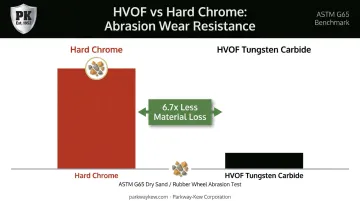
- HVOF tungsten carbide coatings show roughly 6.7x lower abrasion volume loss than hard chrome in industrial testing.
- Corrosion control practices can recover 15% to 35% of corrosion damage costs globally across industries.
- Refurbishing worn components with thermal spray is typically faster and cheaper than buying new parts.
- Choosing the right process (HVOF, plasma spray, arc spray, or hardfacing) depends on the specific wear mechanism, not just the component type.
What Are Thermal Spray Coatings?
Thermal spray is a family of processes in which a material — metal, ceramic, or cermet — is heated and propelled at high velocity onto a substrate surface. The particles impact and bond to the base material, building up a protective layer that changes how a surface behaves mechanically and chemically in service.
In mining, thermal spray isn't applied to outer housings or cosmetic surfaces. It targets the specific contact points where wear actually occurs:
- Hydraulic cylinder rods sliding through contaminated seals
- Pump impellers and casings handling abrasive slurry
- Crusher wear plates in direct contact with ore
- Conveyor screws and augers moving abrasive bulk material
- Gear housings and rotating shafts under high load
By changing the surface material without replacing the underlying component, thermal spray extends service life before failure or maintenance is required — typically at a fraction of replacement cost.
Key Advantages of Thermal Spray Coatings for Mining Equipment
The advantages below connect directly to metrics that mine operators track: maintenance frequency, equipment availability, replacement costs, and production continuity.
Advantage 1: Superior Wear Resistance Against Abrasion and Erosion
Abrasive wear is the dominant surface failure mechanism in mining. Constant contact with ore particles, rock fragments, sand, and slurry physically removes material from component surfaces — lowering dimensional tolerances, degrading performance, and eventually causing failure.
HVOF-sprayed tungsten carbide (WC) cermet coatings are the standard response. Hard WC particles resist abrasion and erosion directly, while the metallic binder — typically cobalt or nickel alloy — provides the toughness to absorb impact without cracking. The combination produces a coating that handles both sliding wear and impact loading.
A 2018 comparative study found that HVOF WC-10Co4Cr coatings lost roughly 6.7x less volume than hard chrome plating in ASTM G65 abrasion testing — a standardized dry abrasion benchmark relevant to mining wear surfaces including hydraulic rods, shafts, and sliding components.
Metrics affected: Component replacement frequency, mean time between maintenance (MTBM), scheduled downtime hours, spare parts inventory cost.
Where it matters most: Crusher jaws, conveyor screws, pump casings, drill string components, and hydraulic rods operating in abrasive slurry.
Advantage 2: Corrosion Protection in Wet and Chemically Aggressive Environments
Hydrometallurgy circuits, flotation cells, and underground operations expose metal components to a steady mix of acidic or alkaline slurries, process chemicals, and moisture. Even high-grade steel substrates corrode under sustained chemical exposure.
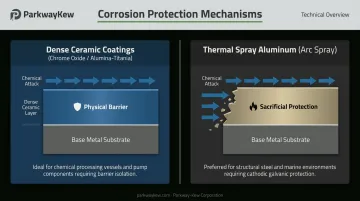
Thermal spray creates two types of corrosion barriers depending on the application:
- Dense ceramic coatings (such as chrome oxide or alumina-titania) form a physical barrier that prevents chemical attack from reaching the substrate
- Thermal spray aluminum (TSA) via arc spray acts sacrificially — the aluminum coating corrodes preferentially in place of the base metal, protecting structural steel, piping, and wet components
The scale of the problem justifies the investment. NACE/AMPP's IMPACT study estimated global corrosion costs at US$2.5 trillion annually — roughly 3.4% of global GDP — and concluded that available corrosion-control practices can recover 15% to 35% of those costs across industries.
The practical advantage of thermal spray for corrosion protection is predictability. Uncoated components corrode internally and invisibly until sudden failure. A coated component can be inspected on schedule, with degradation that follows a known pattern rather than an unpredictable one. That shift from reactive to planned maintenance has direct financial value.
Operational impact: Unplanned failure rate, total corrosion-related repair cost, component inspection intervals, equipment reliability index.
Where it matters most: Structural steel in wet underground environments, pump components handling acidic process fluids, and any part exposed to hydrometallurgical chemicals.
Advantage 3: Extended Equipment Lifespan and Reduced Operational Downtime
Wear resistance and corrosion protection don't work in isolation. Their combined effect is a measurably longer service life for coated components, and that lifecycle extension accumulates over time into lower total cost of ownership.
The more immediate operational benefit is component refurbishment. Rather than discarding a worn part and waiting for a replacement, thermal spray allows a worn surface to be rebuilt to OEM dimensions and recoated — restoring full functionality faster and at lower cost than new part procurement. This matters especially for large or custom components where lead times can stretch for weeks.
ABB's 2023 Value of Reliability survey found unplanned downtime costs $125,000 per hour across capital-intensive industrial operations. In that context, every hour saved through faster component restoration rather than part replacement has measurable financial value. Remanufacturing cost data from Mordor Intelligence's 2025 mining report suggests savings of 30% to 60% versus new parts when refurbishment is used — a range that reflects the variety of component types, not a guarantee for thermal spray alone.
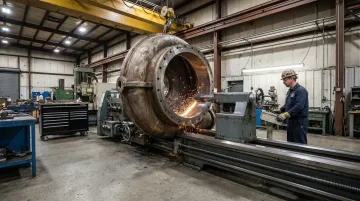
For oversized components, shop capabilities matter as much as coating knowledge. Service providers with large-diameter grinding capacity — some handling parts up to 65 inches in diameter — can restore pump housings, gearbox casings, and other rotating parts that standard shops cannot. Documented results from wire rope pulley refurbishment show rebuilt components exceeding the service life of OEM-hardened replacements, illustrating what restoration can deliver when the process is matched to the component.
Bottom-line metrics: Overall equipment effectiveness (OEE), production availability percentage, total maintenance cost per operating hour, part replacement lead time.
Where it matters most: Large, custom, or long-lead-time components where procurement costs and delays are highest.
What Happens When Mining Equipment Goes Uncoated
Without protective coatings, the failure sequence is predictable.
Abrasive wear removes material from critical surfaces at the full unimpeded rate, while corrosion works inward from below. Components fail before their design life — often without clear warning — and the result is unplanned stoppages at the worst possible times.
The operational fallout compounds quickly:
- Replacement parts for large or custom components often have extended lead times
- Reactive repairs consistently cost more than planned maintenance — U.S. DOE data indicates preventive maintenance programs can save 12% to 18% compared to reactive approaches
- Each unplanned stoppage disrupts production schedules downstream, not just at the failed component
Conditions also tend to worsen over time. As operations work through ore bodies and process harder material, wear rates accelerate — meaning uncoated equipment faces compounding degradation, not a fixed baseline of damage.
How to Choose the Right Thermal Spray Coating for Mining Applications
Not all thermal spray processes deliver the same result. Applying the wrong coating to a component produces premature failure — and leads operators to conclude that coatings don't work at all.
The decision depends on three factors: the dominant wear mechanism, the component geometry, and the operating environment.
| Process | Best Application | Selection Trigger |
|---|---|---|
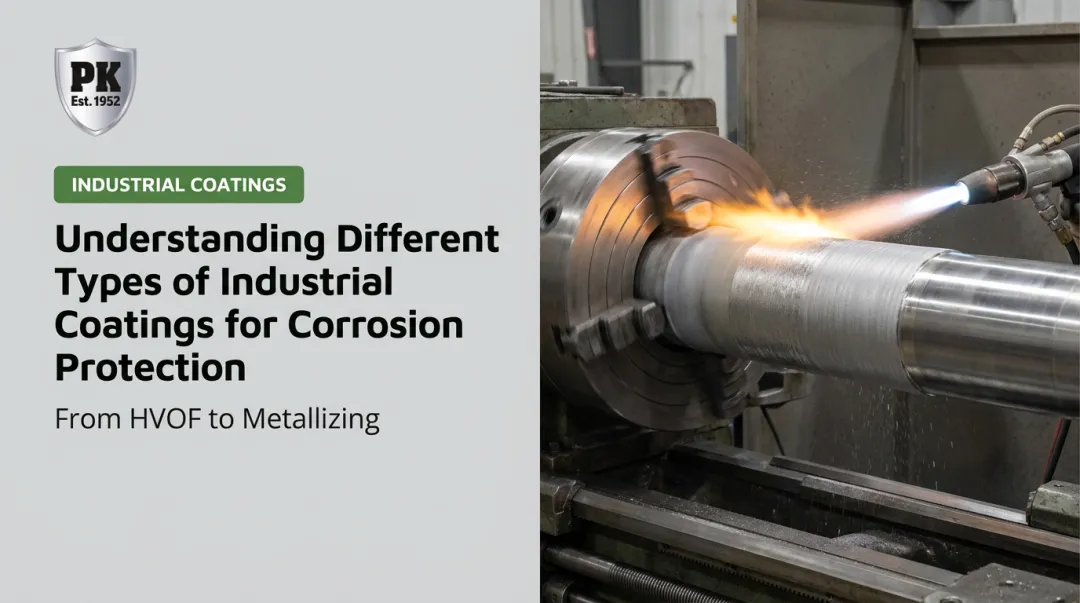
| HVOF | High-wear surfaces needing tungsten carbide hardness | Abrasion or erosion dominates; max coating density required |
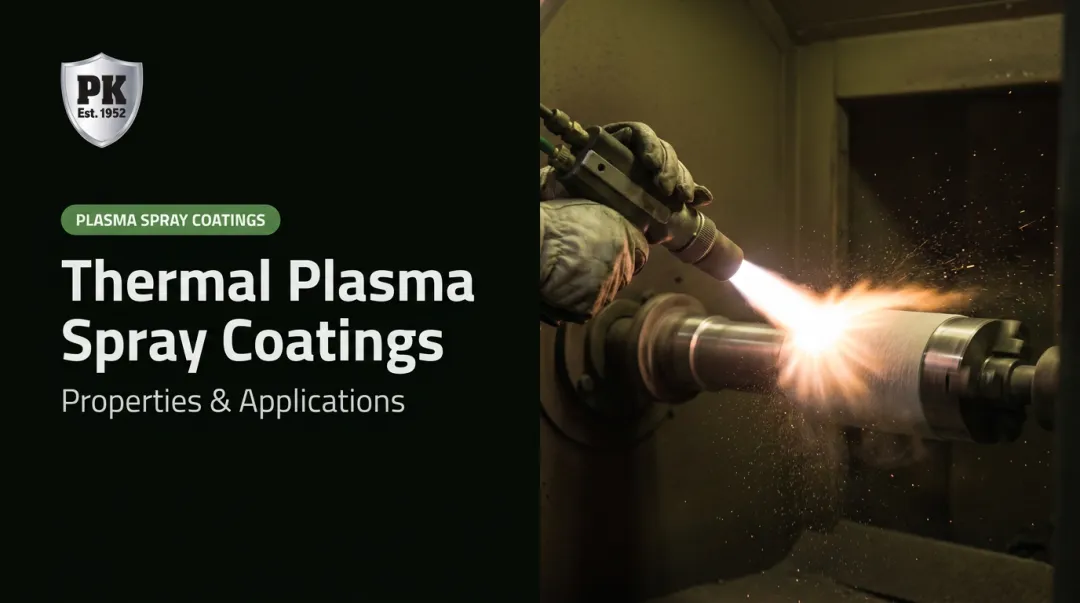
| Plasma Spray | Ceramic coatings for corrosion resistance or thermal barrier | Chemical exposure; high-temperature environments; fine surface finish requirements |
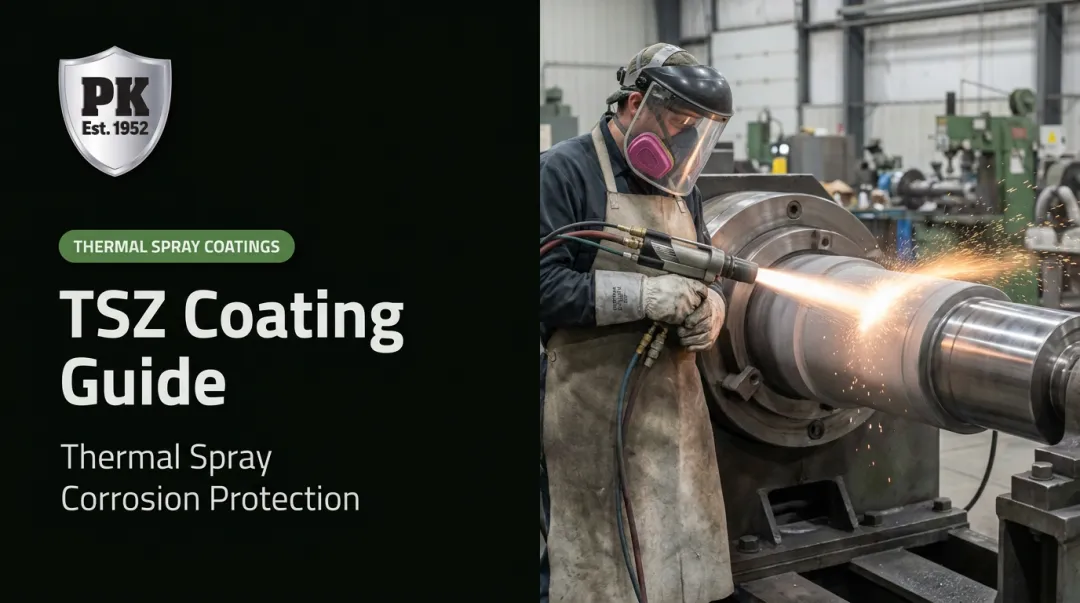
| Arc Spray (Metallizing) | Large structural surfaces needing corrosion protection | Cost-effective coverage of large steel areas; sacrificial protection |
| Hardfacing / Sub-Arc Welding | Heavy buildup on severely worn components | Thick material rebuild needed; deep wear exceeds spray coating thickness |
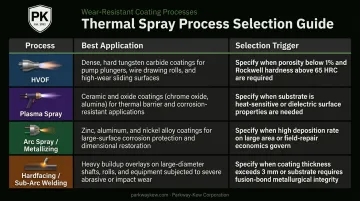
A few practical rules for mining applications:
- When abrasion drives the failure, HVOF tungsten carbide is the starting point
- When corrosion is the primary threat, arc spray aluminum or dense ceramic coatings are the appropriate tools
- When a component needs dimensional restoration before coating, in-house machining and grinding capability is essential — without it, the coating shop can't control the substrate condition
The lowest-cost coating isn't automatically the lowest total-cost solution. An HVOF process that costs more upfront but delivers three times the service life on a pump impeller is the better investment — provided the selection was made deliberately, based on the actual failure mode rather than cost alone.
Parkway-Kew Corporation has applied this application-first approach since 1952, with full in-house HVOF, plasma spray, metallizing, and sub-arc welding capabilities. Their engineering team evaluates the specific wear mechanism and operating conditions before recommending a process — the same methodology that determines whether a coating extends component life or fails within weeks of installation.
Conclusion
Thermal spray coatings protect mining equipment through three interconnected mechanisms: wear resistance that slows material loss from abrasive contact, corrosion barriers that prevent chemical damage from initiating, and extended operational lifespan through component refurbishment rather than replacement.
These benefits compound. A component that lasts longer between maintenance cycles reduces spare parts costs, keeps production schedules intact, and avoids the disproportionate cost of unplanned stoppages.
The decision to coat is a financial one as much as a technical one. The cost of coating is fixed and predictable. The cost of unplanned failure (production loss, emergency procurement, accelerated wear on adjacent components) is variable and routinely higher than the protection would have cost.
Avoiding that cost comes down to treating thermal spray as an ongoing strategy, not a one-time fix. Inspect components on schedule, refurbish before substrate damage becomes irreversible, and match the coating process to what the component actually experiences in service. Shops that apply that approach consistently get more usable life out of every coated part — and spend less time reacting to failures they could have prevented.
Frequently Asked Questions
What types of mining equipment benefit most from thermal spray coatings?
The highest-impact applications are hydraulic cylinder rods, pump impellers and casings, crusher wear plates, conveyor screws, and gearbox components — particularly those in direct contact with abrasive slurry or acidic process fluids. These surfaces combine high wear rates with significant replacement costs, making coating ROI straightforward to calculate.
How long do thermal spray coatings last on mining equipment?
Service life depends on the coating type, application method, and operating conditions. HVOF tungsten carbide coatings show roughly 6–10x lower volume loss than uncoated steel in ASTM G65 abrasion testing, and field performance aligns with that data. Scheduling refurbishment before substrate damage becomes severe extends service life further.
Is it more cost-effective to recoat worn mining components or replace them entirely?
For large, custom, or hard-to-source components, refurbishment is typically faster and less expensive than procurement. Mordor Intelligence's 2025 mining remanufacturing data cites savings of 30% to 60% versus new parts. It also avoids the production downtime that accumulates while waiting for a replacement to arrive.
What is the difference between HVOF and plasma spray for mining equipment?
HVOF produces denser, harder coatings, making it ideal for tungsten carbide wear applications where abrasion resistance is the priority. Plasma spray is better suited for ceramic coatings that provide corrosion resistance or thermal barrier properties.
Can thermal spray coatings be applied to equipment already showing wear?
Yes. A worn component is machined back to a clean, uniform surface, coated to restore dimensions, then finish-ground to tolerance. The key constraint is substrate condition: if corrosion or wear has penetrated too deeply, the restoration window closes.
How do thermal spray coatings compare to hard chrome plating for mining applications?
HVOF tungsten carbide coatings demonstrate comparable or superior hardness and significantly lower abrasion loss than hard chrome in industrial testing, roughly 6.7x lower volume loss in ASTM G65 testing. They can also be applied in thicker layers and to larger component geometries, while avoiding the hexavalent chromium (Cr⁶⁺) regulatory and occupational health requirements that govern hard chrome operations under OSHA's 29 CFR 1910.1026.