Many engineers treat "weathering steel" as shorthand for "won't rust." That assumption causes real failures. This guide breaks down what corrosion resistance actually means in this material, where its protection starts and stops, how it's measured and welded, and what to do when field conditions push past its limits.
Key Takeaways
- Corrosion resistance comes from a self-forming oxide patina, not rust-proof steel
- Patina stability depends on wet/dry cycling; marine and subtropical sites can block it entirely
- Welding and drainage detailing determine whether the structure achieves the promised corrosion resistance and color match
- Moving parts and heavy equipment facing combined wear and corrosion often need supplemental hard-surfacing beyond weathering steel
What Corrosion Resistance Represents in Weathering Steel
Corrosion resistance in weathering steel doesn't mean the metal stops oxidizing. It means the oxide that forms is dense and adherent enough to slow further rusting to a crawl. That layer, the patina, is the entire mechanism. Remove it, or prevent it from stabilizing, and the steel behaves like ordinary carbon steel.
The alloying elements responsible are copper, chromium, nickel, and phosphorus. These don't act as a protective coating themselves. Instead, they get incorporated into the rust layer as it forms, making it denser and less permeable to moisture and oxygen.
ASTM A588 plate, for example, typically carries copper in the 0.20–0.50% range and chromium between 0.40–0.70%, depending on grade, alongside a required ASTM G101 corrosion index of at least 6.0. A242 uses similar chemistry logic, though exact values should always be confirmed against the mill certificate rather than a secondary table.
Here's the part specifiers miss: corrosion resistance isn't a fixed output. It's a derived characteristic: the product of fixed alloy chemistry interacting with a variable, site-specific atmosphere. Same steel, different climate, different result.
Factors That Influence Corrosion Resistance in Real-World Operation
Lab-tested corrosion rates and field performance frequently diverge, sometimes dramatically. A few field variables drive that gap:
- Joint geometry and drainage: overlapping surfaces trap capillary water and develop "pack rust," a self-accelerating failure mode
- Weld detailing: poorly finished welds create crevices where moisture collects and never dries
- Atmosphere type: rural and moderate industrial sites cycle wet and dry reliably; humid subtropical and marine sites often don't
- Mill scale and surface prep: uneven surface prep leaves the substrate exposed unevenly, delaying uniform patina formation
- Mechanical abrasion: moving parts and structural connections that see repeated contact wear through the patina before it can mature, continually exposing bare steel
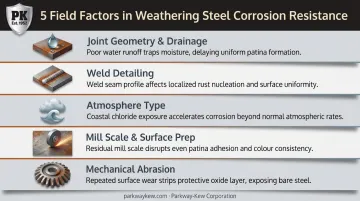
None of these variables show up in a chemistry certificate. They show up in the field, which is exactly why identical steel grades can perform very differently across two sites.
Range of Corrosion Resistance in Weathering Steel
The protection weathering steel provides has boundaries. These limits come partly from design assumptions (grade, thickness) and partly from whatever atmosphere the structure actually sits in, not the one it was specified for.
Nominal Patina Development Range
Visible coloration happens fast. ArcelorMittal notes natural weathering can produce uniform color in up to two years, and sandblasting can speed that along. But color isn't the same as protection.
A 2026 peer-reviewed review found that true protective stabilization (the point where corrosion rate drops sharply and stays low) commonly takes 2 to 6 or even 8 years, depending on how aggressive the local atmosphere is. That range assumes three things:
- Unpainted, freely exposed steel
- Adequate drainage with no standing water
- A moderate rural or industrial atmosphere
Take any of those away, and the timeline stretches or the patina never fully stabilizes.
Boundary Conditions Where Protection Breaks Down
Marine and chloride-heavy environments are the most common failure trigger. Chlorides disrupt the goethite-forming chemistry that makes the patina protective, leaving a looser, less adherent rust layer instead. Continuous immersion, buried applications, and below-grade use fall outside weathering steel's intended service entirely. There's no wet/dry cycling to stabilize anything.
Hawaii's Aloha Stadium is a documented example. A structural evaluation of the stadium's weathering-steel frame found ongoing corrosion, localized coating failures, and repeated member deterioration tied directly to the site's high-chloride coastal exposure. The patina simply never got the chance to stabilize the way it does in a drier, inland climate.
Safe Operating Margin and Design Allowances
Good detailing accounts for the fact that nominal performance won't hold everywhere. That's why experienced designers build in:
- Drainage paths that route water away from structural members instead of across them
- Sacrificial thickness that tolerates some section loss without compromising capacity
- Maintenance access so inspectors can actually reach vulnerable areas
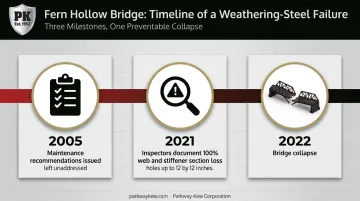
Skipping these allowances has consequences. The NTSB investigation into the 2022 Fern Hollow Bridge collapse found clogged drains had been directing water straight onto the bridge's uncoated weathering-steel legs for years.
By 2021, inspectors documented 100% web and stiffener section loss in places, with holes as large as 12 by 12 inches. The root cause traced back to unaddressed maintenance recommendations dating to 2005: a design and maintenance failure, not an alloy failure.
Key Technical Properties of Corrosion-Resistant Weathering Steel
Corrosion performance doesn't stand alone. It's tied to how the patina evolves chemically, how strong the base steel is, and how welding is handled. These three properties interact rather than operate independently.
Property 1: Patina Stability and Variability
The oxide layer isn't static. It shifts over time from lepidocrocite to goethite, and eventually toward a fine, nanophasic goethite structure that's markedly less permeable to water, oxygen, and chloride ions. This progression determines whether long-term protection is repeatable.
Two structures built from identical steel grades can age very differently. The main variables are pollutant concentration and wet/dry cycling frequency. A dry industrial site and a persistently damp coastal one will produce two very different rust chemistries from the same certified plate.
Property 2: Mechanical Strength
Weathering steel performs comparably to standard structural steel grades across yield and tensile strength.
| Grade / Thickness | Min. Yield | Min. Tensile |
|---|---|---|
| A242, 0.100–0.750 in | 50 ksi | 70 ksi |
| A588, 4 in and under | 50 ksi | 70 ksi |
| A588, over 4–5 in | 46 ksi | 67 ksi |
| A588, over 5–8 in | 42 ksi | 63 ksi |
Strength and corrosion resistance are governed by different alloying pathways. A higher-strength grade isn't automatically more corrosion resistant, and vice versa. Check both properties independently against project requirements.
Property 3: Weldability and Its Trade-Off With Color Match
Weathering steel welds using the same standard processes as mild steel: SMAW, GMAW, GTAW. The complication is filler metal selection, and it comes down to weld size:
- Small, single-pass welds can often use standard carbon steel filler. Base metal dilution supplies enough alloying content to preserve reasonable corrosion resistance.
- Larger, multi-pass welds dilute less predictably. These typically require low-alloy, "W"-designated filler (per AWS A5.5) to match both the base metal's corrosion resistance and its eventual patina color.
Get this wrong on an exposed structural connection, and the result is visible for years: a mismatched weld line standing out against steel that has weathered to a uniform brown.
Specification, Welding, and When Supplemental Protection Is Needed
Corrosion resistance in weathering steel is a design specification on paper and an active fabrication discipline in practice. Both matter.
Specification and Measurement
Five ASTM standards cover most weathering steel applications:
| Standard | Product Form / Use |
|---|---|
| A242 | Structural shapes, plates, bars |
| A588 | Structural shapes, plates, bars (general atmospheric exposure) |
| A606 Type 4 | Sheet and strip |
| A847 | Cold-formed welded/seamless structural tubing |
| A709 Grade 50W | Bridge-specific shapes, plates, bars |
In the field, verification is mostly visual: inspectors look for heavy scale, laminar rust, or pack rust, then remove it to sound metal and check remaining thickness with calipers or ultrasonic gauges.
Laboratory verification goes further, using X-ray diffraction or SEM/EDS to confirm the rust's actual phase composition. This is the only way to distinguish protective goethite from less stable phases that color alone can't reveal.
Recommended Electrodes and Welding Practice
For structural welding, low-hydrogen electrodes such as AWS E7018 are the standard starting point where color match isn't a priority. For multi-pass welds that stay exposed and need to blend in over time, low-alloy "W"-designated fillers or roughly 1% nickel fillers are the better call. Electrode selection ultimately depends on required strength, weld size, and code compliance for the application.
When Weathering Steel's Natural Corrosion Resistance Isn't Enough
The patina handles atmospheric corrosion. It does nothing for mechanical wear, abrasion, or corrosion in submerged or high-chloride service. These conditions show up constantly in industrial equipment.
Common failure scenarios include:
- Outdoor machinery with continuous moving contact
- Wire mill equipment exposed to drawing lubricants and process chemicals
- Oil & gas components operating under combined pressure and chemical exposure
- Heavy equipment parts subject to repeated abrasive loading
In these cases, base metal alone (weathering grade or not) wears through faster than the patina can regenerate. This is where Parkway-Kew Corporation comes in.
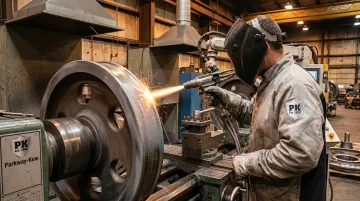
With over 70 years of experience in precision metal coating and hardsurfacing, Parkway-Kew applies HVOF, plasma spray, thermal spray (metallizing), and submerged arc welding to components facing this combined wear-and-corrosion problem.
Typical applications include fracking plungers, wire drawing blocks and capstans, festoon wheels, crane wheels, and wire rope pulleys used across oil & gas, wire mill, and shipping terminal operations. Where weathering steel's atmospheric patina reaches its limit, supplemental coatings pick up the load.
Conclusion
Corrosion resistance in weathering steel depends on a patina that must form and stabilize under specific conditions. That patina can just as easily fail to develop, leaving the steel exposed.
Understanding its real operating range, from atmosphere and drainage to welding practice, separates a structure that performs for decades from one that corrodes faster than the mild steel it replaced.
Published ASTM specifications tell you what the alloy is capable of. Engineering judgment, correct detailing, and supplemental protection where wear or chemical exposure exceeds the patina's limits determine whether it actually delivers.
Frequently Asked Questions
What elements do you need to increase the corrosion resistance of steel?
Copper, chromium, nickel, and phosphorus are the primary alloying additions used to promote a stable, adherent patina. They get incorporated into the rust layer itself, making it denser and more protective than ordinary rust.
Is weathering steel strong?
Yes. A588 plate up to 4 inches thick carries a minimum yield of 50 ksi and tensile strength of 70 ksi, comparable to standard structural steel. Strength drops slightly in thicker sections and varies by grade.
Can weathering steel be welded?
Yes, using standard SMAW, GMAW, or GTAW processes similar to mild or low-alloy steel. The key is filler metal selection, which determines whether the weld preserves the base metal's corrosion resistance and color.
What is the best electrode for corten steel?
Low-hydrogen AWS E7018 works well for structural welds where color match isn't critical. For exposed, multi-pass welds, low-alloy "W"-designated or roughly 1% nickel fillers better preserve both strength and patina appearance.
How long does it take for weathering steel to develop its protective patina?
Visible coloration can appear within about two years, but true protective stabilization typically takes 2 to 6 or 8 years depending on atmospheric exposure. Accelerated pre-weathering treatments can shorten the visible timeline, though not necessarily the protective one.
Does weathering steel require maintenance to stay corrosion resistant?
Yes. While it never needs painting, proper drainage detailing and periodic inspection are essential to keep the patina intact and catch pack rust or section loss before it spreads.